Comparison of Noise Temperature of Rydberg-Atom and Electronic Microwave Receivers
Abstract: Microwave receivers using electromagnetically-induced transparency (EIT) in Rydberg atoms have recently demonstrated improved sensitivities. It is not evident how their state-of-the-art electric field sensitivities compare to those achieved using standard electronic receivers consisting of low-noise amplifiers (LNAs) and mixers. In this paper, we show that conventional room-temperature electronic receivers greatly outperform the best demonstrated sensitivities of room-temperature Rydberg electrometers in standard free-space coupled configurations. However, Rydberg-atom receivers can surpass the sensitivity of conventional receivers if resonant or confining microwave structures are designed to enhance the electric fields sensed by the atoms. For a given microwave resonator, the external (coupling) quality factor must be carefully chosen to minimize their thermal and quantum noise contributions. Closed-form expressions for these optimal design points are found, and compared in terms of noise temperature with conventional LNAs reported in the literature from 600 MHz to 330 GHz.
Paper Prompts
Sign up for free to create and run prompts on this paper using GPT-5.
Top Community Prompts
Explain it Like I'm 14
Overview
This paper compares two ways of “listening” to very weak microwave signals:
- using special atoms called Rydberg atoms that become transparent to light in a certain way (a trick called EIT), and
- using regular electronic receivers with low‑noise amplifiers (LNAs) and mixers.
The big idea is to see which one is more sensitive—meaning which one can detect tinier signals—and to figure out how to design the atomic approach so it can compete or even win.
What questions did the researchers ask?
They focus on three simple questions:
- How does the sensitivity of the newest Rydberg‑atom microwave receivers compare to standard electronic receivers at room temperature?
- What is a fair way to compare them, since atomic sensors measure electric field directly while electronic gear measures power through an antenna?
- If we put the atoms inside a microwave “echo chamber” (a resonator) to make the field stronger, how should we design that chamber so we get the best sensitivity without adding too much noise?
How did they study it?
Think of a receiver like a very quiet “ear” trying to hear whispers. Noise is the unwanted background sound that makes hearing harder. The authors:
- Defined common yardsticks for sensitivity so atomic and electronic receivers can be compared fairly. For atomic sensors, that’s “noise‑equivalent field” (NEF, how tiny a field they can pick up). For electronic receivers, it’s “noise temperature” (NET, how “warm/noisy” the system behaves).
- Considered two setups:
- Free‑space atomic receiver: atoms are just sitting in a glass cell, and microwaves come from all directions (like listening outdoors). They compared this to an electronic receiver with a simple antenna.
- Port‑coupled atomic receiver: atoms sit inside or near a microwave resonator (like a small room that boosts sound), which connects to the outside world through a port. They compared this to electronic gear fed through a cable.
- Explained the physics of noise sources using everyday ideas:
- Thermal noise: the “glow” of heat at room temperature creates random microwave waves that add buzz to the signal.
- Quantum noise: even in perfect darkness, tiny unavoidable fluctuations exist (vacuum fluctuations).
- Built models to calculate how much noise gets inside the receiver:
- A “harmonic oscillator” model for a simple, single‑mode resonator (like one clear musical note).
- A more general waveguide/resonator model for more complex structures (more notes at once).
- Derived closed‑form formulas that tell you the best way to “couple” the resonator to the port (like how wide to leave the door of the echo chamber) to balance field boost vs. added noise.
- Compared these results to published LNA performance from about 600 MHz to 330 GHz.
Key ideas explained simply:
- Rydberg atoms and EIT: shining two lasers prepares atoms so they become extra sensitive to microwave electric fields. When a microwave field is present, a spectral feature splits (Autler–Townes splitting), and that split tells you the field strength.
- Local oscillator (LO) and mixing: adding a strong “reference tone” lets you measure tiny signals by “beating” them down to a lower frequency where you can see them better (heterodyne/homodyne detection).
- Resonator: a structure that traps microwaves and makes the field stronger at the atoms—like shouting in a small tiled bathroom.
- Coupling quality factor: how “open” or “closed” the resonator is to the outside; it changes how much signal and how much noise gets in and out.
What did they find and why does it matter?
Main results:
- In simple, free‑space setups at room temperature, the best Rydberg‑atom receivers demonstrated so far are significantly less sensitive than standard electronic receivers. For example, at around 10 GHz, a typical room‑temperature LNA with about 100 K noise temperature beats the state‑of‑the‑art atomic sensitivity by roughly an order of magnitude.
- The atomic receiver can become more sensitive than the electronic one if the atoms are placed in a well‑designed microwave resonator or confining structure that boosts the electric field they “feel.”
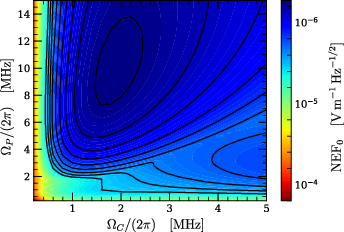
- There is a trade‑off: making the resonator more “closed” increases field enhancement but also traps more thermal noise; making it more “open” cools the mode by letting noise leak out (radiative cooling) but reduces field enhancement. The authors provide formulas to pick the optimal coupling that minimizes total noise.
- They define fair comparison methods:
- For free‑space: use an equivalent antenna gain and pattern so both systems “listen” similarly.
- For port‑coupled: define an input noise temperature so you can compare directly to electronic LNAs and mixers.
- Across a wide frequency range (600 MHz to 330 GHz), the analysis shows conventional LNAs at room temperature often have lower input‑referred noise than free‑space atomic sensors. However, with properly designed resonators, atomic receivers can reach lower effective noise temperatures and surpass conventional receivers.
Why it matters:
- Communication, radar, and radio astronomy all need extremely sensitive microwave receivers. If atomic sensors are designed with the right resonators, they could unlock better sensitivity or performance in frequency ranges where electronic LNAs struggle, especially at very high frequencies.
- The paper turns vague hopes into concrete design rules: it shows how to choose resonator coupling to get the best possible sensitivity, taking both thermal and quantum noise into account.
What is the bigger picture?
Implications and potential impact:
- Atomic receivers alone, in simple room‑temperature free‑space setups, aren’t yet practical replacements for standard electronic receivers.
- But atomic receivers combined with field‑enhancing structures can be engineered to beat conventional systems. This opens doors for ultra‑sensitive detection in challenging bands (like millimeter‑wave), for compact sensors that don’t need cryogenic cooling, or for applications where the atomic approach offers unique advantages (for example, precise field measurements or built‑in calibration linked to atomic properties).
- The design formulas provided help engineers build resonators that balance field boost and noise in the smartest way, guiding future prototypes and products.
- Overall, the research shows a clear path: to make atomic microwave receivers competitive, treat the microwave environment like a carefully tuned musical instrument—shape the mode, pick the right coupling, and manage the unavoidable thermal and quantum noise.
Knowledge Gaps
Knowledge gaps, limitations, and open questions
Below is a single, consolidated list of unresolved issues that the paper either acknowledges or leaves insufficiently explored, phrased to enable concrete follow-up research:
- Fairness of the comparison baseline: quantify sensitivity using realistic antennas matched to the atomic sensor volume (including finite efficiency, feed losses, and mechanical constraints), not just the conservative omnidirectional assumption ; bound the achievable gain without superdirectivity and incorporate associated Q/efficiency penalties.
- Experimental validation of the free-space thermal and quantum noise predictions: measure for both homodyne and heterodyne cases (including image-band contributions), across RF–mmWave bands and variable ambient temperatures, to verify the Callen–Welton–based factors used.
- Partitioning and modeling of intrinsic atomic noise (): develop and validate a quantitative noise budget separating probe shot noise, laser RIN/phase noise, photodetector noise, atomic projection noise, Doppler/transit-time and collision-induced broadening, power broadening, and technical drifts.
- LO technical noise: characterize and model the conversion of LO phase and amplitude noise into IF noise for atomic heterodyne and homodyne operation; specify LO phase-noise requirements and mitigation (e.g., phase locking, optical referencing).
- Coupled-resonator assumptions: extend the harmonic-oscillator model to include realistic lossy couplers (nonzero insertion loss), finite conductor and dielectric losses, and temperature-dependent material properties; quantify their thermal noise contributions and impact on .
- Strongly overcoupled and broadband structures: complete and validate the promised waveguide/resonator model for multi-mode or non-resonant field-confining structures (including arbitrarily overcoupled 1D/3D cases); provide closed-form or computable design rules beyond the high-Q, single-mode limit.
- Practical realization of optimal coupling: demonstrate how to set and maintain the predicted optimal coupling rate in hardware (tunable irises, probes, apertures), and quantify tolerance to detuning, manufacturing variability, and temperature drift.
- Calibration of field enhancement (, ): establish measurement procedures to determine and in situ, including the effects of the vapor cell dielectric, windows, apertures, and atom-induced dispersion; assess calibration stability over time and temperature.
- Near-surface and near-field noise: include Johnson/evanescent near-field noise from proximate conductive/dielectric surfaces and trapped charges when atoms are inside small resonators or near CPWs; quantify added dephasing/line broadening and impact on sensitivity.
- Field-enhancement side effects: assess spurious DC/low-frequency fields, patch potentials, and microwave hot spots in resonators that perturb Rydberg levels; relate these to linewidth, stability, and achievable .
- Bandwidth vs sensitivity: quantify the RF bandwidth penalty of resonant enhancement and develop tunable or multi-band resonator designs that preserve near-optimal across wide spans (e.g., swept or electronically tunable coupling and frequency), including tuning speed and stability.
- Image-band noise management: evaluate whether atomic receivers can realize image-reject or phase-sensitive (SSB) detection to avoid the dual-sideband noise doubling assumed; propose and test optical or microwave schemes to suppress image contributions.
- Low-frequency (1/f) noise: verify the assumption of white IF noise within ; measure and model low-frequency technical noise in lasers, photodetectors, and electronics that may dominate at small IFs or narrowband detection.
- Dynamic range and linearity: quantify compression points, intermodulation products, and spurious-free dynamic range (SFDR) in coherent atomic receivers as a function of LO and optical powers; compare to electronic front-ends under identical test tones.
- Response time and IF bandwidth: determine the achievable IF bandwidth/latency given atomic relaxation rates and cavity photon lifetimes; map sensitivity–bandwidth trade-offs versus , LO power, and optical parameters.
- Antenna–port system aspects: incorporate realistic pre-LNA losses (feeds, windows) for electronics and input-port losses for atomic receivers when comparing ; analyze matched vs mismatched antenna–resonator interfaces and sky-noise coupling in radiometric scenarios.
- Temperature management and practicality: study the scenario where the microwave structure is cooled (to exploit radiative cooling) while the vapor cell is heated for Rydberg population; model net noise benefits, heat loads, gradients, and feasibility.
- Pattern and polarization realism: move beyond the single-polarization, electrically-small interaction volume assumption; experimentally determine the effective reception pattern for realistic optical beam sizes and moving atoms, and validate the gain-equivalence correction for .
- Out-of-band and nonlinear folding: analyze whether atomic nonlinearity folds out-of-band noise/interference into the IF band; specify filtering and operating regimes that prevent intermodulation from inflating the apparent noise floor.
- LO/signal injection and cross-coupling: design and test LO coupling schemes that do not degrade or add thermal noise; quantify isolation between LO and signal ports and its impact on sensitivity and stability.
- Integration with advanced optical schemes: incorporate three-photon Doppler cancellation, repumping, and beam geometries into the sensitivity model by linking these techniques to and ; validate experimentally.
- High-frequency (mmWave–sub-THz) validation: produce concrete, measured case studies (e.g., Ka-, W-, D-bands) where LNA performance degrades, demonstrating that optimized field-enhanced atomic receivers achieve lower under realistic constraints.
- Quantum-noise engineering: explore whether squeezed microwave/optical states, phase-sensitive readout, or back-action evasion can reduce the measurement noise below the standard coherent-detection limits assumed.
- Standardization of metrics: define and adopt standardized reporting for atomic receiver NEF/NET (including bandwidth, DSB/SSB, noise referencing, calibration), enabling apples-to-apples comparisons with electronic front-ends.
- Environmental robustness: evaluate sensitivity to EMI, temperature/humidity fluctuations, and mechanical vibrations in integrated resonator–optics packages; propose shielding and stabilization measures compatible with preserving field enhancement.
- Completeness of the theoretical development: the multi-mode waveguide/resonator treatment is introduced but not completed in the provided text; full derivations, numerical validations, and experimental corroborations are needed to generalize beyond high-Q, single-mode cavities.
Collections
Sign up for free to add this paper to one or more collections.