- The paper demonstrates that room-temperature Rydberg atoms can serve as sensitive microwave detectors using an EIT scheme, achieving an 8-state PSK protocol with a channel capacity of up to 8.2 Mbps.
- It employs a ladder-EIT system with rubidium atoms and both heterodyne and direct detection methods to convert amplitude-modulated microwave signals into optical readouts.
- The study highlights the potential of quantum-limited Rydberg sensors as compact, high-speed alternatives to classical antennas in modern digital communication systems.
Digital Communication with Rydberg Atoms & Amplitude-Modulated Microwave Fields
Introduction
This paper investigates the utilization of room-temperature Rydberg atoms as sensitive, high-bandwidth microwave communication antennas. Rydberg atoms exhibit extreme sensitivity to electric fields due to their large dipole moments, offering a potential alternative to traditional antennas. The study demonstrates that Rydberg atoms can detect amplitude-modulated microwave signals using an electromagnetically-induced-transparency (EIT) probing scheme, achieving near photon-shot-noise limited readout with a channel capacity of up to 8.2 megabits per second (Mbps).
Rydberg Atom Sensitivity
The sensitivity of Rydberg atoms to electric fields scales quadratically with the principal quantum number n, presenting a unique opportunity to exploit their characteristics for communication purposes. The study leverages this sensitivity to detect amplitude-modulated microwave signals, demonstrating that Rydberg atoms can function as high-bandwidth communication receivers with capabilities surpassing classical antennas in terms of sensitivity and bandwidth diversity.
Experimental Setup
The experimental setup (Figure 1) involves a vapor cell containing rubidium atoms, where probe and coupling lasers counter-propagate to establish a ladder-EIT system. Microwave signals from a horn antenna modulate the Rydberg states, leading to a detectable amplitude modulation in the probe laser intensity. The system's intrinsic sensitivity is evaluated under the context of atomic communications receivers, providing a framework for implementing digital communication protocols.
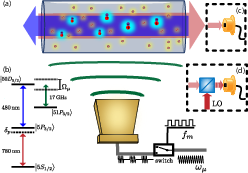
Figure 1: Experimental setup for detecting amplitude-modulated microwaves using Rydberg atoms in a ladder-EIT scheme.
Demonstration of Digital Communication Protocols
One of the significant achievements of the study is the implementation of an 8-state phase-shift-keying (PSK) digital communication protocol (Figures 2 and 3). The authors demonstrate phase-sensitive conversion of amplitude-modulated signals into optical signals through EIT, providing a basis for establishing communication via Rydberg atoms. The authors explore both heterodyne and direct detection methods to assess signal recovery and optimize demodulation phases, effectively achieving data rates up to 8.2 Mbps.
(Figure 2)
Figure 2: Observation of Rydberg EIT transmission with and without Autler-Townes splitting, modulated by microwave phases.
(Figure 3)
Figure 3: Time-domain representation of amplitude-modulated signals demonstrating the PSK protocol and constellation of received phases.
Bandwidth and Channel Capacity
A crucial aspect of the study is the measurement of bandwidth and channel capacity, revealing the photon-shot-noise limited channel capacity when considering both coupling and microwave powers (Figure 4). The authors account for the effects of dephasing due to Doppler broadening and transit effects, illustrating how Rydberg atom communications can achieve high sensitivity and bandwidth, factors that significantly impact the potential of Rydberg sensors in communication protocols.
(Figure 4)
Figure 4: Maximum channel capacity versus symbol frequency, illustrating the potential communication rates achievable with Rydberg atoms.
Future Prospects and Implications
The quantum-limited channel capacity explored in the Rydberg atom-modulated communication system offers promising insights into future developments in quantum sensing and digital communication. The study indicates that by achieving the standard quantum limit with room-temperature Rydberg sensors, significant advances in communication rates are possible. Such systems hold promise as alternatives to conventional antenna technology, providing small, high-speed, sensitive receivers capable of meeting the demands of modern communication systems.
Conclusion
The utilization of Rydberg atoms for digital communication via amplitude-modulated microwaves offers a novel approach with distinct advantages over classical antennas. By demonstrating substantial channel capacity and high sensitivity, the study provides a foundation for further exploration of Rydberg atoms as viable components in advanced communication systems. The integration of quantum sensor technology with digital communication protocols may lead to significant advancements in both theoretical understanding and practical applications, positioning Rydberg atoms as pivotal elements in future communication frameworks.