Papers
Topics
Authors
Recent
Search
2000 character limit reached

MentalHealthAI: Utilizing Personal Health Device Data to Optimize Psychiatry Treatment

Published 9 Jul 2023 in cs.LG and cs.CY | (2307.04777v1)

Abstract: Mental health disorders remain a significant challenge in modern healthcare, with diagnosis and treatment often relying on subjective patient descriptions and past medical history. To address this issue, we propose a personalized mental health tracking and mood prediction system that utilizes patient physiological data collected through personal health devices. Our system leverages a decentralized learning mechanism that combines transfer and federated machine learning concepts using smart contracts, allowing data to remain on users' devices and enabling effective tracking of mental health conditions for psychiatric treatment and management in a privacy-aware and accountable manner. We evaluate our model using a popular mental health dataset that demonstrates promising results. By utilizing connected health systems and machine learning models, our approach offers a novel solution to the challenge of providing psychiatrists with further insight into their patients' mental health outside of traditional office visits.

Definition Search Book Streamline Icon: https://streamlinehq.com
References (21)
  1. American Psychiatric Association. 2023. Clinical Practice Guidelines of American Psychiatric Association. psychiatry.org. https://www.psychiatry.org/psychiatrists/practice/clinical-practice-guidelines
  2. Psychophysiology of positive and negative emotions, dataset of 1157 cases and 8 biosignals. Scientific Data 9, 1 (2022), 1–15.
  3. A novel ECG-based real-time detection method of negative emotions in wearable applications. In 2017 International Conference on Security, Pattern Analysis, and Cybernetics (SPAC). IEEE, 296–301. https://doi.org/10.1109/SPAC.2017.8304293
  4. Federated learning meets human emotions: A decentralized framework for human–computer interaction for iot applications. IEEE Internet of Things Journal 8, 8 (2020), 6949–6962.
  5. Personalized federated learning: A meta-learning approach. arXiv preprint arXiv:2002.07948 (2020).
  6. Machine learning model to predict mental health crises from electronic health records. Nature medicine (2022), 1–9.
  7. Mental health professional perspectives on health data sharing: Mixed methods study. Health informatics journal 26, 3 (2020), 2067–2082.
  8. Mental health professionals’ perceptions on patients control of data sharing. Health informatics journal 26, 3 (2020), 2011–2029.
  9. Advances and open problems in federated learning. Foundations and Trends® in Machine Learning 14, 1–2 (2021), 1–210.
  10. Real-time EEG-based emotion monitoring using stable features. The Visual Computer 32 (2016), 347–358.
  11. Geun Hyeong Lee and Soo-Yong Shin. 2020. Federated learning on clinical benchmark data: performance assessment. Journal of medical Internet research 22, 10 (2020), e20891.
  12. Communication-efficient learning of deep networks from decentralized data. In Artificial intelligence and statistics. PMLR, 1273–1282.
  13. A wearable multi-sensor system for mobile acquisition of emotion-related physiological data. In Affective Computing and Intelligent Interaction: First International Conference, ACII 2005, Beijing, China, October 22-24, 2005. Proceedings 1. Springer, 691–698.
  14. Federated learning in a medical context: a systematic literature review. ACM Transactions on Internet Technology (TOIT) 21, 2 (2021), 1–31.
  15. The future of digital health with federated learning. NPJ digital medicine 3, 1 (2020), 1–7.
  16. Rates of detection of mood and anxiety disorders in primary care: a descriptive, cross-sectional study. The primary care companion for CNS disorders 13, 2 (2011), 27211.
  17. Swarm learning for decentralized and confidential clinical machine learning. Nature 594, 7862 (2021), 265–270.
  18. Emotion Recognition Based on Multi-Variant Correlation of Physiological Signals. IEEE Transactions on Affective Computing 5 (2014), 126–140.
  19. Fedmood: Federated learning on mobile health data for mood detection. arXiv preprint arXiv:2102.09342 (2021).
  20. Federated learning with non-iid data. arXiv preprint arXiv:1806.00582 (2018).
  21. An overview on smart contracts: Challenges, advances and platforms. Future Generation Computer Systems 105 (2020), 475–491.
Citations (2)

Summary

  • The paper demonstrates the integration of decentralized AI and decision tree ensembles to predict mood states with up to 86% accuracy.
  • It introduces a novel cohort framework that handles heterogeneous IoT data by grouping varying device inputs using federated learning.
  • The system employs smart contracts for privacy-preserving model aggregation, outperforming traditional centralized emotion recognition methods.

MentalHealthAI: Utilizing Personal Health Device Data to Optimize Psychiatry Treatment

Introduction

MentalHealthAI proposes a novel approach to addressing the challenges in diagnosing and treating mental health disorders by utilizing personal health device data for mood prediction and psychiatric treatment optimization. The system leverages decentralized learning through federated learning concepts and smart contracts to ensure data privacy while enabling continuous, objective tracking of patients' mental states outside traditional office visits.

System Design and Implementation

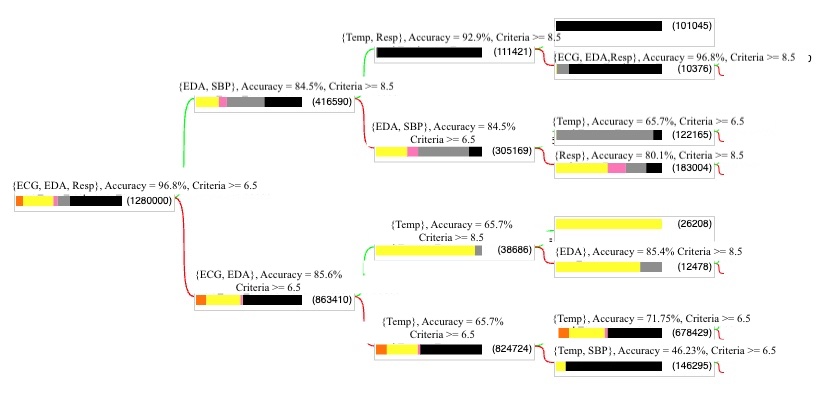
The architecture of the MentalHealthAI system is built upon decentralized learning principles, utilizing physiological data collected via IoT devices to predict patient moods. This enables privacy-preserving insights for psychiatric treatment. Figure 1

Figure 1: An Example Decision Tree. Each branch title is in the following format: data streams utilized in curly braces, the local model accuracy, and the criteria to split the branch.

Multi-Data Stream Cohorts

Traditional machine learning models require uniform feature sets, limiting their use when patients possess varying numbers of personal health devices. MentalHealthAI overcomes this by creating cohorts based on power sets of available data streams for each patient, allowing for diverse model training on subsets of device data.

Decentralized Aggregation

A smart contract is employed to elect aggregators within the decentralized system, enabling model parameter aggregation without exposing sensitive data outside of patient-owned devices. Each client's device can act as both a participant in model training and an aggregator, depending on the smart contract election outcomes.

Decision Tree Methodology

The system uses decision trees trained on emotional states predicted by model ensembles developed from different data stream combinations. This allows dynamic adaptation to patient-specific data characteristics, ultimately yielding patient-specific mood predictions.

Evaluation and Results

Dataset and Simulation

The POPANE dataset provided an ideal medium for testing due to its collection of relevant physiological metrics paired with mood labels, simulating real-world personal health device data collection.

Learning Results

MentalHealthAI demonstrates effective learning in decentralized settings, achieving high accuracy (up to 86%) when incorporating additional node data streams. This surpassed traditional methods even in less controlled environments.

(Figure 2)

Figure 2: Learning Results After Leader Election and Model Aggregation. Nodes refer to the other smartphones contributing to the combined model.

Comparison to Baselines

Despite inherent limitations regarding real-world variability, MentalHealthAI showed superior performance to historical emotion recognition techniques and traditional centralized AI approaches, achieving balanced accuracy metrics even with non-IID distributed data.

Existing Federated Learning Applications

Federated learning frameworks have shown promise in healthcare applications, though challenges in data heterogeneity persist. The MentalHealthAI approach builds upon previous decentralized learning frameworks, such as swarm learning, but uniquely applies IoT-generated physiological data in mental health contexts.

Mental Health Applications

Current emotion prediction models primarily use facial recognition or EHR data, often lacking the granularity needed for effective psychiatric evaluation. The proposed system addresses this gap by integrating continuous physiological metrics, enabling real-time mood tracking.

Conclusion and Future Work

The approach presented in MentalHealthAI illustrates the potential of decentralized AI systems to overcome privacy concerns and varying data availability in mental health assessments. Future work should focus on real-world implementation studies to validate predicted outcomes and refine models based on broader patient data sets. Addressing limitations in emotion recognition granularity remains a critical area for advancement, with continued efforts toward user-specific model optimization.

Paper to Video (Beta)

Whiteboard

No one has generated a whiteboard explanation for this paper yet.

Open Problems

We haven't generated a list of open problems mentioned in this paper yet.

Collections

Sign up for free to add this paper to one or more collections.