- The paper demonstrates an innovative imaging-assisted single-photon approach that eliminates Doppler broadening to achieve sub-MHz resolution in metastable triplet helium transitions.
- It employs correlations between atomic positions and transverse velocities in a supersonic beam, utilizing retro-reflected laser beams and ion imaging to isolate ultranarrow velocity classes.
- The findings provide a precise determination of helium's ionization energy, highlighting a gap with recent theoretical predictions and suggesting potential for broader spectroscopic applications.
Imaging-assisted Single-photon Doppler-free Laser Spectroscopy
Introduction
The paper "Imaging-assisted single-photon Doppler-free laser spectroscopy and the ionization energy of metastable triplet helium" (2308.08329) presents a novel approach in the field of spectroscopic investigation, specifically targeting the pervasive issue of Doppler broadening. Traditionally, atomic and molecular spectra have suffered from Doppler broadening due to velocity distributions, posing challenges in obtaining high-resolution spectral data. This paper introduces an innovative imaging method to surpass this limitation, employing correlations between atomic positions and transverse velocities in supersonic expansions to achieve sub-MHz spectral resolution.
Methodology
The core methodology leverages the correlation between atomic positions and velocities within a supersonic beam expansion. A pivotal advancement is the use of a retro-reflection arrangement combined with imaging to isolate ultranarrow transverse-velocity classes without signal loss. By retro-reflecting the laser beam and employing a cross-correlation method, the authors achieve Doppler-free spectra. This technique is demonstrated by examining the $(1\mathrm{s})(n\mathrm{p})\,^3\mathrm{P}_{0-2}\leftarrow (1\mathrm{s})(2\mathrm{s})\,^3\mathrm{S}_1$ transitions to high Rydberg states of metastable triplet He, achieving linewidths reduced to approximately 1 MHz in the ultraviolet spectrum.
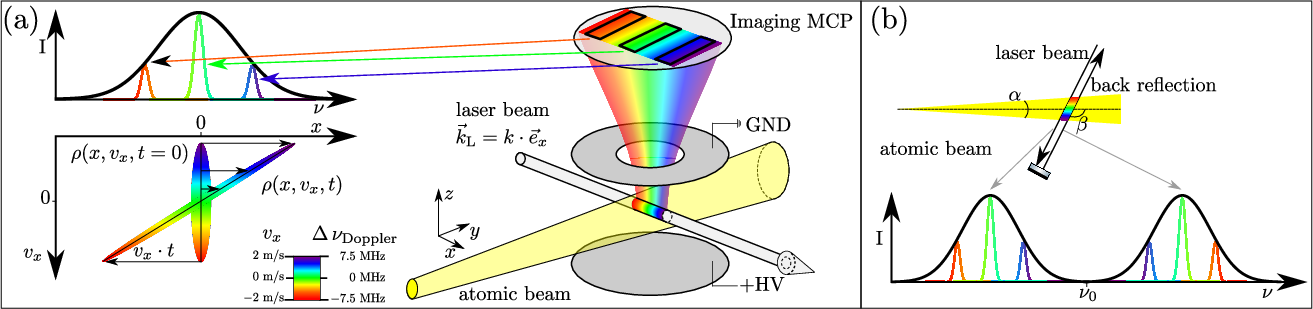
Figure 1: Principle of imaging-assisted sub-Doppler spectroscopy illustrating the correlation between transverse velocities and atomic positions.
Experimental Setup
The experiment employs a sophisticated setup consisting of a supersonic helium beam produced via a cooled pulsed valve, subjected to a dielectric-barrier discharge to generate metastable states. The setup incorporates a frequency-quadrupled diode laser system intersecting the atomic beam at near-right angles within a photoexcitation chamber shielded against magnetic and stray electric fields (Figure 2). A CCD camera captures spatially resolved ionization signals, which are processed to obtain sub-Doppler spectra.
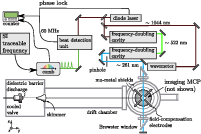
Figure 2: Schematic of the experimental setup including the laser system and photoexcitation components.
Results and Analysis
The results demonstrate effective isolation of narrow velocity classes, verified through spectrum analysis and ion imaging (Figure 3). The method's robustness is further evidenced by multiple measurements across Rydberg states at various principal quantum numbers (n=33 and n=40). Corrected transition frequencies are reported with high precision, and the obtained ionization energy values significantly align with prior experimental data yet diverge from recent theoretical predictions, highlighting a persistent discrepancy.
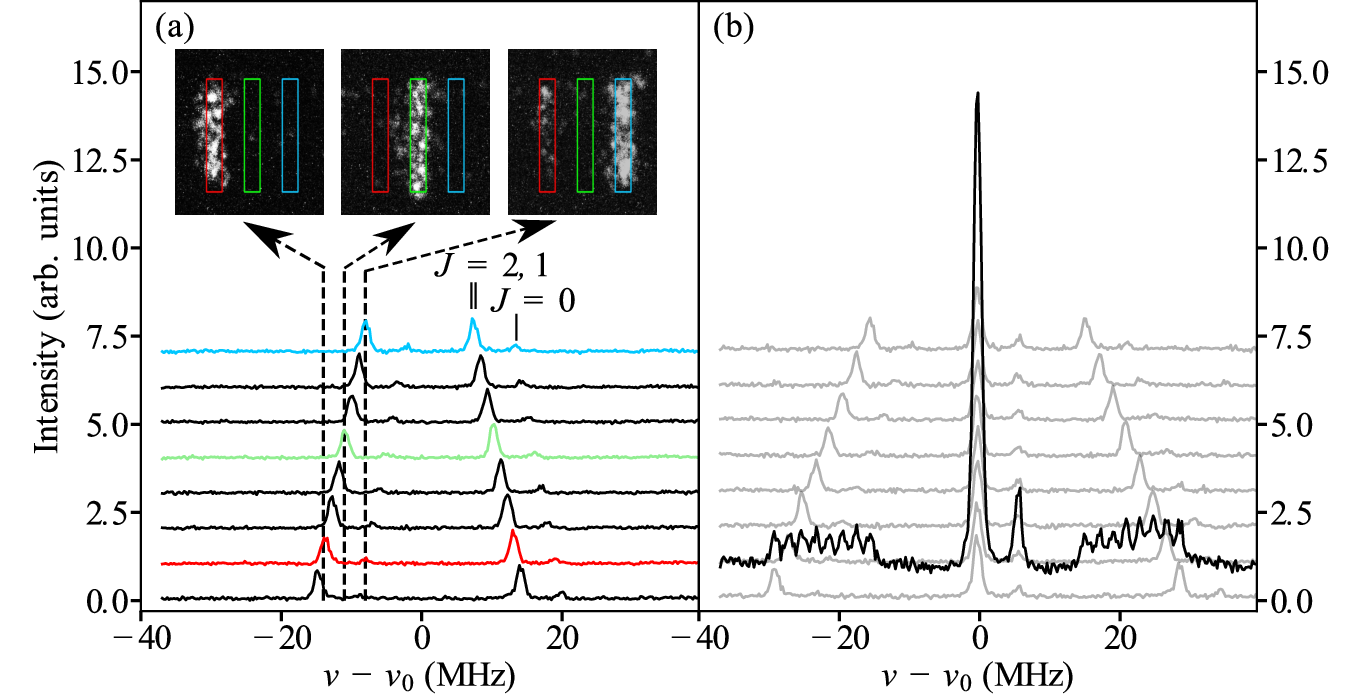
Figure 3: a) Sub-Doppler spectra recorded from adjacent detector regions. b) Cross-correlation yielding sharp Doppler-free transitions.
Implications and Future Directions
The implications of this methodology are profound, providing a versatile tool for single-photon spectroscopy with unprecedented resolution and signal-to-noise ratios. Its applicability extends beyond Rydberg-state detection, potentially enhancing (1+1) REMPI and LIF spectroscopy, widely used in molecular analysis. Future work could explore optimizing ion-imaging optics and beam geometries, possibly integrating with velocity-map imaging for dissociation studies.
Conclusion
This research presents a significant advancement in laser spectroscopy, introducing a method for Doppler-free single-photon transitions with minimal signal degradation. The experimental protocol and results substantiate the method's capability to address longstanding challenges in spectral resolution. The work underscores an existing gap between experimental and theoretical ionization energies in helium, warranting further investigation. Overall, the study offers a robust framework for improving accuracy in spectroscopic measurements.