A Tournament of Transformation Models: B-Spline-based vs. Mesh-based Multi-Objective Deformable Image Registration
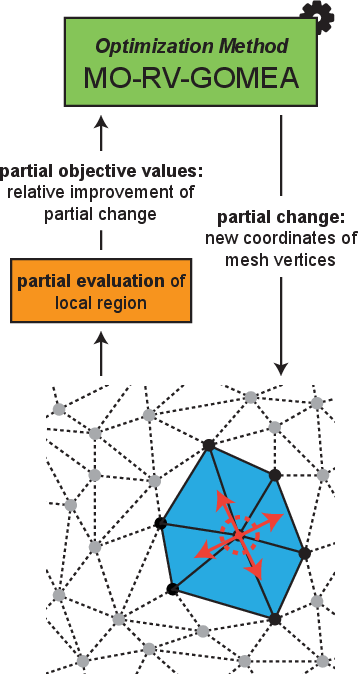
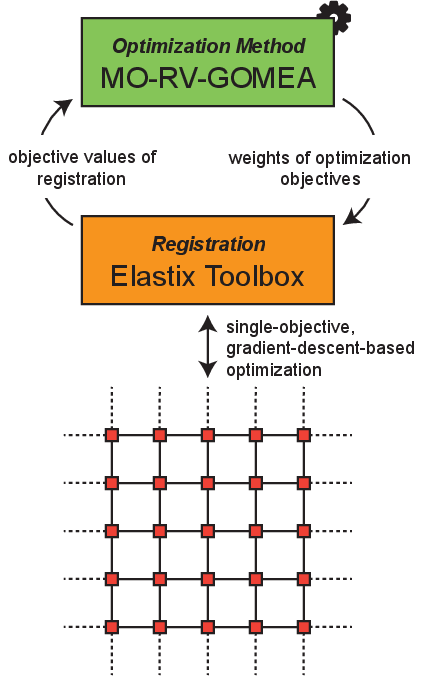
Abstract: The transformation model is an essential component of any deformable image registration approach. It provides a representation of physical deformations between images, thereby defining the range and realism of registrations that can be found. Two types of transformation models have emerged as popular choices: B-spline models and mesh models. Although both models have been investigated in detail, a direct comparison has not yet been made, since the models are optimized using very different optimization methods in practice. B-spline models are predominantly optimized using gradient-descent methods, while mesh models are typically optimized using finite-element method solvers or evolutionary algorithms. Multi-objective optimization methods, which aim to find a diverse set of high-quality trade-off registrations, are increasingly acknowledged to be important in deformable image registration. Since these methods search for a diverse set of registrations, they can provide a more complete picture of the capabilities of different transformation models, making them suitable for a comparison of models. In this work, we conduct the first direct comparison between B-spline and mesh transformation models, by optimizing both models with the same state-of-the-art multi-objective optimization method, the Multi-Objective Real-Valued Gene-pool Optimal Mixing Evolutionary Algorithm (MO-RV-GOMEA). The combination with B-spline transformation models, moreover, is novel. We experimentally compare both models on two different registration problems that are both based on pelvic CT scans of cervical cancer patients, featuring large deformations. Our results, on three cervical cancer patients, indicate that the choice of transformation model can have a profound impact on the diversity and quality of achieved registration outcomes.
- D. Rueckert and J. A. Schnabel, “Medical Image Registration,” in Biomedical Image Processing, Biological and Medical Physics, Biomedical Engineering, ch. 5, pp. 131–154, Springer Berlin Heidelberg, 2011.
- C. T. Metz, S. Klein, M. Schaap, T. van Walsum, and W. J. Niessen, “Nonrigid registration of dynamic medical imaging data using nD+t B-splines and a groupwise optimization approach,” Medical Image Analysis 15(2), pp. 238–249, 2011.
- D. Rueckert, L. I. Sonoda, C. Hayes, D. L. G. Hill, M. O. Leach, and D. J. Hawkes, “Nonrigid Registration Using Free-Form Deformations: Application to Breast MR Images,” IEEE Transactions on Medical Imaging 18(8), pp. 712–721, 1999.
- K. K. Brock, M. B. Sharpe, L. A. Dawson, S. M. Kim, and D. A. Jaffray, “Accuracy of finite element model-based multi-organ deformable image registration,” Medical Physics 32(6), pp. 1647–1659, 2005.
- B. Rigaud, A. Klopp, S. Vedam, A. Venkatesan, N. Taku, A. Simon, P. Haigron, R. De Crevoisier, K. K. Brock, and G. Cazoulat, “Deformable image registration for dose mapping between external beam radiotherapy and brachytherapy images of cervical cancer,” Physics in Medicine and Biology 64(11), p. 115023, 2019.
- S. Klein, M. Staring, K. Murphy, M. A. Viergever, and J. P. Pluim, “Elastix: A toolbox for intensity-based medical image registration,” IEEE Transactions on Medical Imaging 29(1), pp. 196–205, 2010.
- G. C. Sharp, R. Li, J. Wolfgang, G. T. Y. Chen, M. Peroni, M. F. Spadea, S. Mori, J. Zhang, J. Shackleford, and N. Kandasamy, “Plastimatch - an open source software suite for radiotherapy image processing,” in Proceedings of the XVI’th International Conference on the use of Computers in Radiotherapy, pp. 1–4, 2010.
- G. Andreadis, P. A. N. Bosman, and T. Alderliesten, “MOREA: a GPU-accelerated Evolutionary Algorithm for Multi-Objective Deformable Registration of 3D Medical Images,” in Proceedings of the 2023 Genetic and Evolutionary Computation Conference, pp. 1294–1302, 2023.
- W. Sun, W. J. Niessen, M. Van Stralen, and S. Klein, “Simultaneous multiresolution strategies for nonrigid image registration,” IEEE Transactions on Image Processing 22(12), pp. 4905–4917, 2013.
- K. Murphy, B. van Ginneken, J. M. Reinhardt, S. Kabus, K. Ding, X. Deng, K. Cao, K. Du, G. E. Christensen, V. Garcia, T. Vercauteren, N. Ayache, O. Commowick, G. Malandain, B. Glocker, N. Paragios, N. Navab, V. Gorbunova, J. Sporring, M. De Bruijne, X. Han, M. P. Heinrich, J. A. Schnabel, M. Jenkinson, C. Lorenz, M. Modat, J. R. McClelland, S. Ourselin, S. E. Muenzing, M. A. Viergever, D. De Nigris, D. L. Collins, T. Arbel, M. Peroni, R. Li, G. C. Sharp, A. Schmidt-Richberg, J. Ehrhardt, R. Werner, D. Smeets, D. Loeckx, G. Song, N. Tustison, B. Avants, J. C. Gee, M. Staring, S. Klein, B. C. Stoel, M. Urschler, M. Werlberger, J. Vandemeulebroucke, S. Rit, D. Sarrut, and J. P. W. Pluim, “Evaluation of registration methods on thoracic CT: The EMPIRE10 challenge,” IEEE Transactions on Medical Imaging 30(11), pp. 1901–1920, 2011.
- G. Loi, M. Fusella, E. Lanzi, E. Cagni, C. Garibaldi, G. Iacoviello, F. Lucio, E. Menghi, R. Miceli, L. C. Orlandini, A. Roggio, F. Rosica, M. Stasi, L. Strigari, S. Strolin, and C. Fiandra, “Performance of commercially available deformable image registration platforms for contour propagation using patient-based computational phantoms: A multi-institutional study,” Medical Physics 45(2), pp. 748–757, 2018.
- K. Pirpinia, P. A. N. Bosman, C. E. Loo, G. Winter-Warnars, N. N. Y. Janssen, A. N. Scholten, J. J. Sonke, M. van Herk, and T. Alderliesten, “The feasibility of manual parameter tuning for deformable breast MR image registration from a multi-objective optimization perspective,” Physics in Medicine and Biology 62(14), pp. 5723–5743, 2017.
- L. G. Brown, “A Survey of Image Registration Techniques,” ACM Computing Surveys 24(4), pp. 325–376, 1992.
- T. Alderliesten, J. J. Sonke, and P. A. N. Bosman, “Deformable image registration by multi-objective optimization using a dual-dynamic transformation model to account for large anatomical differences,” in SPIE Medical Imaging 2013: Image Processing, 8669, p. 866910, 2013.
- G. Andreadis, P. A. N. Bosman, and T. Alderliesten, “Multi-objective dual simplex-mesh based deformable image registration for 3D medical images - proof of concept,” in SPIE Medical Imaging 2022: Image Processing, pp. 744–750, 2022.
- A. Bouter, N. H. Luong, C. Witteveen, T. Alderliesten, and P. A. N. Bosman, “The multi-objective real-valued gene-pool optimal mixing evolutionary algorithm,” in Proceedings of the 2017 Genetic and Evolutionary Computation Conference, pp. 537–544, 2017.
- E. Zitzler, J. Knowles, and L. Thiele, “Quality Assessment of Pareto Set Approximations,” in Multiobjective Optimization, pp. 373–404, Springer Berlin Heidelberg, 2008.
- G. K. Rohde, A. Aldroubi, and B. M. Dawant, “The adaptive bases algorithm for intensity-based nonrigid image registration,” IEEE Transactions on Medical Imaging 22, pp. 1470–1479, 11 2003.
- A. Pai, S. Sommer, L. Sørensen, S. Darkner, J. Sporring, and M. Nielsen, “Image Registration using stationary velocity fields parameterized by norm-minimizing Wendland kernel,” in SPIE Medical Imaging 2015: Image Processing, pp. 838–844, 2015.



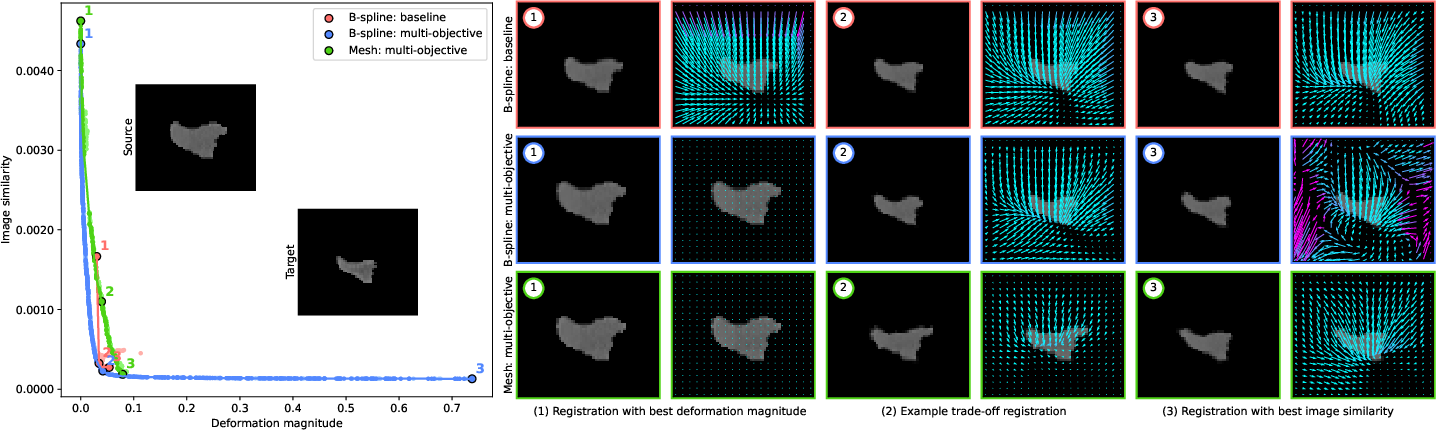
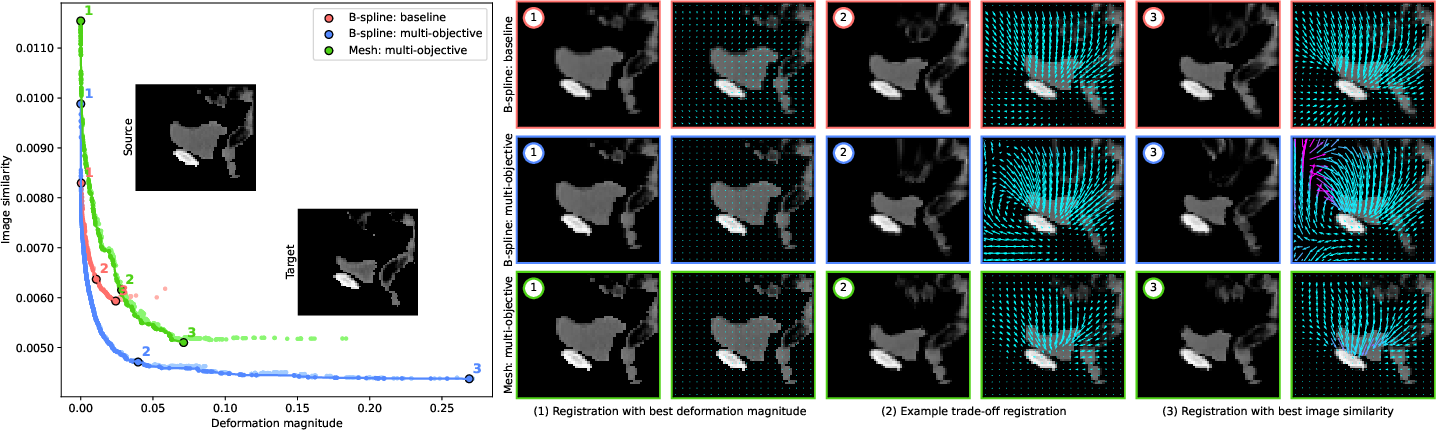
Paper Prompts
Sign up for free to create and run prompts on this paper using GPT-5.
Top Community Prompts
Collections
Sign up for free to add this paper to one or more collections.