Papers
Topics
Authors
Recent
Search
2000 character limit reached

Memory Sharing for Large Language Model based Agents

Published 15 Apr 2024 in cs.CL | (2404.09982v2)

Abstract: The adaptation of LLM-based agents to execute tasks via natural language prompts represents a significant advancement, notably eliminating the need for explicit retraining or fine tuning, but are constrained by the comprehensiveness and diversity of the provided examples, leading to outputs that often diverge significantly from expected results, especially when it comes to the open-ended questions. This paper introduces the Memory Sharing, a framework which integrates the real-time memory filter, storage and retrieval to enhance the In-Context Learning process. This framework allows for the sharing of memories among multiple agents, whereby the interactions and shared memories between different agents effectively enhance the diversity of the memories. The collective self-enhancement through interactive learning among multiple agents facilitates the evolution from individual intelligence to collective intelligence. Besides, the dynamically growing memory pool is utilized not only to improve the quality of responses but also to train and enhance the retriever. We evaluated our framework across three distinct domains involving specialized tasks of agents. The experimental results demonstrate that the MS framework significantly improves the agents' performance in addressing open-ended questions.

Definition Search Book Streamline Icon: https://streamlinehq.com
References (27)
  1. Few-shot training llms for project-specific code-summarization. In Proceedings of the 37th IEEE/ACM International Conference on Automated Software Engineering, pp.  1–5, 2022.
  2. Language models are few-shot learners. Advances in neural information processing systems, 33:1877–1901, 2020.
  3. Pal: Program-aided language models. In International Conference on Machine Learning, pp.  10764–10799. PMLR, 2023.
  4. Solving math word problems by combining language models with symbolic solvers. arXiv preprint arXiv:2304.09102, 2023.
  5. Atlas: Few-shot learning with retrieval augmented language models. arXiv preprint arXiv:2208.03299, 2022.
  6. Can language models learn from explanations in context? arXiv preprint arXiv:2204.02329, 2022.
  7. The inductive bias of in-context learning: Rethinking pretraining example design. arXiv preprint arXiv:2110.04541, 2021.
  8. Retrieval-augmented generation for knowledge-intensive nlp tasks. Advances in Neural Information Processing Systems, 33:9459–9474, 2020.
  9. Chin-Yew Lin. ROUGE: A package for automatic evaluation of summaries. In Text Summarization Branches Out, pp.  74–81, Barcelona, Spain, July 2004. Association for Computational Linguistics. URL https://www.aclweb.org/anthology/W04-1013.
  10. What makes good in-context examples for GPT-3? In Eneko Agirre, Marianna Apidianaki, and Ivan Vulić (eds.), Proceedings of Deep Learning Inside Out (DeeLIO 2022): The 3rd Workshop on Knowledge Extraction and Integration for Deep Learning Architectures, pp.  100–114, Dublin, Ireland and Online, May 2022. Association for Computational Linguistics. doi: 10.18653/v1/2022.deelio-1.10. URL https://aclanthology.org/2022.deelio-1.10.
  11. Pre-train, prompt, and predict: A systematic survey of prompting methods in natural language processing. ACM Computing Surveys, 55(9):1–35, 2023.
  12. Dr. icl: Demonstration-retrieved in-context learning. arXiv preprint arXiv:2305.14128, 2023.
  13. Generation-augmented retrieval for open-domain question answering. arXiv preprint arXiv:2009.08553, 2020.
  14. Cross-task generalization via natural language crowdsourcing instructions. arXiv preprint arXiv:2104.08773, 2021.
  15. In-context retrieval-augmented language models. Transactions of the Association for Computational Linguistics, 11:1316–1331, 2023.
  16. Sentence-bert: Sentence embeddings using siamese bert-networks. arXiv preprint arXiv:1908.10084, 2019.
  17. Learning to retrieve prompts for in-context learning. arXiv preprint arXiv:2112.08633, 2021.
  18. Replug: Retrieval-augmented black-box language models. arXiv preprint arXiv:2301.12652, 2023.
  19. Story centaur: Large language model few shot learning as a creative writing tool. In Proceedings of the 16th Conference of the European Chapter of the Association for Computational Linguistics: System Demonstrations, pp.  244–256, 2021.
  20. Voyager: An open-ended embodied agent with large language models. arXiv preprint arXiv:2305.16291, 2023a.
  21. Learning to retrieve in-context examples for large language models. arXiv preprint arXiv:2307.07164, 2023b.
  22. Chain-of-thought prompting elicits reasoning in large language models. Advances in neural information processing systems, 35:24824–24837, 2022.
  23. A prompt pattern catalog to enhance prompt engineering with chatgpt. arXiv preprint arXiv:2302.11382, 2023.
  24. Reframing human-ai collaboration for generating free-text explanations. arXiv preprint arXiv:2112.08674, 2021.
  25. Ai chains: Transparent and controllable human-ai interaction by chaining large language model prompts. In Proceedings of the 2022 CHI conference on human factors in computing systems, pp.  1–22, 2022.
  26. Bertscore: Evaluating text generation with bert. In International Conference on Learning Representations, 2020. URL https://openreview.net/forum?id=SkeHuCVFDr.
  27. Large language models are human-level prompt engineers. arXiv preprint arXiv:2211.01910, 2022.
Citations (5)

Summary

  • The paper’s main contribution is a dynamic Memory Sharing framework that enriches in-context learning by sharing and retrieving agent experiences.
  • The methodology employs a scoring rubric and cosine similarity to select and integrate relevant (Prompt, Answer) pairs into an evolving memory pool.
  • Experimental evaluation shows improved performance in plan generation and literary tasks through domain-specific pooling and three-shot learning.

Memory Sharing for LLM based Agents

The paper "Memory Sharing for LLM based Agents" proposes an innovative framework aimed at augmenting the capabilities of LLM-based agents. This framework emphasizes the in-context learning process, particularly for open-ended queries, by leveraging a real-time memory storage and retrieval mechanism. It addresses the limitations of traditional in-context learning which faces challenges with examples that insufficiently cover complex, open-ended tasks such as poetry generation or problem-solving scenarios.

Introduction

The study acknowledges the strides in AI through LLMs and the advent of techniques like in-context learning and prompt engineering. In-context learning's ability to adapt to novel tasks without model retraining has provided a flexible approach, outperforming fine-tuning in certain domains. However, its application in generating open-ended responses exposes deficiencies due to inadequate example coverage and the static nature of knowledge bases. The proposed Memory Sharing (MS) framework introduces a dynamic way to store and share memories across agents, guiding them to solve complex queries through a collectively enriched memory pool.

The Memory Sharing Framework

The MS framework systematically organizes agent interactions into (Prompt, Answer) pairs, cataloged into a shared memory pool that is evaluated and continuously enriched in real-time.

Memory Storage

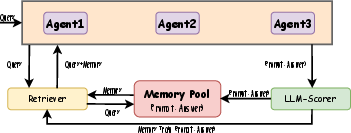
Each interaction's memory candidate undergoes a scoring process employing domain-specific rubrics. These rubrics, designed by the LLM itself for uniform understanding, assess the relevance and potential utility of new memories. High-scoring memories enter the pool, serving as future reference points enhancing agent problem-solving capabilities with diverse examples. Figure 1

Figure 1: The Memory Sharing framework. Whenever a new (Prompt, Answer) pair is generated, it will be considered to be added to the memory pool and to train the retriever.

Memory Retrieval

Upon receiving a query, the MS framework uses cosine similarity-based retrieval strategies to select relevant memories. The retrieved memories are combined with the query to form an enriched prompt, facilitating a nuanced understanding and response by the agent. This process ensures continuous retriever optimization, improving example retrieval through dynamic, real-time training. Figure 2

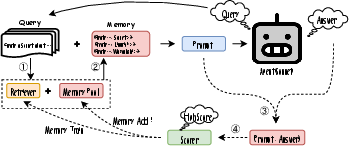
Figure 2: An example of how the Agent (Sonnet) cooperates with the MS framework. (1) + (2) The retriever take the original query from agent as the input, retrieve the suitable memories from the memory pool and concatenate them to the query to form the prompt. (3) The Agent (Sonnet) takes the prompt and makes an answer, pack them as (Prompt, Answer). (4) Scorer generates a score according to the designed rubric for (Prompt, Answer), while (Prompt, Answer) pairs with high scores will be added into the Memory Pool and also be sent to train the Retriever. All agents share the same Memory Pool; they can write memories into the pool and retrieve memories from the pool so that they can share memories with each other.

Experimental Evaluation

The MS framework was empirically validated across three domains: Literary Creation, Unconventional Logic Problem-Solving, and Plan Generation. Agents across these domains used shared and individual domain-specific memory pools to evaluate their performance using different retrieval strategies:

  1. Retrieval Strategies: Agents exhibited performance gains through increased memory access, particularly in plan generation and literary tasks. Utilizing three-shot learning showed maximum performance enhancements.
  2. Memory Pooling: Domain-specific pooling enabled agents to maximize learning benefits, whereas a single-pool setup with mixed-domain memories proved less effective, reducing agents' task-focused efficiencies. Figure 3

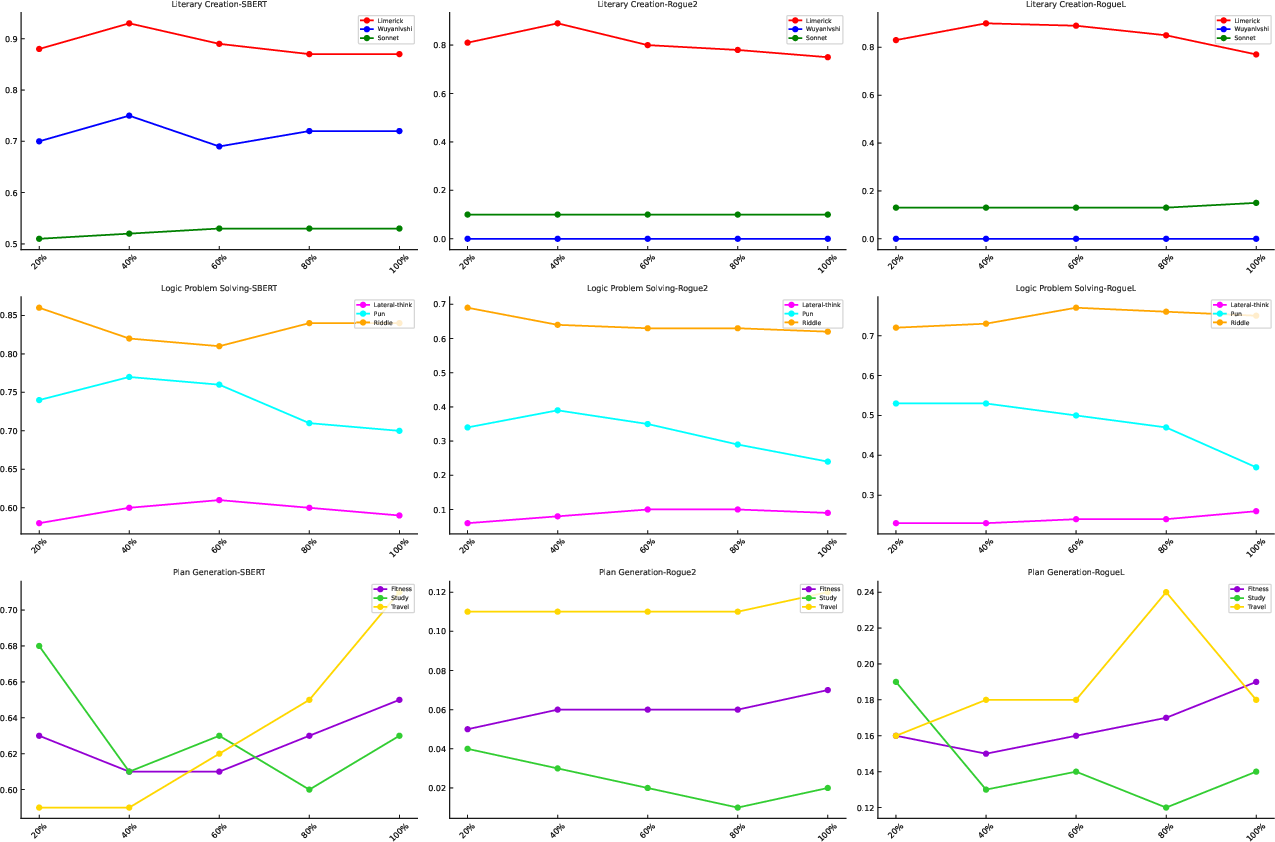
    Figure 3: Evaluating agent performance on open-ended queries using three suitable memories and Domain-pool with periodic updates.

Discussion

The framework demonstrated substantial improvements in agent task handling for open-ended queries, as evidenced by metrics like ROUGE and BERTScore. Key observations included:

  • Domain-Specific Pools: Performance peaks were observed in scenarios using domain-specific memory pools.
  • Memory Accumulation: An optimal pool size is crucial, as excessive memory can dilute learning effectiveness despite guaranteed diversity in examples.

The MS framework successfully enhances LLM agents' contextual understanding and response generation by dynamically sharing and retrieving knowledge.

Conclusions

The Memory Sharing framework successfully enriches the in-context learning process for LLM-based agents, fostering better comprehension and task execution in open-ended domains. By introducing a continually updating memory pool, the proposal effectively addresses inherent challenges of static knowledge bases. Future research will explore the optimal memory pool sizing and the integration of fine-tuning processes with MS to further leverage diverse LLM-contributed insights. Additionally, testing across varied foundational models may elucidate broader applicability and robustness of the MS framework.

Paper to Video (Beta)

No one has generated a video about this paper yet.

Whiteboard

No one has generated a whiteboard explanation for this paper yet.

Open Problems

We haven't generated a list of open problems mentioned in this paper yet.

Authors (2)

Collections

Sign up for free to add this paper to one or more collections.

Tweets

Sign up for free to view the 1 tweet with 3 likes about this paper.