Papers
Topics
Authors
Recent
Search
2000 character limit reached

Nonlinear classification of neural manifolds with contextual information

Published 10 May 2024 in q-bio.NC, cond-mat.dis-nn, cond-mat.stat-mech, cs.NE, and stat.ML | (2405.06851v2)

Abstract: Understanding how neural systems efficiently process information through distributed representations is a fundamental challenge at the interface of neuroscience and machine learning. Recent approaches analyze the statistical and geometrical attributes of neural representations as population-level mechanistic descriptors of task implementation. In particular, manifold capacity has emerged as a promising framework linking population geometry to the separability of neural manifolds. However, this metric has been limited to linear readouts. To address this limitation, we introduce a theoretical framework that leverages latent directions in input space, which can be related to contextual information. We derive an exact formula for the context-dependent manifold capacity that depends on manifold geometry and context correlations, and validate it on synthetic and real data. Our framework's increased expressivity captures representation reformatting in deep networks at early stages of the layer hierarchy, previously inaccessible to analysis. As context-dependent nonlinearity is ubiquitous in neural systems, our data-driven and theoretically grounded approach promises to elucidate context-dependent computation across scales, datasets, and models.

Definition Search Book Streamline Icon: https://streamlinehq.com
References (14)
  1. S. Chung and L. Abbott, Curr. opin. neurobiol. 70, 137 (2021).
  2. T. J. Buschman and S. Kastner, Neuron 88, 127 (2015).
  3. M. F. Panichello and T. J. Buschman, Nature 592, 601 (2021).
  4. T. Moore and K. M. Armstrong, Nature 421, 370 (2003).
  5. T. J. Buschman and E. K. Miller, science 315, 1860 (2007).
  6. M. London and M. Häusser, Annu. Rev. Neurosci. 28, 503 (2005).
  7. E. Sezener et al., bioRxiv  (2022), 10.1101/2021.03.10.434756.
  8. J. Veness et al., in Proceedings of the AAAI Conference on Artificial Intelligence, Vol. 35 (2021).
  9. Q. Li and H. Sompolinsky, Advances in Neural Information Processing Systems 35, 34789 (2022).
  10. E. Gardner, Journal of physics A: Mathematical and general 21, 257 (1988).
  11. R. Monasson and R. Zecchina, Modern Physics Letters B 9, 1887 (1995).
  12. J. A. Zavatone-Veth and C. Pehlevan, Physical Review E 103, L020301 (2021).
  13. T. M. Cover, IEEE transactions on electronic computers  (1965).
  14. C. Stephenson et al., in ICLR 2021 (2021).
Citations (1)

Summary

  • The paper introduces a theoretical framework that incorporates contextual gating to overcome limitations of linear manifold capacity measures.
  • It employs replica theory and gating mechanisms to derive an exact formula for computing manifold capacity influenced by context and geometry.
  • Experiments on synthetic data and Resnet-50 demonstrate that context improves the disentanglement and separability of neural representations across network layers.

Nonlinear Classification of Neural Manifolds with Contextual Information

Introduction

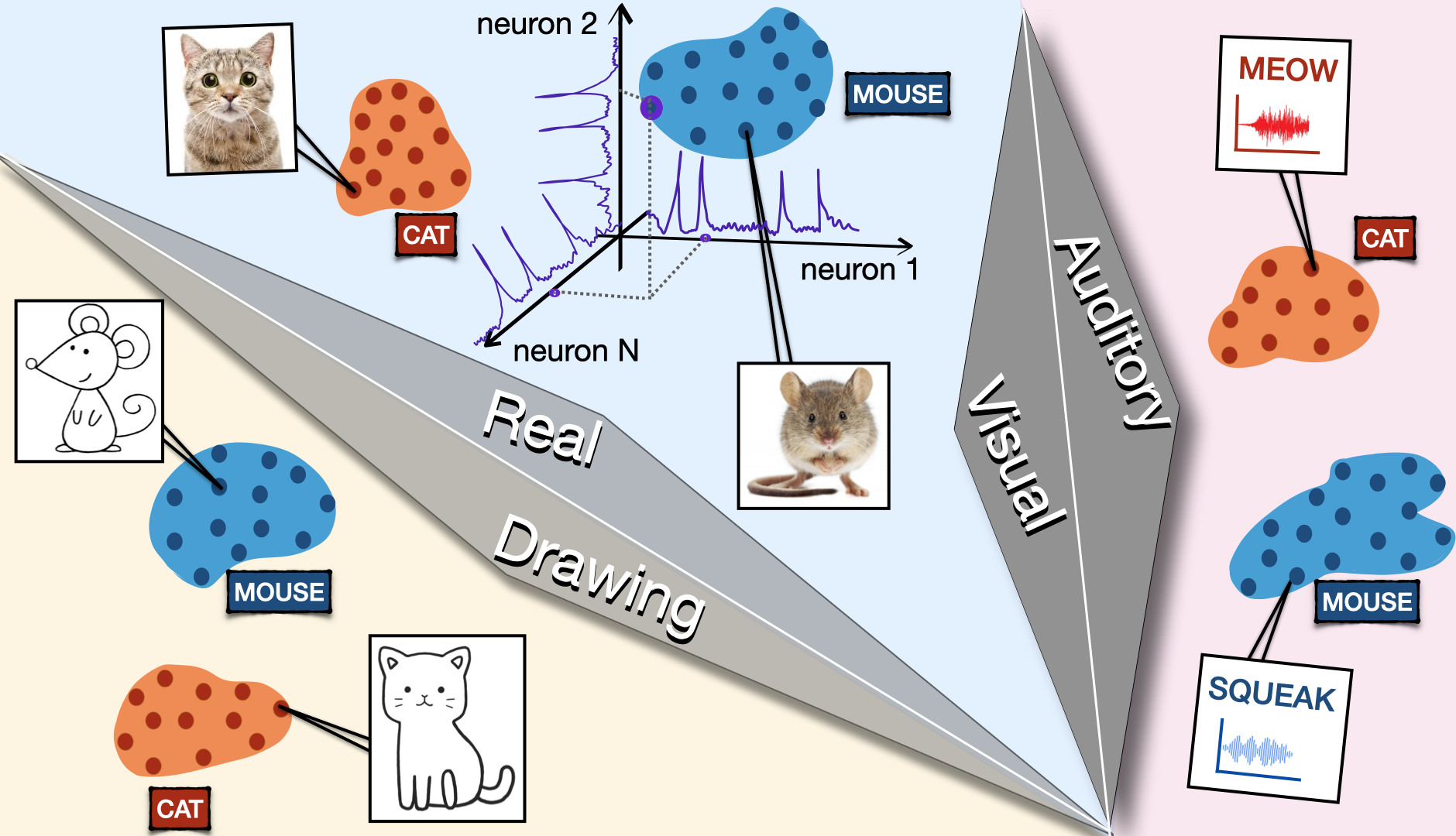
This paper tackles the problem of nonlinear classification of neural manifolds by considering contextual information. Neural manifolds represent a collection of neural responses to variability in input stimuli related to objects and system-generated variability. Existing theories on manifold capacity have predominantly focused on linear readouts, thus limiting their applicability to nonlinear separability challenges, especially in early sensory processing stages where representations are highly entangled. Figure 1

Figure 1: Neural manifolds are composed by the collection of the neural responses elicited by the same concept, either cat'' ormouse'', expressed differently according to contexts.

The authors propose a theoretical framework that incorporates contextual information into the classification of manifolds, thus addressing the limitations of linear manifold capacity theories. The framework reveals how layer hierarchy in deep networks progressively untangles these representations, indicating an increase in capacity, especially in early layers, previously unquantified using linear capacity measures.

Theoretical Framework

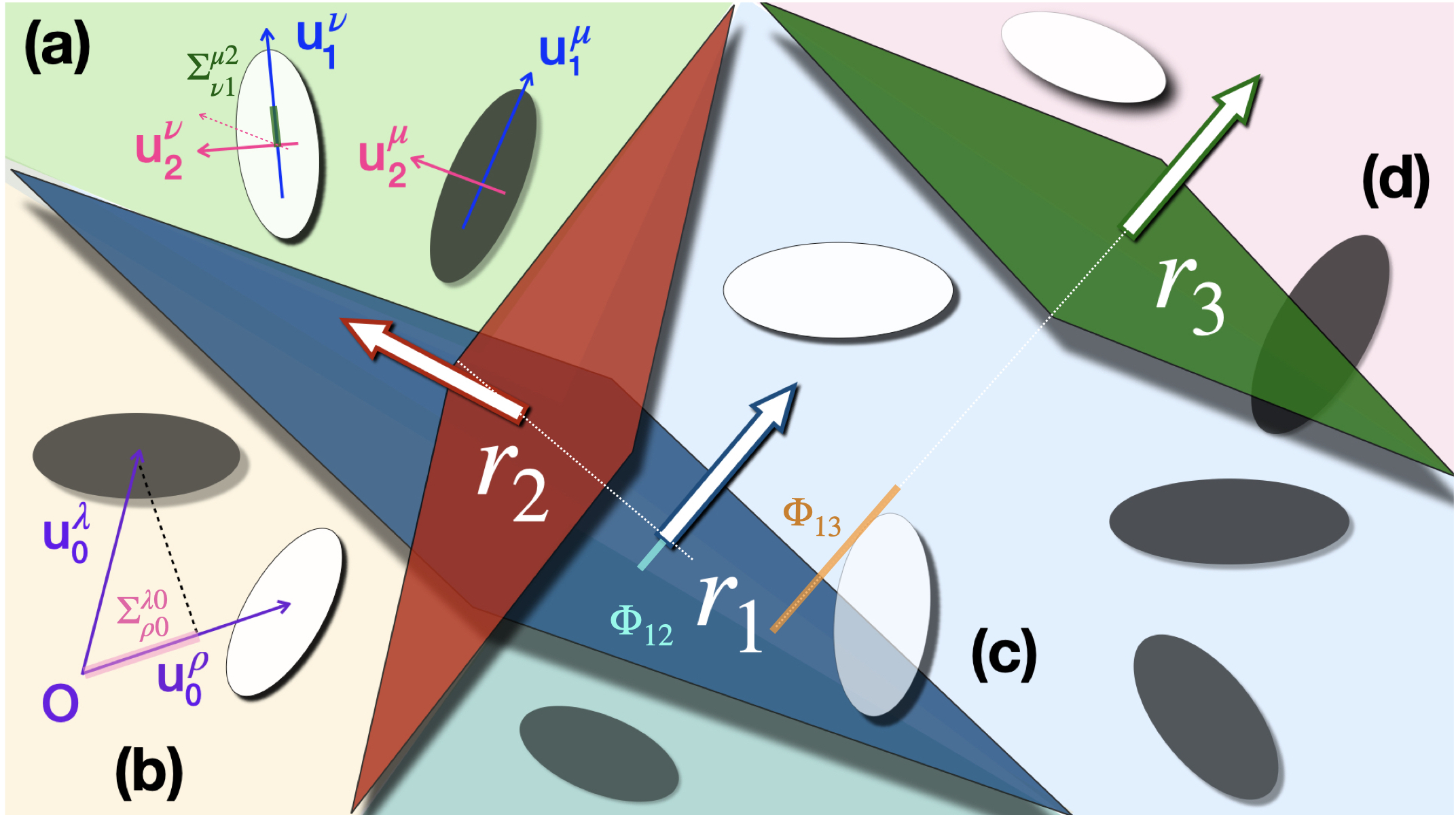
Neural representations are modeled as low-dimensional manifolds embedded within high-dimensional spaces, each characterized by center and axis directions. These manifold directions are sampled from a joint probability distribution, encoding correlations via a tensor. The nonlinear classification model introduces context switching, implemented through gating mechanisms based on half-space shattering with context vectors, resulting in piece-wise linear components in decision boundaries. Figure 2

Figure 2: Three hyperplanes separate the input space into different contexts, denoting context hyperplanes and manifold ellipsoids.

The manifold capacity in this framework is quantified as the maximal number of manifolds per dimension that can be correctly classified by nonlinear rules at a given margin. Utilizing replica theory, the authors derive an exact formula for storage capacity influenced by context correlations and manifold geometry.

Experimental Results

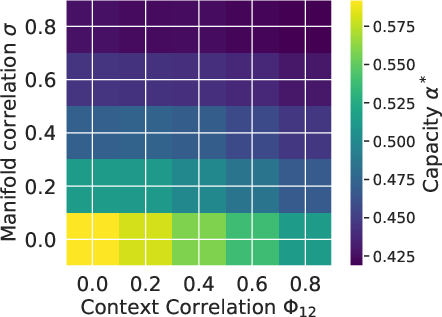
The authors test their framework on synthetic datasets and deep neural networks. For synthetic data, a spherical manifold model is utilized, displaying a decrease in capacity with increasing manifold and context correlations. This illustrates how specific configurations of context and manifold geometries influence separability. Figure 3

Figure 3: Capacity from Eq.~\eqref{eq:formula_manifolds}, highlighting the dependency on uniform manifold correlations and context correlation parameters.

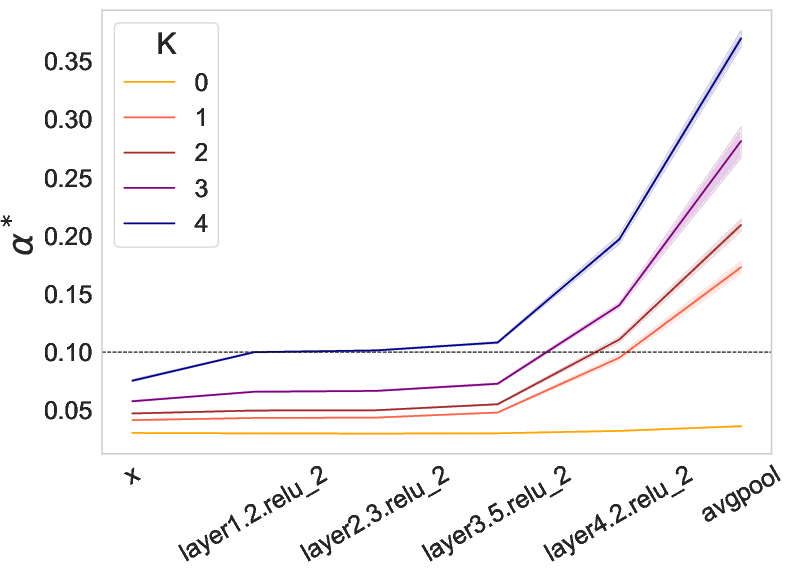
In the application to ImageNet representations using Resnet-50, the model captures the progression of representation disentanglement across layers. The capacity curve reflects progression across layer depth, contrasting with flat capacity in the absence of context, and underscores the role of context in efficient representation processing in neural networks. Figure 4

Figure 4: Capacity observed in different layers of Resnet-50, demonstrating how the number of contexts impacts separability thresholds.

Discussion and Conclusion

The framework successfully connects contextual information to the nonlinear separability of neural representations, broadening prior works focused on linear separability. By capturing how manifold disentanglement unfolds across layer hierarchies, it offers insights into learning dynamics in deep neural networks and biological systems. Future directions involve optimizing context assignments to maximize capacity, exploring hierarchical data structures' impact, and extending the analysis to biological datasets to assess representational efficiency.

This exploration could pave the way toward finding optimal neural architectures for nonlinear separable tasks, leveraging contextual gating as a lens. Such advancements may have implications in expanding the understanding of representation processing in artificial intelligence and neuroscience. The paper's findings suggest significant applications in contexts where entangled information must be efficiently processed and delineated.

Paper to Video (Beta)

Whiteboard

No one has generated a whiteboard explanation for this paper yet.

Open Problems

We haven't generated a list of open problems mentioned in this paper yet.

Collections

Sign up for free to add this paper to one or more collections.

Tweets

Sign up for free to view the 3 tweets with 3 likes about this paper.