- The paper demonstrates that magnetic reconnection effectively extracts energy from Kerr-Newman black holes within a perfect fluid dark matter environment.
- It employs a parameter space analysis showing how spin, charge, and the PFDM parameter λ impact the ergoregion and event horizon structures.
- The study quantifies power extraction rates and reconnection efficiency, providing insights applicable to astrophysical jets from AGNs and GRBs.
Introduction
The study of energy extraction mechanisms from rotating black holes is a significant area in high-energy astrophysics, with implications for understanding relativistic jets and energy emissions in the universe. The paper under discussion investigates a novel energy extraction process via magnetic reconnection in the context of a Kerr-Newman black hole surrounded by perfect fluid dark matter (PFDM). This expands on the Comisso-Asenjo process, which leverages magnetic reconnection—a phenomenon where magnetic field lines rearrange and release energy—within the ergosphere of a black hole.
Kerr-Newman Black Hole in PFDM
The authors initiate their analysis by defining the metric for a Kerr-Newman black hole influenced by a PFDM background. The action introducing the U(1) gauge field and PFDM modifies the traditional Einstein-Maxwell theory, incorporating the electromagnetic and dark matter energy-momentum tensors into the field equations. Notably, the presence of PFDM and electric charge alters the structure of the event horizons and ergoregion compared to a standard Kerr black hole.
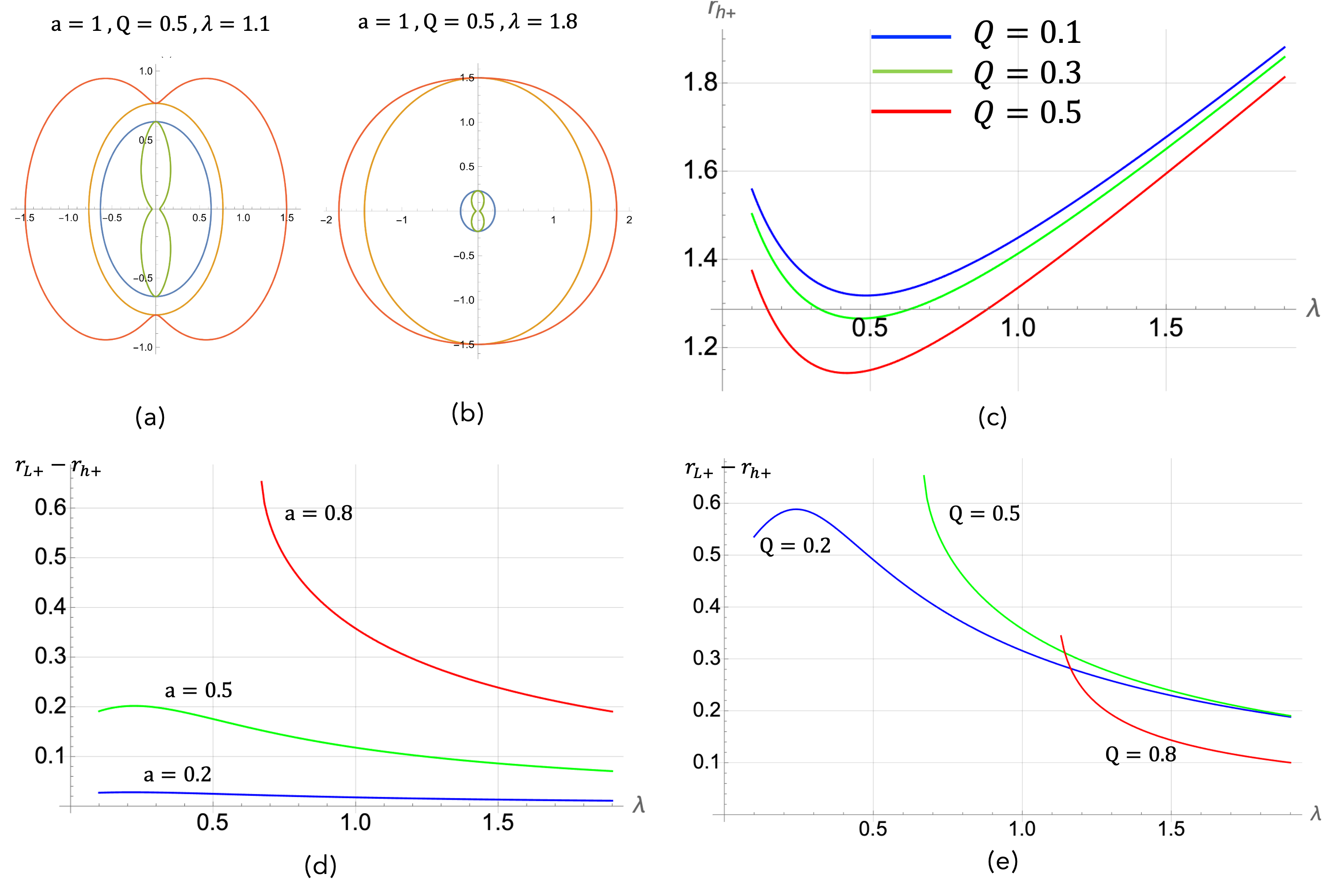
Figure 1: Event horizons and ergoregion for varying dark matter parameter λ with constant spin a=1 and charge Q=0.5.
Geodesics and Ergosphere Dynamics
The study progresses by examining the dynamic effects of the parameters—spin a, charge Q, and PFDM parameter λ—on the horizons and the ergoregion. It is observed that the size of the ergoregion is influenced non-linearly by λ, increasing significantly with higher spins (>0.8) and lower λ. The inner and outer event horizons also show non-trivial dependencies on these parameters. Moreover, they analyze circular geodesics and conclude that the particles’ innermost stable circular orbit remains well-positioned within the ergoregion, thereby enabling effective magnetic reconnection.
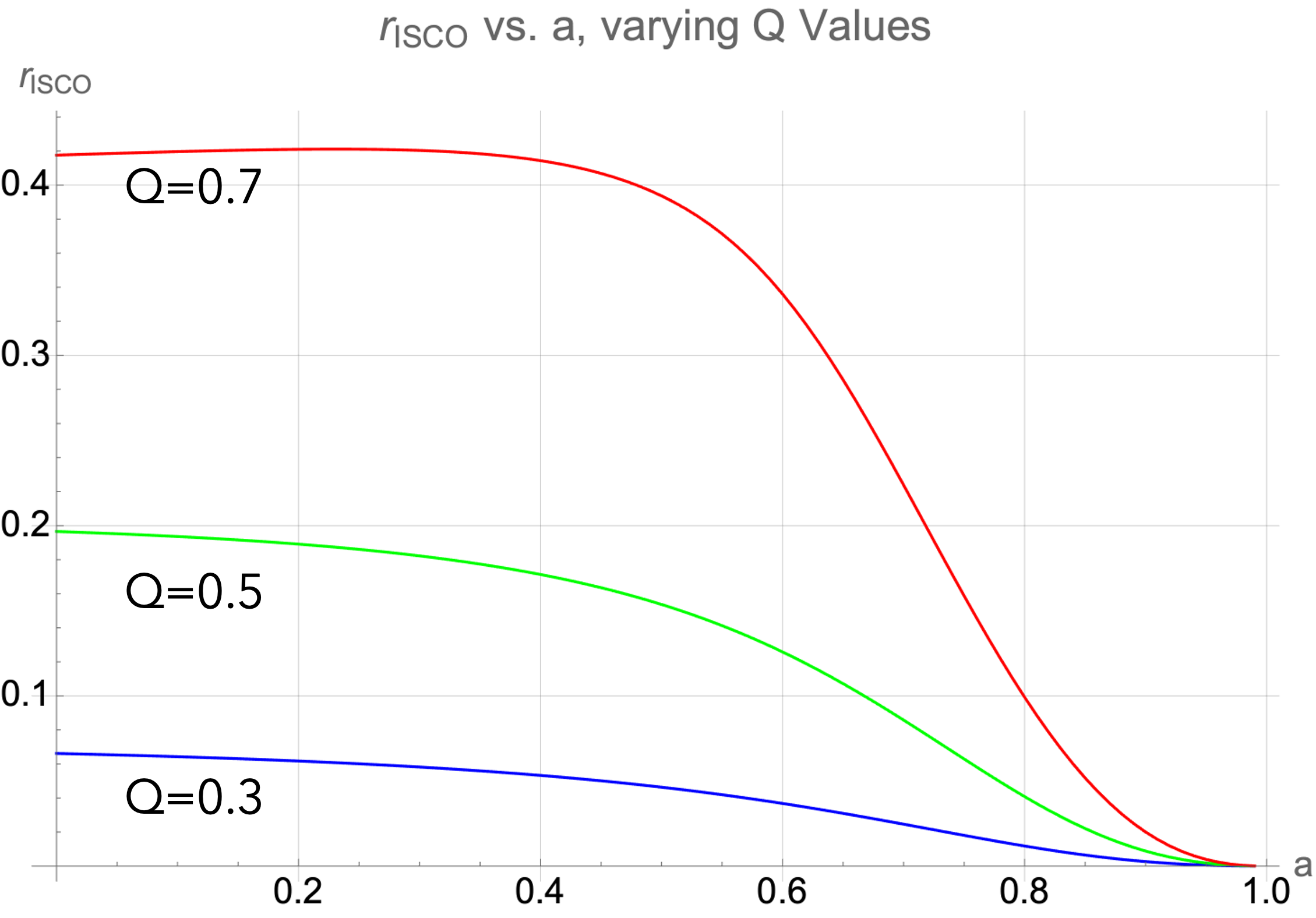
Figure 2: Innermost stable circular orbits as a function of black hole spin for varying charges, highlighting geodesic structures in the PFDM-augmented black hole metric.
The paper elaborates on the Comisso-Asenjo magnetic reconnection process in the context of Kerr-Newman metrics. Utilizing the Zero Angular Momentum Observer (ZAMO) frame, the energy-at-infinity density associated with reconnecting plasma flows is evaluated, emphasizing the conditions under which energy extraction occurs. The role of plasma magnetization, orientation angle, and other critical parameters are assessed to determine the efficacy of energy extraction.
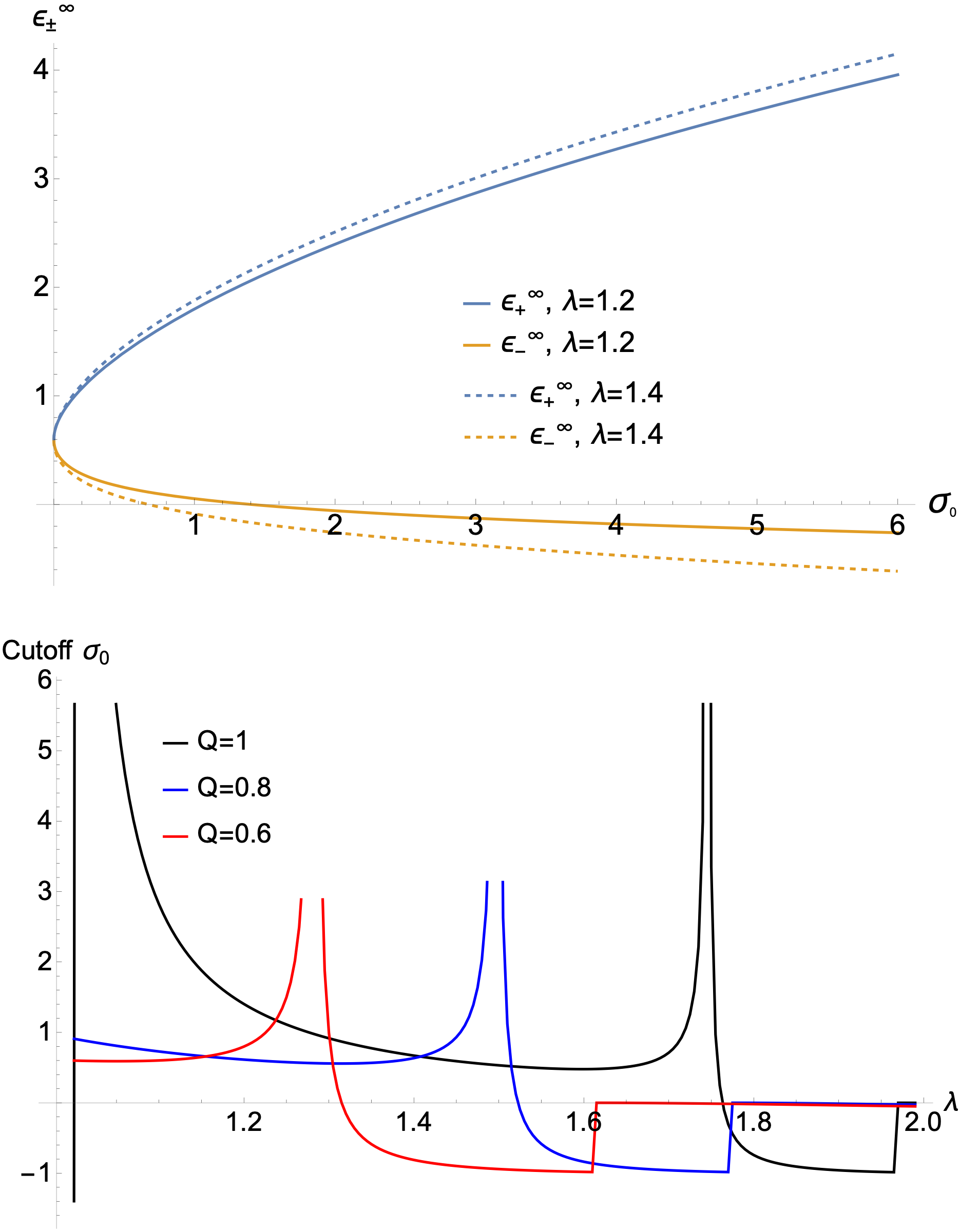
Figure 3: Energy-at-infinity densities for accelerating and decelerating plasma as functions of plasma magnetization σ0, illustrating the influence of the PFDM parameter λ.
Parameter Space and Phase Analysis
A detailed parameter space analysis outlines how variations in λ and Q affect energy extraction conditions. The findings suggest that appropriate tuning of these parameters allows changes in the magnetic reconnection dynamics, enhancing energy extraction even at sub-maximal black hole spins.
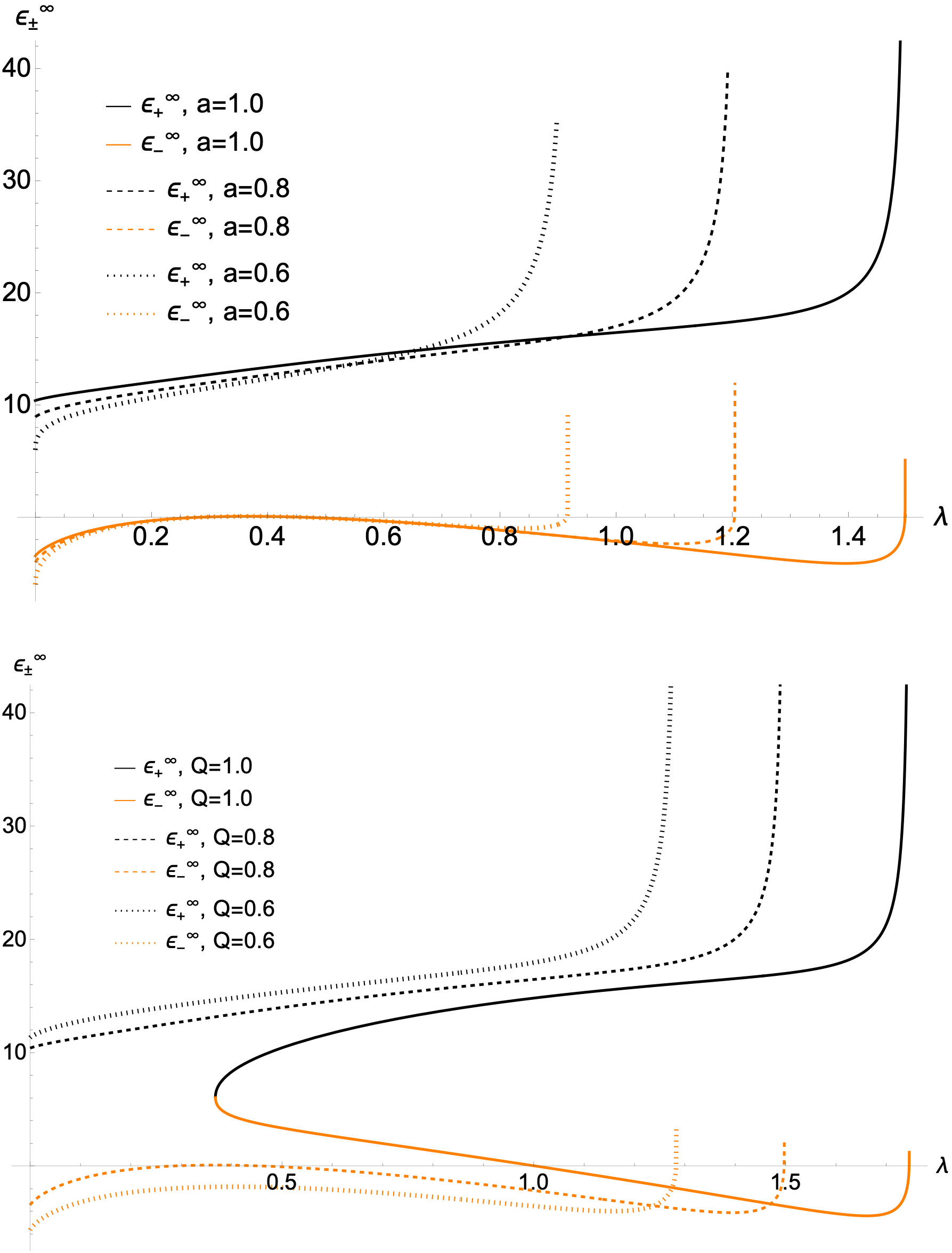
Figure 4: Phase space regions for energy extraction where ϵ−∞<0, varying the dark matter parameter λ under fixed charge values.
Energy Extraction Rate and Reconnection Efficiency
Finally, the study investigates the power extraction rate and reconnection efficiency as functions of r/M (the radial X-point location), highlighting the optimal conditions needed for maximizing energy extraction. The dependence on plasma and black hole parameters is quantified, revealing that strategic adjustments to charge and dark matter can lead to efficiencies comparable to high-spin cases, but at lower spins.
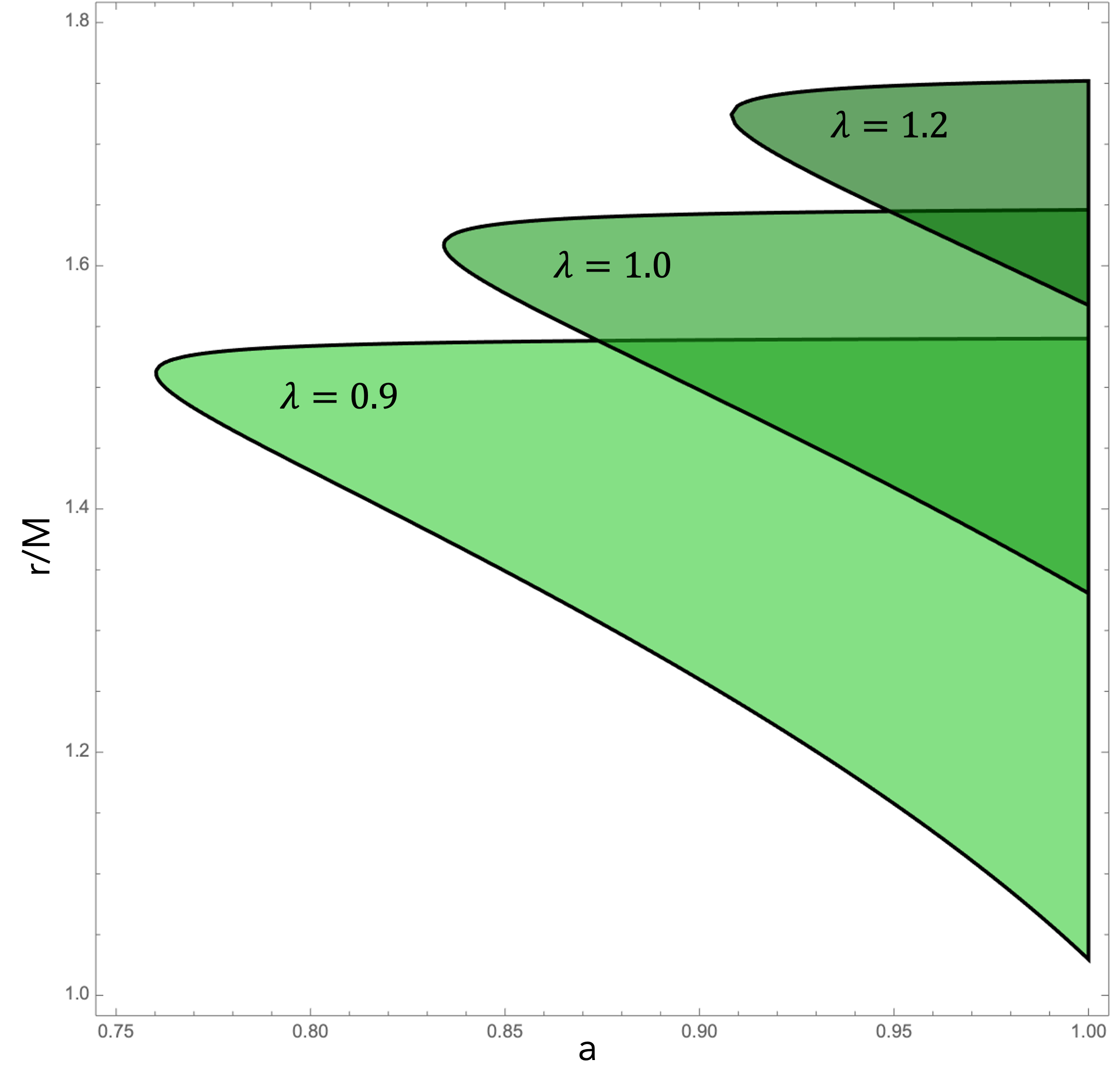
Figure 5: Extracted power and reconnection efficiency across parameter variations, showing influences of spin a, charge Q, and PFDM parameter λ on Pextr and η.
Conclusion
This research extends magnetic reconnection-based energy extraction to Kerr-Newman black holes considering PFDM. The addition of dark matter not only impacts geodesic and ergoregion structures but also provides a new lever to control energy extraction efficiency and rates. These findings open possibilities for applying this model to astrophysical phenomena such as jets from AGNs or GRBs—where the interplay of spin, charge, and dark matter could be vital. Future research could explore other gravity theories, such as conformal Weyl gravity, to further understand the role of dark matter in black hole mechanics and cosmic energy dynamics.