- The paper presents a novel classification of black holes in PFDM using a generalized off-shell free energy framework.
- It demonstrates that PFDM minimally alters Kerr topologies while significantly affecting Kerr-AdS and magnetically charged solutions.
- The findings imply that intrinsic magnetic charges in rotating Hayward and Kerr–Newman black holes lead to distinct topological shifts.
Topological Classes of Thermodynamics of Black Holes in Perfect Fluid Dark Matter Background
Introduction
The paper "Topological classes of thermodynamics of black holes in perfect fluid dark matter background" (2310.15182) addresses the complex interplay between black hole thermodynamics and the surrounding perfect fluid dark matter (PFDM) environment. The analysis focuses on black holes like Kerr and Kerr–AdS, examining how their topological properties change when embedded in a PFDM context. This study uses the generalized off-shell free energy framework to classify black hole solutions into distinct topological classes. The implications of electric, magnetic charges, and PFDM on these classifications are analyzed, reinforcing the relevance of topological defects in black hole thermodynamics.
Kerr Black Hole in PFDM
The Kerr black hole's metric in PFDM is derived using the action for gravity theory minimally coupled to PFDM. The modified metric reveals that PFDM alters the characteristic parameters like the event horizon. The off-shell free energy formula and vector field ϕ are used to compute the horizon temperature τ and determine the winding numbers. Notably, the Kerr black hole in PFDM maintains the same topological number W=0 as the standard Kerr black hole, indicating negligible PFDM influence on its topological properties.
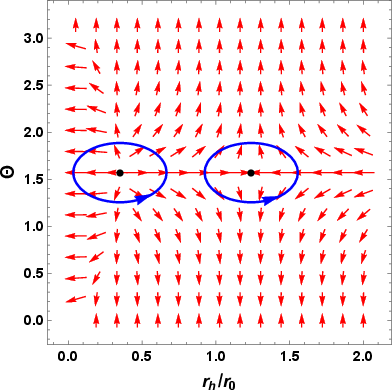
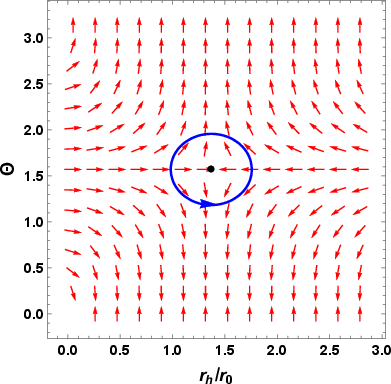
Figure 1: The red arrows represent the unit vector field n for the Kerr black hole in PFDM.
Kerr-AdS Black Hole in PFDM
For Kerr-AdS black holes, the presence of PFDM leads to different topological classes compared to their counterparts without PFDM. The analysis of the vector field ϕ and associated winding numbers show distinct behaviors, with generation and annihilation points indicated by variations in τ. Unlike Kerr black holes, Kerr–AdS in PFDM exhibits altered topological numbers W=1, suggesting further complexity due to cosmological and PFDM interactions.
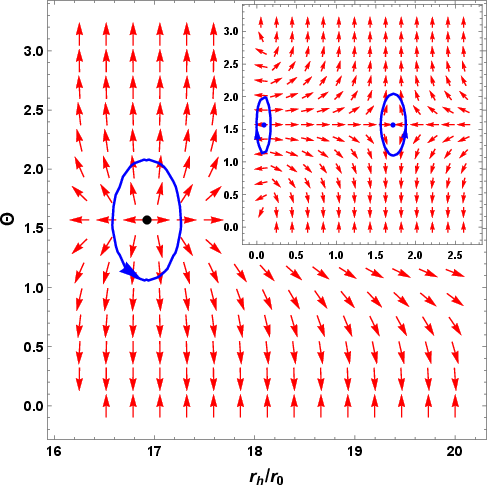
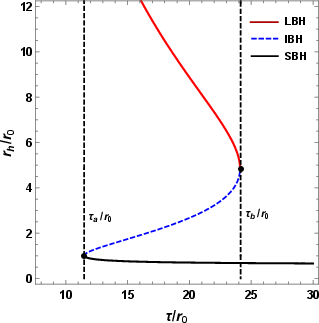
Figure 2: The n vector field ϕ for Kerr-AdS black hole in PFDM, showing three zero points.
Role of Electric and Magnetic Charges
The Kerr–Newman black hole within PFDM also retains its topological numbers like its non-PFDM version, reinforcing the limited effect of PFDM on electric charge interactions. However, a significant departure is observed in the Hayward black hole with magnetic charge. Unlike their PFDM counterparts, these solutions reveal altered topological numbers due to magnetic interactions, highlighting the profound effects of intrinsic magnetic charges on topological classifications.
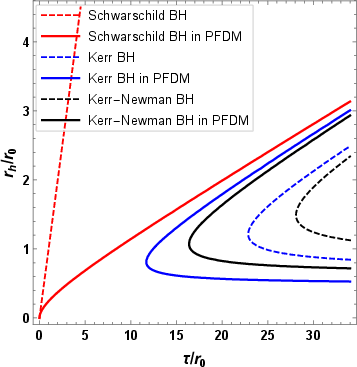
Figure 3: The zero points of vector field ϕ showing effects of rotation and electric charge on spacetime's topological behavior.
Schwarzschild Black Hole and PFDM
In the Schwarzschild black hole context, the PFDM slightly modifies parameters like event horizon size without altering its topological class. The PFDM Schwarzschild black hole maintains W=−1, consistent with its non-PFDM version, indicating that static black hole topologies are largely immune to PFDM-induced topological changes.
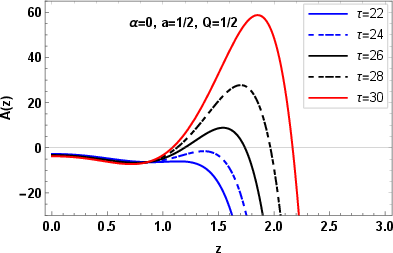
Figure 4: Zero points indicative of topological number W=−1 for Schwarzschild black hole in PFDM.
Rotating Hayward Black Hole and PFDM
The study of the rotating Hayward black hole within PFDM reveals that magnetic charges, unlike electric ones, significantly impact topological properties. For the first time, the presence of PFDM results in distinct changes in the topological number W, especially for the static solution in PFDM, which notably shifts to W=1. This divergence accentuates the magnetic charge's critical influence and rotation within the PFDM context.
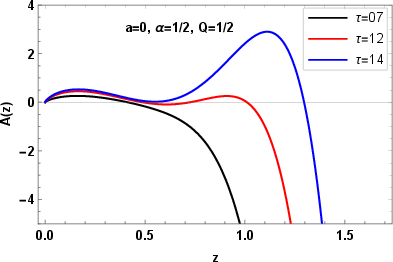
Figure 5: Unit vector field ϕ for rotating Hayward black hole depicting zero points for different parameter settings.
Conclusion
In conclusion, the paper highlights that while PFDM imposes notable shifts in black hole metrics and thermodynamics, its broader impact on black holes' topological properties is nuanced. Notably, the presence of magnetic charges fundamentally alters the thermodynamic topology, challenging previous static assumptions about PFDM's influence. Future research might extend these findings, considering other non-linear interactions or additional dark matter models. The comprehensive table of results encapsulates the comparative analysis of various black hole types, underlining the complexity introduced by PFDM, rotation, and magnetic charges.