- The paper presents a novel PFDM black hole solution with a unique metric function that extends classical black hole lifetimes through dark sector effects.
- It employs the Misner-Sharp energy framework to derive precise thermodynamic parameters, ensuring the condition rₕ > λ for non-negative temperatures.
- The analysis contrasts constant dark sector density with decaying density scenarios, illustrating how each modifies Hawking radiation and the evaporation process.
Thermodynamics and Evaporation of Perfect Fluid Dark Matter Black Holes in Phantom Background
Introduction
This paper explores the thermodynamic properties and evaporation behavior of a perfect fluid dark matter (PFDM) black hole situated in a phantom energy background, a scenario relevant for understanding astrophysical phenomena influenced by dark matter and dark energy. The investigation focuses on the influence of the ratio between initial dark sector density and the black hole horizon radius on the evaporation process, highlighting significant extensions to black hole lifetimes.
PFDM Black Hole Model
The model positions a spherically symmetric black hole within a phantom dark energy background, incorporating a non-homogeneous phantom field minimally coupled to gravity, alongside a dark matter field. The relevant action for this configuration includes the Einstein-Hilbert term, a kinetic and potential term for the phantom field, and a matter Lagrangian representing dark matter.
Key results indicate the emergence of a novel black hole solution characterized by the metric function:
ds2=−(1−r2M−rλlogλr)dt2+(1−r2M−rλlogλr)−1dr2+r2(dθ2+sin2θdϕ2),
where M is linked to the total mass, and λ represents the `dark sector' density, incorporating contributions from both dark matter and phantom dark energy.
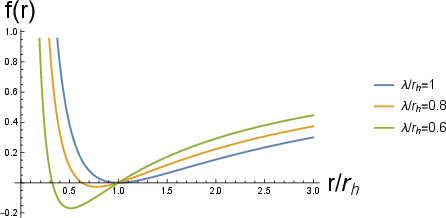
Figure 1: Metric function with different λ/rh=1,0.8,0.6, demonstrating the convergence of inner and outer horizons as λ increases, with λ/rh=1 indicating extremal conditions.
Thermodynamics of PFDM Black Holes
The paper derives the thermodynamic properties of PFDM black holes, using Misner-Sharp energy to formulate the first law of black hole thermodynamics. The temperature and entropy expressions derived suggest that the black hole must satisfy rh>λ to avoid a naked singularity and maintain non-negative temperature:
T=4πrh2rh−λ,S=πrh2.
The formulation distinguishes between the total and Misner-Sharp energy, leading to refined definitions over previous works which utilized the mass parameter M ambiguously.
Evaporation Process Analysis
The evaporation process, influenced by Hawking radiation and potential dark sector decay via a Schwinger-like effect, encompasses two scenarios:
- Constant Dark Sector Density: Black hole temperature remains above zero, and rh decreases until reaching extremal conditions, aligning with the third law of black hole thermodynamics.
- Decay of Dark Sector Density: Accounts for potential dark sector particle pair production analogous to QED, significantly altering the rate of evaporation and extending black hole lifetime, analogous to the behavior seen in charged Reissner-Nordstrom (RN) black holes.
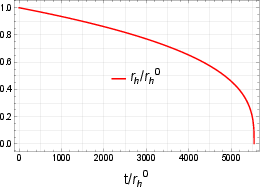
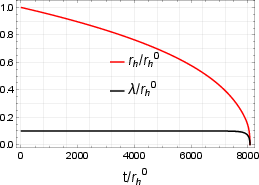
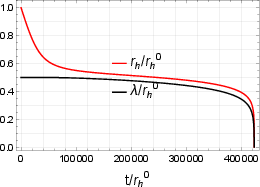
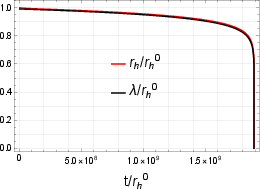
Figure 2: Black hole evaporation processes showcasing the extension of black hole life due to different initial λ0/rh0 ratios compared to a standard Schwarzschild evaporation.
Conclusion
The study comprehensively assesses the thermodynamics and evaporation dynamics of PFDM black holes in phantom backgrounds, offering a novel perspective on how dark matter and energy interact with classical black hole mechanics. The results suggest that the presence of a dark sector can substantially extend black hole lifetimes, potentially influencing observational astronomy and theoretical modeling. Future avenues include detailed exploration of underlying particle physics and potential observational implications, leveraging black hole lifetimes to infer dark sector properties.
Further experimental corroboration could illuminate the nature of dark matter and its interaction mechanisms, further integrating these elements into the gravitational frameworks that define our universe.