- The paper demonstrates that increasing the dark matter parameter α reduces both absorption probability and quasinormal mode frequencies for scalar and Dirac fields.
- It employs the 3rd-order WKB and Pöschl-Teller approximation methods to calculate effective potentials and assess black hole stability.
- Results indicate that higher scalar field mass notably suppresses absorption, offering insights into field interactions in PFDM environments.
Quasinormal Modes and Absorption Cross-Sections of a Bardeen Black Hole in PFDM
Introduction
The study investigates the quasinormal modes (QNMs) and absorption cross-sections of a Bardeen black hole surrounded by perfect fluid dark matter (PFDM) in four dimensions. The parameters considered include a massive scalar field and a massless Dirac field. The analysis employs the semi-analytical 3rd-order WKB method and the Pöschl-Teller approximation to compute QNM frequencies. The absorption characteristics are explored using reflection and transmission coefficients.
Background and Effective Potentials
The Bardeen black hole, immersed in PFDM, is analyzed using the Einstein's field equations for nonlinear electromagnetic fields and PFDM. The analytical setup involves metric potentials to express spacetime line elements, contributing to the effective potentials for both scalar and Dirac fields.
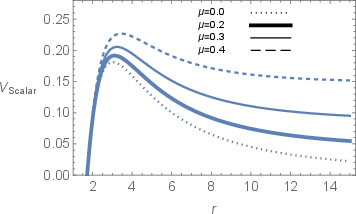
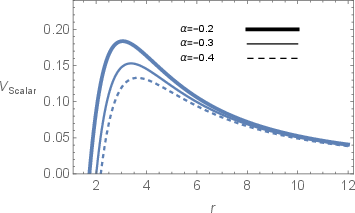
Figure 1: The potential VScalar(r) is shown against r for varying μ, revealing dependency on the mass of the scalar field.
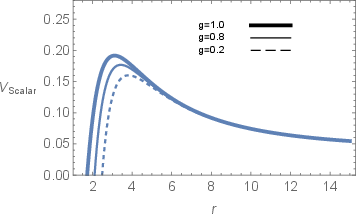
Figure 2: The figure illustrates VScalar(r) against r for different α values, showing the impact of the dark matter parameter.
Quasinormal Modes
QNMs are computed using two fundamental approaches: the WKB approximation and the Pöschl-Teller method. The analysis focuses on how different parameters, such as ℓ, n, α, μ, and λ, influence QNM frequencies.
General Observations
For the massive scalar field perturbation:
- Multipole Number (ℓ): Increased ℓ leads to higher Re ω and Im ω, indicating increased oscillation frequency and damping.
- Mass (μ): Greater mass suppresses the absorption, with a noticeable impact on potential height.
- Dark Matter Parameter (α): Increasing α reduces absorption probability, aligning with higher potential heights.
For the massless Dirac field perturbation:
- Multipole Number (λ): Increased λ reduces Re ω while increasing Im ω.
- Dark Matter Parameter (α): Similar effects are observed as in scalar field perturbations, confirming reduced absorption capacity with increasing α.
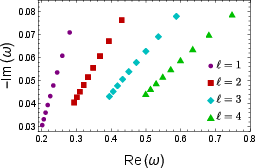
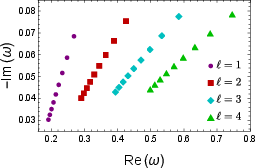
Figure 3: QNMs for scalar perturbations using fitting and WKB methods highlight α dependency.
Absorption Cross-Section and Greybody Factors
Absorption properties are explored by computing reflection (R(ω)) and transmission coefficients (∣T(ω)∣2) using the WKB approach.
Scalar Field Case
- Increasing μ lowers the GBF and partial absorption cross-section, corroborating with the observation that more massive fields are less absorbed.
- An increase in the dark matter parameter α diminishes GBF, substantiating its suppressive role in wave absorption.
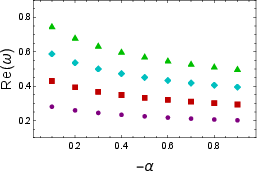
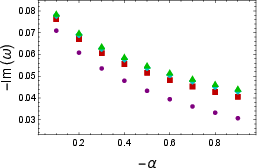
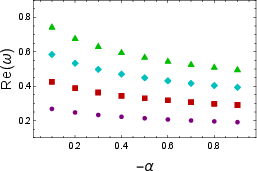
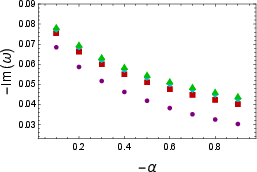
Figure 4: The ∣R∣2 and ∣T∣2 coefficients demonstrate variation with mass (μ) and dark matter parameter influence.
Dirac Field Case
For Dirac perturbations:
- Each increase in α shows a clear decrease in the GBF, with graphical patterns consistent with scalar field observations.
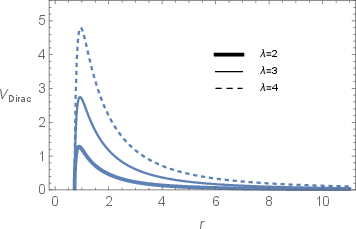
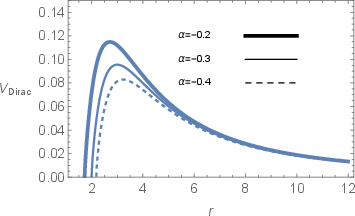
Figure 5: Graphs illustrate GBF variations for Dirac fields with different α values.
Conclusion
The investigation into quasinormal modes and absorption cross-sections of a Bardeen black hole in a PFDM environment reveals critical insights into the interaction of massive scalar and massless Dirac fields with such black holes. Results underline that high mass and dark matter parameters significantly suppress wave absorption, verified through comprehensive numerical calculations and graphical analyses. Future work may explore additional field types and broader parameter settings to expand understanding of interactions within dark matter-surrounded black holes.