- The paper introduces a sixth-order WKB approximation to compute quasinormal modes in black holes influenced by PFDM.
- Results reveal that dark matter modifies QNM frequencies and decay rates, identifying a critical threshold for scalar mass behavior.
- The study correlates PFDM intensity with photon sphere modes, offering new insights for refining gravitational wave astronomy.
Overview of "Massive Scalar Field Perturbations of Black Holes Surrounded by Dark Matter" (2310.00857)
This paper examines the perturbative dynamics of massive scalar fields around black holes enveloped in perfect fluid dark matter (PFDM). It employs the sixth-order Wentzel-Kramers-Brillouin (WKB) approximation to uncover quasinormal modes (QNMs), detailing the anomalous decay rates contingent upon the scalar field mass relative to a critical threshold. This exploration is crucial for understanding dark matter's influence on black hole metrics, pertinent to gravitational wave astronomy.
Theory Setup
The investigation revisits Einstein's field equations, addressing scenarios where black holes are encircled by perfect fluid dark matter. The metric solution applied is spherically symmetric, informed by prior studies that modeled dark matter with negative pressure as a scalar field [Kiselev:2002dx]. The scalar field is characterized by a Lagrangian promoting additivity and linearity, effectively modeling dark matter's gravitational influence within an isotropically pressured framework.
Noteworthy is the incorporation of a phantom field hypothesis, which posits dark matter as devoid of electromagnetic interactions while exerting tangible gravitational effects [Li:2012zx]. The parameter k quantifies PFDM intensity, influencing the characteristic black hole spacetime described by the modified Schwarzschild metric function.
Scalar Field Perturbations
The paper explores the dynamics induced by massive scalar fields within the PFDM-modified spacetime. It demonstrates that PFDM's presence deviates QNM spectra compared to those of an isolated Schwarzschild black hole. Enhanced QNM frequencies and decay rates reflect the interplay between the scalar perturbations and PFDM.
Calculations leverage the Klein-Gordon equation, expressed in tortoise coordinates, yielding a Schrödinger-like equation that posits an effective potential sensitive to variations in PFDM intensity and scalar field mass. The paper identifies critical scalar masses beyond which perturbative behaviors become anomalous, characterized by a reversal in decay rate hierarchy among QNM modes.
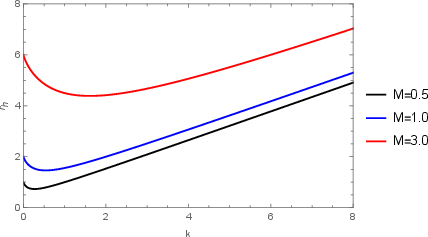
Figure 1: The behaviour of the event horizon radius rh as a function of the PFDM intensity parameter k. Black line for M=0.5, blue line for M=1.0, and red line for $M=3.0.</p></p>
<h2 class='paper-heading' id='photon-sphere-modes'>Photon Sphere Modes</h2>
<p>Employing a WKB approximation facilitates analytical insights into QNM phenomena, helping to discern <a href="https://www.emergentmind.com/topics/photon-sphere-modes" title="" rel="nofollow" data-turbo="false" class="assistant-link" x-data x-tooltip.raw="">photon sphere modes</a>' peculiarities. This method highlights the effects of PFDM as the real and imaginary parts of QNMs become distinct at certain PFDM intensities. Specifically, the spectral extrema are observed at $k_0 \approx 0.81,apivotalpointreflectingmaximaloscillatoryfrequenciesandsubsequently,aninsightintoshadowradiusphenomena.</p><p>Criticalscalarmassbehavioralignswiththetheoreticalforecast,peakingatadistinctPFDMintensityandreflectingcorrelatedchangesinquasinormalmodedecay.Thepeculiaritiesofthelongest−livedmodes,consideringscalarmassandPFDMintensity,furtherenrichthetheoreticalunderpinningsexplored.<imgsrc="https://emergentmind−storage−cdn−c7atfsgud9cecchk.z01.azurefd.net/paper−images/2310−00857/ReQNFsN0k.png"alt="Figure2"title=""class="markdown−image"loading="lazy"></p><p><imgsrc="https://emergentmind−storage−cdn−c7atfsgud9cecchk.z01.azurefd.net/paper−images/2310−00857/ImQNFsN0k.png"alt="Figure2"title=""class="markdown−image"loading="lazy"><pclass="figure−caption">Figure2:ThebehaviourofRe(\omega)(leftpanel),andIm(\omega)(rightpanel)forthefundamentalmode(n=0)asafunctionofthePFDMintensityparameterkwithM=1,and\ell=20. Black line for massless scalar field (m=0), and blue line for massive scalar field ($m=1.0).
Implications and Prospects
The paper invites further exploration into PFDM's gravitational imprints, postulating potential extrapolations to environments with additional astrophysical complexity like charged black holes—an area ripe for future inquiry. It bridges modern observational discrepancies in gravitational wave studies with classical concepts, enabling a refined understanding of environmental effects on black hole metrics.
Prospective developments might involve simulations that incorporate dark matter influences with heightened fidelity, improving both theoretical forecasts and observational strategies. The recognition and correlation of QNM characteristics with astrophysical milieu expand our grasp on cosmic phenomena, particularly concerning gravitational wave emissions and black hole astrophysics.
Conclusion
The research presented advances the comprehension of black holes in an enriched astrophysical context, outlining substantial interactions between massive scalar fields and surrounding dark matter fields. Its insights contribute to refining gravitational wave astronomy methodologies and engage with broader theoretical inquiries into cosmic structure and behaviors.