- The paper presents superradiance analysis using asymptotic matching, showing enhanced energy extraction with increased spin and dilaton parameters.
- It applies the asymptotic iteration method to compute QNMs, detailing shifts in frequency and damping due to EMDA and PFDM effects.
- The research reveals that while PFDM suppresses superradiance, dilaton effects boost energy extraction, confirming theoretical predictions.
Superradiance and Quasinormal Modes of Massive Scalar Fields around Kerr Black Holes in Einstein-Maxwell-Dilaton-Axion Theory with Perfect Fluid Dark Matter
Introduction
The paper examines the dynamics of massive scalar fields in the vicinity of Kerr black holes under the framework of Einstein-Maxwell-Dilaton-Axion (EMDA) theory with the incorporation of Perfect Fluid Dark Matter (PFDM). Key parameters, including the dilaton parameter r2 and pfDM parameter λ, critically influence the black hole's ergosphere and the effective potential experienced by the scalar field. This exploration employs the asymptotic matching method to derive superradiance amplification factors and uses the asymptotic iteration method (AIM) for determining quasinormal modes (QNMs).
EMDA Theory with PFDM
The EMDA theory integrates gravity, electromagnetism, dilaton φ, and axion χ, with the distinctive feature of coupling between these elements as detailed in the Lagrangian density:
$\mathcal{L}_{\mathrm{EMDA} = -2\, g^{\mu\nu} \partial_\mu \varphi\, \partial_\nu \varphi - \frac{1}{2} e^{4\varphi} g^{\mu\nu} \partial_\mu \chi\, \partial_\nu \chi - e^{-2\varphi} F_{\mu\nu} F^{\mu\nu} - \chi\, F_{\mu\nu} \tilde{F}^{\mu\nu}.$
For axisymmetric spacetime, the Newman-Janis algorithm is utilized to derive configurations extending the spherical EMDA solutions into rotating black holes, contributing to the Kerr-Sen metric. The presence of PFDM further alters the stress-energy tensor, represented primarily by λ contributing to gravitational backreaction.
Dynamics of Scalar Fields
Massive scalar fields propagate via the Klein-Gordon equation. Incorporating separability, the equation yields form separations for angular and radial components, revealing dynamics sensitive to variations in r2 and λ.
Superradiance Analysis
The paper ingeniously applies the asymptotic matching method, focusing on the near-horizon and far-region scenarios to ascertain the superradiance amplification factor, Zlm. Results show an increase in Zlm with enhanced spin a and dilaton parameter r2, but a notable suppression with increased PFDM parameter λ.
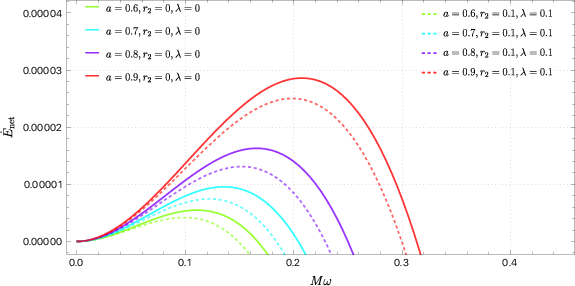
Figure 1: Net extracted energy varying a for fixed r2, λ, showing increased extraction with higher a.
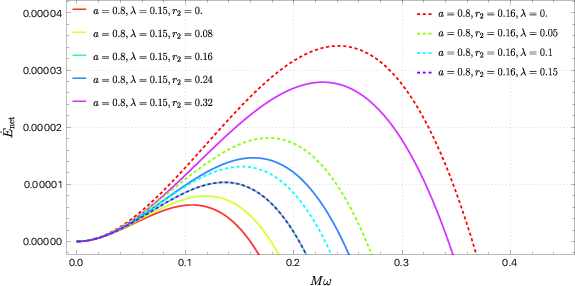
Figure 2: Net extracted energy varying r2 and λ for fixed a, demonstrating enhancement with r2 and suppression with λ.
Energy extraction is further quantitatively analyzed, demonstrating proportional dependency on the spacetime configuration parameters, aligning with the suppression and enhancement trends observed in Zlm.
Superradiant Instability and Quasi-Bound States
The addition of a PFDM term modifies potential wells, thereby impacting superradiant instabilities primarily through the alteration of the effective potential. Analytical developments extend current spectra calculations to incorporate effective mass shifts Meff due to the dilaton, confirming previously known spectra within boundary conditions for trapping modes.
Quasinormal Modes (QNMs) Implementation
Emphasizing computational methods, the AIM intricately maps the radial equation onto a form suitable for iterative resolution, facilitating spectral analysis. This research confirms the significant role of EMDA theory and PFDM in modifying QNM frequencies with distinct signature effects from r2 and λ.
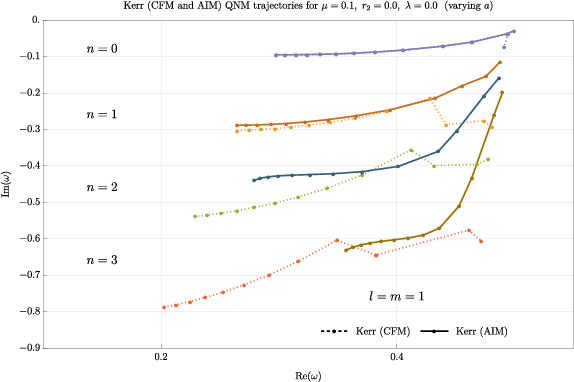
Figure 3: Comparison of QNM trajectories for l=1,m=1 between AIM (solid lines) and Konoplya {additional_guidance} Zhidenko (2006) (dashed lines) for Kerr black hole with μ=0.1 (varying a).
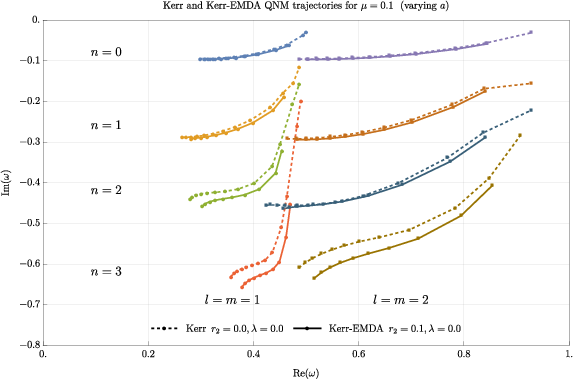
Figure 4: QNM trajectories for Kerr (r2=0) and Kerr-EMDA (r2=0.1) with μ=0.1 and varying a. Higher spins shift modes to higher frequencies and increase damping.
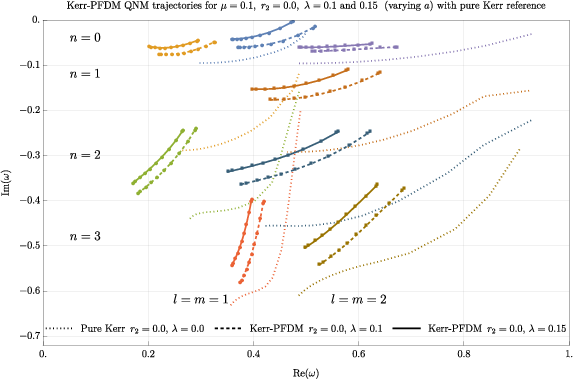
Figure 5: QNM trajectories for Kerr-PFDM (r2=0.0, λ=0.1,0.15) with μ=0.1, compared with pure Kerr. Increasing λ lowers the frequency and reduces damping.
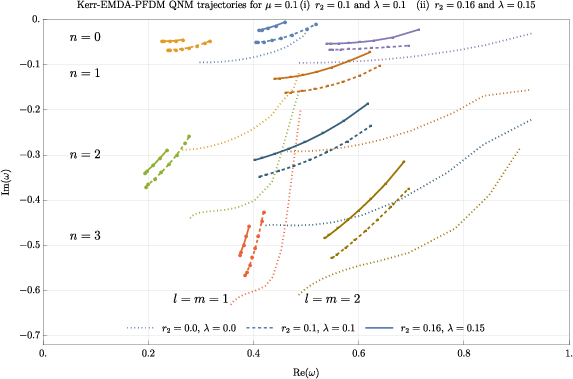
Figure 6: Combined effects of r2 and λ on QNM trajectories for μ=0.1. PFDM’s up-left shift partially offsets the dilaton’s down-right trend.
Conclusion
The study provides critical insights into the contrasting effects of EMDA theory and PFDM on the dynamical instability and energy extraction processes of black holes. The entries into computational modeling, such as AIM and the underlying theoretical analysis, offer substantial contributions to current understanding, enabling refined predictions and potential observational matches to explore dark matter effects in astrological phenomena. Further explorations into full gravitational perturbations and time-dependent simulations are recommended to bridge observational gaps.