- The paper presents a detailed analysis showing that anisotropic fluid environments significantly alter black hole shadow curves and QNM frequencies.
- It employs the eikonal approximation and dual observer metrics to compute precise deviations in shadow shapes due to dark matter, dust, and radiation.
- The study demonstrates that variations in QNM frequencies and damping times provide potential observational tests for general relativity through gravitational wave detection.
Shadow Curves and Quasinormal Modes for Rotating Black Holes Surrounded by Dark Matter, Radiation, and Dust
This essay explores the intricate interactions between rotating black holes and surrounding matter, including dark matter, radiation, and dust, as analyzed in the provided paper. The primary focus is on shadow curves and quasinormal modes (QNMs), with an emphasis on how different matter compositions affect these phenomena.
Introduction to Rotating Black Holes and Surrounding Matter
Rotating black holes, particularly those described by the Kerr metric, are distinguished by their mass and spin parameters. The presence of surrounding matter—such as dark matter, radiation, or dust—introduces deviations from this classical picture, particularly when the matter is modeled using the Kiselev spacetime. This paper investigates these deviations by examining the shadow curves and QNMs, employing the eikonal approximation to simplify the computational analysis.
Shadow Curves Analysis
The shadow of a black hole represents the region from which no light escapes to a distant observer, thus appearing as a dark spot against the background. The methodology used in the paper calculates shadow curves using both naive observer metrics and Bardeen's distant observer metrics.
Naive Observer Shadow Curves
The calculation starts with determining the constants of motion for light rays traced back from an observer's position. The geodesic equations in the context of rotating Kiselev black holes allow the definition of azimuthal and colatitude angles, (ψ,ζ), that parameterize the shadow curve. These calculations demonstrate significant deviations in shadow size and shape when compared to classical Kerr black holes, depending on whether the surrounding matter is modeled as dark matter, dust, or radiation.
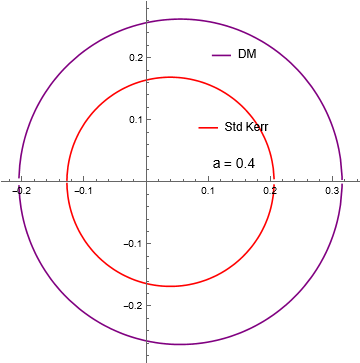
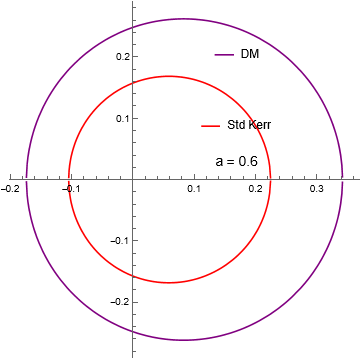
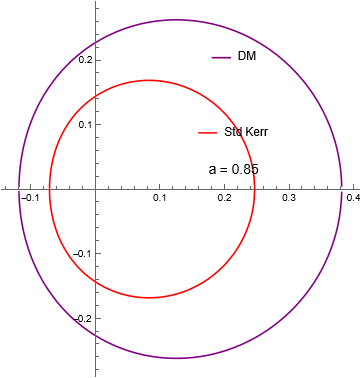
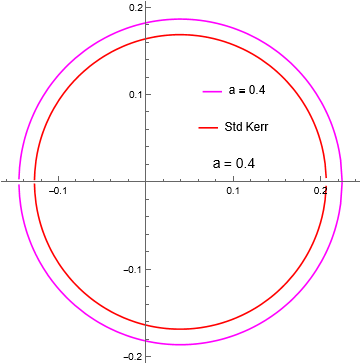
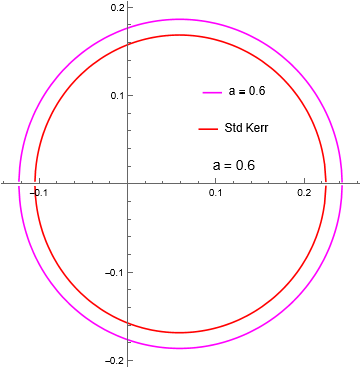
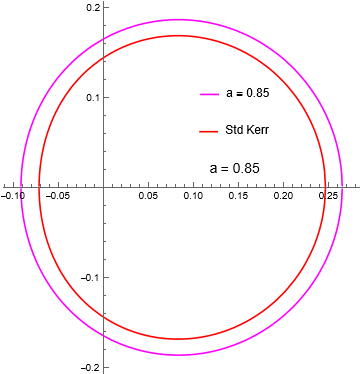
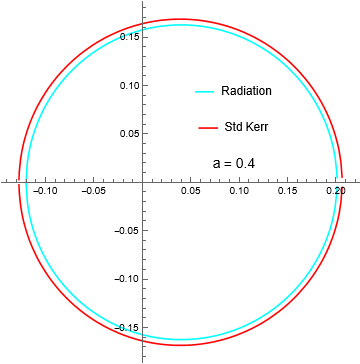
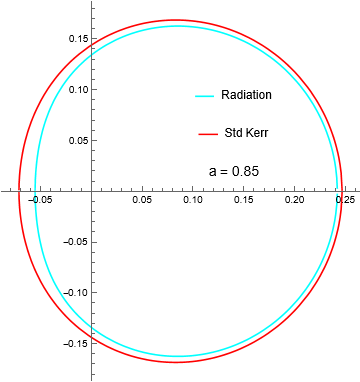
Figure 1: Shadows for different values of alpha including dark matter, dust, and radiation.
Bardeen's Distant Observer Method
Bardeen's method uses impact parameters defined at infinity to provide an alternative representation of shadow curves. This method is useful for astronomical observations. For each type of fluid matter, the shadow shape—and the deviations from Kerr shadows—are illustrated with varying fluid parameters and spin values.
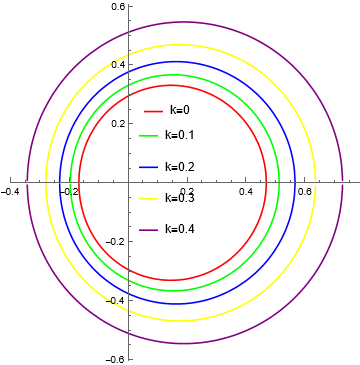
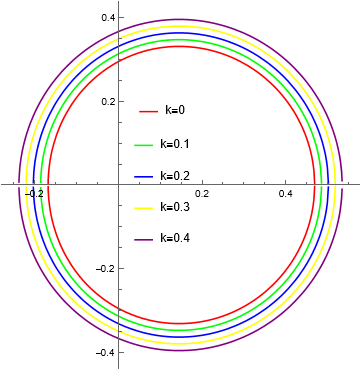
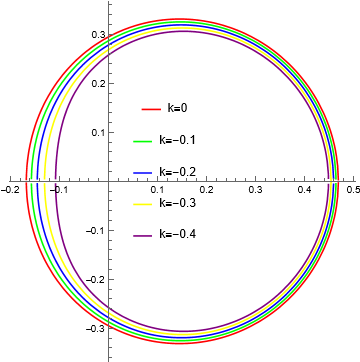
Figure 2: Shadow curves using Bardeen's method highlighting different fluid compositions.
Quasinormal Modes and Their Analysis
Quasinormal modes represent the "ringdown" phase following perturbations of a black hole, characterized by specific frequencies and damping rates. The paper uses the eikonal approximation to derive these QNMs for rotating Kiselev black holes surrounded by anisotropic fluid matter. The approximation is particularly useful for large angular momentum limits, simplifying complex wave equations.
QNM Behavior
The real part of the QNM frequency, which dictates oscillation, showed significant sensitivity to the surrounding matter's composition. Dark matter greatly affects the damping time and the frequency's real part, enhancing prospects for gravitational wave detection. Figures illustrating QNM frequencies as functions of spin parameter and fluid density provide insights into potential observational differences.
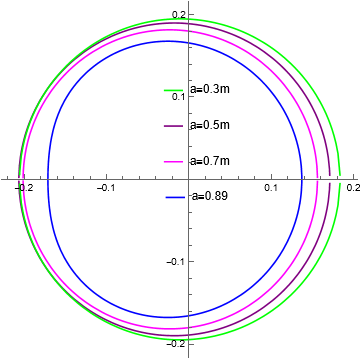
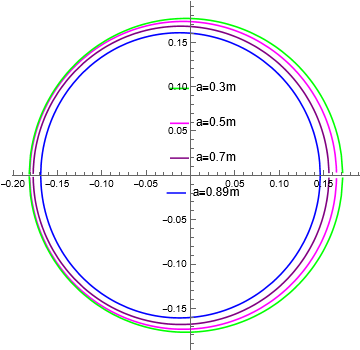
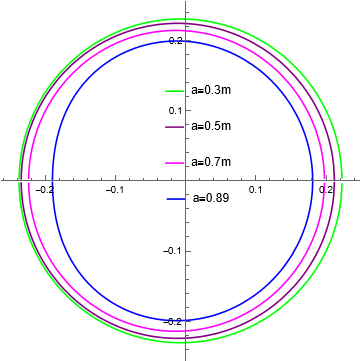
Figure 3: Real and imaginary parts of QNM frequencies compared across different types of surrounding matter.
Observational Implications and Future Directions
The deviations introduced by surrounding matter have significant implications for observational astronomy and gravitational wave physics. The distinct imprints of dark matter on shadow curves and QNMs suggest that these phenomena could be used to probe the nature of the matter surrounding black holes in a cosmological context.
The paper speculates that the sensitivity of QNMs to fluid composition might offer future gravitational wave detectors novel tests of general relativity or modified gravity theories. The Kerr metric's uniformity, in contrast to the varied shadow shapes due to different α values, presents a compelling opportunity for discovery.
Conclusion
The paper provides a thorough analysis of the effects of surrounding anisotropic fluid matter on rotating black holes' phenomenology. It offers significant theoretical insights into the observable characteristics of black holes, paving the way for potential applications in distinguishing dark matter from other forms of matter around black holes in the universe. Future experiments are poised to exploit these findings, enhancing our understanding of the universe's most enigmatic entities.