- The paper presents a detailed analysis of quasinormal modes in Schwarzschild black holes influenced by Dehnen-type dark matter halos and string clouds.
- It employs a 6th-order WKB approximation to compute scalar, electromagnetic, and gravitational perturbation frequencies, demonstrating stable black hole configurations.
- The study correlates shadow and photon sphere calculations with astrophysical observations, offering constraints on dark matter density and string cloud parameters.
Quasinormal Modes and Shadow of Schwarzschild Black Holes
The study of quasinormal modes (QNMs) and shadows around black holes (BHs) embedded in dark matter (DM) halos with string clouds offers critical insights into the gravitational properties and spacetime structure under extreme conditions. The paper examines the effects of Dehnen-type DM halos and string clouds on BH metrics, QNMs, and photon shadows. This essay discusses the theoretical framework, computational strategies, and potential astrophysical implications of these phenomena within the context of Schwarzschild black holes.
Black Hole Metric Geometry
The investigated black hole is described by a metric function embedded in a Dehnen-type DM halo exhibiting a cloud string. The Dehnen profile is characterized by parameters α, β, and γ, with the DM density expressed as ρD. The effective mass distribution and metric function are derived considering the influence of DM core density ρs and string cloud parameter a.
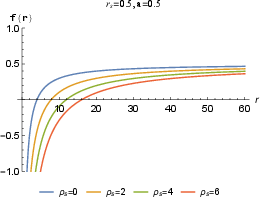
Figure 1: Plotted function f(r) for different values of DM central density ρs, showing its influence on BH horizons.
The geometrical structure of the BH remarkably depends on these parameters, affecting the occurrence of horizons. The presence of DM and string clouds can lead to a unique horizon configuration.
Quasinormal Modes Analysis
QNMs are perturbations characterized by complex frequencies resulting from oscillations and subsequent damping. The paper utilizes the 6th-order WKB approximation to compute QNMs for scalar, electromagnetic, and gravitational perturbations.
Effective Potentials
The potential equations are adapted to each perturbation type, revealing substantial effects from ρs and a. The cloud string parameter, particularly, exhibits significant influence over the perturbation potentials.
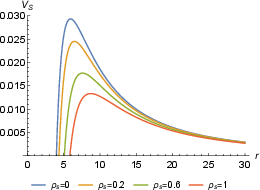
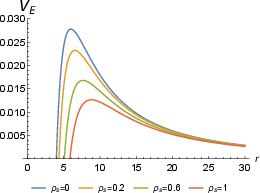
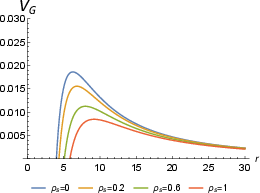
Figure 2: Behaviors of BH potential with respect to radial distance r for different values of central density of the DM halo ρs.
Frequency Calculations
Quasinormal frequencies display stability through negative imaginary components across all perturbations, indicating stable BH configurations. The frequency amplitudes and damping rates exhibit distinct patterns with respect to the halo density and string cloud parameter changes.
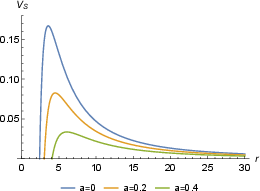
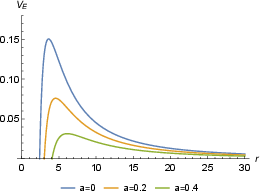
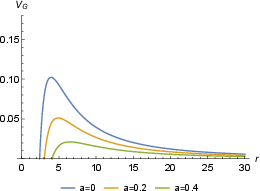
Figure 3: Complex frequency plane for the Scalar, EM and Dirac perturbations showing the behavior of the quasinormal frequencies.
The effect of cloud string is dominant, with amplitude and damping reduced considerably as the parameter a increases.
Shadow and Photon Sphere
Calculating the shadow and photon sphere of the BH involves relating geodesic equations to the DM and string cloud influences. Both parameters enlarge the shadow's radius and photon sphere, providing observationally significant changes in BH appearance.
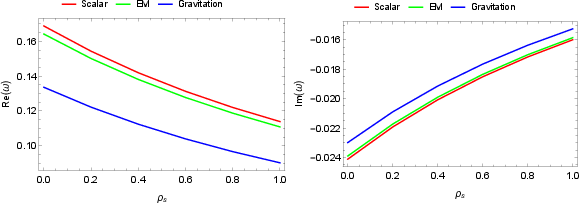
Figure 4: Dependence of rps and Rs with respect to cloud string a for different values of ρs.
The presence of string clouds causes more pronounced effects on shadow size, and the equations governing shadow are reliant on core density and string cloud parameters.
Astrophysical Implications
By correlating shadow and QNM data with EHT observations from M87⋆ and Sgr A⋆, constraints on BH and DM parameters can be established. The shadow diameter upper limits reflect significant findings concerning mass and cloud distributions.
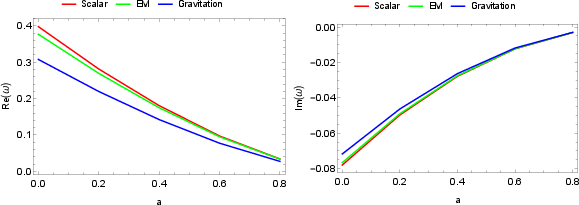
Figure 5: Constraint values of the DM density ρs and string cloud a for M87⋆ and Sgr A⋆.
Astrophysical observations of these BH shadows provide insights into DM distributions and potential extensions of general relativity.
Conclusion
The embedding of Schwarzschild BHs within Dehnen-type DM profiles and string clouds significantly impacts key gravitational phenomena like QNMs and photon sphere characteristics. These structures influence observable properties and provide potential constraints on DM distributions near BHs. Advancing observational techniques, paired with theoretical models, amplify our understanding of space-time geometry under the presence of extreme gravitational fields. Further exploration into weak and strong particle deflections around such BH profiles offers future avenues for testing our understanding within modified gravitational frameworks.