Multi-Agent System for Cosmological Parameter Analysis
Abstract: Multi-agent systems (MAS) utilizing multiple LLM agents with Retrieval Augmented Generation and that can execute code locally may become beneficial in cosmological data analysis. Here, we illustrate a first small step towards AI-assisted analyses and a glimpse of the potential of MAS to automate and optimize scientific workflows in Cosmology. The system architecture of our example package, that builds upon the autogen/ag2 framework, can be applied to MAS in any area of quantitative scientific research. The particular task we apply our methods to is the cosmological parameter analysis of the Atacama Cosmology Telescope lensing power spectrum likelihood using Monte Carlo Markov Chains. Our work-in-progress code is open source and available at https://github.com/CMBAgents/cmbagent.
Paper Prompts
Sign up for free to create and run prompts on this paper using GPT-5.
Top Community Prompts
Glossary
- ACT DR6: The sixth public data release from the Atacama Cosmology Telescope. "Derive cosmological parameter constraints from ACT DR6 CMB lensing data"
- A_s: Amplitude of the primordial scalar power spectrum in cosmology. "for example, the cosmological parameters and "
- Atacama Cosmology Telescope (ACT): A millimeter-wave telescope used to observe the Cosmic Microwave Background. "This task involves Atacama Cosmology Telescope (ACT) Data Release 6 (DR6) Cosmic Microwave Background (CMB) lensing data"
- autogen: An open-source framework for building multi-agent systems with LLMs. "We implement our multi-agent system (MAS) with the open source autogen programming framework"
- Bayesian inference: Statistical method that updates the probability of hypotheses as evidence accumulates. "Cosmological parameter constraints obtained by the ACT Collaboration were based on Bayesian inference, using Markov Chain Monte Carlo (MCMC) sampling."
- Boltzmann solver: A code that solves Boltzmann equations for cosmological perturbations to predict CMB observables. "The camb code is a Boltzmann solver written in Fortran that computes cosmological perturbations across cosmic time and can predict summary statistics of the CMB"
- camb: A widely used Boltzmann solver for computing CMB and cosmological observables. "The camb code is a Boltzmann solver written in Fortran"
- class: A C-based Boltzmann solver for cosmology, counterpart to CAMB. "Along with its C language counter-part, class, it is one of the most widely used codes in cosmology."
- classy_sz: A Python/C package extending CLASS with fast, ML-accelerated cosmology computations. "classy_sz is a machine-learning accelerated CMB and Large Scale Structure code written in Python and C"
- cobaya: A framework for Bayesian inference and MCMC sampling in cosmology. "For the MCMC sampling the ACT Collaboration used cobaya"
- CMB lensing: Gravitational lensing of the Cosmic Microwave Background by large-scale structure. "This task involves Atacama Cosmology Telescope (ACT) Data Release 6 (DR6) Cosmic Microwave Background (CMB) lensing data"
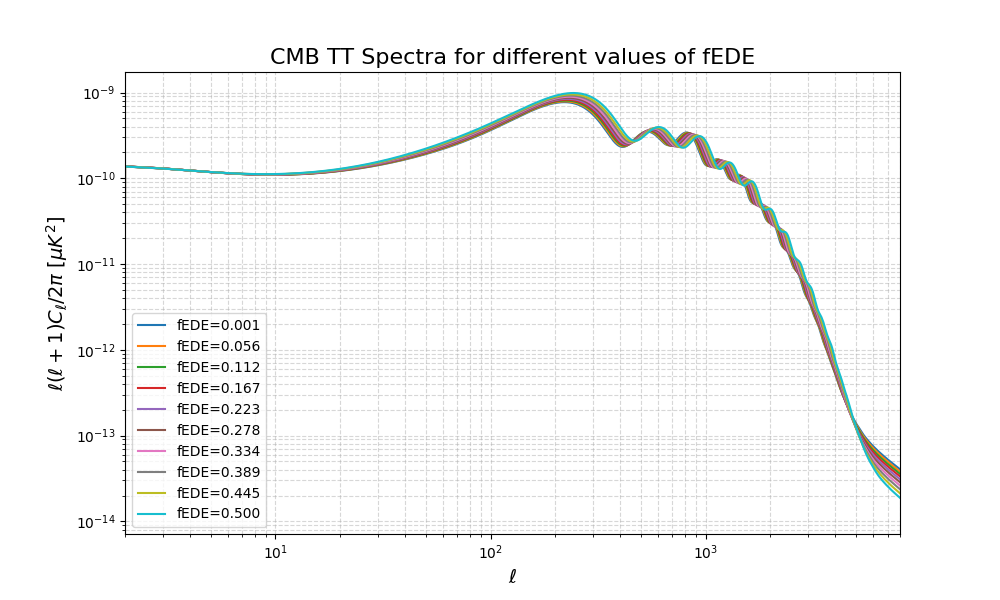
- CMB power spectra: Statistical summaries of temperature/polarization anisotropies in the CMB across angular scales. "CMB power spectra for ten values of the cosmological parameter "
- Cosmic Microwave Background (CMB): Relic radiation from the early universe used for cosmological inference. "This task involves Atacama Cosmology Telescope (ACT) Data Release 6 (DR6) Cosmic Microwave Background (CMB) lensing data"
- cosmocnc: A Python package for fast number-count likelihoods of galaxy cluster catalogs. "cosmocnc is a Python package for computing the number-count likelihood of galaxy cluster catalogs in a fast, flexible and accurate way"
- cosmological parameter constraints: Quantitative bounds on parameters describing the universe’s model. "Derive cosmological parameter constraints from ACT DR6 CMB lensing data."
- cosmological perturbations: Small deviations from uniformity in the universe’s matter/energy fields. "computes cosmological perturbations across cosmic time"
- cosmopower: Neural-network-based emulators for cosmological power spectra to accelerate inference. "The emulators are made with TensorFlow and cosmopower"
- Data Release 6 (DR6): A specific public release of ACT data products and documentation. "Atacama Cosmology Telescope (ACT) Data Release 6 (DR6) Cosmic Microwave Background (CMB) lensing data"
- early dark energy (EDE): A model where dark energy has a non-negligible early-time contribution to the universe’s energy budget. "This parameter is part of a modified early universe model known as early dark energy"
- Fast Fourier Transform convolutions: Efficient convolution technique leveraging FFTs to compute integrals in likelihoods. "It is based on the use of Fast Fourier Transform convolutions in order to efficiently evaluate some of the integrals in the likelihood"
- f_EDE: Parameter controlling the peak fractional contribution of early dark energy. "CMB power spectra for ten values of the cosmological parameter "
- GetDist: A package for kernel density estimation and posterior visualization from MCMC samples. "and for the kernel density estimation (going from samples to posterior probability distribution), it used GetDist"
- Gellman-Rubin convergence diagnostic: A statistic to assess MCMC convergence across chains, often reported as R-1. "Gellman-Rubin convergence diagnostic of ."
- halo mass function: Distribution of dark matter halo counts as a function of mass, used in cluster likelihoods. "its core theoretical input, the halo mass function, is computed in a fast way with the cosmopower neural networks."
- kernel density estimation: Nonparametric method to estimate probability density from samples. "for the kernel density estimation (going from samples to posterior probability distribution), it used GetDist"
- lensing convergence power spectrum: The power spectrum of the CMB lensing convergence field summarizing lensing strength over scales. "which is summarized into the lensing convergence power spectrum"
- lensing power spectrum likelihood: Likelihood function constructed from the measured CMB lensing power spectrum. "lensing power spectrum likelihood using Monte Carlo Markov Chains."
- Markov Chain Monte Carlo (MCMC): Sampling technique for approximating posterior distributions in Bayesian inference. "using Markov Chain Monte Carlo (MCMC) sampling."
- mass bias: Systematic offset between true and inferred cluster masses in SZ or lensing analyses. "as a function of the mass bias"
- Monte Carlo Tree Search: Heuristic search algorithm using stochastic sampling to guide tree exploration. "Monte Carlo Tree Search techniques described in \cite{2024arXiv241008115C}."
- neural network emulators: ML models trained to mimic expensive cosmological computations rapidly. "uses deep neural network emulators for the matter power spectrum."
- posterior probability distribution: The distribution of parameters conditioned on observed data under a Bayesian model. "going from samples to posterior probability distribution"
- Retrieval Augmented Generation (RAG): Technique that augments LLM generation with retrieved context from external sources. "The two primary methods used to specialize LLMs to a specific field or context are fine-tuning and Retrieval Augmented Generation (RAG)"
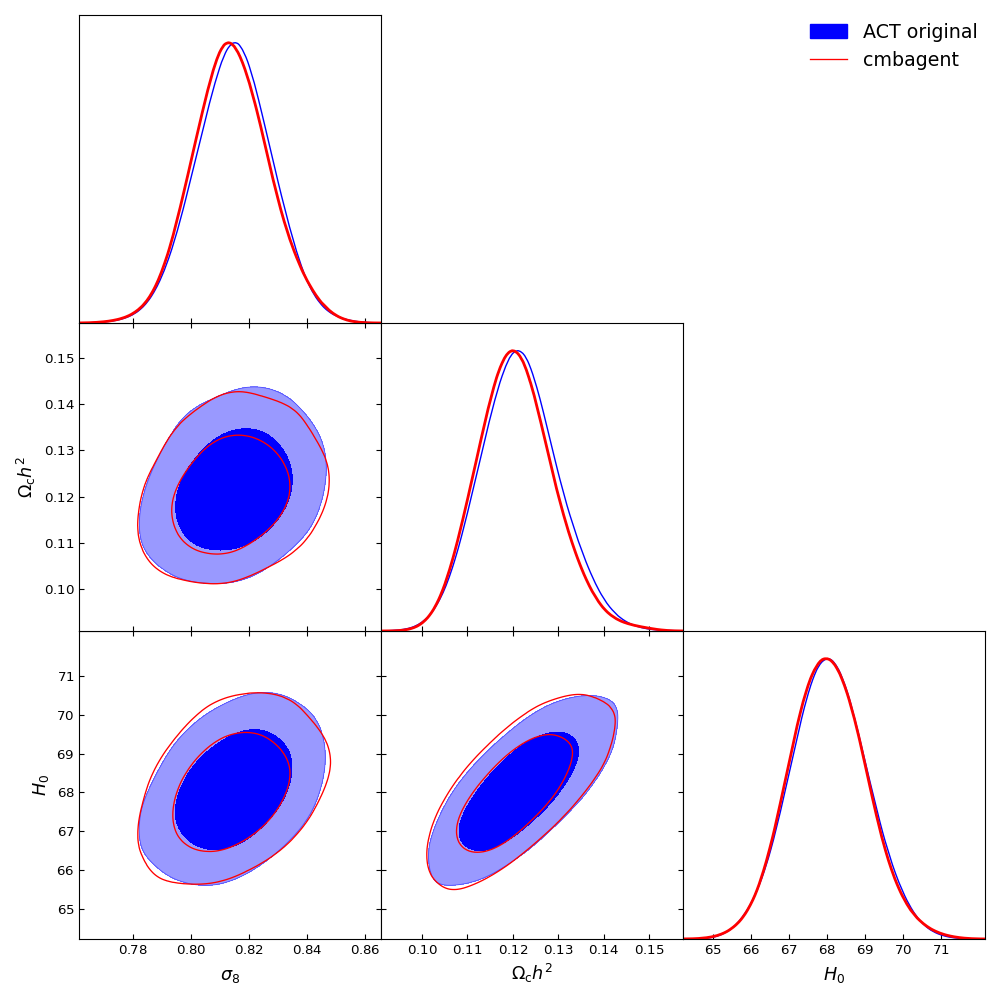
- sigma_8: RMS amplitude of matter fluctuations on 8 h⁻¹ Mpc scales, a key cosmological parameter. "for example, the cosmological parameters and "
Collections
Sign up for free to add this paper to one or more collections.