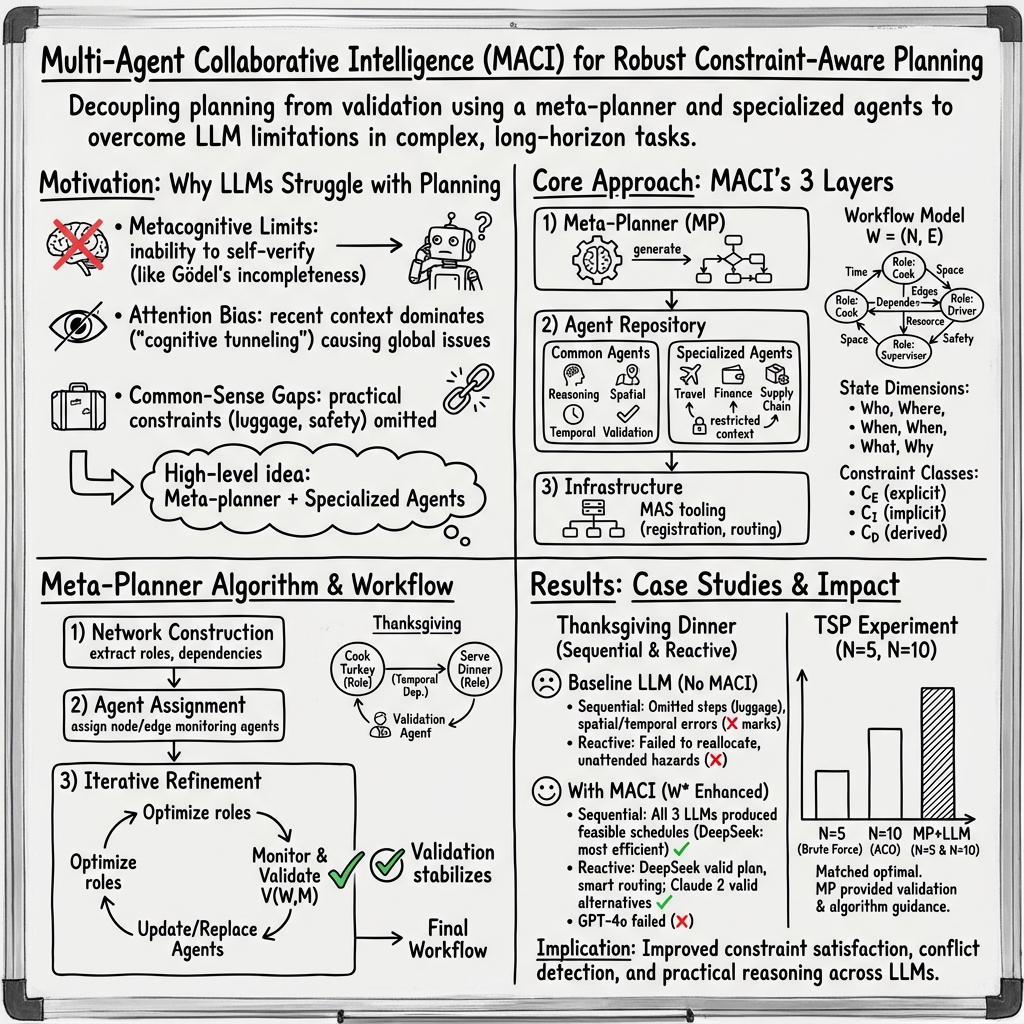
- The paper introduces MACI, a multi-agent framework that overcomes LLM limitations by integrating adaptive reasoning and temporal planning.
- It employs a hierarchical architecture with a meta-planning module, common agents, and specialized agents to manage dynamic constraints and role dependencies.
- The framework demonstrates improved planning reliability and constraint handling in real-world scenarios, as evidenced by its successful case study.
MACI: Multi-Agent Collaborative Intelligence for Adaptive Reasoning and Temporal Planning
Overview
The paper "MACI: Multi-Agent Collaborative Intelligence for Adaptive Reasoning and Temporal Planning" introduces the MACI framework, aimed at addressing critical limitations in current LLMs regarding complex reasoning and temporal planning. LLMs primarily rely on pattern matching and struggle with tasks demanding deliberate reasoning, temporal awareness, and robust constraint management. The MACI framework proposes a multi-agent architecture that coordinates specialized agents through meta-planning and distributed validation. This collaboration enhances constraint awareness, output validation, and adaptability in planning processes.
MACI Architecture
The MACI framework employs a three-tiered architecture:
- Meta-Planning Module: This high-level orchestration layer generates task-specific planner templates, defining roles and dependencies among multiple agents. It ensures comprehensive planning that includes temporal, spatial, and resource management aspects.
- Common Agents: These agents handle general reasoning tasks, practical constraints, and robustness analysis across domains. They form the backbone of planning capabilities by integrating common-sense knowledge and validating solutions.
- Specialized Agents: Focused on domain-specific challenges, these agents bring in expertise for specialized tasks like travel scheduling or risk assessment, supplementing the common agents’ efforts.
Implementation and Application
The MACI framework can be applied to scenarios requiring complex temporal reasoning and adaptable planning. The architecture supports agile responses to dynamic changes through its multi-agent coordination. For instance, in a travel planning scenario, MACI could orchestrate agents to manage flight schedules, vehicle rentals, and personal preferences, dynamically adapting to delays and cancellations while ensuring all constraints are satisfied.
Key Features:
- Dynamic Constraint Handling: By decoupling planning and validation, the framework allows for better error detection and constraint compliance.
- Role and Dependency Modeling: MACI’s meta-planner structures workflows as networks of roles and dependencies, enhancing the clarity and manageability of complex planning tasks.
- Validation Process: Specialized agents verify planning consistency, manage constraint violations, and perform recovery actions to maintain feasibility.
Case Study and Evaluation
The paper evaluates MACI using a case study of a Thanksgiving dinner plan involving multiple coordination tasks. It successfully demonstrates MACI’s ability to enhance planning by integrating common sense constraints and ensuring coherent workflows across agents. When applied to real-world scenarios like scheduling or resource management, MACI shows significant improvements in constraint satisfaction and planning reliability.
Technical Insights and Future Directions
The MACI framework addresses critical gaps in current LLM architectures by embedding domain-specific expertise within a collaborative multi-agent system. Future expansions could include enhancing agent communication protocols, integrating more extensive common sense databases, and improving real-time adaptability. These advancements could extend MACI’s applicability to more complex domains, such as healthcare logistics and intelligent transportation systems.
Conclusion:
MACI presents a promising approach to overcoming LLM limitations through sophisticated multi-agent collaboration. It shifts the focus from pattern matching to deliberate reasoning and temporal planning, marking a step towards more intelligent, adaptable AI systems capable of tackling real-world problems effectively.