- The paper provides a comprehensive analysis of how AI-induced shifts affect cognitive processes using frameworks like Bloom’s and Dewey’s.
- It reveals that reliance on AI encourages passive engagement, reduces critical reasoning, and may lead to skill atrophy in novices.
- The study recommends curriculum redesign and friction techniques to scaffold metacognitive engagement and counter cognitive offloading.
Cognitive Protection amid Generative AI Proliferation: An In-Depth Analysis
The paper "Protecting Human Cognition in the Age of AI" (2502.12447) provides a comprehensive synthesis of the empirical and theoretical landscape regarding the cognitive effects of widespread Generative AI (GenAI) adoption, with a particular focus on novices and educational contexts. The work leverages frameworks such as Krathwohl’s revised Bloom’s Taxonomy and Dewey’s theory of reflective thought to analyze mechanisms driving these cognitive shifts. The paper systematically deconstructs both the benefits and, more critically, the long-term risks to crucial human cognitive functions and distinguishes implications across experience levels and sociotechnical factors.
Cognitive Impacts of GenAI: Multifaceted Challenges
GenAI induces changes across the spectrum of knowledge acquisition, reasoning, learning, creativity, metacognition, and critical thinking. An especially salient observation is the transition from active engagement with information—requiring validation and synthesis from diverse sources—to a paradigm of passive consumption of synthesized, potentially bias-reinforcing outputs. This shift diminishes opportunities for cognitive dissonance and productive confusion, which are essential precursors to reflective, analytic reasoning.
Passive Engagement: The “echo chamber” and “homogenization” effects—where GenAI outputs conform to majority or widely accepted perspectives—restrict exposure to heterogeneous viewpoints, compounding confirmation bias, and resulting in the marginalization of less dominant knowledge systems. Recent studies document observable selective attention toward AI-congruent responses and greater retention when outputs reinforce preexisting beliefs.
Reasoning Deterioration: User over-reliance on AI-generated responses, even when these conflict with contextual cues or users' own prior reasoning, leads to degraded decision-making quality. Survey data indicate user awareness that increasing reliance on AI can facilitate cognitive laziness. Furthermore, knowledge about the AI origin of advice increases trust and reliance, independently of merit.
Learning and Skill Atrophy: Empirical gold-standard studies show that while short-term performance (e.g., essay writing, coding tasks) may improve with GenAI assistance, measurable knowledge gain and transfer are not enhanced. Moreover, the atrophy of metacognitive and problem-solving skills occurs, especially when students rely on AI-generated feedback or code generation: performance deteriorates when AI support is subsequently withdrawn.
Creativity Constraints: The effect on creativity is nuanced and bifurcated. LLM-driven tools show improvement in convergent thinking—structured, goal-oriented creative reasoning—at the expense of divergent thinking, which requires exploration and novel connection-making. The recursive reuse of prevailing knowledge by GenAI models raises the risk of creative stagnation, as evidenced by empirical reductions in output diversity.
Metacognitive and Critical Thinking Erosion: Increased GenAI confidence correlates inversely with critical thinking propensity among knowledge workers, mediated by “cognitive offloading” and subsequent self-regulatory deficits. Novice users demonstrate greater metacognitive laziness and increased dependency compared to experts with robust domain knowledge and more effective prompt engineering capabilities.
Theoretical Frameworks: Bloom’s and Dewey’s Insights
The paper’s deployment of Bloom’s Revised Taxonomy offers a dual-axis framework to dissect the evolving interplay between knowledge types and cognitive processes under GenAI mediation.
- Bloom’s Taxonomy: In the pre-GenAI era, learning advanced sequentially through declarative, procedural, and metacognitive knowledge, engaging complex processes such as analysis and evaluation through cognitive difficulty and repeated exposure. GenAI acts as an accelerant for factual/procedural access but can occlude the layers of cognitive transformation—particularly for novices—by reducing the necessity for active remembering, analyzing, and evaluating.
Expert/Novice Dichotomy: Domain experts leverage GenAI mainly for lower level cognitive offloading and creative ideation, maintaining agency over prompt design and critical assessment. In contrast, novices, lacking structured knowledge and prompt literacy, are susceptible to overoutsourcing and shallow engagement, jeopardizing metacognitive development.
Dewey’s Reflective Thinking: Dewey’s prerequisites—perplexity, prior experience, persistent inquiry, suspension of judgment, and connection-building—are systematically undermined when GenAI is used as a frictionless answer engine. The lack of explicit uncertainty calibration, persuasive language, and response confidence in LLM outputs foster premature closure and superficial understanding.
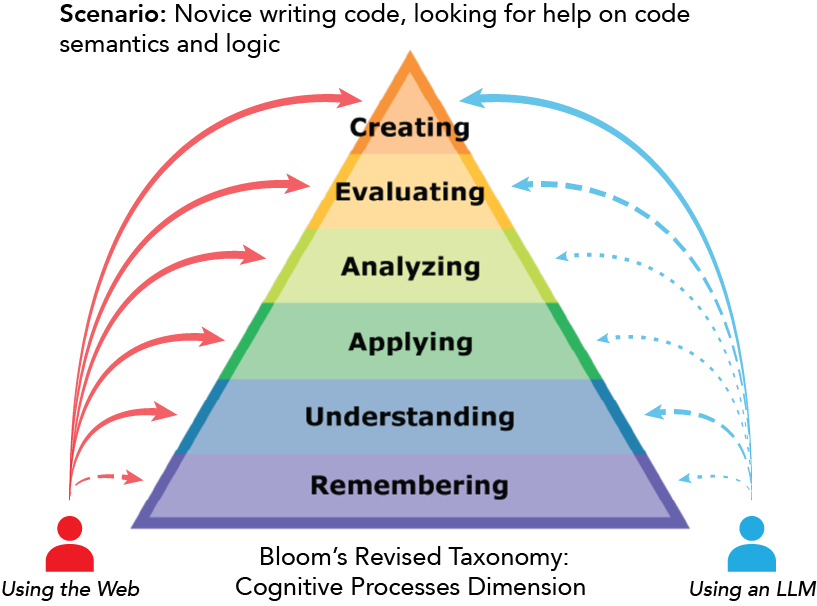
Figure 1: Comparative engagement of cognitive processes when a novice uses traditional web search versus an LLM for support, showing reduced activation of core processes under LLM mediation.
Sociotechnical and Environmental Interactions
The cognitive sequelae of GenAI are not observed in a vacuum. The interplay with chronic societal stressors and digital information overload exacerbates reliance on AI, encourages shallow information processing, and increases susceptibility to emotional manipulation. The persuasive, empathic simulation capacities of GenAI agents further promote misplaced trust and, in extreme cases, can cause detrimental dependencies.
Tactical Interventions and Design Implications
The paper emphasizes several practical strategies for stakeholders:
- Curricular and Assessment Re-design: Curriculum and standardized tests must pivot from formulaic problem solving—where GenAI excels—towards activities requiring critique, evaluation, and reflection on AI-generated content.
- Friction and Scaffolding: Educational AI should implement graduated exposure: limiting AI support at early mastery stages and using “desirable friction” techniques, such as mandatory reflection or engagement checkpoints, to drive deeper cognitive engagement.
- Schema Activation and Knowledge Graphs: Interactive tools should employ navigable cognitive schemas (e.g., knowledge graphs) to scaffold connections among concepts and trigger retrieval of prior knowledge.
- Metacognitive Prompting and Provocations: Both human and algorithmically delivered metacognitive prompts, as well as AI-generated “provocations,” can incentivize users to scrutinize outputs, consider alternatives, and develop a tolerance for ambiguity and uncertainty.
- Evaluation Metrics: New evaluation frameworks must move beyond short-term performance, targeting constructs such as engagement depth, critical thinking, and metacognitive activity.
Implications and Future Directions
Current research on GenAI’s cognitive impacts is predominantly short-term; rigorous longitudinal studies are essential to elucidate the sustained effects—especially for adolescent and young adult learners during cognitive development's sensitive windows. Additionally, the “metacognitive laziness” induced by frictionless GenAI interfaces necessitates reconsidering how AI systems are designed, deployed, and regulated in both educational and professional domains.
Beyond education, these findings mandate a shift in interface and trust calibration design, requiring explicit uncertainty representation, source diversity exposure, and a focus on user agency over cognitive processes. From a theoretical perspective, the integration of cognitive psychology, HCI, and AI ethics will be necessary for a holistic understanding and mitigation of cognitive risks.
Conclusion
The paper provides an integrated framework for understanding and protecting human cognition as GenAI systems proliferate, particularly emphasizing the risks of skill atrophy, metacognitive erosion, and homogenization of thought. These challenges necessitate collaborative interventions from educators, technologists, policymakers, and cognitive scientists to ensure that AI acts as a true “tool for thought,” amplifying, rather than undermining, human intellectual capacities. The outlined design principles and empirical results provide a foundation for the reengineering of human-AI interaction to mitigate cognitive offloading without sacrificing the legitimate productivity and accessibility gains made possible by generative models.