- The paper introduces an LLM-ARS architecture that integrates multimodal data to deliver proactive and adaptive recommendations.
- It employs user simulation techniques to generate realistic interactions and continuously recalibrates personalizations based on evolving preferences.
- The study emphasizes balancing system autonomy with ethical controllability, highlighting the need for robust evaluation frameworks.
Agentic Recommender Systems in the Era of Multimodal LLMs
Introduction
The integration of LLMs into recommender systems (RS) has enabled the emergence of agentic systems that surpass traditional models by offering increased autonomy and adaptability. This transition involves empowering LLMs with the ability to perceive and interact with external environments and to process multimodal information, significantly enhancing their capacity for context-aware and proactive recommendations. Despite the potential of LLM-based Agentic Recommender Systems (LLM-ARS), several challenges remain. These include incorporating external knowledge, balancing autonomy with controllability, and evaluating performance in dynamic settings. This discourse provides a comprehensive overview of how agentic capabilities can be leveraged to drive the next wave of RS innovation.
Conceptualization and Architecture of LLM-ARS
LLM-ARS represents a paradigm shift in RS, aspiring towards more intelligent, autonomous, and collaborative recommendation experiences that adapt in real time to evolving user preferences and complex decision-making contexts. Unlike traditional RS which often operate reactively, LLM-ARS proactively refine user experiences by considering long-term preferences and context.
Agentic Attributes in LLM-ARS:
- Planning and Memory: These capabilities enable the system to partition complex tasks, maintain context, and adapt strategies dynamically over time.
- Multimodal Integration: LLM-ARS systems' ability to interpret data across different modalities (e.g., text, image, and behavior) enhances recommendation relevance and user engagement.
- Interaction and Feedback: Beyond providing static recommendations, LLM-ARS systems engage in multi-turn dialogues to clarify user intents and refine personalization continually.
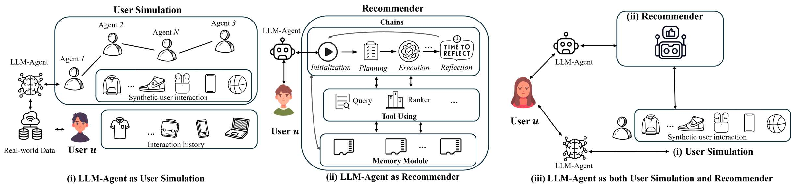
Figure 1: Different types of personalized LLM-based agents in LLM-ARS, where (i) LLM-Agent simulates user behavior, (ii) LLM-Agent acts as a recommender, and (iii) LLM-Agent functions as both user simulation and recommender.
Integration of LLM Agents for User Simulation and Personalized Recommendation
User Simulation:
User simulation via LLM agents provides invaluable training data by mimicking realistic user behaviors, generating synthetic interactions that reflect user diversity and complexity. By acting as autonomous agents, these models capture and predict a wide array of behaviors, enhancing model robustness to data scarcity and cold-start challenges.
Personalized Recommendations:
LLM agents leverage their advanced reasoning capabilities to tailor suggestions effectively. They process vast amounts of data to generate recommendations contextually aligned with evolving user profiles. This is achieved through dynamic recalibration of user intent models, aimed at capturing shifts in user preferences with high fidelity.
Challenges and Research Directions
Balancing Autonomy and Controllability:
The integration of autonomous LLMs into RS necessitates ensuring that these systems act safely and ethically, adhering to user preferences while proactively offering value. Methods to prevent and rectify potential misalignments, such as interactive feedback loops and controlled governance measures, are essential.
Multimodal Reasoning and Lifelong Adaptation:
Developing robust mechanisms for multimodal reasoning within LLM-ARS is pivotal. This encompasses aligning LLM inference capabilities with multimodal input processing to deliver layered, contextual interpretations and recommendations. Furthermore, advancing lifelong learning abilities to ensure systems remain relevant and accurate as user profiles change over time is crucial.
Conclusion
The exploration of LLM-ARS reveals substantial opportunities to revolutionize recommenders towards more autonomous, dynamic systems that align closely with intricate user interactions. However, bringing about these enhancements demands addressing core challenges related to adaptability, safety, and user-centricity. As research continues to expand, refining architectures that balance autonomy with transparency and controllability, alongside establishing robust evaluation frameworks, will be key to advancing the capability and reliability of agentic recommender systems.