- The paper introduces the ARAG framework that employs a multi-agent system to integrate real-time user data for personalized recommendations.
- It combines embedding-based retrieval, natural language inference, and context summarization to refine semantic alignment of user intent.
- Experimental results show notable improvements, including a 42.1% boost in NDCG@5, demonstrating its effectiveness over conventional methods.
ARAG: Agentic Retrieval Augmented Generation for Personalized Recommendation
Introduction
The paradigm of Retrieval-Augmented Generation (RAG) has revolutionized the capabilities of recommendation systems by infusing real-time, contextually rich data into traditional recommendation frameworks. The paper, "ARAG: Agentic Retrieval Augmented Generation for Personalized Recommendation" (2506.21931), outlines a novel framework, ARAG, that integrates an Agency-augmented approach into RAG systems. This framework aims to address the dynamic nature of user preferences in digital environments by employing a multi-agent system powered by LLMs.
The ARAG framework is introduced to resolve limitations inherent in traditional RAG systems, which primarily depend on static retrieval mechanisms, often failing to capture nuanced user preferences. Through multi-agent collaboration, ARAG refines the retrieval pipeline by using specialized agents to conduct a multi-level analysis of user preferences and semantically align item content, thus offering personalization in real-time recommendation scenarios.
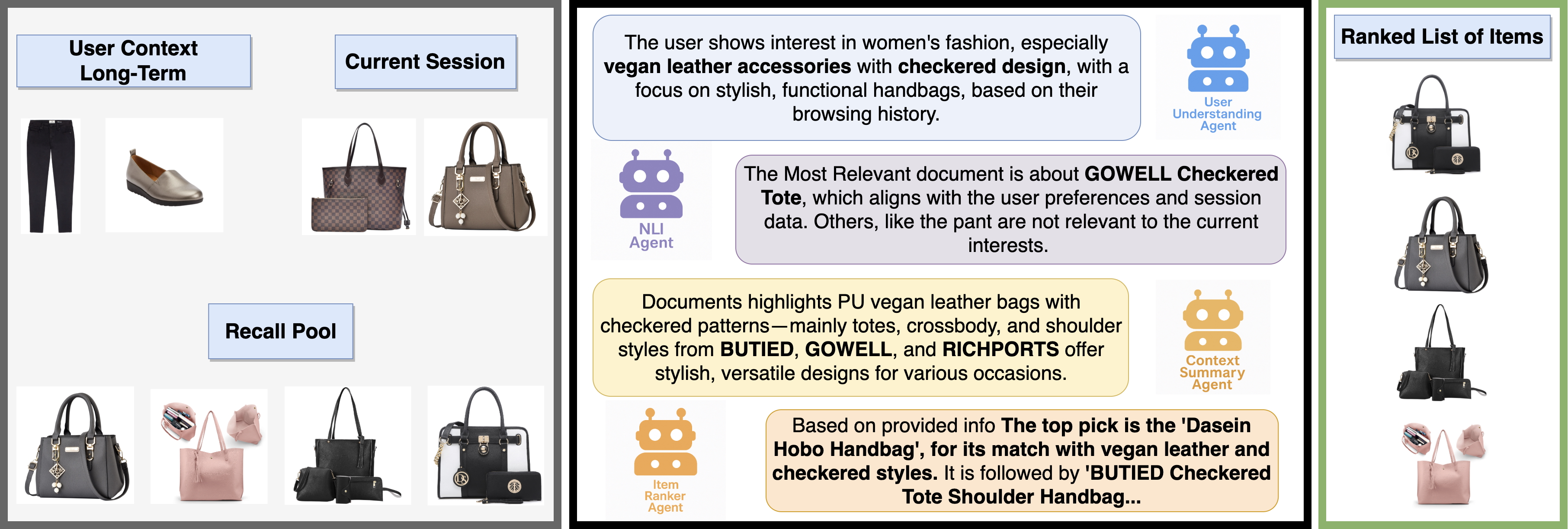
Figure 1: ARAG framework: the User Understanding Agent summarizes long-term and session-level preferences; the NLI Agent scores each candidate for semantic alignment; the Context Summary Agent condenses NLI-filtered evidence into a focused context; and the Item Ranker Agent fuses these signals to produce the final personalized ranking.
Methodology
ARAG's core architecture is articulated as a multi-agent framework designed to enhance item ranking in personalized recommendation systems through several specialized agents.
Initial Retrieval
The initial stage of the ARAG framework leverages an embedding-based RAG approach to extract an initial recall set of candidate items based on a user's long-term and session-based context. The retrieved items are initially selected using cosine similarity, a process that provides a broad focus for the subsequent agents to refine.
Multi-Agent System
The ARAG framework capitalizes on a sophisticated multi-agent system. The four agents—User Understanding Agent, NLI Agent, Context Summary Agent, and Item Ranker Agent—collaboratively process user preferences and item data to produce a finalized, personalized recommendation ranking.
The User Understanding Agent synthesizes a comprehensive summary of user preferences from historical user interactions, delivering linguistic insights into generic long-term interests which are essential for the context summary and ranking tasks. In conjunction, the Natural Language Inference (NLI) Agent determines semantic alignments by evaluating the congruence between retrieved item content and the user's current session-based intent.
An intermediary Context Summary Agent synthesizes the NLI-evaluated candidates into a compressed, contextually aligned summary. This ensures the ranking task leverages only highly relevant items.
Ultimately, the Item Ranker Agent integrates the insights from all prior agents. The ranking output maximizes relevance and personalization by incorporating signals such as user intent, long-term preferences, and contextual alignment, positioning items that best match these criteria at the forefront of recommendations.
The experimental results presented in the paper demonstrate the ARAG framework's superiority over standard RAG and recency-based baselines. Evaluated across three distinct Amazon-related datasets covering Clothing, Electronics, and Home categories, ARAG achieved a marked improvement in key performance metrics, notably a 42.1% increase in NDCG@5 and a 35.5% improvement in Hit@5 compared to its baselines.
The detailed performance analysis confirms the robustness of ARAG's agent-driven approach. Its incorporation of complex user behavior and temporal dynamics has proven to effectively address the common constraints of static retrieval methods, showing clear advantages over conventional systems. Notably, the Clothing category witnessed the most significant improvements, underscoring the framework's applicability across diverse item domains.
Experimental Evaluation
The paper presents comprehensive experimental evaluations on the Amazon Review dataset, which offers a diverse and large-scale platform to validate ARAG's efficiency. The dataset's complex and varied nature makes ARAG's features highly valuable, particularly its ability to address challenges such as cold start conditions and long-tail problematics in recommendation systems.
The ablation study further dissects the contributions of each agent within the ARAG framework. This analysis illustrates the significant role of the NLI Agent and the User Understanding Agent in elevating the system's performance. The findings suggest that each of these agents plays a distinct role in the multi-agent system and collectively contribute to its performance advantages.
Conclusion
In conclusion, the ARAG framework introduces a novel agentic extension to traditional RAG systems, overcoming inherent limitations by deploying specialized LLM-based agents for personalized recommendations. Through the orchestration of its four core agents, ARAG achieves superior contextual understanding, semantic alignment, and user preference modeling. The framework's empirical success has profound implications for the development of advanced, context-aware recommendation systems, paving the way for more nuanced future applications that adapt dynamically to user preferences across various domains. The integration of agentic reasoning represents a promising trajectory for the advancement of retrieval-augmented recommendations, potentially setting new benchmarks for both personalization and interpretability in AI-driven systems.