Papers
Topics
Authors
Recent
Search
2000 character limit reached

A Survey of Foundation Model-Powered Recommender Systems: From Feature-Based, Generative to Agentic Paradigms

Published 23 Apr 2025 in cs.IR and cs.AI | (2504.16420v1)

Abstract: Recommender systems (RS) have become essential in filtering information and personalizing content for users. RS techniques have traditionally relied on modeling interactions between users and items as well as the features of content using models specific to each task. The emergence of foundation models (FMs), large scale models trained on vast amounts of data such as GPT, LLaMA and CLIP, is reshaping the recommendation paradigm. This survey provides a comprehensive overview of the Foundation Models for Recommender Systems (FM4RecSys), covering their integration in three paradigms: (1) Feature-Based augmentation of representations, (2) Generative recommendation approaches, and (3) Agentic interactive systems. We first review the data foundations of RS, from traditional explicit or implicit feedback to multimodal content sources. We then introduce FMs and their capabilities for representation learning, natural language understanding, and multi-modal reasoning in RS contexts. The core of the survey discusses how FMs enhance RS under different paradigms. Afterward, we examine FM applications in various recommendation tasks. Through an analysis of recent research, we highlight key opportunities that have been realized as well as challenges encountered. Finally, we outline open research directions and technical challenges for next-generation FM4RecSys. This survey not only reviews the state-of-the-art methods but also provides a critical analysis of the trade-offs among the feature-based, the generative, and the agentic paradigms, outlining key open issues and future research directions.
Summary

  • The paper presents a survey categorizing recommender systems enhanced by foundation models into feature-based, generative, and agentic paradigms.
  • It details how FM-powered systems improve recommendations by using advanced feature extraction, personalized content generation, and interactive decision-making.
  • It addresses challenges such as scalability, explainability, and long-term user engagement, proposing actionable strategies for future research.

A Survey of Foundation Model-Powered Recommender Systems: From Feature-Based, Generative to Agentic Paradigms

Introduction

Foundation model-powered recommender systems (FM4RecSys) represent a significant shift in the design and capability of modern recommendation systems. Utilizing foundation models (FMs), which include large-scale pre-trained networks like GPT, LLaMA, and CLIP, these systems offer new avenues for capturing complex user-item interactions and providing personalized content recommendations. This paper surveys the integration of FMs into recommender systems through three distinct paradigms: feature-based, generative, and agentic, thus offering a comprehensive overview of the current landscape and future directions.

Paradigms of FM-Powered Recommender Systems

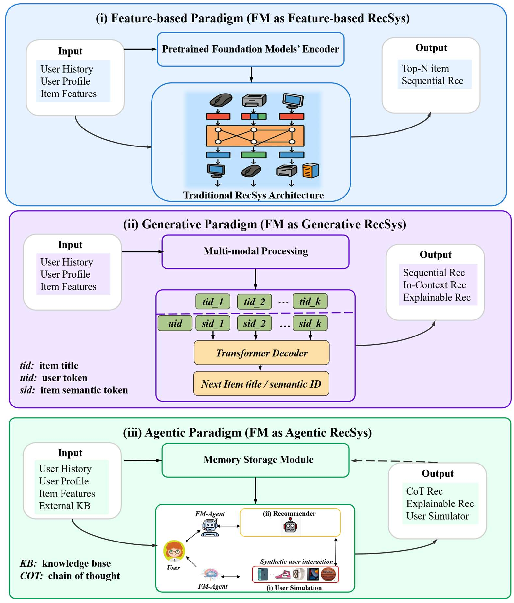
The integration of foundation models into recommender systems can be categorized into three paradigms: feature-based, generative, and agentic, each with distinct roles and applications.

  • Feature-Based Paradigm: Foundation models serve as advanced feature extractors, enhancing item and user embeddings with rich semantic information. This paradigm improves traditional model capabilities by incorporating FMs' representation learning, thus allowing for superior generalization, especially in cold-start scenarios. Figure 1

    Figure 1: Three Paradigms of FM-Powered Recommender Systems

  • Generative Paradigm: Instead of providing mere rankings, this paradigm utilizes generative capabilities of FMs to create personalized recommendations, explanations, and content. Foundation models synthesize recommendations directly from user and item data, enabling more nuanced and flexible personalization strategies.
  • Agentic Paradigm: This paradigm envisions recommender systems as interactive agents capable of dynamic adaptation and real-time decision-making. Leveraging the reasoning abilities of FMs, agentic systems offer proactive recommendation strategies, integrating user feedback loops and external tool usage.

Tasks Enabled by FM-Powered Recommender Systems

FM integration facilitates a wide array of recommendation tasks, ranging from traditional top-N recommendation to complex generative and conversational tasks.

  • Top-N Recommendation: Enhanced by feature-based paradigms, FMs improve the quality of ranking and recommendations by leveraging dense semantic embeddings that capture intricate user-item relationships.
  • Sequential and Conversational Recommendations: Generative paradigms excel in handling sequential data, using FMs to predict user behavior patterns and facilitate interactive sessions with conversational interfaces.
  • Cross-Domain Recommendations: FMs' ability to generalize across various data sources enables cross-domain recommendations, providing insights and personalized experiences by leveraging multimodal data integration.

Challenges and Future Directions

Despite the advantages brought by FM-powered recommender systems, several challenges and opportunities remain:

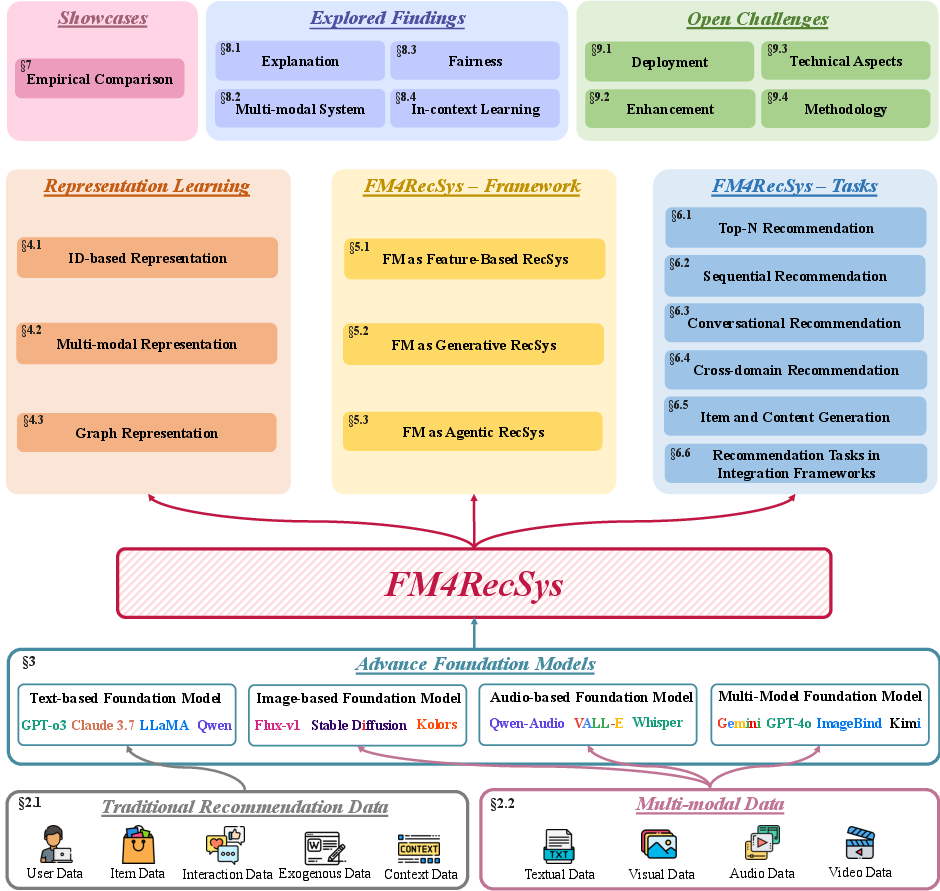
  • Efficiency and Scalability: The computational complexity and resource demands of foundation models pose significant barriers to real-time deployment. Strategies like caching, lightweight FMs, and parameter-efficient tuning can mitigate these issues. Figure 2

    Figure 2: The taxonomy of FM4RecSys from data characteristics to open problems and opportunities

  • Explainability and Trustworthiness: The opacity of foundation models necessitates improved methodologies for generating interpretable recommendations and ensuring fairness. Using techniques such as reasoning graph integration, researchers can offer clearer insights into the decision-making processes.
  • Long-term User Engagement: The agentic paradigm proposes solutions for dynamic adaptation to user preferences through interactive capabilities, yet ensuring robust long-term personalization remains an ongoing challenge.

Conclusion

Foundation model-powered recommender systems hold promise for transforming the landscape of personalized recommendation by harnessing the capabilities of deep learning and large-scale pre-trained models. By systematically integrating feature-based, generative, and agentic paradigms, FMs are setting new benchmarks in the personalization and efficacy of recommendation systems. Addressing current deployment, scalability, and trust challenges will be key to realizing the full potential of these technologies, paving the way for next-generation recommendation systems that are more aligned with user preferences and needs.

Paper to Video (Beta)

Whiteboard

No one has generated a whiteboard explanation for this paper yet.

Open Problems

We haven't generated a list of open problems mentioned in this paper yet.

Collections

Sign up for free to add this paper to one or more collections.