- The paper shows that aligning LLM-based methods with ISO/IEC standards significantly improves requirement validation and automated test generation.
- The study applies empirical evaluations, including prompt-based assessments, to demonstrate efficiency gains while identifying challenges like data privacy and model bias.
- The research proposes adaptive, privacy-enhanced deployments and evolving standards for broader cross-industry applications in software development.
Advancing Software Quality: A Review of LLM-Based Assurance Techniques
Introduction
The paper "Advancing Software Quality: A Standards-Focused Review of LLM-Based Assurance Techniques" (2505.13766) explores the integration of LLMs into Software Quality Assurance (SQA) processes. By examining the intersection of LLM-driven methods and established software quality standards such as ISO/IEC frameworks, the study provides a comprehensive perspective on enhancing traditional SQA practices through AI technologies. The paper discusses various applications of LLMs, including requirement validation, test generation, and compliance auditing, while considering potential challenges like model bias and data privacy.
Core Contributions
Integration with Software Quality Standards
The study highlights the alignment of LLM-based methods with pivotal standards, such as ISO/IEC 12207 and ISO/IEC 25010, which provide structured processes to ensure robust software quality. By mapping specific LLM applications to standard components, the paper demonstrates the potential of LLMs to automate and enhance tasks across the software development lifecycle—from requirement specification to validation and configuration management.
Empirical Evaluation and Challenges
Empirical case studies presented in the paper demonstrate the practical utility and potential efficiency gains from integrating LLMs within SQA. For instance, the use of LLMs in generating test cases has shown improvements in test coverage and defect detection rates, yet challenges such as data privacy, explainability, and governance remain prevalent.
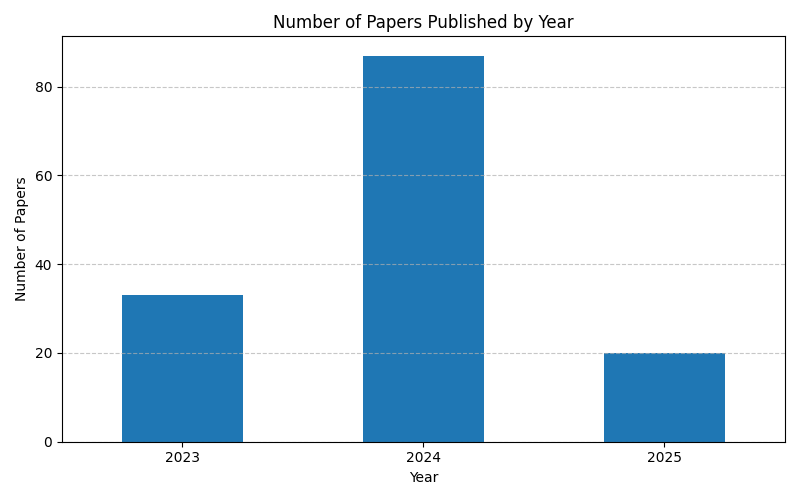
Figure 1: Number of papers published per year from 2023 to early 2025, showing a rise in 2024 as interest in LLMs for software quality assurance surged.
Mapping LLM Applications to Standards
ISO/IEC 12207: Software Life Cycle Processes
The paper elaborates on the role of LLMs in software life cycle processes, particularly in translating stakeholder needs into detailed requirements and facilitating code verification and validation. By providing automated support for test generation and analysis, LLMs help ensure that software products adhere to predefined quality benchmarks.
ISO/IEC 25010: Systems and Software Quality Model
LLMs contribute significantly to various quality characteristics defined by ISO/IEC 25010, including functional suitability, reliability, and maintainability. For example, the automation of test case generation and documentation analysis can improve both the reliability and maintainability of complex software systems.
Adopted Methods and Results
Fine-Tuning and Evaluation Approaches
The paper discusses the usage patterns of pre-trained and fine-tuned LLMs in the literature, highlighting that the majority of studies rely on prompt-based interactions with pre-trained models. The evaluation approaches widely employed include automated performance metrics and empirical studies, linking LLM outputs against traditional rule-based or manual baselines.
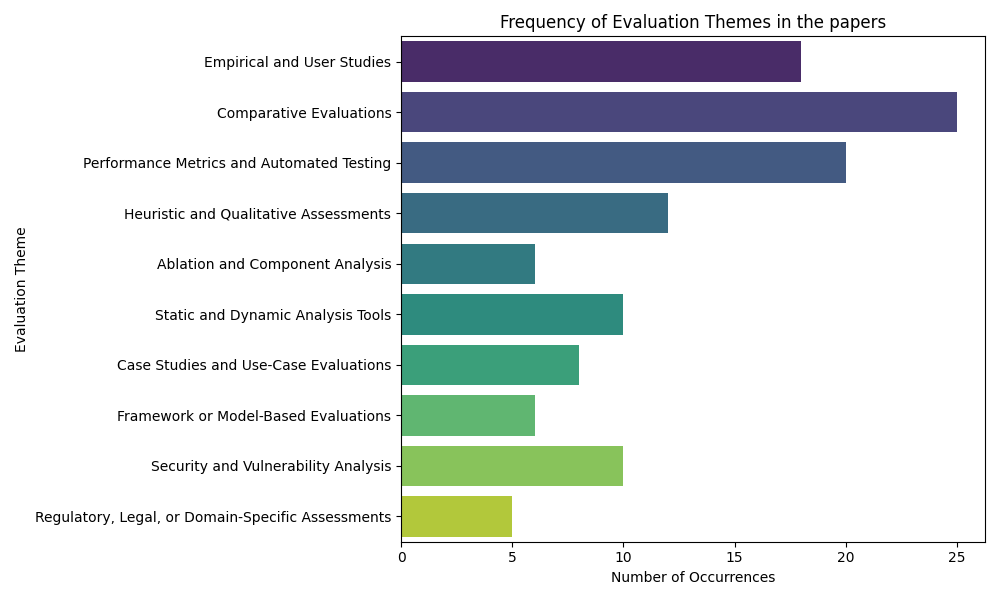
Figure 2: Frequency of evaluation approaches used in the papers. Comparative studies, empirical/user evaluations, and automated performance metrics dominated the landscape.
Future Research Directions
Adaptive Learning and Privacy-Focused Deployments
The paper proposes prospective directions for LLM-enhanced SQA, advocating for adaptive learning strategies that preserve privacy, such as federated or on-premises model deployments. This approach can mitigate data privacy risks and ensure compliance with data protection regulations.
Evolving Standards and Cross-Industry Applications
There is a call for evolving existing standards to accommodate AI and LLM-specific methodologies. The paper envisions cross-industry applications of LLMs, adapting successful approaches from one domain, like automotive software quality, to others, such as healthcare or finance, enhancing software reliability and safety across sectors.
Conclusion
The introduction of LLMs into software quality assurance processes holds promise for automating and enhancing traditional methods, as elucidated by this study. However, the full potential of LLM-driven SQA systems can only be realized through the careful management of associated challenges, such as data privacy, model bias, and integration with existing quality standards. The paper paves the way for future research to explore these avenues and craft a comprehensive framework for AI-enhanced SQA methodologies.