- The paper introduces a modular agentic system that leverages LLMs to automate the data-to-dashboard workflow.
- It integrates techniques like domain detection, concept extraction, and iterative self-reflection to generate insightful visual analytics.
- Experiments demonstrate significant improvements in insightfulness and analytical depth compared to traditional question-based approaches.
Data-to-Dashboard: Multi-Agent LLM Framework for Insightful Visualization in Enterprise Analytics
Introduction
The paper "Data-to-Dashboard: Multi-Agent LLM Framework for Insightful Visualization in Enterprise Analytics" introduces a novel framework leveraging LLMs for business analytics. The research addresses the limitations of existing methodologies by automating the data-to-dashboard pipeline through modular LLM agents, capable of domain detection, concept extraction, multi-perspective analysis generation, and iterative self-reflection. Traditional approaches often rely on closed ontologies or question templates, limiting the scope of insights extracted from raw data. This work evaluates the proposed system on datasets from various domains, demonstrating improved insightfulness, domain relevance, and analytical depth compared to existing systems and benchmarks.
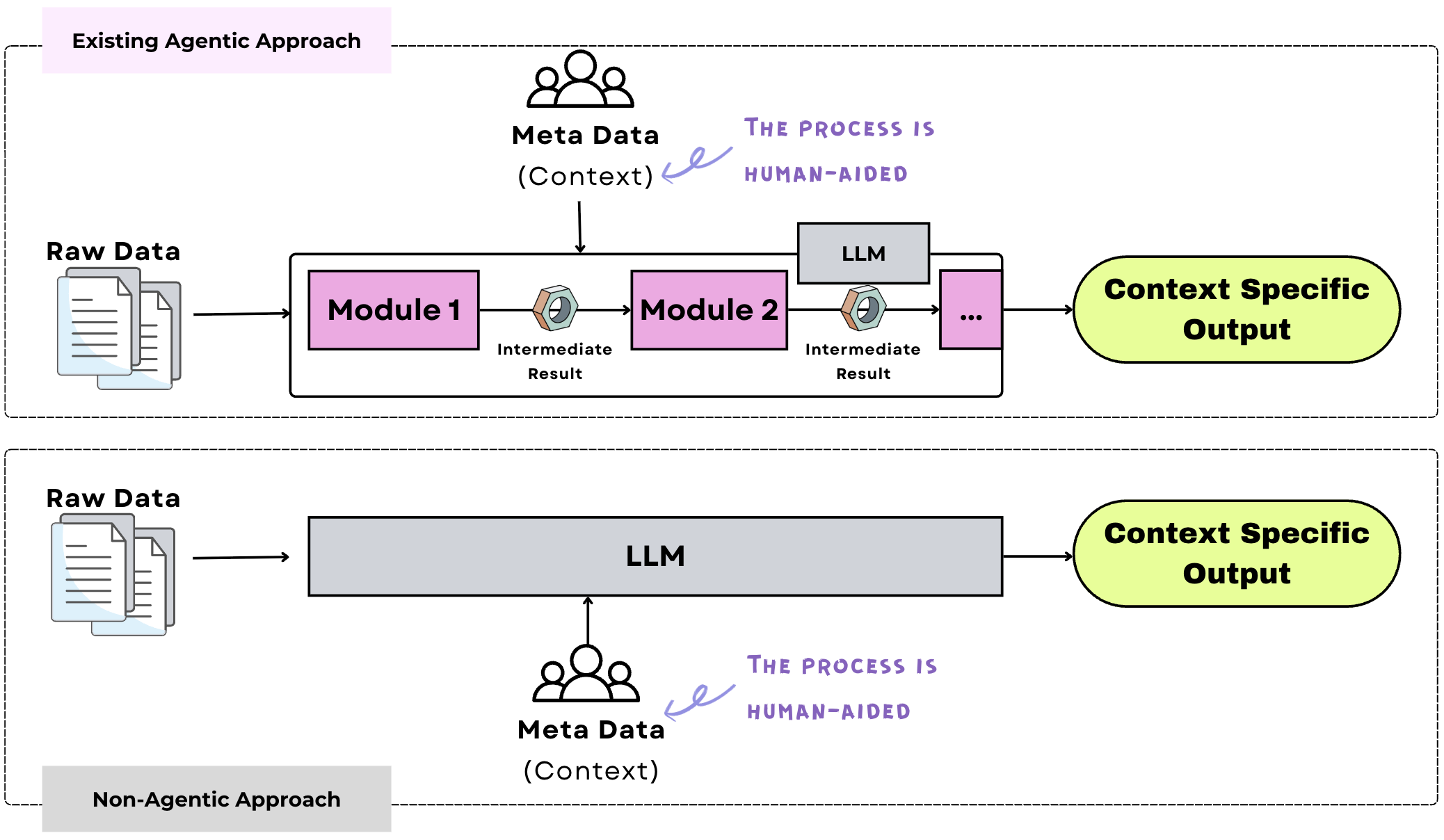
Figure 1: Existing approaches, whether agentic or non-agentic, use LLMs to obtain context-specific answers and insights, often overlooking the deeper value still embedded in the underlying raw data.
Problem Statement and Motivation
The primary challenge addressed in the paper is the development of a robust, generalizable agentic system that employs state-of-the-art LLMs to produce domain-related insights, enhancing data visualization significantly. Current studies predominantly focus on question-driven analysis, which constrains the generative potential of LLMs and limits the exploration of datasets for novel insights. The authors propose a system integrating domain detection and knowledge retrieval mechanisms, supporting feature selection and multi-perspective analytical reasoning, thus enhancing the depth and accuracy of insights.
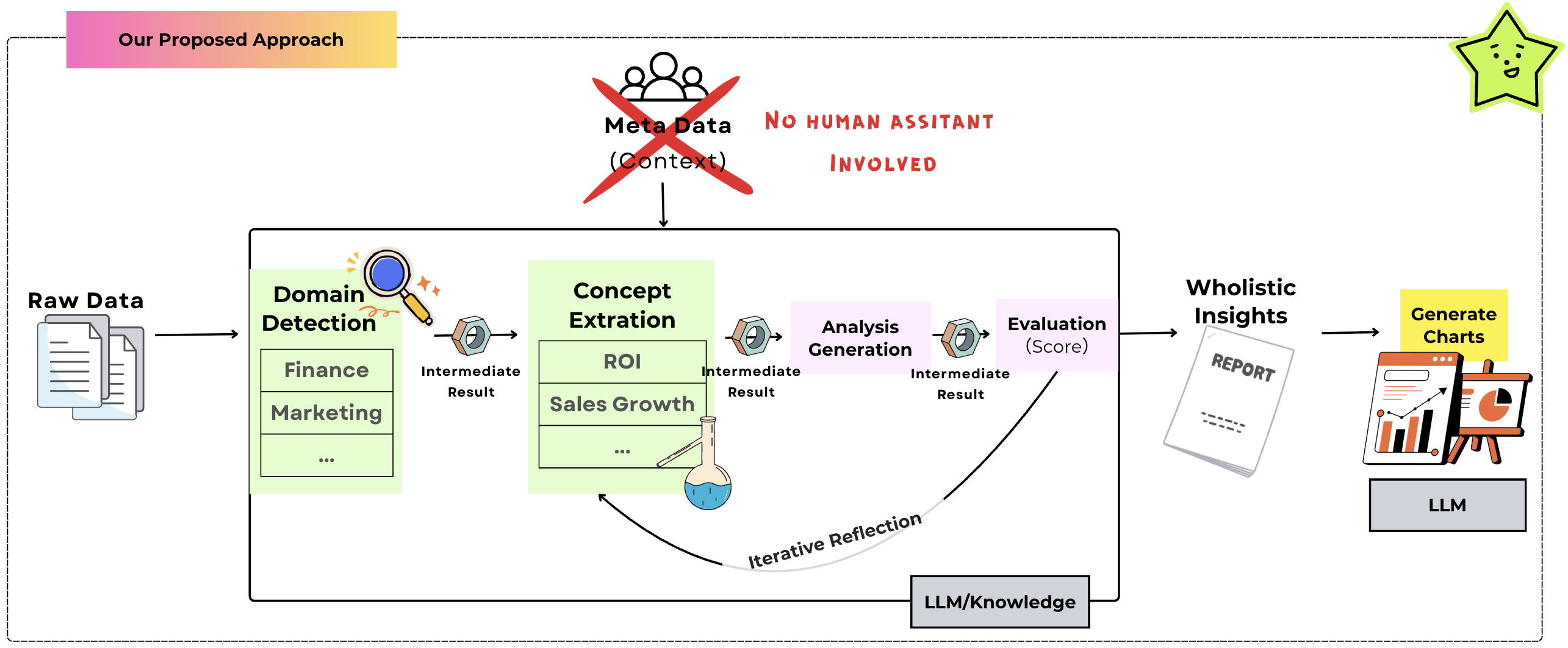
Figure 2: Our end-to-end data-insight-visualization approach provides context-independent domain-aware insights, thus overcoming the limitations of existing systems.
Proposed Solution
The proposed solution is an end-to-end agentic system that automates the workflow from raw data to a dashboard with charts. This system uses specialized agents for detecting domain and concepts, retrieving domain-relevant knowledge, and visualizing data. The framework is designed to reflect business analysts' cognitive processes, offering iterative improvements and reflective interpretation. It consists of several modules: data profiling, domain detection, concept extraction, analysis generation, evaluation, and self-reflection, each contributing to the generation of structured and insightful analyses.
Evaluation Criteria and Experiments
The evaluation framework comprises textual insight and chart evaluation, using metrics like G-Eval and comparisons with existing datasets such as InsightBench. Experiments focus on determining the impact of explicit domain identification, comparing the agentic pipeline against simpler prompt-based baselines, and analyzing insights generated with domain-knowledge versus question-based systems. Results indicate significant improvements in insightfulness, novelty, and depth, validating the framework's effectiveness in generating domain-informed analytical insights.
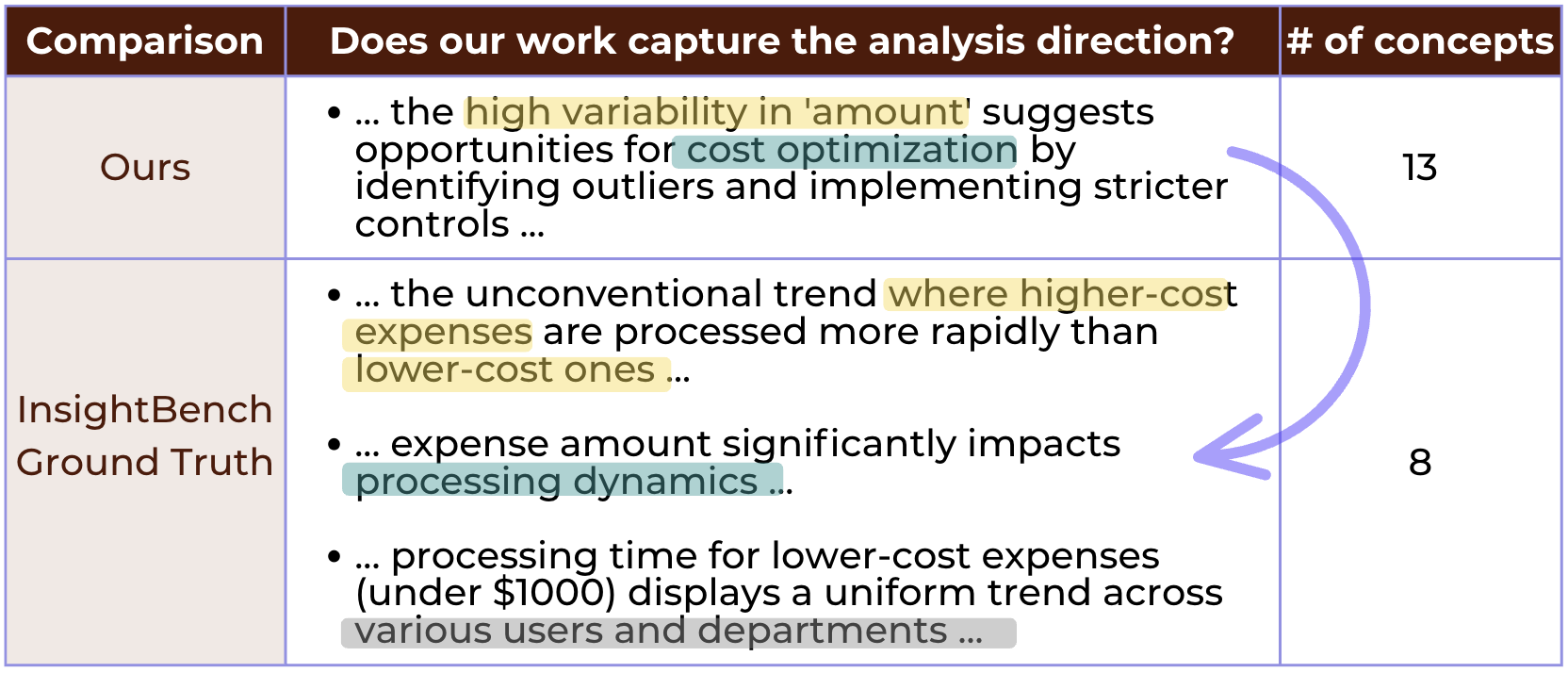
Figure 3: Comparison of our generated insights with InsightBench ground truth. Our system captures the core analytical direction, identifying key themes such as cost variability, processing dynamics, and optimization opportunities, with broader concept coverage.
Results and Discussion
The agentic system showcases enhanced insightfulness and analytical depth compared to non-agentic approaches, effectively linking domain knowledge to visualization tasks. Explicit domain identification plays a critical role in grounding insights, significantly improving relevance and structure. The experiments demonstrate the superiority of the proposed framework, achieving higher metrics in analytical tasks compared to existing benchmarks and practical implementations. The system facilitates human-in-the-loop validation, providing domain experts the opportunity to refine and validate insights in real-time.
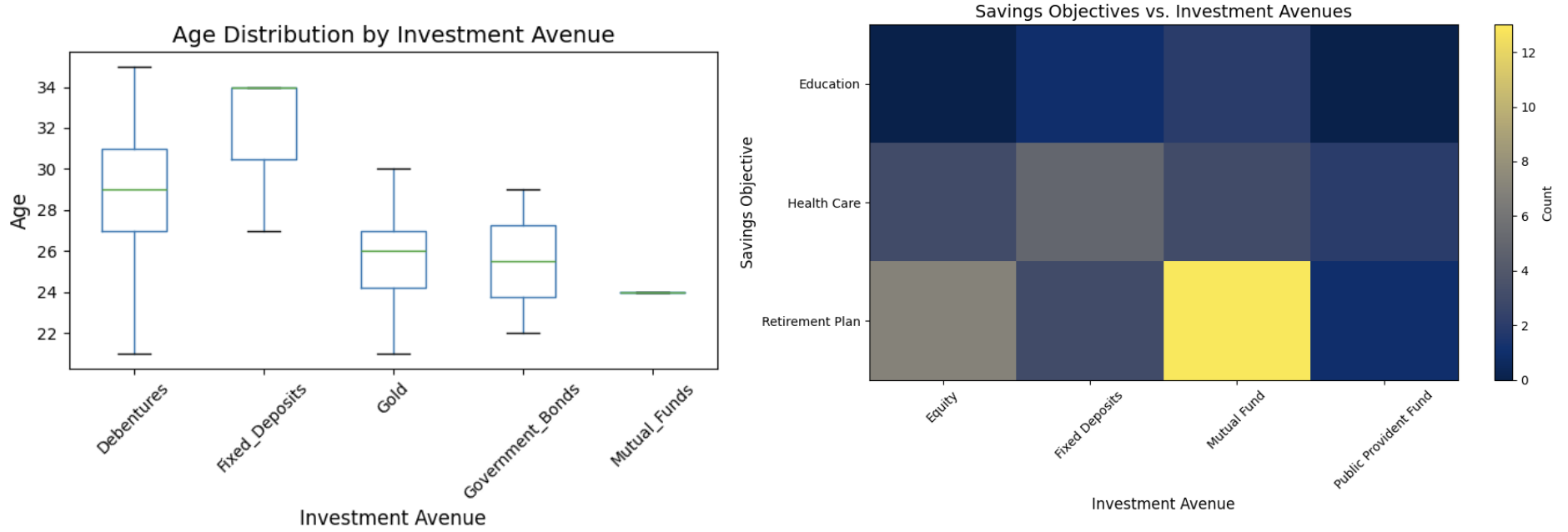
Figure 4: Examples of insightful figures generated by our approach.
Conclusion
The research contributes to the field of enterprise analytics by introducing an innovative modular agentic framework that processes raw data into insightful dashboards. It effectively leverages the reasoning capabilities of LLMs to identify domain-specific insights, offering significant improvements in business intelligence tasks. The findings suggest pathways for future development, potentially integrating more refined domain identification mechanisms and expanding application domains. The methodology promises significant advancements in automated data analysis and visualization, emphasizing the importance of domain-grounded reasoning in enterprise contexts.