- The paper introduces CID-GraphRAG which integrates intent transition graphs with semantic retrieval for improved dialogue system performance.
- The dual-pathway retrieval mechanism adaptively balances graph traversal with semantic similarity to boost response quality by 58% in evaluations.
- The framework demonstrates potential in customer service dialogues, highlighting benefits in contextual coherence and goal-oriented responses.
Conversational Intent-Driven GraphRAG: Enhancing Dialogue Systems
Overview
"Conversational Intent-Driven GraphRAG: Enhancing Multi-Turn Dialogue Systems through Adaptive Dual-Retrieval of Flow Patterns and Context Semantics" (2506.19385) presents an advanced framework for addressing limitations in multi-turn dialogue systems, specifically within customer service contexts. The proposed CID-GraphRAG (Conversational Intent-Driven Graph Retrieval Augmented Generation) innovatively combines intent transition graphs with semantic retrieval for improved conversational coherence and goal orientation.
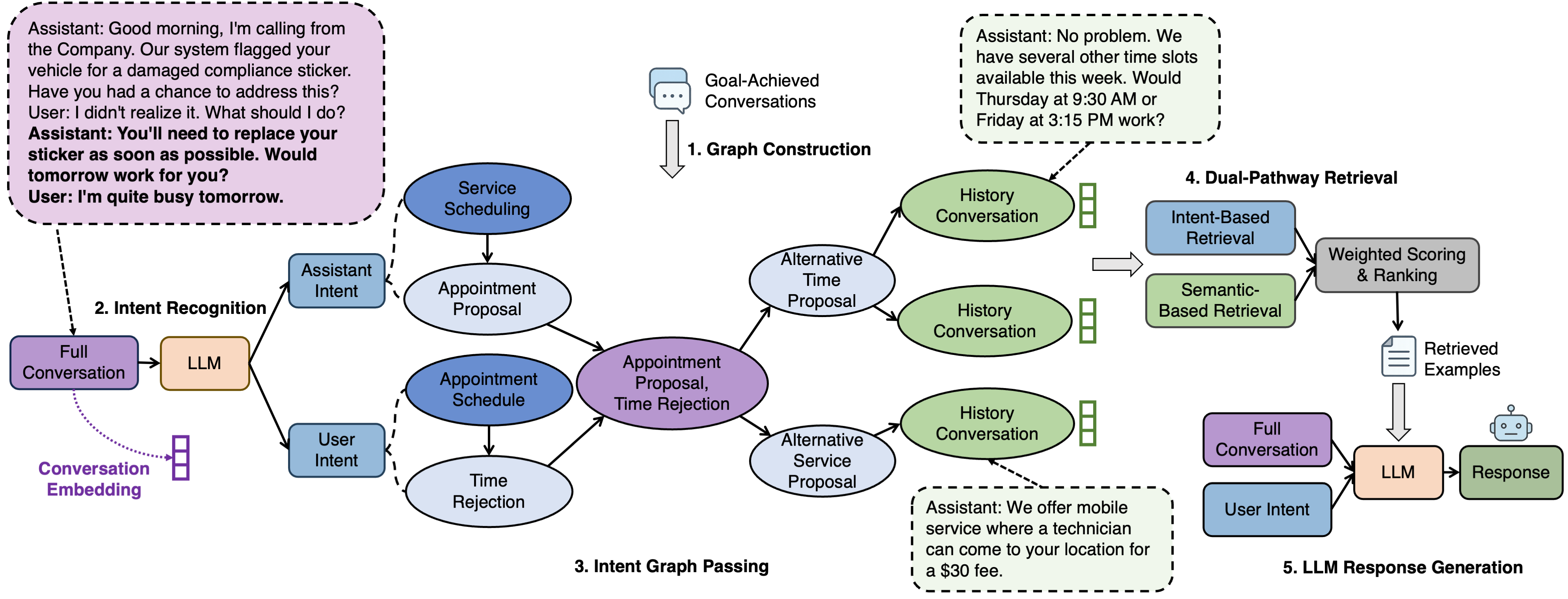
Figure 1: The detailed framework of CID-GraphRAG. The CID-GraphRAG consists of two phases: (1) a construction phase that builds an intent graph from goal-achieved conversations, and (2) an inference phase that identifies user and assistant intents from current dialogue turn, retrieves high-quality examples from both intent-based and semantic-based pathways via an adaptive weighting mechanism, and uses LLM for structured response generation.
Methodological Contributions
The CID-GraphRAG framework is built on three foundational components: intention graph construction, adaptive dual-pathway retrieval, and structured response generation.
Intent Transition Graph Construction: CID-GraphRAG automatically constructs dynamic intent transition graphs, cataloging hierarchical intent structures from both user and system utterances. This component provides a comprehensive representation of conversation dynamics, enabling the system to anticipate future conversational directions more effectively.
Dual-Pathway Adaptive Retrieval: The framework balances an intent-based graph traversal with semantic similarity search. This dual retrieval mechanism employs an adaptive weighting system, allowing it to leverage both conversational flow patterns and contextual semantics, addressing the limitations of each retrieval method when used independently.
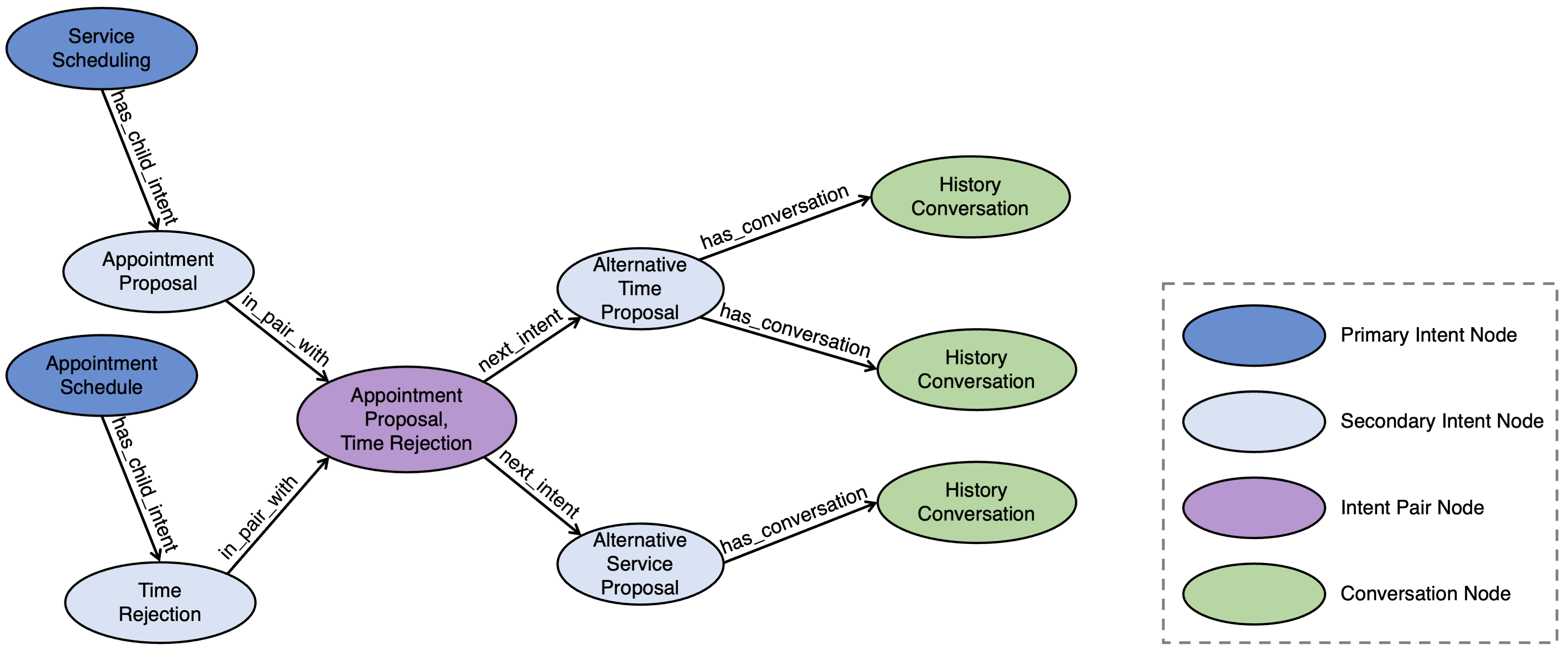
Figure 2: Internal structure of the CID-Graph. The graph comprises distinct primary intent and secondary intent nodes and conversation nodes. Key relations include hierarchical, pairing, transition, and dialogue anchoring.
Experimental Setup and Evaluation
The evaluation employed a real-world customer service dataset consisting of complex, task-oriented dialogues. The CID-GraphRAG framework was benchmarked against several baselines: a direct LLM, an intent-based RAG, and a conversation-based RAG. Evaluation metrics included BLEU, ROUGE, METEOR, and BERTSCORE, supplemented by LLM-as-Judge and human evaluations.
CID-GraphRAG demonstrated significant improvements over baselines, with a notable 58% increase in response quality according to LLM-as-Judge evaluations. Semantic matching within intent graphs outperformed exact matching, underscoring the importance of integrating semantic retrieval paths.
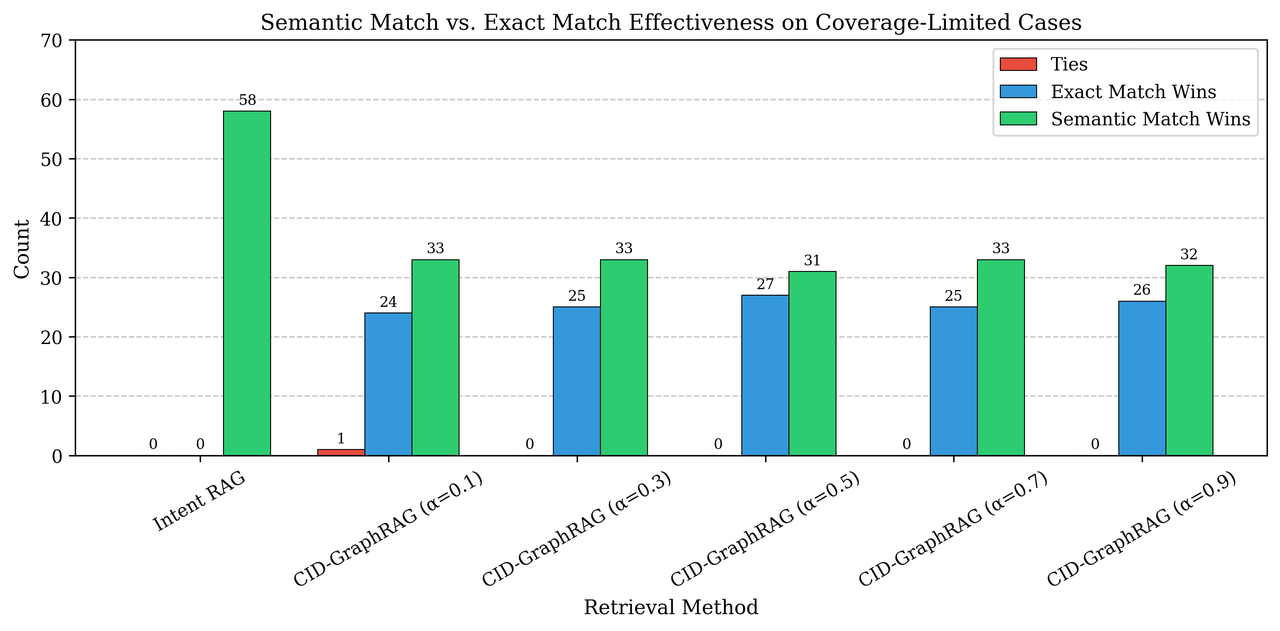
Figure 3: Comparison between semantic matching and exact matching on 58 cases. Semantic matching outperforms exact matching across all weight configurations in CID-GraphRAG.
Analysis and Implications
The study indicates that the integration of intent transition structures with semantic retrieval creates a synergistic effect, substantially improving both retrieval and response quality. The optimal configuration emphasized a semantic-driven approach, guided by a small, significant intent component (α=0.1), which effectively maintained dialogue structural dynamics.
The CID-GraphRAG framework's ability to predict and adapt to conversational flow reflects its potential in diverse applications, particularly where maintaining goal-oriented progression is crucial. However, computational overhead remains a challenge, suggesting future work could explore reinforcement learning techniques and lightweight intent recognition to enhance efficiency.
Conclusion
The CID-GraphRAG framework sets a new standard in the field of multi-turn dialogue systems by enhancing contextual coherence and goal progression through advanced retrieval mechanisms. Future research will likely explore the adaptability of the intent hierarchy and domain transferability, expanding CID-GraphRAG's applicability across broader dialogue scenarios.
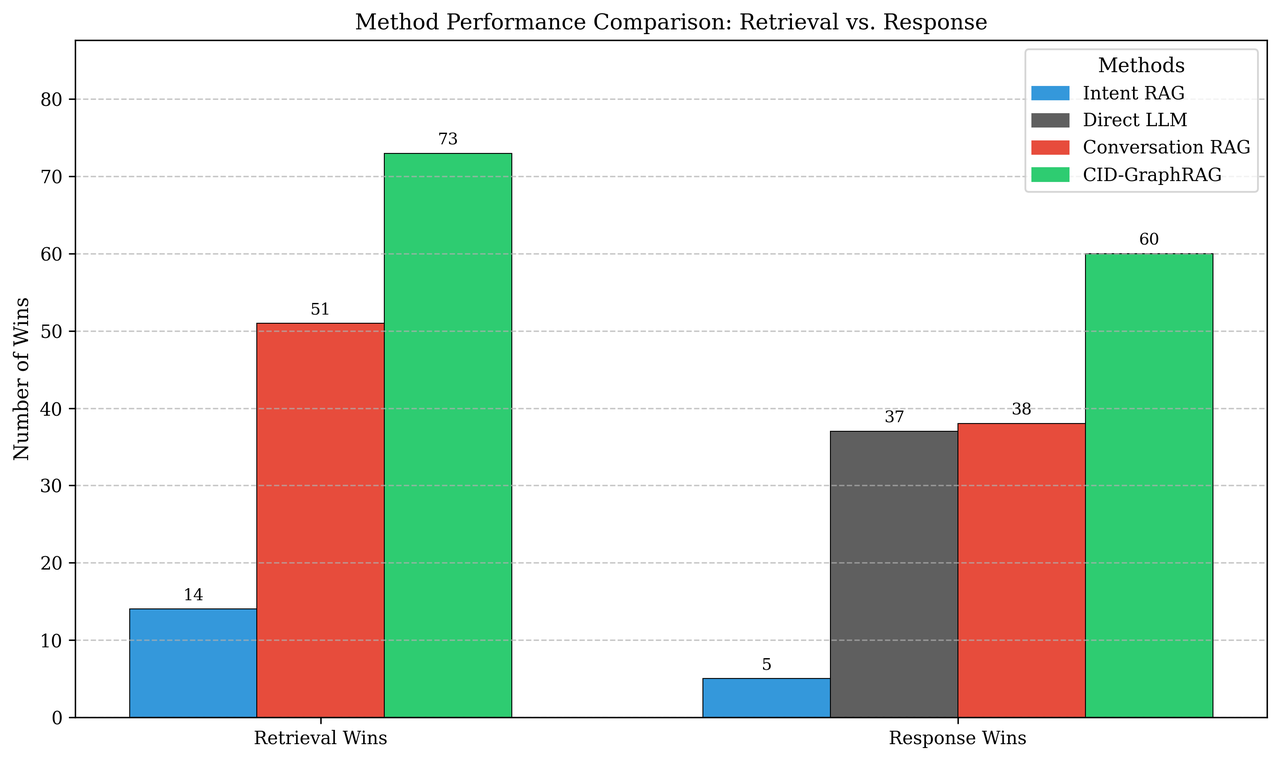
Figure 4: Performance comparison of different methods based on LLM-as-Judge win counts. The left group shows retrieval quality wins, and the right group shows response generation wins. CID-GraphRAG consistently outperforms all baseline methods in both aspects, with particularly significant advantages in retrieval quality.