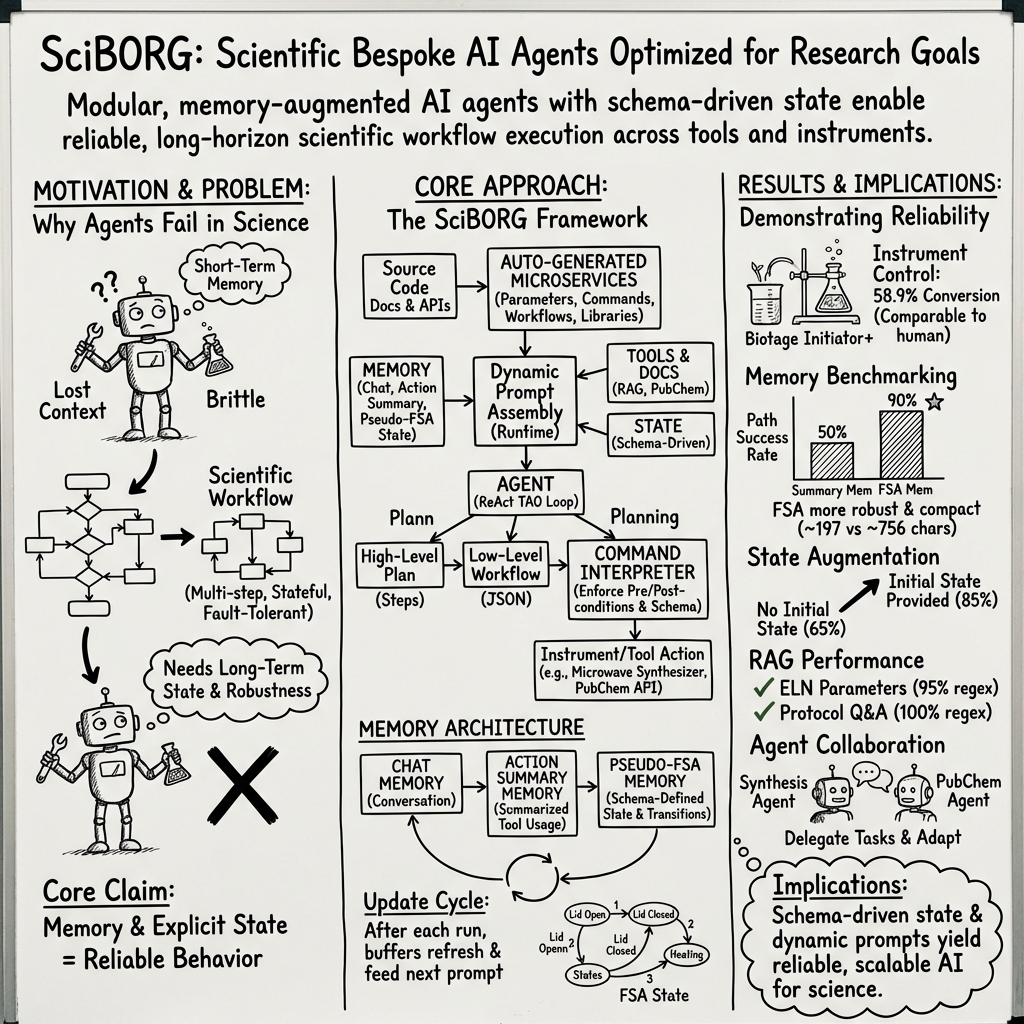
- The paper introduces SciBORG, a framework that integrates state-aware memory using finite-state automata to enhance LLM-based agent reliability.
- It demonstrates a modular design that interfaces with various APIs and experimental equipment, enabling dynamic, autonomous task planning.
- Benchmarking shows significant improvements in state tracking and contextual information retention, leading to more consistent multi-step task execution.
"State and Memory is All You Need for Robust and Reliable AI Agents" Summary
Introduction
The paper "State and Memory is All You Need for Robust and Reliable AI Agents" introduces SciBORG, a novel framework designed to enhance the operation of LLM-based agents in complex, real-world scientific tasks. These tasks often require a comprehensive grasp of state and memory management to ensure robust, scalable deployment in diverse environments. Despite the promising capabilities of LLMs like GPT, PaLM, and others, their applications are hindered by limitations such as static knowledge bases and lack of persistent memory. SciBORG addresses these issues by introducing a specialized framework that dynamically constructs agentic infrastructures capable of autonomous planning and decision-making.
SciBORG Framework
SciBORG leverages LLMs within a modular structure primarily driven by state-aware finite-state automata (FSA) memory architectures. This modularity allows for the integration of memory functionalities essential for keeping track of agent state, enabling continuity and adaptability in task execution. Such a design facilitates the development of agents that can autonomously configure workflows from instrument documentation, minimizing the dependency on manual prompt engineering. A key element of SciBORG is the interoperability of its components, tightly coupling agent behaviors with scientific tasks through documented APIs, microservices, and schema-defined interactions. This approach creates a robust foundation for building agents capable of coherent and structured decision-making.
Practical Implementations
The paper demonstrates SciBORG's practicality through various applications, such as controlling experimental equipment like the Biotage Initiator+ microwave synthesizer. The framework supports interactions with both virtual and physical environments by interfacing with diverse toolset APIs. Key demonstrations include autonomous multi-step task executions, such as the exploration tasks of retrieving bioassay data from the PubChem database, which illustrates the multi-agent coordination enabled within SciBORG's infrastructure.
Benchmarking and Results
Extensive benchmarking was conducted to assess the robustness and reliability of SciBORG's agents. These benchmarks included state-based and path-based validations under varying configurations of memory setups. The results indicate that agents equipped with SciBORG's memory architectures consistently demonstrate superior performance in task execution continuity, state-tracking, and dynamic adaptation compared to those without such systems. Specifically, agents integrated with FSA memory showed a significant improvement in retaining critical contextual information across iterative tasks, leading to more reliable outcomes.
Implications and Future Directions
The integration of state and memory into AI systems reveals significant potential for enhancing agent reliability and task execution efficiency in real-world environments. SciBORG represents a pivotal shift towards creating AI agents that are truly autonomous and capable of performing complex scientific discovery tasks across diverse domains. Moving forward, the framework could integrate more advanced features such as uncertainty estimation, multimodal inputs, and active learning from real-time user feedback, further enabling robust autonomous exploration and discovery in scientific applications.
Conclusion
SciBORG provides a systematic solution for overcoming the limitations of traditional LLM-based agents by embedding memory and state-awareness into their infrastructures. This advancement enhances their reliability in executing complex scientific workflows, addressing critical challenges in AI deployment for research and industry settings. As autonomous agents continue to evolve, frameworks like SciBORG will be crucial in realizing the full potential of AI in facilitating dynamic scientific and engineering processes.