HAWK: A Hierarchical Workflow Framework for Multi-Agent Collaboration
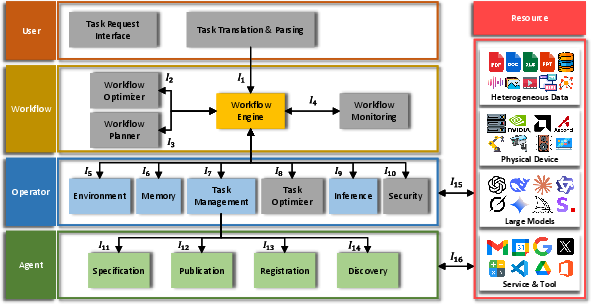
Abstract: Contemporary multi-agent systems encounter persistent challenges in cross-platform interoperability, dynamic task scheduling, and efficient resource sharing. Agents with heterogeneous implementations often lack standardized interfaces; collaboration frameworks remain brittle and hard to extend; scheduling policies are static; and inter-agent state synchronization is insufficient. We propose Hierarchical Agent Workflow (HAWK), a modular framework comprising five layers-User, Workflow, Operator, Agent, and Resource-and supported by sixteen standardized interfaces. HAWK delivers an end-to-end pipeline covering task parsing, workflow orchestration, intelligent scheduling, resource invocation, and data synchronization. At its core lies an adaptive scheduling and optimization module in the Workflow Layer, which harnesses real-time feedback and dynamic strategy adjustment to maximize utilization. The Resource Layer provides a unified abstraction over heterogeneous data sources, large models, physical devices, and third-party services&tools, simplifying cross-domain information retrieval. We demonstrate HAWK's scalability and effectiveness via CreAgentive, a multi-agent novel-generation prototype, which achieves marked gains in throughput, lowers invocation complexity, and improves system controllability. We also show how hybrid deployments of LLMs integrate seamlessly within HAWK, highlighting its flexibility. Finally, we outline future research avenues-hallucination mitigation, real-time performance tuning, and enhanced cross-domain adaptability-and survey prospective applications in healthcare, government, finance, and education.
Paper Prompts
Sign up for free to create and run prompts on this paper using GPT-5.
Top Community Prompts
Glossary
- Adaptive Scheduling: Real-time, context-aware adjustment of task allocation and execution strategies to maximize system performance. "Adaptive Scheduling: Intelligent Task Management, Reasoning, Optimization, and Security modules enable real-time, context-aware task allocation."
- Agent-to-Agent communication (A2A): A protocol enabling direct, peer-to-peer negotiation and exchange between agents. "and Agent-to-Agent communication (A2A) \cite{google2025a2a} for peer-to-peer negotiation."
- AGI: A hypothesized form of AI with general, human-level capabilities across diverse tasks. "As AI technology advances toward AGI, AI agents have found broad application across domains..."
- Chainâofâthought (CoT): A prompting strategy encouraging stepwise reasoning to improve planning and problem-solving. "using a chainâofâthought (CoT) approach, it produces a chapterâspecific objective and refines this into a concrete, stepâbyâstep plan."
- Closed-logit LLM: A LLM interface that exposes only sampled outputs (not raw logits), often requiring alternative truth estimation. "while for a closed-logit LLM using sampled outputs:"
- Cognitiveâdecision architecture: A structured model of decision-making that integrates cognitive reasoning components. "using a Tellerâinspired cognitiveâdecision architecture \cite{liu-etal-2024-teller}"
- Conjunctive clauses: Logical constructs formed by the conjunction (AND) of atoms within a DNF reasoning layer. "The DNF layer constructs conjunctive clauses:"
- Cross-platform adaptation layer: An architectural component that allows workflows or agents to run across different ecosystems without reimplementation. "but it lacks a cross-platform adaptation layer"
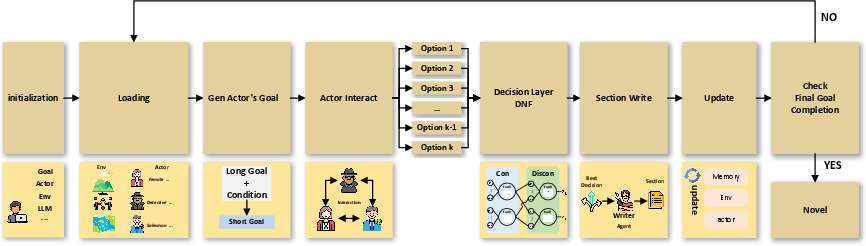
- Decision Agent: A specialized agent that evaluates candidate trajectories and selects the optimal plot or plan. "The pool of candidate trajectories is passed to the Decision Agent, which, using a Tellerâinspired cognitiveâdecision architecture..."
- Disjunctive Normal Form (DNF): A logical form consisting of disjunctions (OR) of conjunctions (AND) used for interpretable reasoning. "this agent integrates a differentiable Disjunctive Normal Form (DNF) reasoning layer to evaluate and rank alternative candidate storylines."
- Environment Agent: An agent responsible for maintaining, updating, and versioning the world state in the workflow. "Environment Agent: Responsible for maintaining the storyâs evolving world state, this agent handles the storage, retrieval, and versioned updating of all environment-related data."
- Governance mechanisms: Standardized operations for managing agent lifecycle and collaboration (e.g., specification, publication, registration, discovery). "Implement Specification, Publication, Registration, Discovery four Agent governance mechanisms"
- Graphâbased workflow management: Modeling workflows as graphs to capture dependencies and execution order among nodes. "LangGraph \cite{duan2024langgraph_crewai} utilizes a graphâbased workflow management approach that enables flexible modeling of interâagent dependencies"
- Hallucination mitigation: Strategies to reduce or prevent erroneous outputs from LLMs that can disrupt workflows. "we outline future research avenuesâhallucination mitigation, realâtime performance tuning, and enhanced crossâdomain adaptability"
- HAWK: The Hierarchical Agent WorKflow framework that structures multi-agent collaboration across layered modules and standardized interfaces. "We propose Hierarchical Agent Workflow (HAWK), a modular framework comprising five layersâUser, Workflow, Operator, Agent, and Resourceâand supported by sixteen standardized interfaces."
- Hybrid deployments: Combining multiple LLMs or models within a single system to leverage their complementary strengths. "We also show how hybrid deployments of LLMs integrate seamlessly within HAWK"
- Message-Centric Protocol (MCP): An industry protocol emphasizing loose coupling among components via message-based interfaces. "including the Message-Centric Protocol (MCP) \cite{anthropic2024mcp} for loose coupling"
- Multi-agent systems (MAS): Systems composed of multiple interacting agents that coordinate to achieve complex goals. "as with other multiâagent systems (MAS) reported in the literature \cite{cemri2025multiagentllmsystemsfail}"
- Multi-modal collaboration protocol: A communication layer enabling agents to collaborate using diverse modalities (e.g., text, images, devices). "Leveraging a multi-modal collaboration protocol, HAWK enables cross-domain synergy"
- Open-logit LLM: A LLM interface that provides raw logits for outputs, enabling direct computation of truth values. "Specifically, for an open-logit LLM, truth values are computed as:"
- Predicate: A logical statement evaluated as true/false (or in a continuous truth space) used within reasoning layers. "For each predicate , the truth value of its -th logic atom is represented as "
- Resource Layer: The foundational layer abstracting heterogeneous data, models, tools, and devices via unified interfaces. "The Resource Layer, positioned on the right side of the framework, serves as the fundamental support layer for the multi-agent workflow system"
- Retrieval-augmented generation (RAG): A technique combining external retrieval with generation to improve accuracy and grounding. "seamless integration with a variety of communication protocols and retrieval-augmented generation (RAG) frameworks"
- Standard Operating Procedures (SOPs): Formalized, repeatable processes used to guide agent tasks and task decomposition. "MetaGPT \cite{hong2023metagpt}, which leverages standard operating procedures (SOPs) and a taskâdecomposition mechanism"
- Task decomposition: Breaking complex tasks into smaller, manageable subtasks to facilitate planning and execution. "such as task decomposition, temporal arrangement, and dependency resolution"
- Task Optimizer: A module that dynamically adjusts execution strategies based on policies and available resources. "Task Optimizer, which dynamically adjusts execution strategies based on policies and available resources"
- Task scheduling: Assigning tasks to agents or resources over time, often under constraints, to optimize performance. "Contemporary multi-agent systems encounter persistent challenges in ... dynamic task scheduling"
- Teller dual-system cognitive architecture: A cognitive framework combining fast and slow reasoning systems for decision-making. "Building on the Teller dual-system cognitive architecture \cite{liu-etal-2024-teller}, this agent integrates a differentiable Disjunctive Normal Form (DNF) reasoning layer"
- Unified resource abstraction: A common interface and representation for diverse resources to simplify invocation and integration. "through a unified resource access and abstraction mechanism, the Resource Layer delivers standardized interfaces"
- Versioned State Update: A controlled update process that assigns version tags to environment and memory states for traceability. "Versioned State Update: Upon completing a chapter, the system updates and assigns version tags to both the environment state and character memories"
- Workflow Engine: The central component that selects workflow models, orchestrates execution, and coordinates modules. "The Wrkflow Engine selects appropriate workflow models based on task requirements and exposes interfaces to the underlying Operator Layer"
- Workflow Monitoring: Continuous tracking of execution state and performance metrics for analysis and optimization. "Interface I\textsubscript{4} defines the communication protocol between the Workflow Engine and the Workflow Monitoring, enabling real-time reporting of execution states and key performance metrics"
- Workflow Optimizer: A component that uses feedback to adapt workflow structures and scheduling strategies for better throughput. "Interface I\textsubscript{2} defines the communication protocol between the Workflow Optimizer and the Workflow Engine, enabling the optimizer to receive real-time feedback ... and to dynamically adjust workflow structures and task scheduling strategies."
- Workflow Planner: A planning module handling task breakdown, timing, and dependency resolution before execution. "Interface I\textsubscript{3} defines the communication protocol between the Workflow Engine and the Workflow Planner, through which the engine delegates planning-related responsibilitiesâsuch as task decomposition, temporal arrangement, and dependency resolutionâto the planner."
- Workflow orchestration: Coordinating tasks, agents, and resources to realize a complete, coherent workflow. "HAWK delivers an endâtoâend pipeline covering task parsing, workflow orchestration, intelligent scheduling, resource invocation, and data synchronization."
Collections
Sign up for free to add this paper to one or more collections.