- The paper introduces computational methods using tensorized execution and modular design to efficiently simulate millions of agents.
- It employs differentiable specifications enabling gradient-based calibration and robust data assimilation across high-dimensional parameter spaces.
- The work incorporates decentralized, privacy-preserving protocols for secure, real-time integration of heterogeneous real-world data.
Large Population Models
This paper discusses the development and implementation of Large Population Models (LPMs), aimed at simulating large-scale agent-based models with efficient computational methods, mathematical frameworks for data assimilation, and privacy-preserving protocols. LPMs are introduced as an evolution of agent-based models (ABMs) to overcome challenges related to scalability, data integration, and privacy in simulating complex societal systems like pandemic response, supply chain disruptions, and climate adaptation.
Introduction
LPMs extend the capabilities of conventional ABMs by offering three significant innovations: compositional design for scalable simulation, differentiable specifications for effective learning, and decentralized computation to maintain privacy. These advances enable researchers to simulate populations at scale, integrating real-world heterogeneous data streams and bridging gaps between simulated agents and their real-world counterparts.
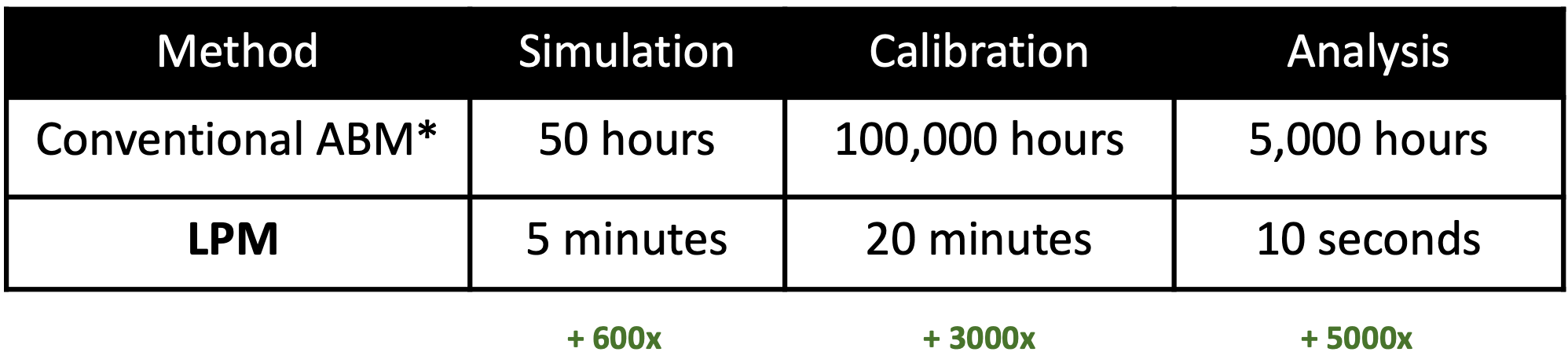
Figure 1: Performance benchmarking comparing computational efficiency of LPMs versus conventional ABMs for simulating 8.4 million agents representing NYC's population.
Technical Contributions
Compositional Design
LPMs utilize tensorized execution and compositional interactions, which facilitate simulating millions of agents with complex behaviors efficiently on commodity hardware. This enables realistic simulations that can balance behavioral complexity with computational constraints. The framework decouples simulation environments into modular substeps executed via tensor operations, allowing extensive scalability and flexible specification.
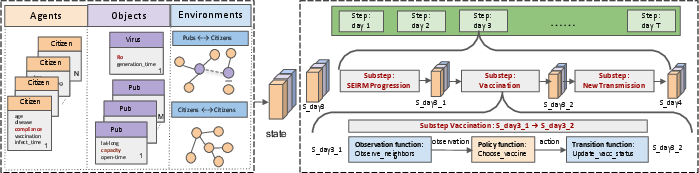
Figure 2: Domain Specific Language for modeling interactions and processes within simulated environments.
Differentiable Specification
LPMs incorporate differentiability across entire simulation protocols, allowing gradient-based learning for calibration, sensitivity analysis, and data assimilation. This approach integrates LPMs with neural networks and supports efficient gradient computation, enabling advanced calibration techniques and robust inference over high-dimensional parameter spaces without the need for surrogate models.
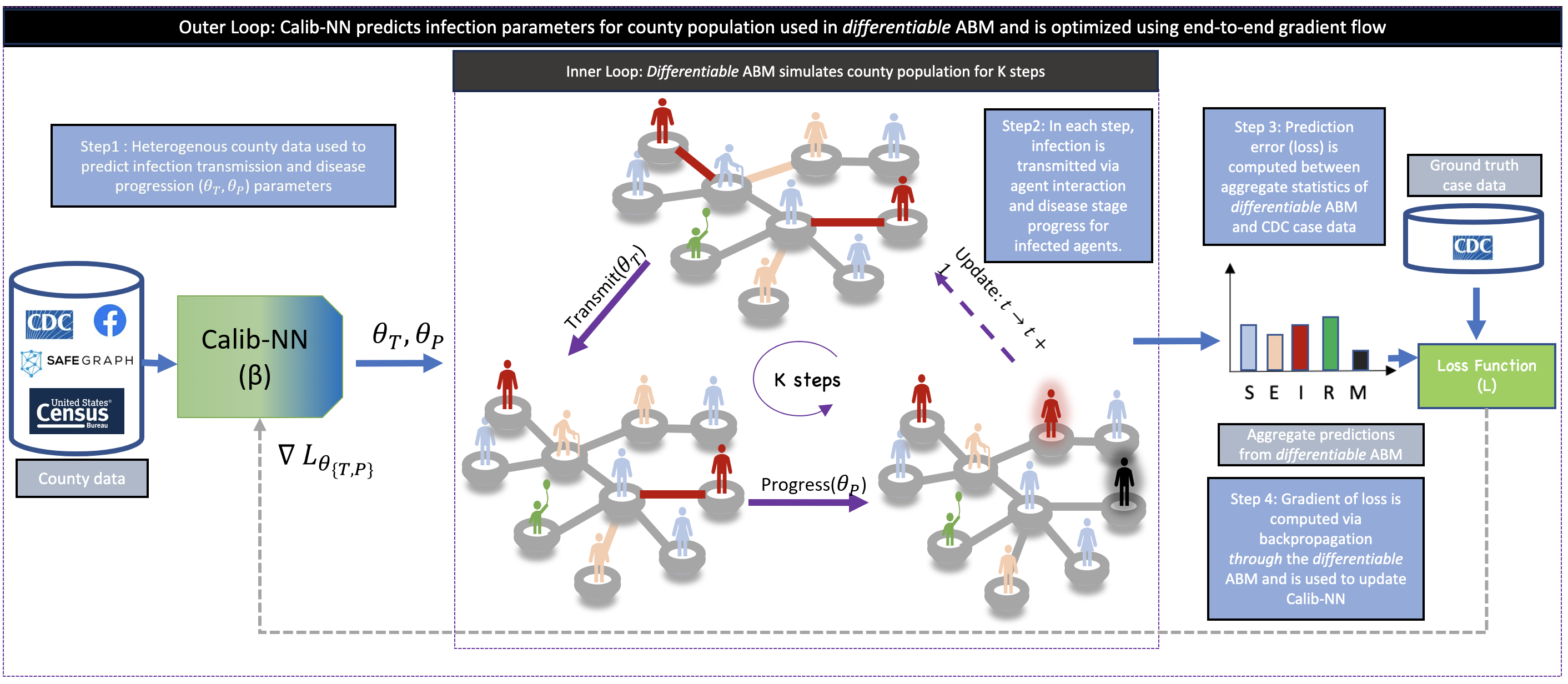
Figure 3: Calibration protocol for a differentiable ABM showing gradient-based learning leveraging heterogeneous data sources.
Decentralized Computation
The paper introduces secure computation frameworks to enable decentralized simulations, protecting individual privacy within large-scale modeling applications. Using secure multi-party protocols, LPMs can integrate real-world data with simulation processes, maintaining privacy and improving real-time simulation capabilities by operating directly where data resides.
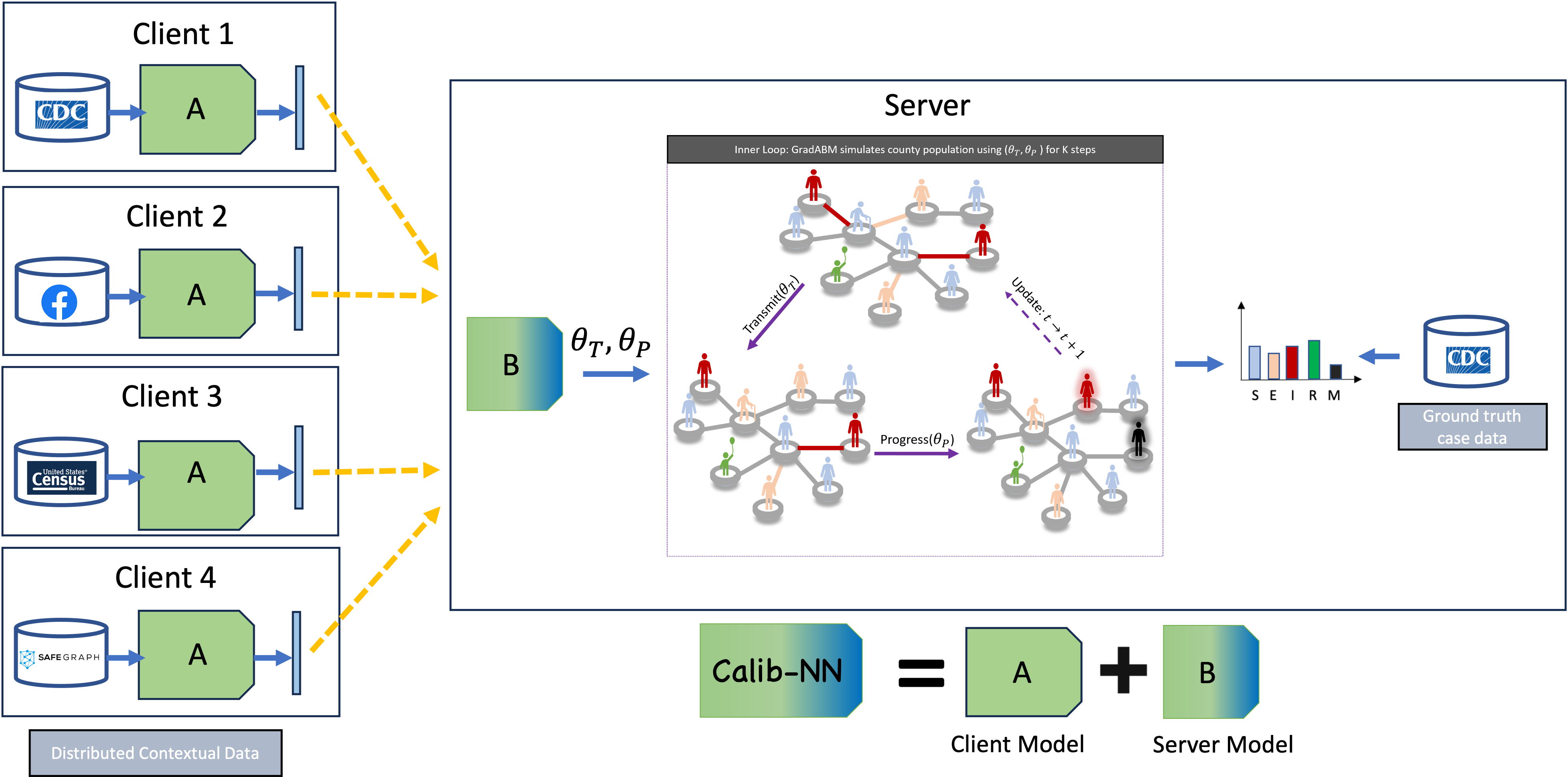
Figure 4: Distributed Calibration illustrating how calibration is executed across distributed clients using multi-modal data.
Case Study: COVID-19 in New York City
The paper provides a case study on the application of LPMs in modeling COVID-19 dynamics in New York City. It highlights how LPMs can simulate complex interactions between disease transmission, economic impacts, and intervention strategies across an 8.4 million-agent population. This demonstration emphasizes LPMs' capabilities in capturing emergent behaviors and informing policy decisions.
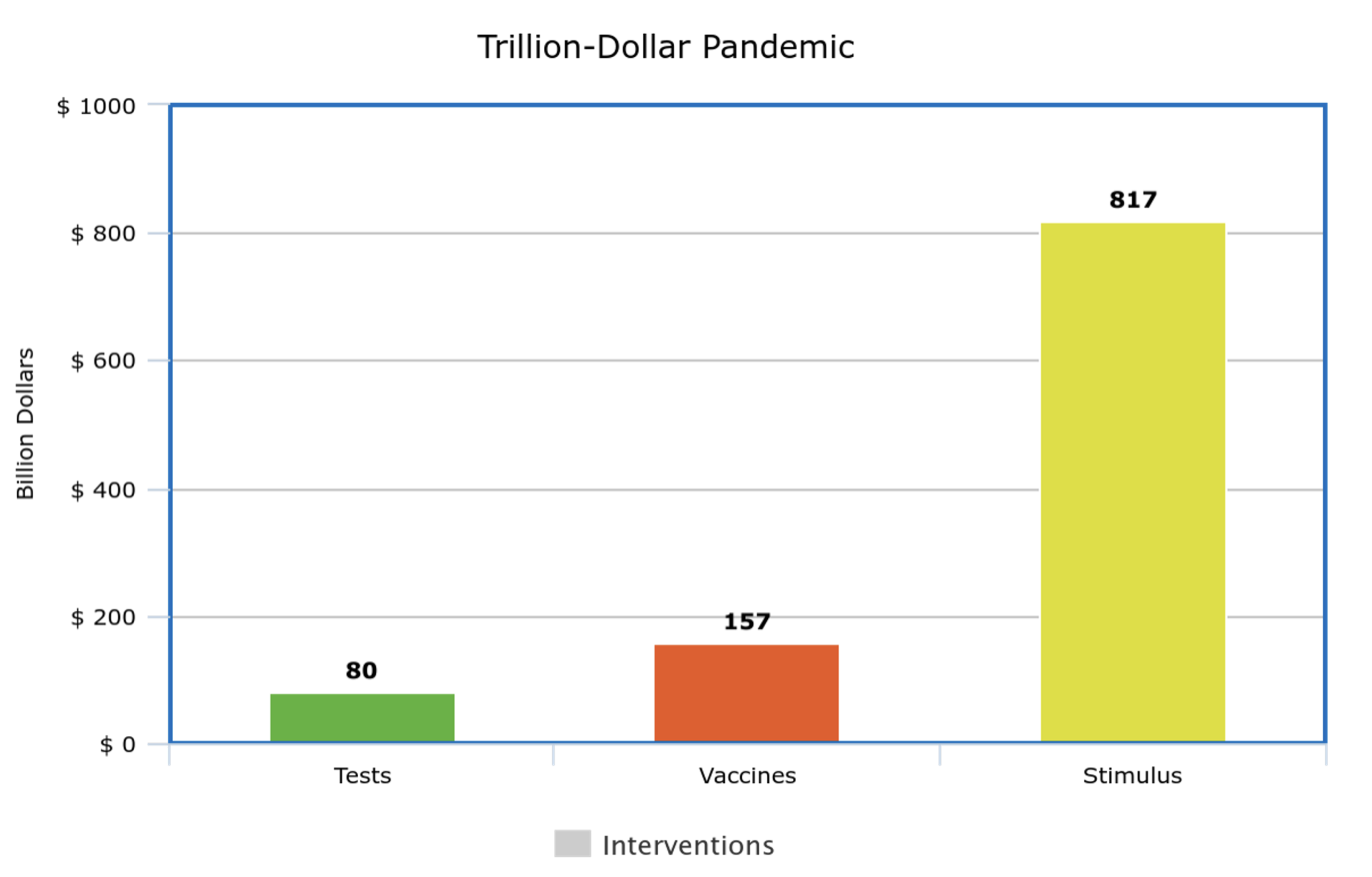
Figure 5: Trillion-Dollar Pandemic resource allocation emphasizing the role of behavioral incentives in pandemic management.
Implications and Future Work
LPMs offer a comprehensive framework for addressing complex societal challenges by efficiently modeling large populations and their interactions. Challenges related to privacy, scalability, and data integration are mitigated through innovations in distributed computation and differentiable modeling. Future work involves refining these models, improving real-time data assimilation, and exploring cross-domain applications in public health, economics, and disaster response.
Conclusion
Large Population Models represent a significant development in agent-based modeling, enabling scalable, efficient, and privacy-preserving simulations of large populations. Through advancements in compositional design, differentiable frameworks, and decentralized computation, LPMs provide a path for more accurate, timely, and ethical modeling of complex systems. These capabilities are crucial for crafting informed interventions and understanding the intricate dynamics of societal challenges.