- The paper presents a robust cryo-EM pipeline that jointly optimizes pose estimation and shift correction using an ℓ1-norm spherical embedding approach.
- It enforces strict orthogonality and normalization constraints to mitigate angular errors and enhance reconstruction accuracy under low SNR conditions.
- Experimental results on synthetic and class-averaged data demonstrate improved fidelity and reduced particle requirements compared to classical methods.
Robust ℓ1-Norm Joint Pose Estimation and Shift Correction in Cryo-EM
Introduction
High-fidelity 3D structure recovery of macromolecules from single-particle cryo-EM remains fundamentally limited by low SNR in acquired micrographs and the necessity for precise estimation of both orientation (pose) and in-plane translational shift for each 2D projection. This work presents a new pipeline for robust orientation and shift parameter recovery that combines a statistically grounded ℓ1-norm spherical embedding approach with iterative shift refinement, significantly enhancing pose estimation quality and reconstruction accuracy. Distinct from classical methods that optimize over squared-error objectives or permit soft constraint enforcement, this pipeline incorporates exact orthogonality constraints and robust loss formulations, delivering improved angular recovery and downstream 3D reconstruction accuracy, demonstrated on multiple synthetic and experimental datasets.
Methodological Contributions
The core advancement is a robust spherical embedding-based joint optimization for global orientation and in-plane rotation estimation, formulated under strict orthogonality and normalization constraints. Orientation recovery relies on the geometry of common lines between projection Fourier slices, but, critically, angular measurements are aggregated using a probabilistic voting approach for confidence-weighted, denoised angular evidence, mitigating outlier effects that are inevitable under low SNR.
For the shift estimation, the pipeline couples pose recovery with an iterative, globally consistent, common-line-based refinement, leveraging a least-squares solution to a sparse, linear system constructed from pairwise phase offsets detected between properly re-centered projections. This method adapts principles from earlier consistency-based shift correction methods but ensures continual common-line consistency throughout the iterative process, directly correcting for the degradation in common line reliability observed with prior approaches.
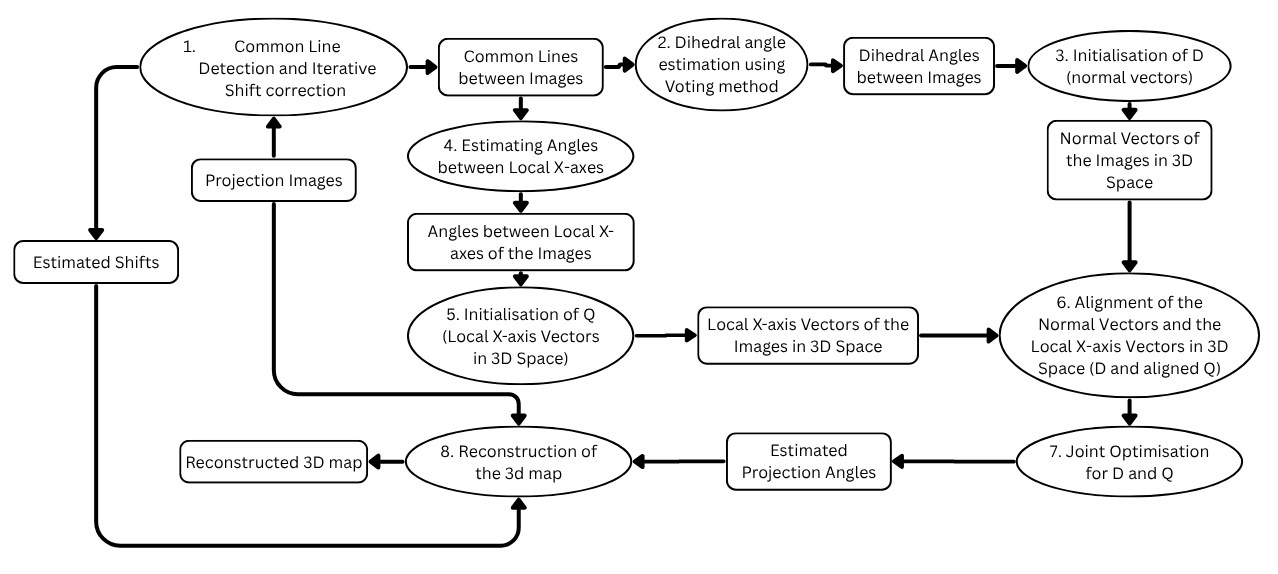
Figure 1: The full pipeline integrates orientation estimation and in-plane shift refinement into a unified procedure.
Detailed Algorithmic Framework
The algorithm for pose recovery initializes rotation axes and in-plane vectors via projected gradient descent, carefully enforcing unit norm and per-projection orthogonality constraints between axis and in-plane vectors. The joint spherical embedding loss is minimized via a robust ℓ1-objective:
J(D,Q)=∥W⊙(DD⊤−cos(Θ))∥1+∥W⊙(QQ⊤−cos(Φ))∥1
subject to ∥di∥2=∥qi∥2=1 and di⊤qi=0 for all i, where all angular measurements are weighted by confidence derived from the probabilistic histograms over aggregated dihedral estimation.
Optimization alternates between projected updates to axis and in-plane vectors, with each gradient step orthogonally projected, fully resolving geometric constraints at each iteration—an approach that distinguishes this method from alternatives relying on post-hoc projections, synchronizations, or ℓ2-loss minimization, thus achieving improved robustness to errors in angular measurements.
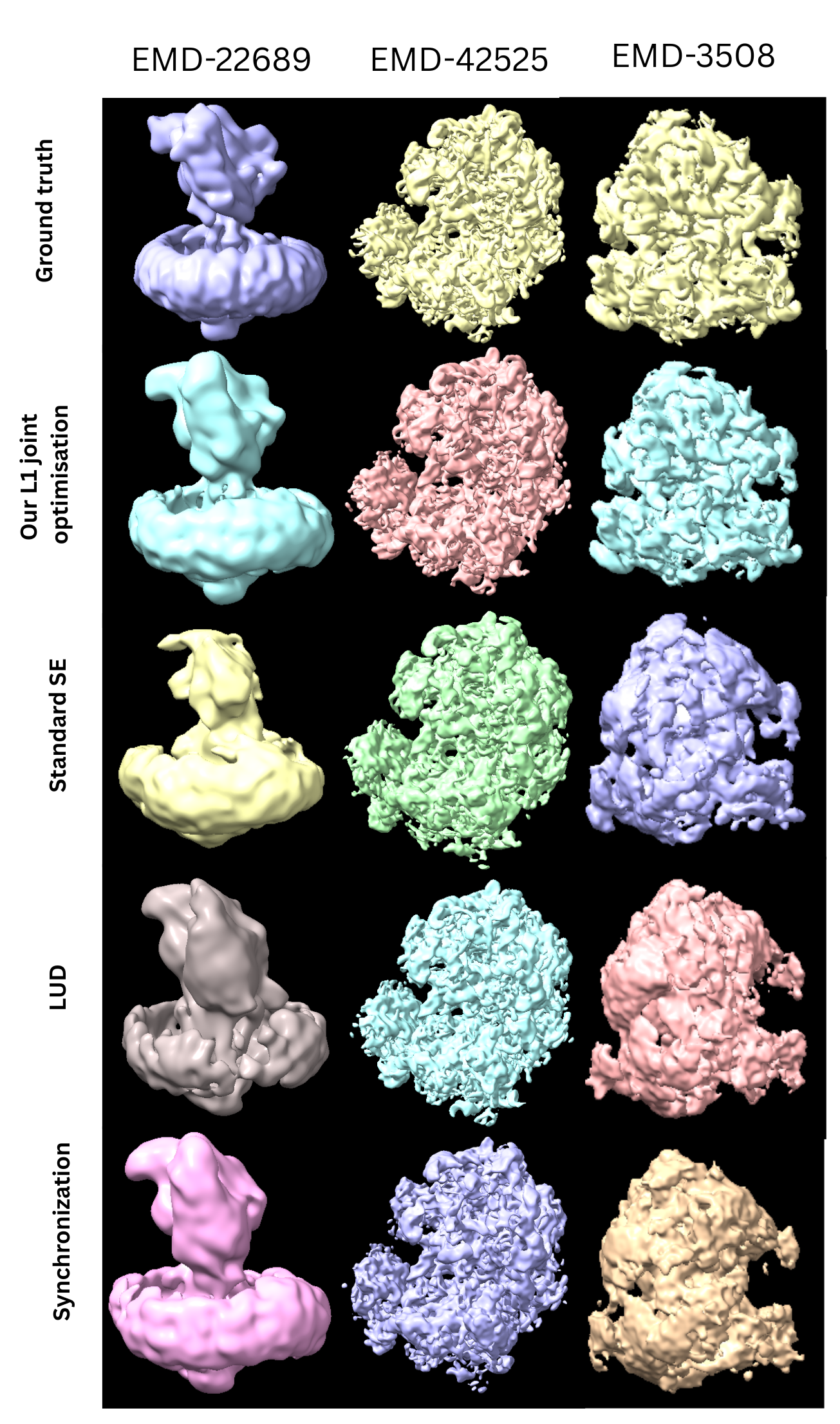
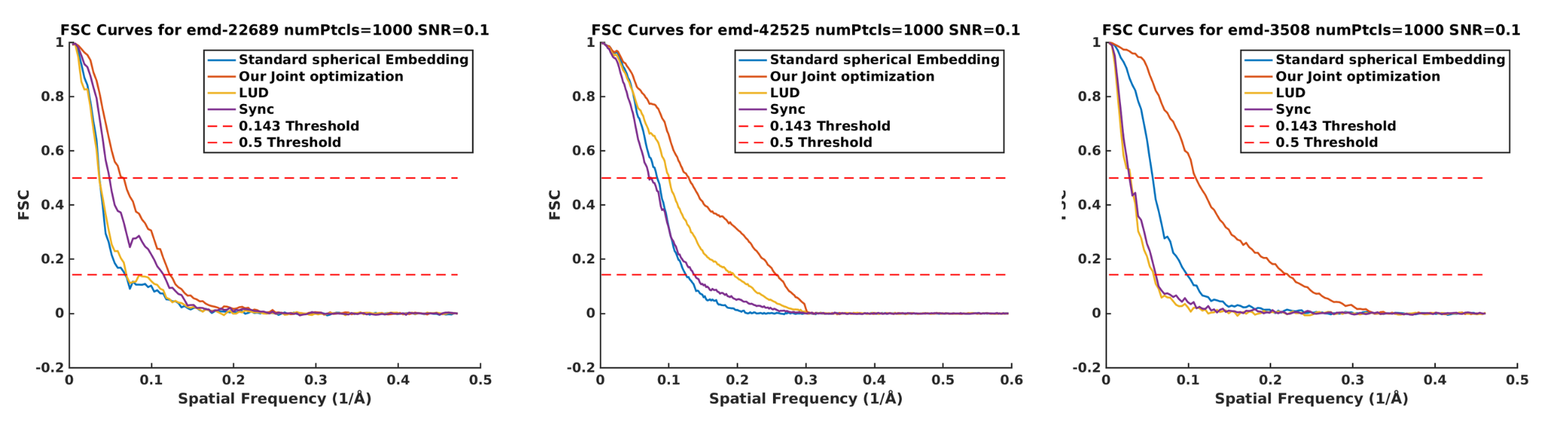
Figure 2: FSC curves and visual comparisons for reconstructions with known centered particles, highlighting the accuracy gains from the joint pose estimation.
The shift correction operates in Fourier space. At each outer iteration, phase corrections corresponding to current shift estimates are applied to the polar Fourier slices. Common lines are detected on corrected images, and the relative phase offset between original (uncorrected) rays is identified for every image pair, thereby relating observed correlations back to true unknown shifts. The resulting linear system across all pairs is solved in closed form, and after each global update, the consistent geometry of the system is improved, leading to numerical convergence in practice.
Experimental Results
Synthetic Datasets
On simulated projections from diverse atomic-resolution maps, under severe (SNR=0.1) noise conditions, the proposed method yields substantially lower mean angular errors and improved FSC metrics versus SE [lu2022], LUD [wang2013_lud], and synchronization [Shkolnisky2012_sync] variants, both in the purely angular recovery setting and when combined with realistic translational shifts.
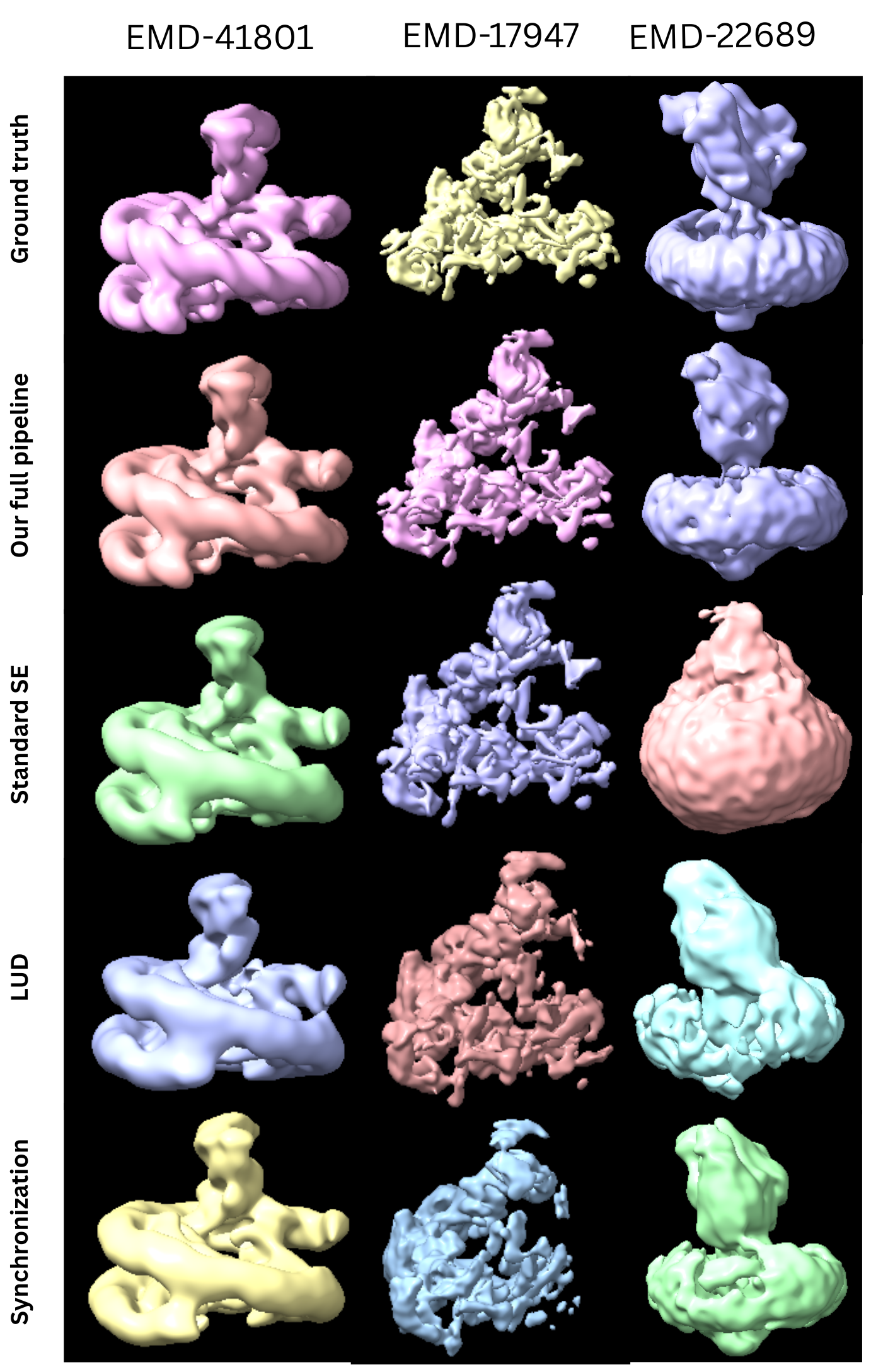
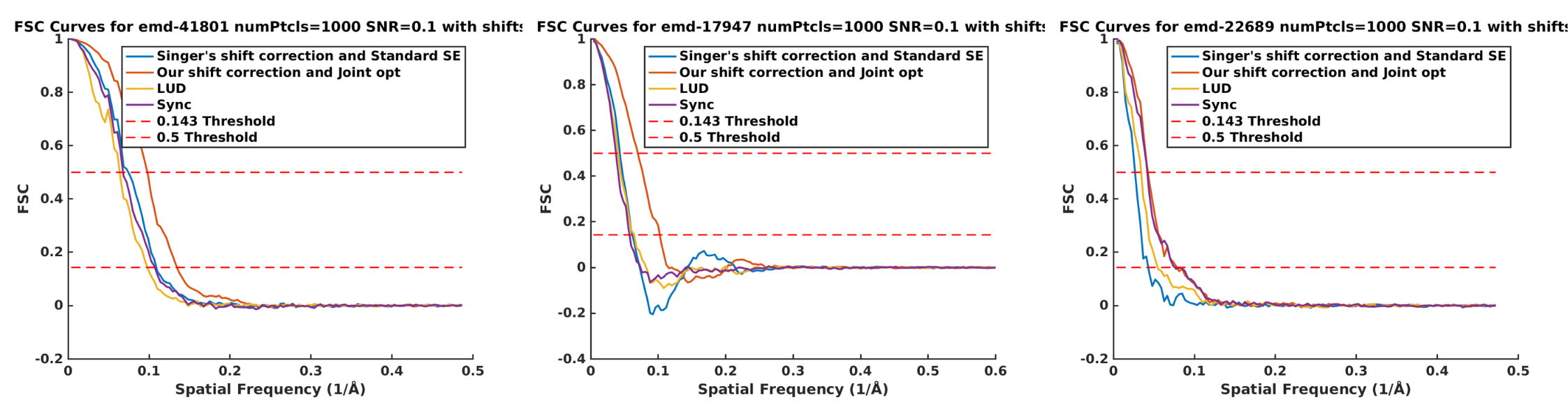
Figure 3: Joint pose and shift estimation results for synthetic data, confirming the efficacy of the pipeline relative to state-of-the-art alternatives.
Moreover, the pipeline achieves similarly high-fidelity reconstruction outcomes with as few as 1000 particles, compared to previous approaches that require orders of magnitude more input images to reach comparable detail and structural consistency.
Real (Class-Averaged) Data
On experimental micrograph datasets, pose and shift estimation were performed on class-averaged projections, which significantly boost SNR at the cost of potential loss in fine structural information. The proposed method delivers reconstructions that are competitive with RELION-class ground-truths generated from millions of raw particles, and substantially outperforms prior methods particularly on challenging nucleosome datasets, where alternative pipelines fail to recover structural detail.
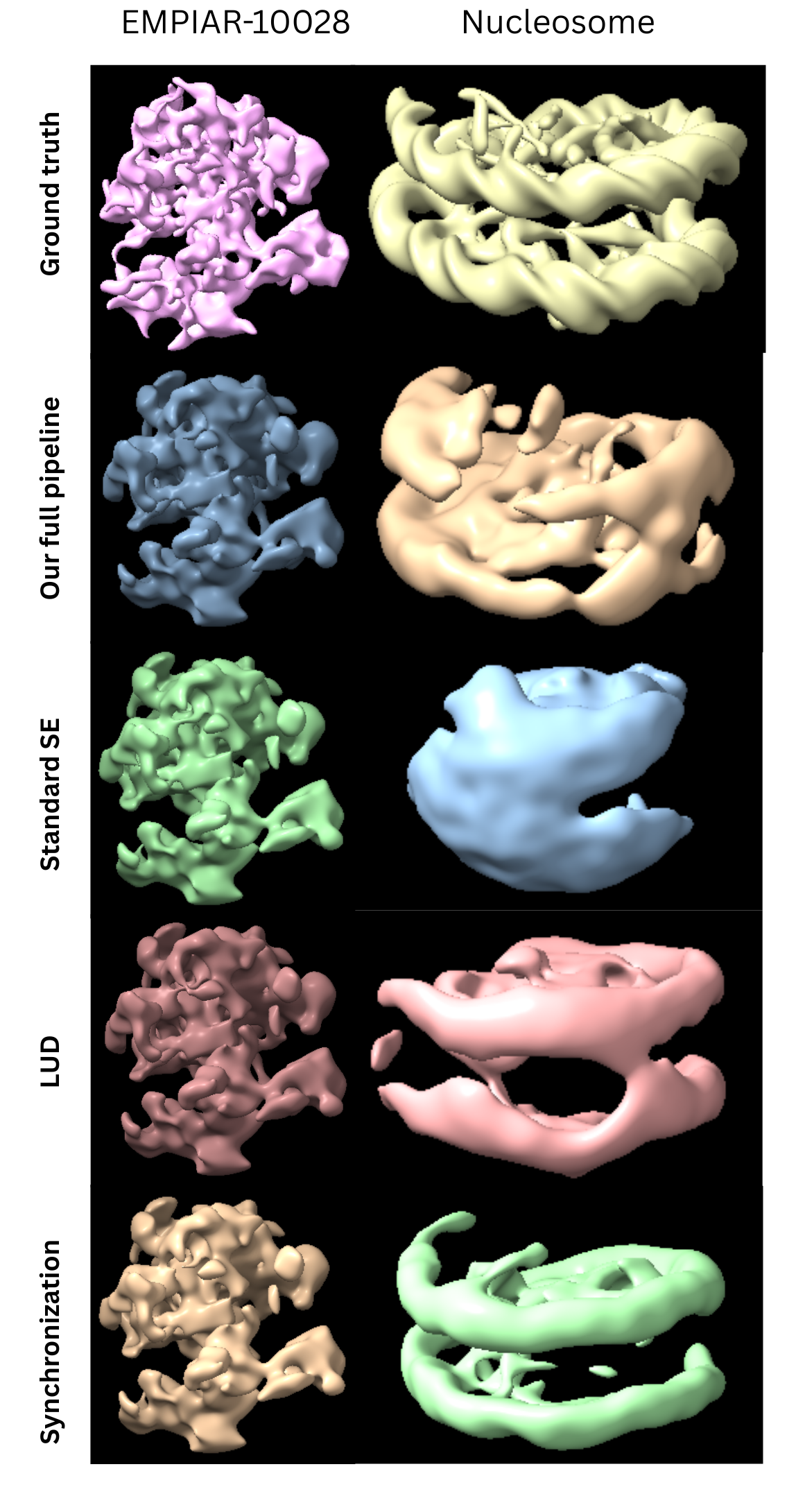
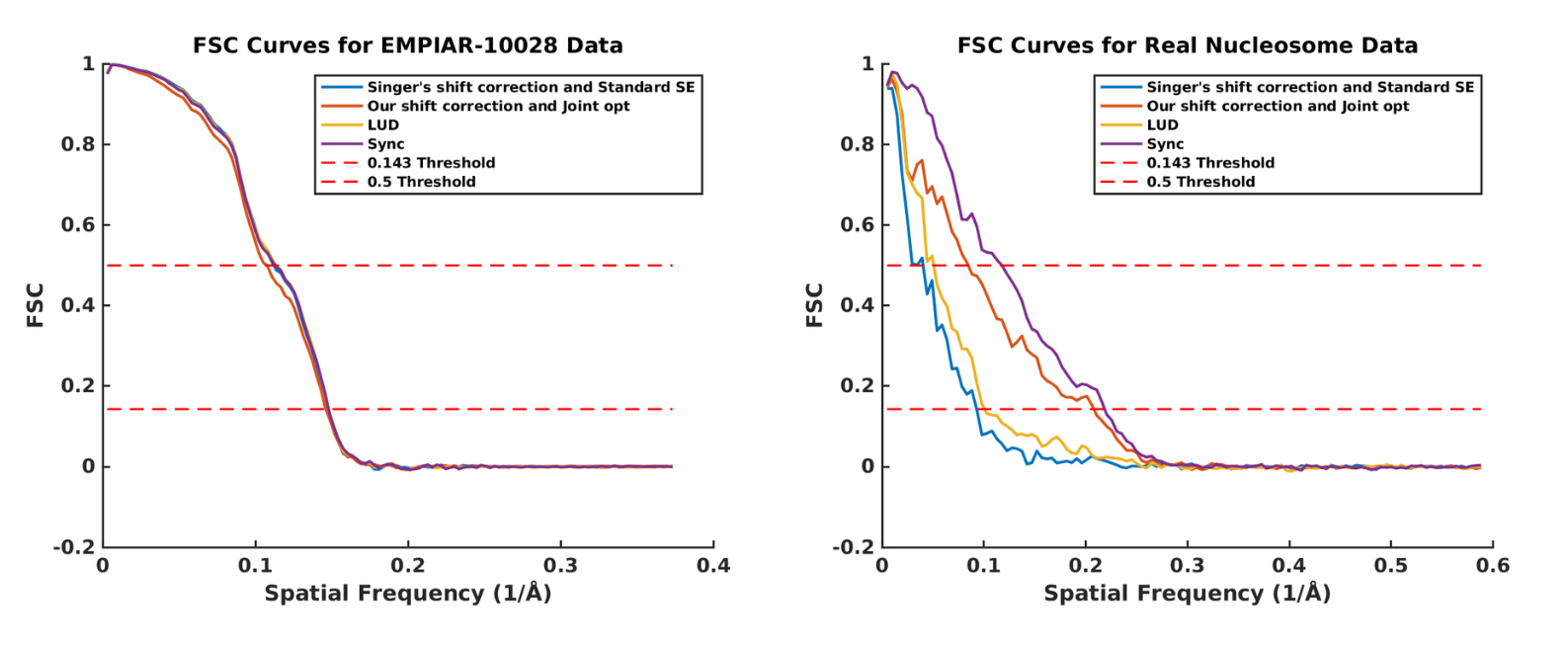
Figure 4: Reconstructions from real class-average datasets, indicating structural fidelity and improved Fourier domain correlation.
Application to raw micrograph data remains challenging due to extreme SNR limitations; as highlighted by visual examples, current projection images before averaging are typically too noisy for effective pose recovery.
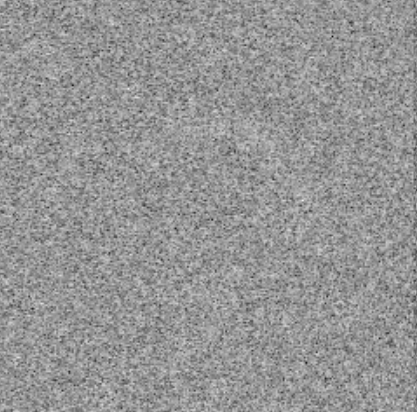
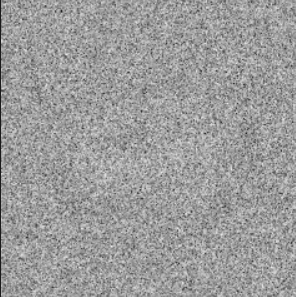
Figure 5: Example raw 70S ribosome micrograph, underscoring the formidable SNR challenge faced by pose estimation pipelines.
Class averaging presents a practical solution but at significant data and computational cost.
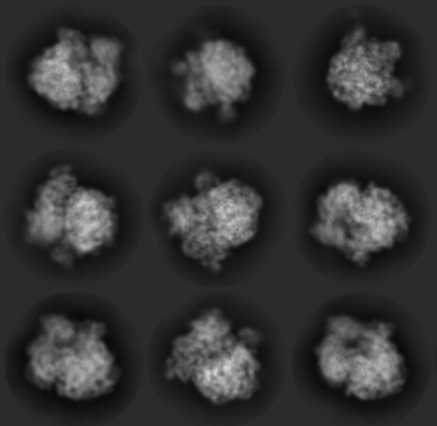
Figure 6: Sample class averages produced by RELION, showing improved SNR that enables successful 3D recovery with a small number of views.
Comparative Analysis and Discussion
The proposed framework is distinguished by:
- Strict orthogonality enforcement during joint pose estimation, in contrast with SE and LUD.
- Robust ℓ1-based loss that mitigates angular outlier effects due to low SNR, as opposed to ℓ2-optimized or synchronization methods.
- Iterative shift correction that maintains ongoing consistency between detection geometry and estimated shifts, reducing error propagation and instability in reconstructions.
- Superior empirical results especially notable under low-SNR simulation, where competing pipelines fail to recover meaningful structures.
Notably, the pipeline does not require iterative EM loopbacks between structure and pose estimation (as in RELION), but can be incorporated as a high-quality initialization method, providing both algorithmic simplicity and computational efficiency.
Implications and Future Directions
This methodology enables real-time 3D reconstruction during cryo-EM data collection, facilitating on-the-fly quality assurance and potentially accelerating the molecular discovery pipeline. It opens avenues for fully unsupervised, robust pose estimation directly on minimized datasets, reducing experimental and computational demands.
However, the reliance on common line detection remains a vulnerability under ultra-low SNR, especially for raw, unaveraged particle images. Advances in learning-based common line detection or integration with deep scoring functions could address failure modes in noisy or highly heterogeneous samples.
Future work should target further improvements in the geometric reliability of common line estimates within the iterative refinement procedure, and extension toward single-shot reconstructions from raw data, including potential hybridization with end-to-end learned representations.
Conclusion
The pipeline delivers a robust, efficient, and statistically grounded solution for cryo-EM 3D pose and shift parameter estimation. By coupling a principled ℓ1-norm spherical embedding with iterative, globally consistent shift correction, and enforcing strict geometric constraints, the method advances the state-of-the-art in reconstruction quality—especially under data-poor or noise-dominated regimes. This positions the method as an effective component for both stand-alone and hybrid high-throughput cryo-EM analysis workflows, promising both practical utility and avenues for further theoretical innovation in geometric recovery of biological structure.
(2507.14924)