- The paper presents a novel runtime that fuses semantic operators with deep research systems to optimize unstructured data analytics.
- It demonstrates up to a 1.95x improvement in F1-scores along with 76.8% cost and 72.7% runtime savings compared to traditional methods.
- The integrated approach employs logical and physical optimizations, such as cached context reuse, to dynamically enhance query execution efficiency.
Deep Research as an AI-Driven Analytics System
Introduction to AI-Driven Analytics
The integration of AI in analytics systems aims to provide efficient analysis of vast unstructured datasets through AI-driven approaches. Traditional systems, such as OLAP databases, have historically excelled in handling structured data but lack robustness when addressing unstructured workloads. The paper "Deep Research is the New Analytics System: Towards Building the Runtime for AI-Driven Analytics" proposes a novel system that leverages the advantages of semantic operators and Deep Research systems.
Semantic operators represent AI-driven transformations specified in natural language, providing a declarative framework for task optimization. Meanwhile, Deep Research systems utilize LLMs to execute and refine query plans, bridging the gap between dynamic execution and optimized semantic processing.
The main objective of this research is to create a runtime system that effectively combines the efficiency of semantic operators with the dynamic capabilities of Deep Research systems for unstructured analytics tasks.
Semantic Operators and Deep Research Integration
Semantic operator systems have proven effective in optimizations for tasks such as information extraction, ranking, and summarization across large unstructured datasets. They utilize relational-like operators in an AI-driven context. Despite their strengths, they are currently limited by their iterator execution semantics, which often results in inefficiencies for interactive analytics tasks over extensive datasets.
Conversely, Deep Research systems dynamically adapt to user queries using tools, iterative planning, and execution with LLMs, yet they often suffer from suboptimal execution plans due to their flexibility and lack of formal optimization steps.
The proposed system integrates Deep Research computational strategies with optimized execution plans generated through semantic operators, offering a comprehensive solution to dynamic and efficient unstructured data processing.
Implementation and Evaluation
The prototype implementation extends the Palimpzest framework, introducing compute and search operators supported by LLM agents. These operators process inputs in a dynamic fashion while offering optimized execution facilitated by semantic operators.
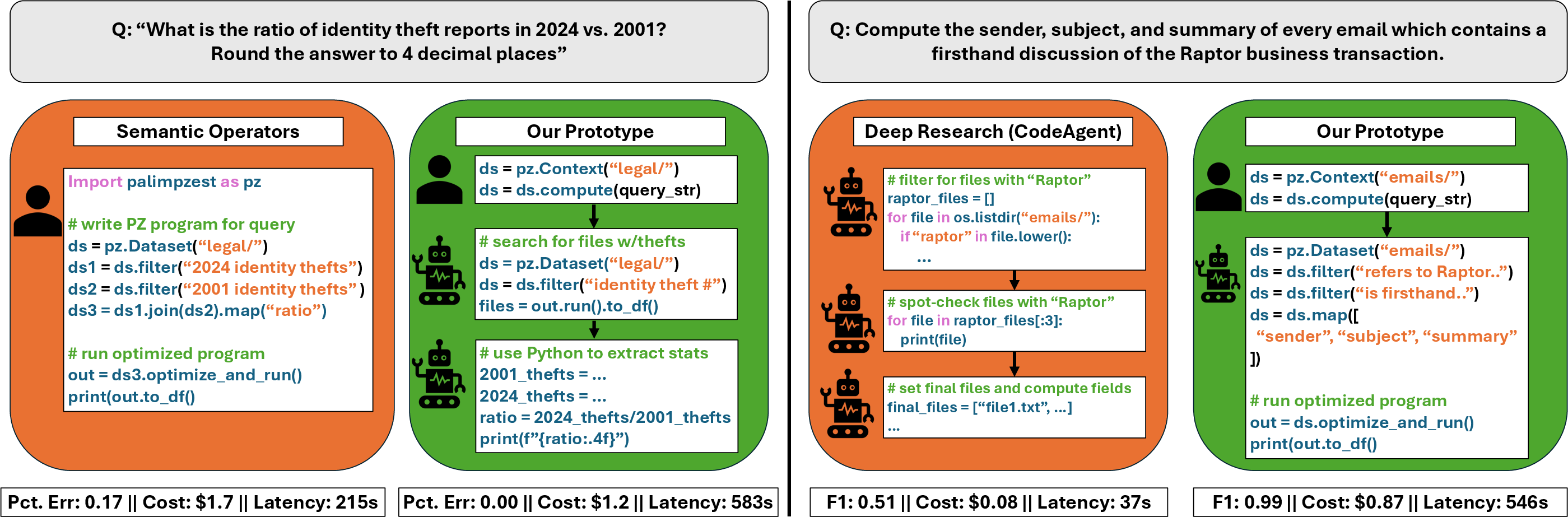
Figure 1: An example implementation showcasing queries on unstructured datasets where semantic operators struggle due to high execution cost, remedied by the dynamic and optimized approach of the prototype system.
Experiments demonstrate the prototype's efficiency over traditional approaches by significantly reducing error rates and execution times. The system achieves up to 1.95x better F1-scores compared to standard open Deep Research systems, while demonstrating resource savings of up to 76.8% in cost and 72.7% in runtime.
Optimizations for Efficient Execution
Logical and physical optimizations are key to the proposed system's framework. Logical optimizations involve rewriting queries to improve scope specification and potentially merge similar operations to reduce redundant computation. Physical optimizations, conversely, focus on reusing cached contexts to enhance query efficiency, implementing materialized Contexts with retrieval capabilities that match new instructions closely.
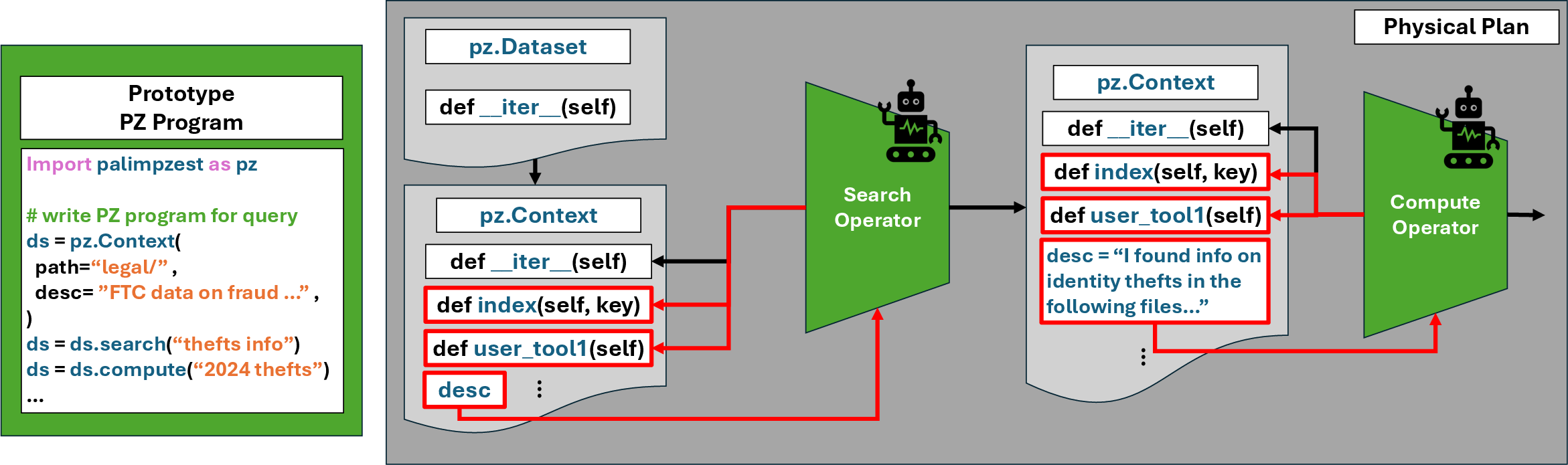
Figure 2: Overview of the Palimpzest program illustrating Context object creation and operator execution, reflecting the system's optimized approach to analytics.
Future Directions
The research suggests several avenues for future improvement, including enhancements to query optimization techniques and further integration of LLMs for adaptive runtime. Materialized Contexts hold promise for long-term efficiency and responding to dynamic environments through indexed caching.
Ongoing advancements in AI-driven analytics demand further exploration into unifying structured and unstructured data processing capabilities by drawing on the strengths inherent in existing systems while innovatively addressing current limitations.
Conclusion
This study offers a foundational approach to AI-driven analytics, merging the tailored execution capabilities of Deep Research systems with the optimized pathways of semantic operators. While traditional techniques face challenges with unstructured data, this integrated system presents a robust alternative with proven efficacy, offering considerable advancements in both flexibility and efficiency.
In sum, the contribution of "Deep Research is the New Analytics System" lies in its innovative proposal for overcoming existing challenges in AI-driven data analytics, fostering new possibilities for efficient and automated unstructured data processing.