- The paper provides a detailed kinematic reconstruction showing that stellar flybys impart negligible perturbations to 3I/ATLAS's trajectory.
- It employs backward orbital integration with the Gala package and Gaia DR3 astrometry to identify 62 high-confidence close encounters.
- Results confirm 3I/ATLAS’s thin-disk membership, suggesting its ejection mechanism is driven by processes other than recent stellar flybys.
Dynamical History and Galactic Context of 3I/ATLAS
Introduction
The paper presents a comprehensive kinematic and dynamical analysis of 3I/ATLAS, the third confirmed interstellar object (ISO) detected traversing the Solar System. With its highly hyperbolic orbit (e∼6.1) and excess velocity (∼58 km s−1), 3I/ATLAS provides a unique probe of the Galactic population of icy planetesimals. The study aims to reconstruct the object's past trajectory through the Milky Way, identify close stellar encounters using Gaia DR3 astrometry, and assess whether any such encounters could be linked to its origin or have significantly perturbed its orbit.
Methodology
The authors employ a backward integration of the 3I/ATLAS orbit for 10 Myr, using initial conditions derived from pre-Solar System entry astrometry. The integration utilizes the Gala Python package and the MilkyWayPotential2022 model, incorporating a spherical nucleus and bulge, Miyamoto-Nagai disks, and an NFW halo, with Solar and LSR parameters from recent literature. The stellar sample is constructed from Gaia DR3, filtered for high astrometric and radial velocity quality, and supplemented with external RV catalogs (APOGEE, LAMOST, GALAH, RAVE, Gaia-ESO). Monte Carlo sampling of astrometric uncertainties is performed for robust encounter statistics.
A close encounter is defined as a passage within 2 pc, corresponding to the maximum distance for significant cometary perturbation. The Classical Impulse Approximation (CIA) is used to estimate the velocity kick (∣Δv∣) and deflection angle (θ) imparted by each flyby, with stellar masses interpolated from Gaia colors and extinction-corrected using 3D dust maps.
Results: Encounter History and Dynamical Effects
The integration identifies 93 nominal encounters, of which 62 are significant at the 2σ level. The strongest encounter, Gaia DR3 6863591389529611264 (0.30 pc, vrel=35 km s−1), imparts a velocity change of only ∣Δv∣≃5×10⁻⁴ km s−1 and a deflection angle θ≃1.6×10⁻⁵ rad, corresponding to a negligible positional deviation (∼0.05 pc over 100 Myr). All other encounters yield even smaller perturbations, with θ values in the 10−6--10−5 range.
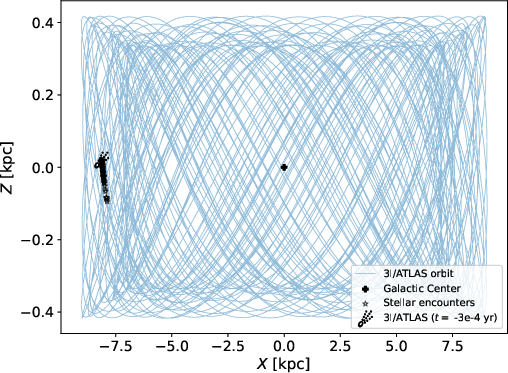
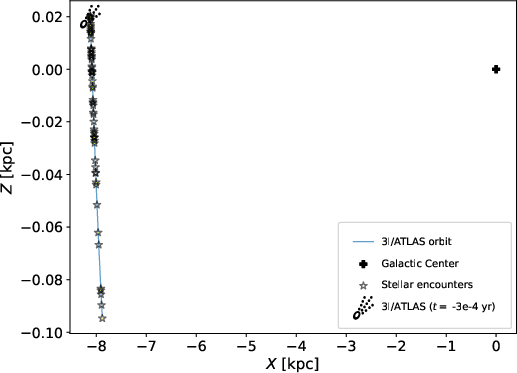
Figure 1: Galactic trajectory of 3I/ATLAS integrated 12 Gyr Myr backward in time, projected onto the Galactic XY plane. Stars mark the 62 high-confidence encounters identified in this work.
The completeness analysis, based on local stellar density and RV coverage, suggests that the Gaia DR3 sample is ∼25% complete within the relevant volume. However, statistical modeling indicates that the probability of missing a strong encounter (θ>10−2) is negligible (N∼10−5 for the 4.27 Myr window).
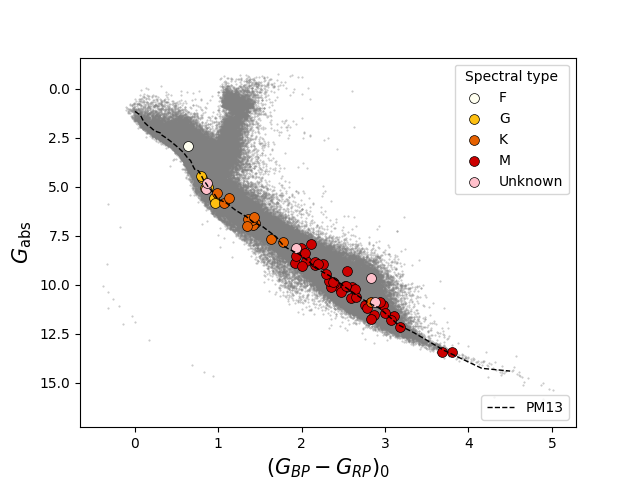
Figure 2: Position on the Gaia CMD diagram of the stars that experienced a close encounter with 3I/ATLAS, with spectral types indicated in the legend.
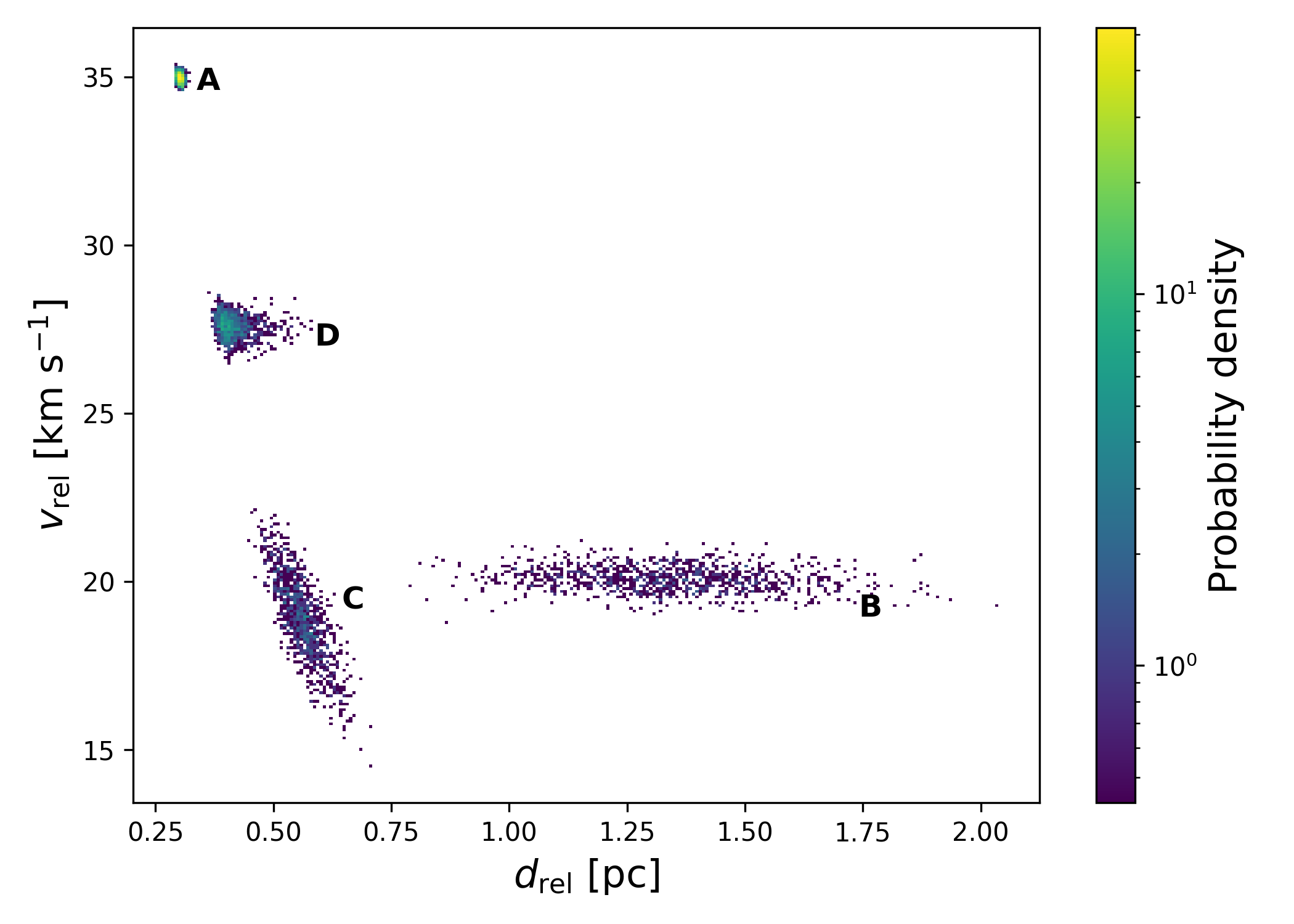
Figure 3: Relative velocity vrel as a function of relative distance drel for the four strongest encounters obtained from 103 Monte Carlo orbits.
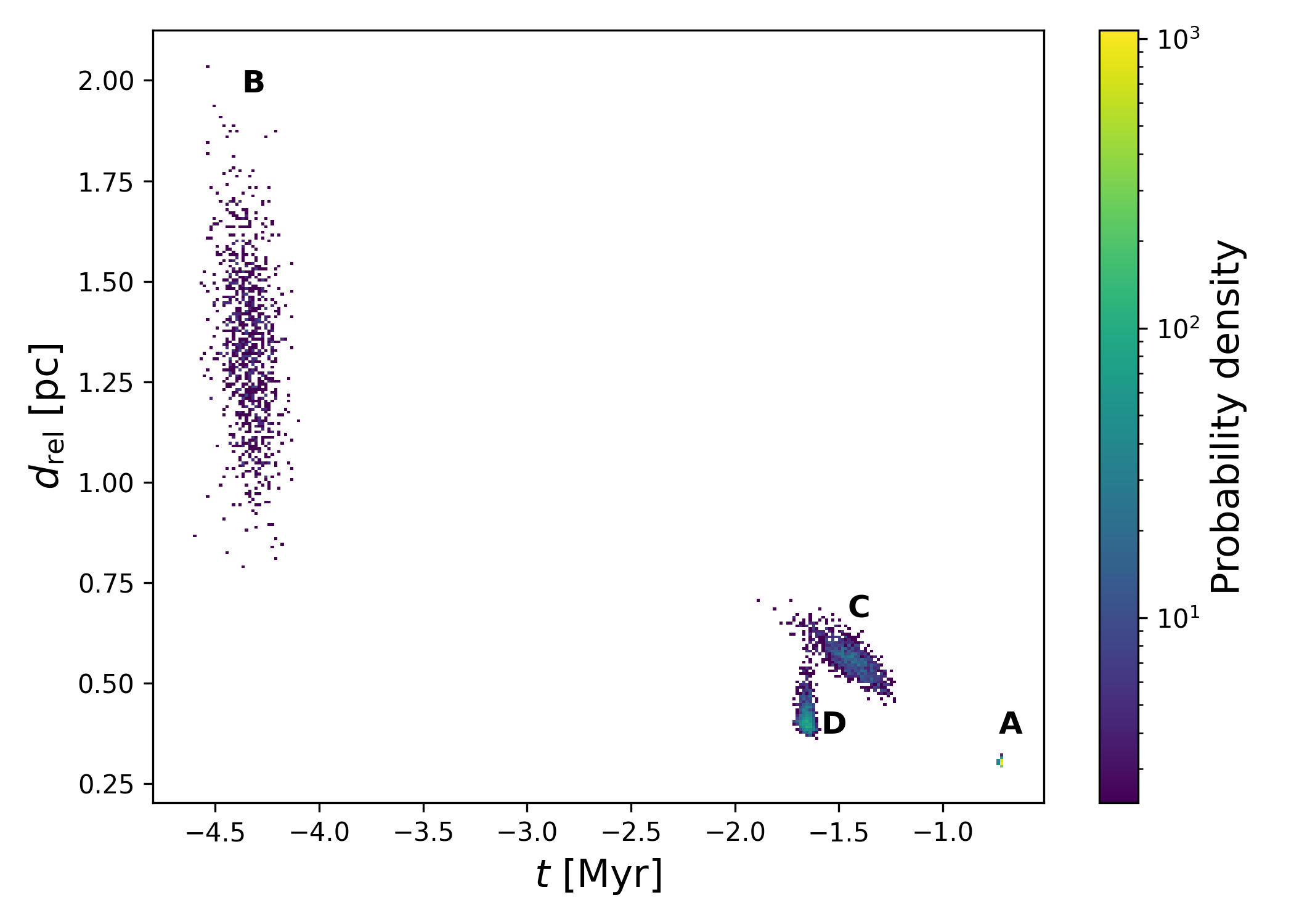
Figure 4: Relative distance drel as a function of time t for the four strongest encounters obtained from 103 Monte Carlo orbits.
Galactic Population Membership
The vertical excursion of 3I/ATLAS (∣Z∣∼0.42 kpc) and its Toomre velocity (T∼58 km s−1) place it within the thin disk regime, well below the canonical thin/thick disk boundary (T∼70--$100$ km s−1). The Bensby et al. (2014) kinematic classification yields a thick-to-thin disk odds ratio of 0.04, indicating that 3I/ATLAS is ∼20 times more likely to belong to the thin disk. The E--Lz integrals-of-motion also confirm its thin-disk locus.
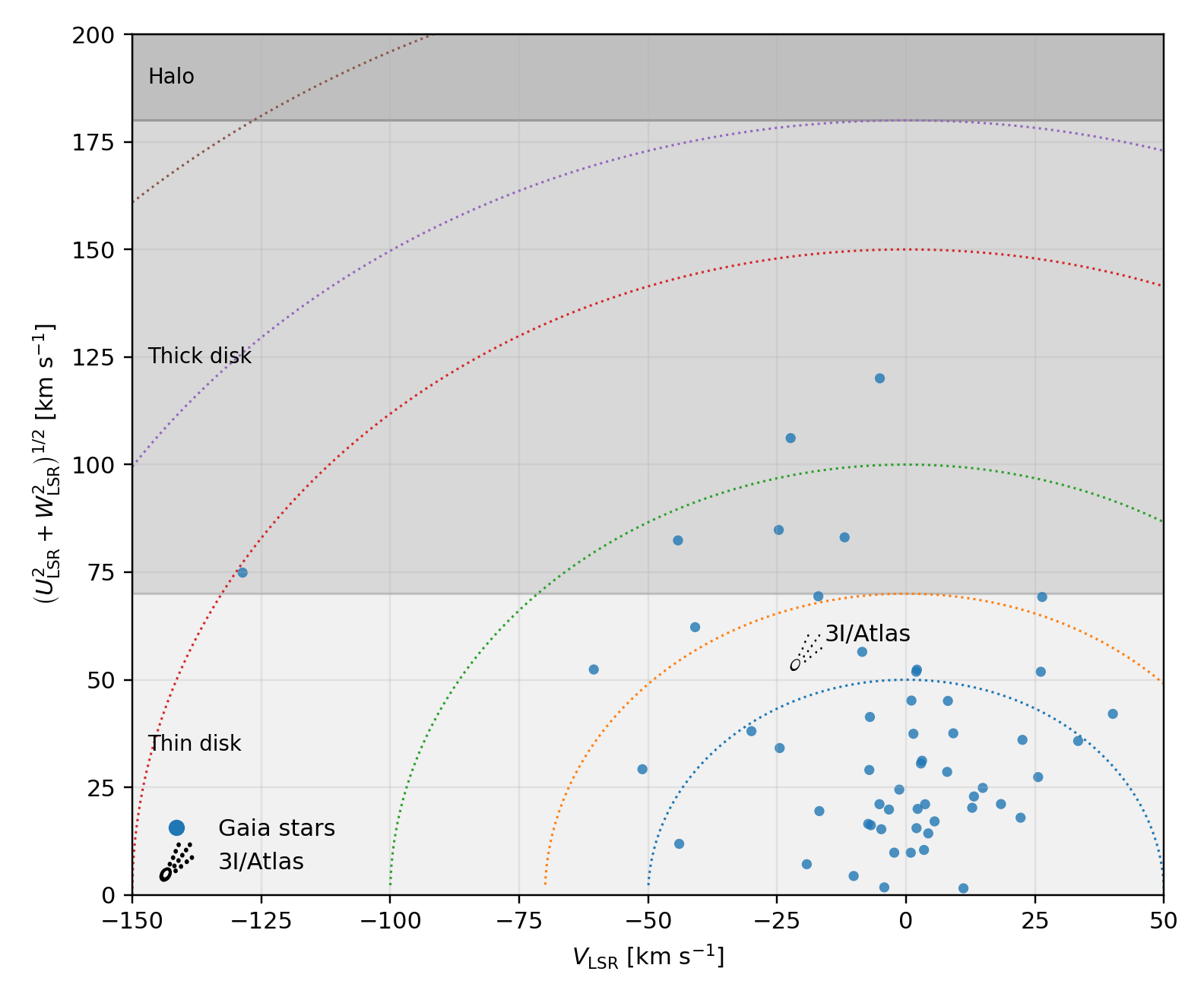
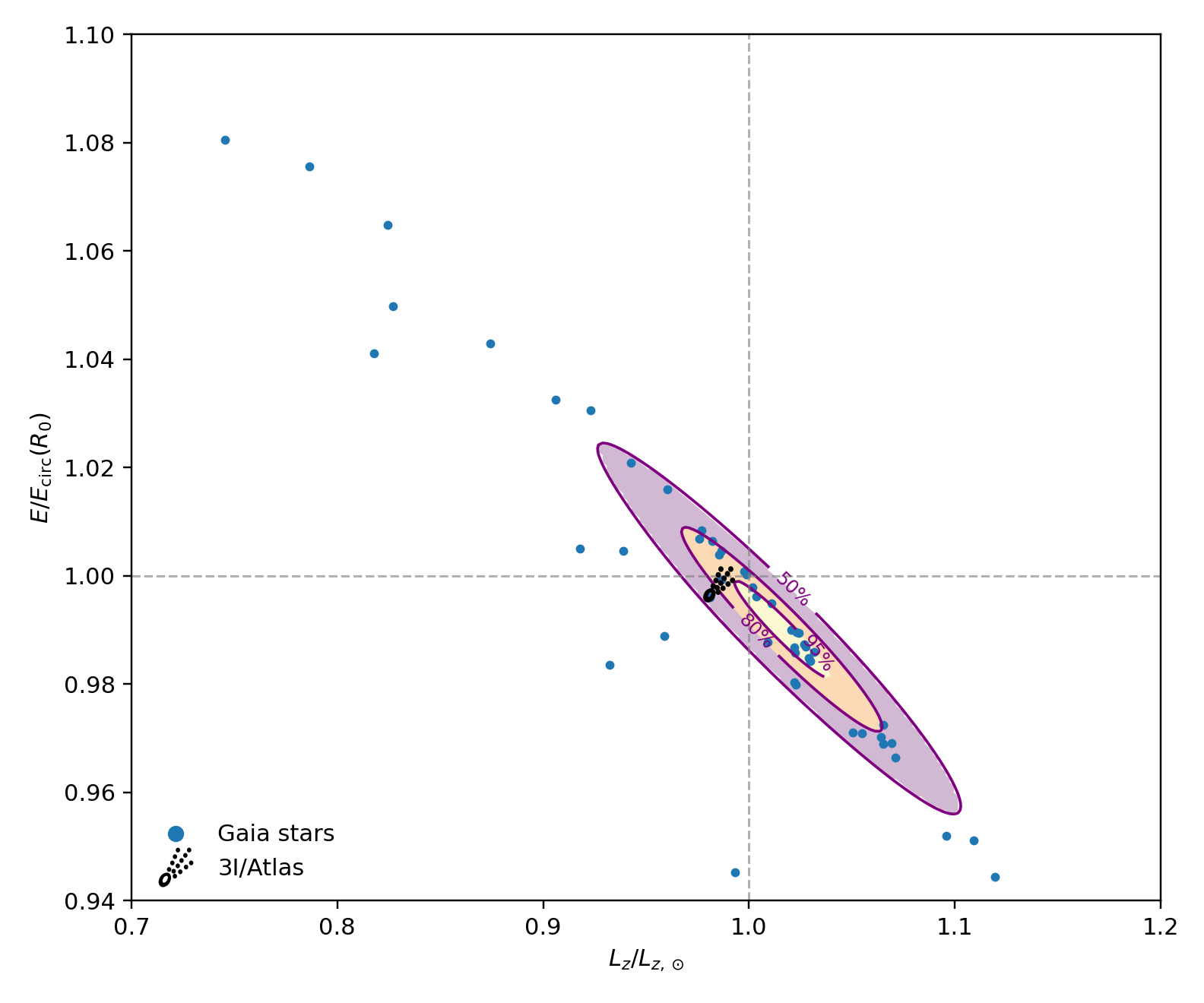
Figure 5: Kinematic diagnostics for 3I/ATLAS. Left: Toomre diagram for 3I/ATLAS. The vertical axis shows the quadrature of the radial and vertical velocities (T) and the horizontal axis the azimuthal velocity. Shaded regions indicate the thin disk (T≲70 km s−1).
Comparison with Previous Studies
The encounter list partially overlaps with that of Guo et al. (2025), with discrepancies attributed to differences in initial conditions, Gaia systematics, and Galactic potential models. The analysis demonstrates that robust encounter identification is limited to short look-back times (≲1 Myr), beyond which astrometric and model uncertainties dominate.
Implications and Future Directions
The results strongly indicate that 3I/ATLAS's present trajectory cannot be attributed to any stellar flyby within the past 10 Myr and 500 pc covered by Gaia DR3. The lack of significant perturbations supports the hypothesis that ISOs such as 3I/ATLAS are ejected from their parent systems by mechanisms other than close stellar encounters, such as planetesimal scattering, post-main-sequence mass loss, or dynamical heating by GMCs and spiral arms. The thin-disk kinematics, combined with a possible old kinematic age (∼7 Gyr), suggest ejection from a long-lived primordial disk or exo-Oort cloud.
The study highlights the limitations of current astrometric catalogs for reconstructing ISO encounter histories, especially for older objects. As the ISO sample grows and Gaia-like astrometry improves, chemodynamical correlations between ISO compositions and Galactic kinematics may become accessible, enabling direct tests of planet formation and disk evolution models across the Galaxy.
Conclusion
The dynamical analysis of 3I/ATLAS demonstrates that its orbit has remained essentially unperturbed by stellar encounters in the solar neighborhood over the past 10 Myr. The object is kinematically consistent with the Galactic thin disk, and its origin is not associated with any known nearby star. The findings reinforce the view that ISOs are a heterogeneous population, shaped by a variety of ejection mechanisms, and that their encounter histories are challenging to reconstruct with current data. Future surveys and improved astrometric precision will be essential for advancing the chemodynamical study of ISOs and their role in Galactic planetary system evolution.