- The paper presents a novel ISAC framework that passively harvests irregular, multi-band CSI for Wi-Fi sensing, eliminating the need for active packet injection.
- It introduces a dual-stage process with CSI sanitization and a time-aware attention-based DNN, achieving 96.88% HAR accuracy on real-world datasets.
- The framework fuses diverse packet types across 2.4/5 GHz bands to preserve communication throughput while enabling efficient, non-intrusive sensing.
UniFi: A Unified Framework for Irregular, Multi-Band CSI Wi-Fi Sensing
Introduction and Motivation
The paper presents UniFi, an Integrated Sensing and Communication (ISAC) framework that leverages ambient, irregularly sampled Channel State Information (CSI) extracted passively from Wi-Fi communication packets across multiple frequency bands. Unlike previous solutions that rely on high-rate packet injection—resulting in significant communication overhead and poor scalability—UniFi operates entirely by repurposing naturally occurring data, management, and control frames on commodity hardware. Empirical traffic analysis confirms that over 70% of Wi-Fi packets in typical deployments are non-data frames, providing a rich, previously untapped source of CSI for downstream sensing tasks.
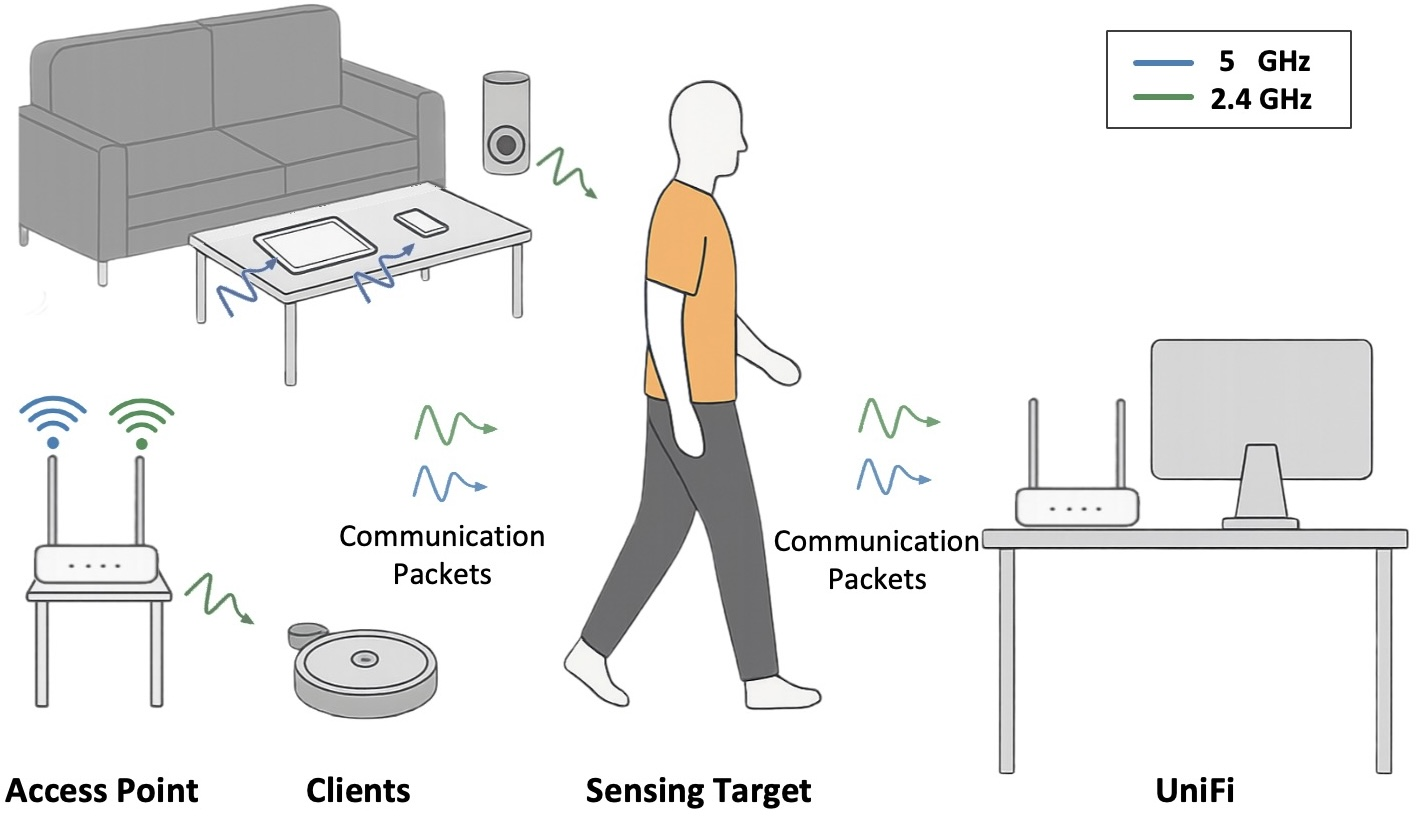
Figure 1: UniFi harvests irregularly sampled CSI from diverse communication packets seamlessly and non-intrusively.
Existing Wi-Fi sensing systems almost universally depend on regular, high-frequency CSI acquisition (100–1000 Hz) either by injecting artificial packets or by heavily resampling/interpolating naturally sparse streams. Notably, SenCom [he2023sencom] achieves partial ISAC by extracting CSI from communication data packets but reverts to injection when data traffic is insufficient, fundamentally retaining the communication–sensing trade-off. Solutions such as CSI-BERT2 [zhao2024mining] use robust deep models to handle packet loss, but fail to address the highly heterogeneous, non-uniform properties of real-world communication traffic.
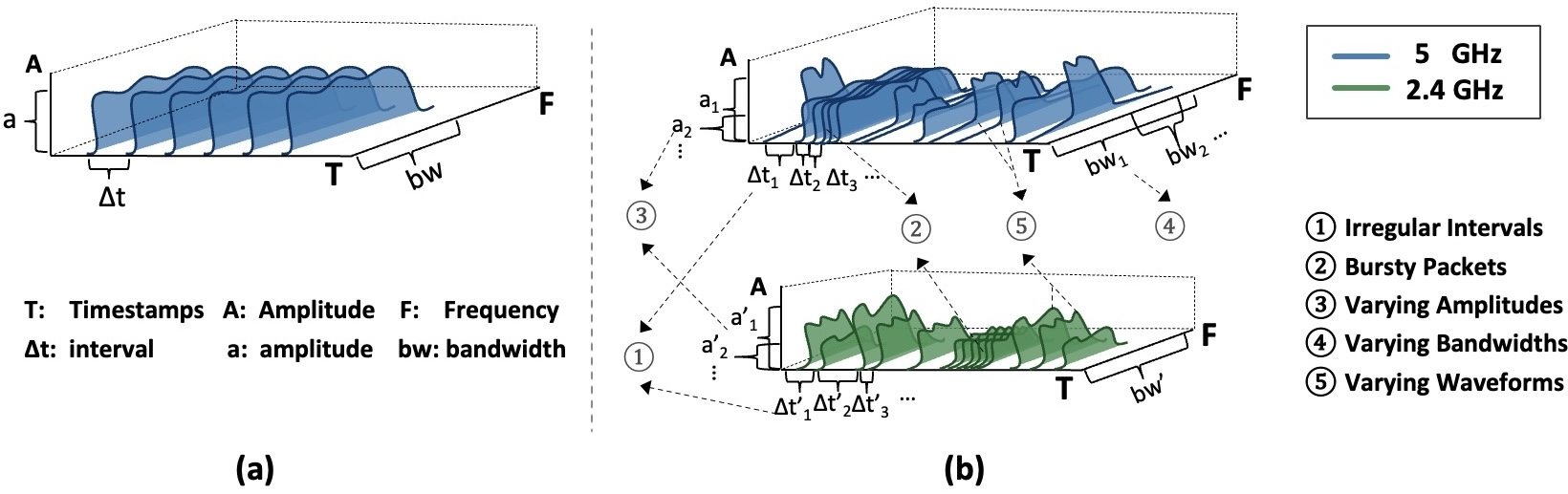
Figure 2: Contrasting traditional, artificially regularized sensing frameworks with UniFi’s approach leveraging irregular, bursty, and heterogeneous communication-driven CSI.
UniFi Framework: Architecture and Key Contributions
UniFi’s principal technical innovations are twofold: a signal processing pipeline for CSI sanitization, and a time-aware attention-based DNN capable of direct learning from irregular, heterogeneous input sequences. The pipeline clusters packets by PHY characteristics, normalizes and aligns subcarrier amplitudes to mitigate protocol- and hardware-induced distortions, discards intra-burst redundancies, and applies subcarrier selection to focus computation on informative subbands.
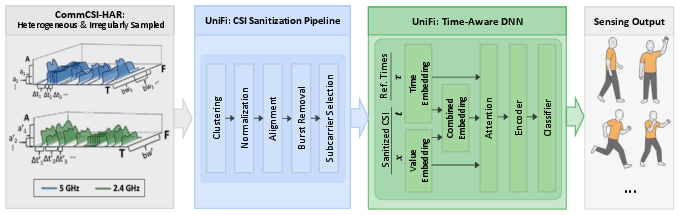
Figure 3: The UniFi framework: heterogeneous, irregular CSI input is processed via sanitization and then embedded via time-aware attention for sensing tasks.
By structuring sanitization and learning as independent stages, UniFi optimally exploits all available CSI diversity (frame types, bandwidths, and frequency bands) without sacrificing model tractability. The DNN backbone, based on a modification of Multi-Time Attention Networks (mTAN), jointly embeds the CSI and continuous time, dispensing entirely with intrusive resampling/interpolation.
Dataset and Experimental Setup
To properly assess the real-world utility of UniFi, the authors collected CommCSI-HAR, the first public dataset featuring irregular, dual-band CSI from ambient Wi-Fi traffic, with no packet injection. Eight subjects performed six canonical activities in an office testbed; concurrent reference datasets were acquired with injected fixed-rate packets for empirical upper-bound comparison.
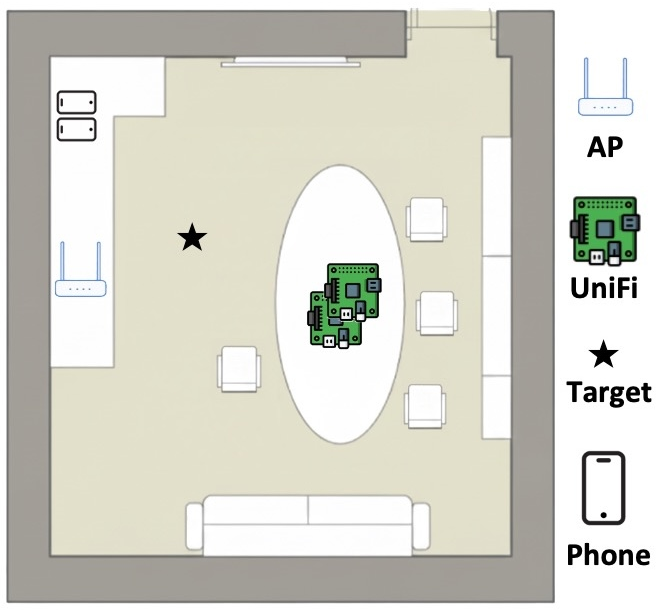
Figure 4: Data collection environment illustrating dual-band monitoring of natural Wi-Fi traffic for human activity recognition.
In addition, published gesture, action, fall detection, and people counting benchmarks—collected with injected CSI on 2.4 GHz at 100 Hz—were used to assess generalization, evaluating UniFi against state-of-the-art baselines for fixed-rate CSI.
Results and Analysis
Accuracy, Efficiency, and Robustness
UniFi achieves 96.88% HAR accuracy on CommCSI-HAR—exceeding the concurrent injected CSI reference. Notably, on all public benchmarks, the compact UniFi-DNN (∼3% of CSI-BERT2's parameter count) reaches or slightly surpasses baseline accuracy, but its gains are most pronounced in truly irregular settings, reflecting strong robustness to both CSI sparsity and irregularity.
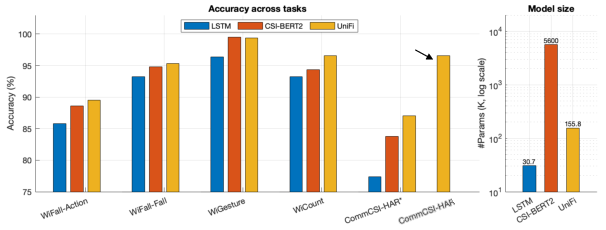
Figure 5: Model accuracy/size trade-offs on multiple tasks—UniFi-DNN dominates state-of-the-art with minimal parameterization.
Linear interpolation, a widely used but crude regularization step, consistently degrades accuracy by introducing artifacts, demonstrating the need for native time-aware processing.
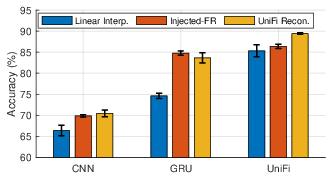
Figure 6: Comparison of linearly interpolated, injected, and UniFi-reconstructed fixed-rate CSI—UniFi preserves accuracy without harmful artifacts.
UniFi's time-aware model maintains high accuracy for missing rates up to 0.5 and substantial sampling irregularity, showing graceful performance degradation only at high sparsity.
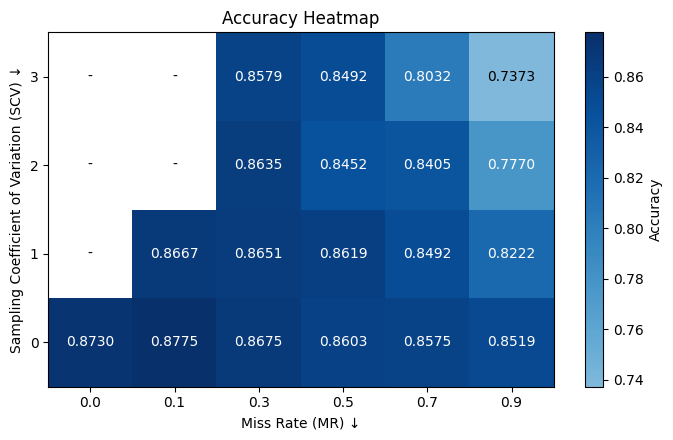
Figure 7: Accuracy as a function of synthetic missing rate (MR) and sampling coefficient of variation (SCV); UniFi remains robust under realistic irregularity.
Impact of CSI Fusion and Sanitization
Fusion of multiple frame types and both frequency bands (2.4/5 GHz) is shown to be highly beneficial: accuracy with dual-band, full-frame-type input is significantly above single-format CSI. Ablation studies reveal substantial accuracy drops if burst-filtering or content-aware attention design is omitted.
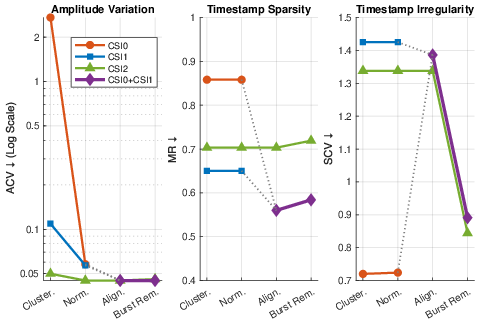
Figure 8: Sequential quality improvements on CSI (amplitude/irregularity metrics) at each sanitization pipeline stage.
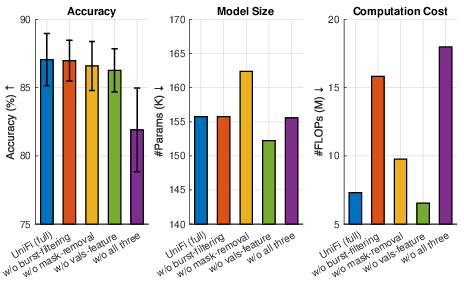
Figure 9: Ablation on DNN architecture: removing burst filtering and mask-feature logic increases error and compute.
Individual Subcarrier Selection (ISS), which prunes redundant or low-motion subbands, yields significant computation/parameter savings on wideband (5 GHz) inputs with no accuracy loss, but should be disabled on 2.4 GHz (narrowband) where all subcarriers are informative.
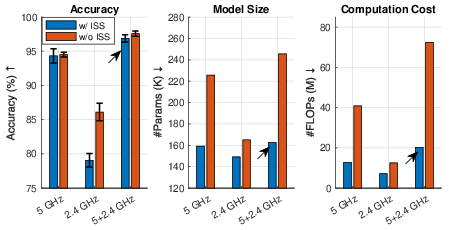
Figure 10: ISS impact on performance–efficiency tradeoff—adopted configuration noted for UniFi.
Quantitative measures for CSI clusters (by frame type/waveform) affirm that fusing clusters yields better temporal coverage, lowers burstiness, and increases classification accuracy, confirming the value of heterogeneous traffic aggregation.
Zero Communication Overhead
By relying solely on ambient traffic and dispensing with active packet injection, UniFi imposes no additional overhead on communication throughput, in contrast to previous ISAC and sensing systems (e.g., WiImg2) that can cause over 40% degradation under heavy probing.
Theoretical and Practical Implications
UniFi’s architecture establishes that practical, high-fidelity Wi-Fi sensing is possible without any intrusive network modification or configuration. The implications for ISAC are substantial: Wi-Fi environments can support ubiquitous sensing (activity recognition, gesture detection, occupancy, etc.) completely transparently, leveraging both increased diversity and higher temporal coverage from all ambient packets, even at low SNRs or traffic rates.
Use of time-aware attention opens prospects for direct, end-to-end learning from all naturally occurring wireless signals—removing longstanding requirements for regularization (sampling, injection) and enabling rapid deployment onto arbitrary traffic and protocol environments. The sanitization pipeline is modular, supporting extensions for uplink traffic, joint AP fusion, or hybrid (passive + sparse probe) strategies for prolonged inactivity.
Conclusion
UniFi provides a compelling advance in Wi-Fi sensing, demonstrating that passive, irregular, heterogeneous communication traffic can be comprehensively sanitized, fused, and interpreted for state-of-the-art accuracy in diverse ISAC tasks, using a lightweight and communication-preserving architecture. This enables broad practical deployment on commodity infrastructure, unlocking new directions for non-intrusive, scalable, and efficient wireless sensing. Future work may integrate uplink and multi-AP sources and further refine cross-domain robustness in truly open-world settings.
Reference: "UniFi: Combining Irregularly Sampled CSI from Diverse Communication Packets and Frequency Bands for Wi-Fi Sensing" (2512.22143)