- The paper demonstrates that SNIS efficiency depends on whether the base distribution is bounded, showing polynomial scaling for bounded versus super-polynomial growth for unbounded cases.
- It employs exponential tilting and Kolmogorov-Smirnov measures to establish precise conditions for convergence and accuracy.
- The findings impact practical applications in finance and climate science by outlining computational limits in high tilt scenarios, guiding effective sampling strategies.
Fundamental Limits for Weighted Empirical Approximations of Tilted Distributions
Introduction
The paper "Fundamental limits for weighted empirical approximations of tilted distributions" (2512.23979) explores the theoretical constraints associated with generating samples from tilted distributions using self-normalized importance sampling (SNIS). These tilted distributions, derived from a random vector with an unknown base distribution, have numerous applications in areas like finance, climate science, and rare event simulation. The authors focus on the asymptotic efficiency and accuracy of the SNIS technique against variations in the sample size and tilt degree. They reveal a dichotomy in the sample complexity required for accurate tilting between bounded and unbounded distributions.
Exponential Tilting Technique
Exponential tilting is a technique used to change the measure within a probability space, aiming to simplify sampling from desired outcome sets. It applies widely in stochastic modeling, including financial securities allocation and prediction of rare climate events. The measure transformation through exponential tilting often results in distributions that systematically favor certain outcomes over others, thus making specified events or scenarios easier to simulate.
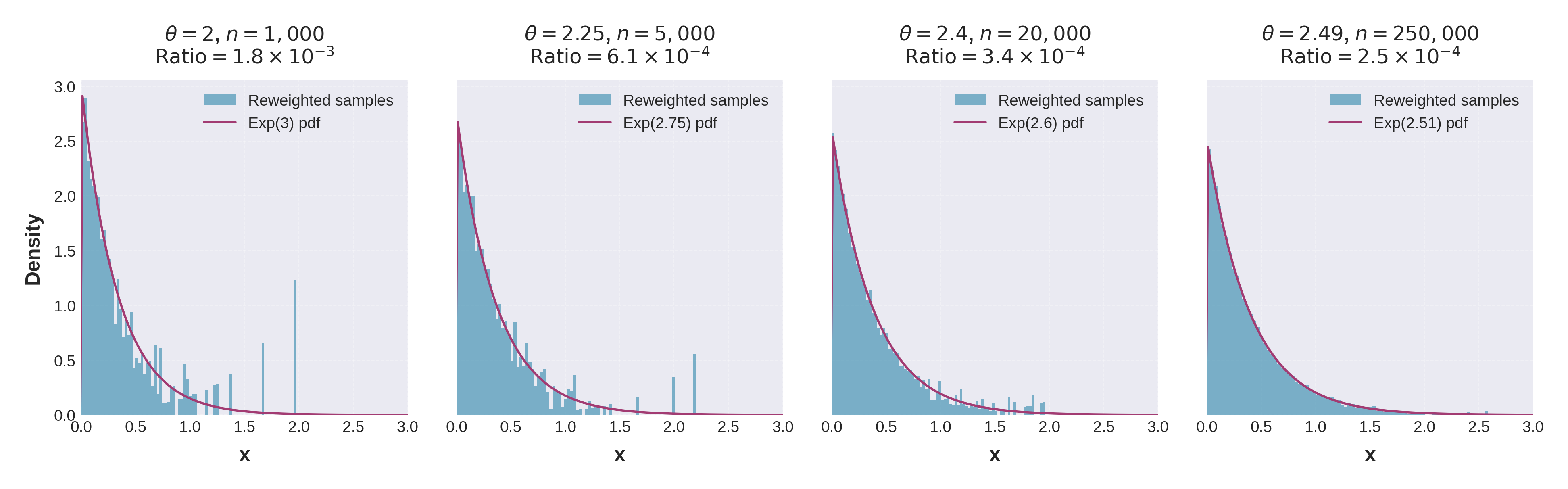
Figure 1: Exponential tilting of Exp(5) distribution with a sequence of (θi,ni) s.t. $M_\theta / n \rightarrow 0.</p></p>
<h2 class='paper-heading' id='asymptotic-efficiency-of-snis'>Asymptotic Efficiency of SNIS</h2>
<p>The paper examines the SNIS method for sampling from tilted distributions, laying out sharp characterizations of its accuracy relative to sample size and tilt degree. SNIS involves re-weighting sampled outcomes to approximate the target distribution, achieving this through empirical re-estimation. As established, the sample complexity for accurate tilting of bounded distributions scales polynomially with the tilt degree, whereas unbounded distributions require super-polynomial growth in sample size for equivalent accuracy.</p>
<h2 class='paper-heading' id='mathematical-characterization'>Mathematical Characterization</h2>
<p>The paper explores the mathematical regularity and constraints governing the SNIS approach. Using Kolmogorov-Smirnov (KS) distance assessments, the authors characterize conditions for convergence in tilting, establishing bounds on estimation accuracy through coefficient variation measures.
<img src="https://emergentmind-storage-cdn-c7atfsgud9cecchk.z01.azurefd.net/paper-images/2512-23979/graph_c_beta.png" alt="Figure 2" title="" class="markdown-image" loading="lazy">
<p class="figure-caption">Figure 2: Exponential tilting of Beta(2, 5) distribution with a sequence of $\left(\theta_i, n_i\right)s.t.M_\theta / n \not\rightarrow 0.
Implications and Applications
The findings underscore the practical limitations of implementing SNIS for vastly tilted distributions, and outline scenarios where polynomial sample scaling is feasible. In substantial tilt scenarios, where distributions are unbounded or grow exponentially, the sample complexity drastically increases, limiting real-world applicability in scenarios such as high-stakes financial modeling or predictive climate simulations.
Conclusion
This paper elucidates the mathematical underpinnings of SNIS in the context of tilted distributions, enhancing understanding of sample efficiency and asymptotic accuracy. While SNIS can be effectively applied to bounded distributions with polynomial sample increments, the exponential sample growth required for accurate tilting of unbounded distributions presents challenges for application in high-dimensional spaces and other complex environments. Future work may explore alternative methodologies or augmentations to SNIS that can mitigate these limitations, improving predictive fidelity in practical applications.
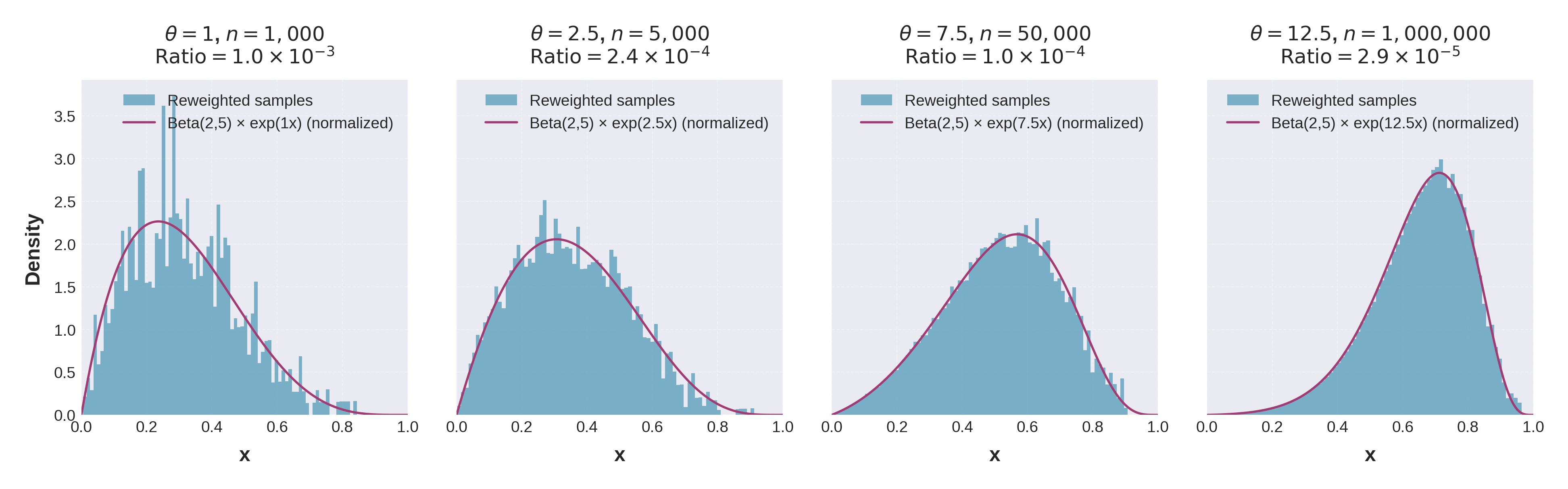
Figure 3: Exponential tilting of Beta(2, 5) distribution with θ=50. The PDF of the samples and true distribution is on the left. The transformed samples, given in theorem~\ref{thm:sltrue1D}