Resisting Manipulative Bots in Memecoin Copy Trading: A Multi-Agent Approach with Chain-of-Thought Reasoning
Abstract: The launch of \$Trump coin ignited a wave in meme coin investment. Copy trading, as a strategy-agnostic approach that eliminates the need for deep trading knowledge, quickly gains widespread popularity in the meme coin market. However, copy trading is not a guarantee of profitability due to the prevalence of manipulative bots, the uncertainty of the followed wallets' future performance, and the lag in trade execution. Recently, LLMs have shown promise in financial applications by effectively understanding multi-modal data and producing explainable decisions. However, a single LLM struggles with complex, multi-faceted tasks such as asset allocation. These challenges are even more pronounced in cryptocurrency markets, where LLMs often lack sufficient domain-specific knowledge in their training data. To address these challenges, we propose an explainable multi-agent system for meme coin copy trading. Inspired by the structure of an asset management team, our system decomposes the complex task into subtasks and coordinates specialized agents to solve them collaboratively. Employing few-shot chain-of-though (CoT) prompting, each agent acquires professional meme coin trading knowledge, interprets multi-modal data, and generates explainable decisions. Using a dataset of 1,000 meme coin projects' transaction data, our empirical evaluation shows that the proposed multi-agent system outperforms both traditional machine learning models and single LLMs, achieving 73% and 70% precision in identifying high-quality meme coin projects and key opinion leader (KOL) wallets, respectively. The selected KOLs collectively generated a total profit of \$500,000 across these projects.
Paper Prompts
Sign up for free to create and run prompts on this paper using GPT-5.
Top Community Prompts
Explain it Like I'm 14
Overview: What this paper is about
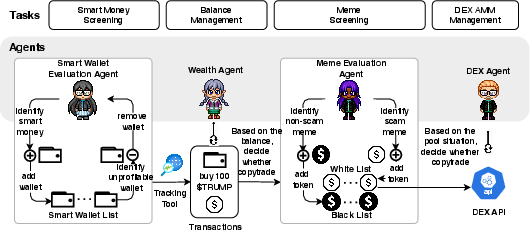
This paper looks at “memecoins” (joke-themed cryptocurrencies) and a popular habit called copy trading, where beginners automatically copy the trades of “star” wallets. The authors show that many bots manipulate these markets—making coins look more popular than they are—and that this can trick copy traders into buying at the worst time. To help, they build an AI “team” that works like a mini investment firm: different AI agents each do a specific job (pick good coins, pick trustworthy wallets, manage money, and place orders) and explain their decisions in simple terms.
The big questions the researchers asked
- Can we spot fake activity (from manipulation bots) early, so copy traders don’t get fooled?
- Can an AI “team” do a better job than a single AI or a traditional model at:
- Picking memecoins with better chances to rise and last longer
- Finding “KOL” wallets (Key Opinion Leaders) whose trades are consistently profitable and not too frequent
- Can this AI system make choices that are both accurate and easy to understand?
How they approached it (in everyday terms)
Think of the system as a sports team where each player has a role:
- Meme coin evaluation agent: judges which new coins look promising.
- Wallet evaluation agent: finds reliable, profitable wallets to copy.
- Wealth agent: decides how much money to put into each opportunity.
- DEX agent: actually places the buy orders on the exchange.
They trained these agents using “few-shot chain-of-thought prompting,” which is like showing the AI a few worked examples and asking it to “show its work” step by step. The agents look at different kinds of information together:
- Numbers from on-chain transactions (who bought/sold, how much, how often)
- Candlestick charts (price moving up/down over time)
- Comments on the platform (to check if real people or bots are talking)
They also created simple detection rules (algorithms) to spot manipulation bots. Here are the common bot types they targeted:
- Bundle bots: split one person’s big buys across many wallets to hide who’s really buying.
- Sniper bots: jump in extremely fast right after launch to get cheap coins.
- Bump (wash-trading) bots: buy and sell the same amount back and forth to fake high activity and push the coin to the front page.
- Comment bots: flood short, hypey messages like “To the moon!” to make it seem like there’s a big, excited community.
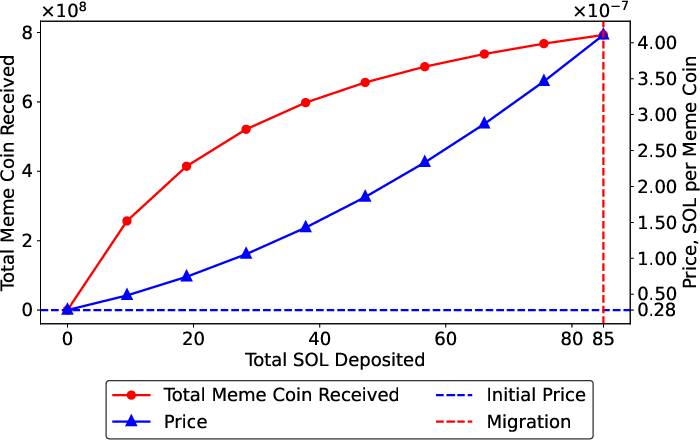
Analogy for pricing at launch (bonding curve): imagine a vending machine that raises the price a little each time someone buys a snack. The more people rush in to buy, the more the price goes up automatically. That’s how many memecoin launchpads price new tokens.
They tested their system on about 1,000 newly launched memecoins that later listed on a decentralized exchange (DEX), checking how well the agents picked coins and wallets compared to both traditional machine learning and single AI models.
What they found and why it matters
- The multi-agent AI team beat traditional models and single AI models.
- It reached about:
- 73% precision in finding high-quality memecoins (meaning, when it said “yes,” it was right about 73% of the time).
- 70% precision in picking profitable KOL wallets to copy.
- The KOL wallets the system selected together made around $500,000 in profit across the tested projects.
- Using all data types together (transactions + charts + comments) worked much better than using any single type alone.
- Their bot-detection rules helped explain weird patterns and avoid traps. For example, coins with bump or comment bots often look “hot” because they’re constantly on the front page and hyped, but that can be fake momentum. Bundle bots can make returns spike for a moment but then lead to quick crashes (a “rug pull”), where creators dump their coins and leave late buyers with losses.
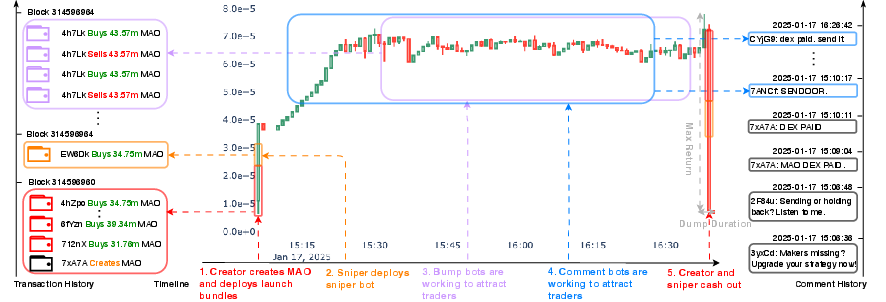
- A case study of a coin called MAO showed the life cycle of manipulation: bundle buys at launch to hide ownership, sniper entries, hyped comments, fake volume, and then a sudden sell-off by the creator—hurting regular traders.
Why this matters: many new traders copy trades without knowing the risks. An explainable system that spots bots and evaluates coins and wallets more carefully can help beginners avoid common traps.
What this could mean going forward
- Safer copy trading: Platforms could use systems like this to flag suspicious coins and guide users toward better choices.
- Better transparency: Because the agents explain their reasoning, people can learn how decisions were made instead of trusting a “black box.”
- Wider use: The same “AI team” approach could be adapted to other fast-moving markets that mix numbers, charts, and social buzz.
- Important reminder: Even with better tools, memecoin markets are risky and can change quickly. No system can guarantee profits. But smarter, clearer tools can help people make fewer mistakes and spot red flags earlier.
Knowledge Gaps
Knowledge gaps, limitations, and open questions
Below is a concise list of unresolved issues and limitations that future research could address:
- Ground-truth for bot detection is absent; the paper evaluates bot heuristics (bundle, bump, comment) without a labeled dataset or external validation against known bot providers or platform enforcement actions.
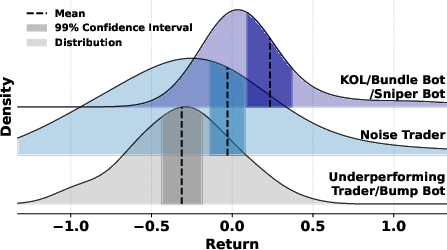
- Sniper bot detection methodology is not specified, despite reporting distributions by “Sniper Bot”; a concrete detection algorithm, labeling criteria, and evaluation are missing.
- Bot detection relies on simple rule-based heuristics and a fixed threshold () without sensitivity analysis, calibration, or ROC-based selection of ; robustness to parameter choices is unexplored.
- Creator-funded bundle detection acknowledges evasion via intermediary wallets or CEX but offers no solution (e.g., graph analysis, fund-flow clustering, timing correlation, or entity resolution) to catch indirect funding paths.
- No benchmarking against existing on-chain fraud/wash-trading detection methods (graph ML, anomaly detection, MEV analysis), limiting claims of being “first” or “better.”
- The definition of high-quality meme coins (“above-average log return”) is underspecified and the formula for is malformed; the exact horizon , decision timestamp, and label construction need formalization to avoid look-ahead bias.
- KOL labeling (“infrequent but consistently profitable”) lacks precise thresholds, windowing schemes, and persistence criteria; definitions should be made operational and sensitivity-tested.
- Dataset scope and consistency are unclear (claims of 1,000 vs. 4,000 projects); the sampling strategy, inclusion/exclusion rules (e.g., only migrated coins), and potential survivorship bias are not rigorously handled.
- The time horizon is short (up to 12 hours post-migration); performance persistence, longer-term outcomes, and regime shifts are not studied.
- Generalization beyond Solana/Pump.fun (other chains, launchpads, bonding curves, fee structures) is unexplored; the approach may be overly platform-specific.
- Real-time deployment is not demonstrated; latency, rate limits, inference speed, and system stability under live conditions (including bursts of activity) are untested.
- Execution realism is not modeled: slippage, MEV/front-running risk, partial fills, gas/fee dynamics, and copy-trading-induced market impact are omitted from P&L.
- Profit accounting lacks detail on whether platform fees (1% buy/sell, migration fee), DEX fees, and on-chain transaction costs are fully included; reproducible P&L calculations are needed.
- The $500,000 profit claim for selected KOLs is not accompanied by distributional statistics, drawdowns, or risk-adjusted metrics; outlier dependence and variance are not reported.
- Wealth management logic is unspecified (position sizing, max exposure, stop-loss/take-profit, diversification, rebalancing); risk controls and capital allocation rules need to be formalized and evaluated.
- Order execution agent details (smart contract interfaces, failover, error handling, reverts, transaction bundling) are sparse; reliability and security considerations are not assessed.
- Multi-agent architecture is under-described: agent coordination, messaging protocols, conflict resolution, and failure modes are not systematically examined.
- No ablation studies quantify the contribution of each agent, each modality (transactions, candlesticks, comments), or CoT prompting; the source of gains remains ambiguous.
- Baseline comparisons are insufficiently documented (which ML models, hyperparameters, training procedures, and feature sets); reproducible baselines and statistical significance tests are missing.
- LLM specifics (model name/version, vision-language capability, context length, temperature, prompt design) are not provided; reproducibility and model dependence are unclear.
- The claim of multimodal capability appears limited to candlestick images and platform comments; broader external social signals (Twitter/X, Telegram, Discord, influencer posts) are not integrated or evaluated.
- Comment sentiment analysis lacks bot-resilience; no method is proposed to discount fabricated engagement or detect coordinated comment campaigns beyond simple heuristics.
- Causal impact of bots on performance is not established; analyses are correlational without controls for confounders (e.g., simultaneous hype events, celebrity endorsements).
- Threshold selection for classification (precision/recall trade-off) is reported but not optimized per use-case (risk appetite, capital constraints); utility-based evaluation is missing.
- Training/testing splits, temporal validation, and leakage controls are not described; the risk of look-ahead or contamination in feature construction is undiscussed.
- The framework optimizes precision but suffers low recall in some modalities; portfolio-level implications of this trade-off (missed opportunities vs. fewer false positives) are not quantified.
- Resilience to adversarial adaptation is unaddressed; bot providers could evolve tactics to evade detection and exploit the agents—robustness and continuous learning strategies are needed.
- Ethical and regulatory considerations around copy trading, market manipulation detection, and automated execution are not discussed; compliance and user protection mechanisms are absent.
- Scalability and cost are not evaluated (inference cost per decision, throughput, cloud/on-chain resource usage); economic feasibility at scale remains uncertain.
- Code, prompts, and data access pathways (Flipside queries, preprocessing scripts) are not released; replication and independent verification are currently infeasible.
Practical Applications
Immediate Applications
The following applications can be deployed with current methods, data, and tooling described in the paper, acknowledging typical engineering and integration effort.
Industry
Below are immediate, sector-linked use cases that can be integrated into existing products and workflows.
- Bold title: Platform-level bot-risk scoring and UI warnings (Sector: finance/crypto exchanges, analytics platforms)
- What: Integrate the paper’s bundle/bump/comment bot detection algorithms into Pump.fun-like launchpads, DEX frontends (e.g., Raydium), and analytics dashboards (e.g., GMGN, Dune/Flipside-powered apps) to surface per-coin bot-risk flags in real time.
- Tools/products/workflows: “BotScore API” (bundle bot scanner, bump/wash trading score, comment-bot quality signals); front-page ranking penalties; red/yellow badges on token pages; back-office surveillance alerts.
- Assumptions/dependencies: Low-latency access to on-chain transactions and transfers; accurate threshold calibration for wash-trade ratios; willingness of platforms to expose risk flags; adversaries adapt to detection heuristics.
- Bold title: Copy-trading guardrails and pre-trade risk checks (Sector: wallets, retail trading apps, copy-trade platforms)
- What: Use the meme and wallet evaluation agents as pre-trade validators for copy-trades to reduce “exit liquidity” risk (e.g., block copying of KOLs associated with creator-funded bundles; require extra confirmation on coins with bump/comment bot signals).
- Tools/products/workflows: “CopyTradeGuard” wallet plugin (Phantom/Solflare extension) that shows bot signals, KOL precision likelihood (~70%), stop-loss presets, per-trade spending caps; pre-migration candlestick health check.
- Assumptions/dependencies: Wallet extension integration and permissions; latency tolerable vs. sniping; UI/UX that preserves user autonomy; model precision calibrated to current market regime.
- Bold title: Quant research copilot for fund screening (Sector: asset management/prop trading)
- What: Deploy the multi-agent, CoT-driven screening pipeline to prioritize memecoin opportunities and KOLs (precision ~70–73% as reported).
- Tools/products/workflows: “Multi-Agent Alpha Lab” notebooks/pipelines; scheduled screening of new launches; research reports with CoT explanations for investment committees.
- Assumptions/dependencies: Compute budget for multi-agent LLM inference; compliance sign-off on AI-assisted decisions; stable model behavior under domain shift.
- Bold title: DeFi market surveillance as a service (Sector: regtech, cybersecurity/fraud analytics)
- What: Offer wash trading, bundle bot, sniper bot, and comment bot detection to protocols, exchanges, and market integrity teams.
- Tools/products/workflows: “DEX Surveillance Suite” with token-level alerts, bot-wallet cluster views, and evidence logs; webhook feeds for risk teams.
- Assumptions/dependencies: Comprehensive cross-source data ingestion (on-chain + platform comments); governance around false positives; privacy/terms-of-service compliance.
- Bold title: Derived data products with bot labels and KOL scores (Sector: data providers/market intelligence)
- What: Publish curated datasets (e.g., Flipside/Dune tables) containing per-coin bot flags, KOL reliability scores, pre-/post-migration metrics.
- Tools/products/workflows: “Bot-Flag Tables,” “KOLScore Feeds,” “Pre-Migration Health” features available via SQL/API.
- Assumptions/dependencies: Reproducible implementations of Algorithms 1–2; licensing and redistribution rights; versioning to track changing heuristics.
- Bold title: Front-page gaming resistance for launchpads (Sector: platform product teams)
- What: Detect and down-weight bump-bot patterns that artificially push coins to front pages; highlight organic engagement instead.
- Tools/products/workflows: “Engagement Integrity Filter” that reduces visibility for tokens with high wash-trade ratios; dashboards for content moderation teams.
- Assumptions/dependencies: Accurate wash-trade metrics; A/B testing to quantify impact on user growth; incentive alignment with revenue goals.
Academia
These uses accelerate research and teaching with current artifacts and methods from the paper.
- Bold title: Open benchmarks for DeFi manipulation detection (Sector: academic research)
- What: Construct labeled datasets of bundle/bump/comment/sniper bot presence using the paper’s heuristics and case methodology.
- Tools/products/workflows: Public datasets; evaluation harnesses for bot detection and agentic trading tasks; reproducible notebooks.
- Assumptions/dependencies: Data sharing agreements; careful de-identification; transparent definitions to avoid label leakage.
- Bold title: Teaching modules on agentic finance and CoT explainability (Sector: higher education)
- What: Use the multi-agent, multimodal CoT framework as a teaching case for explainable AI in markets.
- Tools/products/workflows: Course labs simulating pre-trade screening with candlestick, transaction, and comment modalities; grading rubrics that include interpretability quality.
- Assumptions/dependencies: Access to LLM APIs; cost controls for classroom use; sandboxed datasets.
Policy
These actions can inform oversight and consumer protection now.
- Bold title: Supervisory dashboards for memecoin market integrity (Sector: regulators/SupTech)
- What: Monitor live bot-risk signals, cluster suspected manipulator wallets, and review rug-pull heuristics.
- Tools/products/workflows: “Memecoin Risk Monitor” with per-token bot flags, dump-duration anomalies, KOL impact tracking.
- Assumptions/dependencies: Data sharing from platforms; legal authority to act on DeFi signals; inter-agency collaboration on definitions.
- Bold title: Evidence-based consumer risk disclosures (Sector: consumer protection)
- What: Standardize risk disclosure templates referencing common manipulations (launch bundles, wash/bump trades, comment bots).
- Tools/products/workflows: Plain-language disclosures; illustrative case timelines similar to the MAO example.
- Assumptions/dependencies: Industry adoption; harmonization across jurisdictions; continuous updates as tactics evolve.
Daily life
Practical tools and content for individual users.
- Bold title: Browser/wallet “MemeRisk Lite” warnings (Sector: consumer fintech)
- What: Lightweight indicators of bot presence and KOL quality when viewing token pages or copy-trading a wallet.
- Tools/products/workflows: Color-coded badges; single-screen explanations of risks; optional safe-mode caps.
- Assumptions/dependencies: Extension store approval; minimal latency; clear opt-in/opt-out controls.
- Bold title: Community moderation aids for Discord/Telegram (Sector: community management)
- What: Comment-bot pattern filters to reduce low-quality hype content in token discussion channels.
- Tools/products/workflows: “Comment Integrity Bot” that flags repetitive, context-free shill patterns; rate-limits suspected bot bursts.
- Assumptions/dependencies: Access to message streams; tuning to avoid overblocking; transparent appeal process.
Long-Term Applications
The following require further research, scaling, cross-ecosystem collaboration, or regulatory changes.
Industry
Forward-looking products and infrastructural changes that extend the paper’s innovations.
- Bold title: Cross-chain autonomous agentic trader with compliance guardrails (Sector: asset management, trading infrastructure)
- What: An end-to-end multi-agent system that ingests multimodal signals across L1/L2s, handles pre-trade risk, executes on DEXs/CEXs, and provides CoT audit trails.
- Tools/products/workflows: “AgentTrader Pro” with mempool awareness, slippage control, and explainability logs for audits.
- Assumptions/dependencies: Robust LLMs fine-tuned on crypto-domain data; low-latency infra; legal clarity on autonomous trading; resilience against adversarial manipulation.
- Bold title: Bot-net and creator-collusion detection via graph learning (Sector: regtech/fraud analytics)
- What: Cluster analysis linking creator wallets, fund flows, and synchronized trade patterns to expose covert networks.
- Tools/products/workflows: “SybilGraph” graph ML pipeline; explainable cluster reports; on-chain labeling feedback loops.
- Assumptions/dependencies: High-quality entity resolution; privacy considerations; adversarial obfuscation via CEX bridges/mixers.
- Bold title: On-chain reputation and KOL “credit scores” (Sector: wallets, social trading)
- What: Persistent, portable reputations for trader wallets with decay, uncertainty bounds, and manipulation resistance.
- Tools/products/workflows: “KOLScore on-chain” with verifiable attestations; wallet-native displays; staking/slashing for integrity.
- Assumptions/dependencies: Decentralized identity (DID) standards; sybil resistance; governance to prevent score gaming.
- Bold title: Platform redesign against engagement gaming (Sector: product strategy)
- What: Front-page and ranking algorithms that discount wash-trade patterns and reward organic dispersion of holdings and comment quality.
- Tools/products/workflows: “Integrity-weighted Ranking”; causal impact testing; creator incentives aligned to healthy launches.
- Assumptions/dependencies: Willingness to trade short-term fee revenue for long-term trust; robust measurement frameworks.
Academia
Deeper scientific inquiries building on this work.
- Bold title: Generalization to NFTs, microcaps, and social-token markets (Sector: computational finance)
- What: Study transfer of multi-agent, multimodal methods to adjacent volatile, hype-driven markets.
- Tools/products/workflows: Cross-domain benchmarks; ablation studies on modality contributions; robustness to regime shifts.
- Assumptions/dependencies: Domain-specific data availability; consistent manipulation taxonomies; evaluation fairness.
- Bold title: Standards for evaluating agentic financial systems (Sector: AI safety/ethics in finance)
- What: Protocols for backtesting, causal inference, CoT auditing, and adversarial stress tests in trading contexts.
- Tools/products/workflows: Open leaderboards; red-team toolkits; interpretability metrics.
- Assumptions/dependencies: Community consensus; reproducible environments; safeguards for market impact.
Policy
Longer-horizon governance and consumer protection initiatives.
- Bold title: Mandatory creator disclosures and on-chain proofs (Sector: financial regulation)
- What: Require creators to disclose related wallets and funding sources, with cryptographic proofs and standardized smart-contract metadata.
- Tools/products/workflows: “Creator Registry” contracts; attestations for no-self-funding guarantees; verifiable launch audits.
- Assumptions/dependencies: Enforceability in decentralized contexts; international coordination; privacy-preserving designs.
- Bold title: Guardrails for copy-trading features (Sector: consumer protection)
- What: Default position limits, pre-trade risk prompts, and cool-off periods for high-risk tokens; standardized labeling of bot-risk.
- Tools/products/workflows: Regulatory guidance; platform certification marks for compliant copy-trading UX.
- Assumptions/dependencies: Industry adoption; evidence tying guardrails to harm reduction; avoiding paternalism that pushes users off-platform.
Daily life
Consumer-facing innovations that mature with the ecosystem.
- Bold title: Personalized “risk autopilot” in wallets (Sector: personal finance)
- What: An agent that maps user risk tolerance to dynamic trade limits and token allowlists/denylists with explainable CoT justifications.
- Tools/products/workflows: Preference learning; privacy-preserving profiles; adaptive safety rails.
- Assumptions/dependencies: Reliable preference inference; data protection; acceptance of guardrails during hype spikes.
- Bold title: Memecoin market simulators with adversarial bots (Sector: education/gamification)
- What: Realistic, game-like environments to learn strategies and recognize manipulation patterns before trading real funds.
- Tools/products/workflows: “PumpSim” with bonding curves, bump/comment bots, and KOL dynamics; classroom and self-serve modes.
- Assumptions/dependencies: Accurate simulation of market microstructure; sustained engagement; content updates as tactics evolve.
Cross-cutting assumptions and risks (applicable across many items)
- Domain shift and adversarial adaptation: Detectors and agents must be re-tuned as tactics evolve; precision may degrade outside the studied 2025 regime.
- Data latency and coverage: Real-time, lossless access to on-chain and comment data is crucial; mempool visibility varies by chain.
- Model reliability and cost: Multi-agent, multimodal LLM pipelines require monitoring, cost control, and fallback rules for outages or uncertainty spikes.
- Legal/compliance: Automated trading and surveillance implicate jurisdiction-specific rules; ensure KYC/AML and market manipulation definitions are respected.
- User safety and privacy: Wallet integrations and profiling must respect consent and minimize data collection; provide clear opt-outs.
- Reproducibility and evaluation: Backtests are sensitive to survivorship/selection biases; standardize evaluation and publish assumptions and code where feasible.
Glossary
- AMM: An automated market-making mechanism that sets prices and provides liquidity on decentralized exchanges without an order book. "The DEX relies on \ac{amm} for liquidity provision and meme coin pricing."
- Archive nodes: Full-history blockchain nodes that store and index all past data to enable comprehensive queries and analytics. "Flipside, which maintains archive nodes with fully indexed access to Solanaâs historical data."
- Bonding curve mechanism: A pricing model that ties a token’s price to cumulative deposits or supply, typically increasing price with demand. "The bonding curve mechanism, introduced in the next subsection, sets the price."
- Bump bot: An automated script that repeatedly executes offsetting buy and sell orders to artificially increase visibility and perceived activity. "Between 15:37:36 and 16:40:45, the bump bot 4h7Lk.. repeatedly bought and sold the same amount of MAO (purple box and stage 4)."
- Bundle bot: A bot that coordinates multiple wallets to transact in the same block to mask ownership concentration and fabricate demand. "A launch bundle bot is utilized when a creator launches a meme coin."
- Buy bundle: A coordinated group of buy transactions occurring within the same block, often indicative of manipulation. "Buy bundle."
- Candlestick chart: A financial chart type that displays open, high, low, and close prices to visualize price movements over time. "The agent then examines the meme coin's candlestick chart to identify potential bundle bot activities."
- CEX: A centralized exchange where a company or entity controls custody and order matching for cryptocurrency trades. "as the creator may channel funds indirectly through intermediary wallets or \ac{cex}."
- Chain-of-thought prompting: An LLM prompting technique that elicits step-by-step reasoning to improve decision quality and explainability. "Employing few-shot \acf{cot} prompting, each agent acquires professional meme coin trading knowledge, interprets multi-modal data, and generates explainable decisions."
- Comment Bot: An automated script that posts fabricated comments to simulate community engagement and hype around a token. "A Comment Bot is an automated script designed to fabricate user engagement by generating fake comments that simulate community interest and enthusiasm around a meme coin."
- Copy trading: An automated strategy that replicates the transactions of selected wallets to mirror their investment decisions. "copy trading, an automated, one-click feature that allows users to replicate other wallets."
- Creator-funded bundles: Transaction bundles funded or coordinated by the creator to conceal concentrated ownership and manipulate perception. "bundles in the launch block involving transfers between the creator and transaction makers are identified as creator-funded bundles;"
- Creator-funded buy bundle: A buy bundle where funds flow from the creator to the transaction makers, indicating potential manipulation. "bundles outside the launch block with only buy orders and creator-to-trader transfers are classified as creator-funded buy bundles;"
- DEX: A decentralized exchange that enables peer-to-peer trading via smart contracts without central custody. "After a meme coin reaches its migration threshold on Pumpfun, it is migrated to a DEX, Raydium, for secondary market trading."
- Dump duration: The time from a token’s peak price to the moment its price falls to 10% of that peak. "The horizontal dashed gray line denotes dump duration, measured as the time in seconds from the peak time to the point where the price falls to 10\% of its peak price."
- Exit liquidity: Later buyers who provide liquidity enabling early holders to sell; often exploited in manipulative schemes. "then exiting at a profit---using copiers as exit liquidity."
- Front-running: Executing trades ahead of others by anticipating their orders, often through speed advantages. "Sniper Bot Front-Running"
- Graduation: The transition of a meme coin from the launch platform to a DEX listing after meeting thresholds. "Once all 800 million meme coins are purchased, it will be listed on a \ac{dex} and the locked 200 million meme coins are migrated, a process known as \enquote{migration} or \enquote{graduation}."
- IPO: Initial Public Offering; the stock market process analogous to token subscription during launch. "This is similar to the \ac{ipo} application stage in the stock market, but with no extremely simple prospectus and no regulatory approval."
- KOL: Key Opinion Leader; a wallet perceived to have insider knowledge, expertise, and consistent profitability. "copiers attempt to identify so-called \ac{kol} wallets---addresses perceived to possess insider knowledge, trading expertise, and consistent profitability---and replicate their trades."
- Launch bundle: A bundle of purchases in the creation block used to inflate price and conceal ownership concentration. "Launch bundle."
- Launchpad: A platform that standardizes the creation and initial sale of tokens. "Pumpfun is the most prominent meme coin launchpad at the time this paper is written."
- LLM: LLM; an AI model capable of understanding and generating natural language (and multimodal) outputs. "Recently, \acp{LLM} have shown promise in financial applications by effectively understanding multi-modal data and producing explainable decisions."
- Liquidity pool: A pool of tokens locked in a smart contract to facilitate trading via AMMs on DEXs. "Pumpfunâs business model involves charging a 1\% fee on each buy or sell transaction, as well as a 0.015 SOL migration fee deducted from the liquidity pool."
- Migration: The process by which a token moves from the launch stage to being listed on a DEX for secondary market trading. "Migration means the meme coin project receives sufficient subscription and will be listed on a \ac{dex} so that traders can trade with other traders (i.e., the secondary market)."
- Primary market: The market where participants transact directly with the issuer during the launch phase. "This stage is similar to the primary market, where traders trade with the issuer."
- Pump-and-dump: A manipulative scheme that inflates a token’s price through hype and then dumps holdings, causing a crash. "Moreover, meme coin values are typically driven by hype and vulnerable to pump-and-dump schemes"
- Pump.fun: A Solana-based platform for creating and crowdfunding meme coins. "Pump.fun, the largest meme coin crowdfunding platform on Solana, lets users create meme coins for free."
- Raydium: A Solana decentralized exchange used for token trading after migration. "After a meme coin reaches its migration threshold on Pumpfun, it is migrated to a DEX, Raydium, for secondary market trading."
- Rug pull: A sudden exit scam where creators and early holders cash out and abandon the project. "The speculative nature of meme coins makes them highly susceptible to rug pullsâsudden exit scams where the meme coin creator and early participants cash out and abandon the project."
- Secondary market: The market where traders buy and sell tokens from each other after listing. "Migration means the meme coin project receives sufficient subscription and will be listed on a \ac{dex} so that traders can trade with other traders (i.e., the secondary market)."
- Sell bundle: A coordinated group of sell transactions in the same block, often signaling orchestrated exits. "Sell bundle."
- Sniper bot: A fast-acting bot that buys immediately after launch to secure a low entry price, often front-running others. "Most projects have sniper bots, and performance differences between those with and without sniper bots are negligible."
- SOL: The native cryptocurrency of the Solana blockchain used for subscriptions and trades. "traders can subscribe to the meme coin using SOL, Solanaâs native cryptocurrency"
- Wash trading: Executing offsetting trades to fabricate volume and interest without changing net positions. "deploying wash trading bots to manufacture an illusion of interest and liquidity."
- Wash trading score: A metric quantifying suspected wash trading by comparing matched flips to net position. "We define a wash trading score for each meme coin trader, calculated as the ratio of the number of matched buyâsell transaction pairs of identical amounts to the traderâs net position."
Collections
Sign up for free to add this paper to one or more collections.