- The paper introduces CryptoTrade, a reflective LLM-based agent that uses integrated on- and off-chain data for zero-shot cryptocurrency trading.
- It employs a methodology combining market technical indicators with sentiment analysis from financial news to optimize real-time trading strategies.
- Experimental results demonstrate that CryptoTrade outperforms traditional and LSTM baselines by achieving higher returns and improved Sharpe ratios.
A Reflective LLM-based Agent to Guide Zero-shot Cryptocurrency Trading
Introduction
The paper "A Reflective LLM-based Agent to Guide Zero-shot Cryptocurrency Trading" presents CryptoTrade, a novel framework leveraging LLMs to facilitate zero-shot cryptocurrency trading. The approach integrates both transparent on-chain data and timely off-chain information to optimize trading decisions. Its unique reflective mechanism analyzes the efficacy of prior trades to refine future strategies, setting a new benchmark in cryptocurrency trading applications. The paper argues that despite LLM success in stock markets, the complexity of cryptocurrencies, with their real-time data availability, offers untapped potential for LLM deployment.
CryptoTrade Framework
The CryptoTrade framework comprises three major components. Initially, data collection merges on-chain data, such as transaction statistics and market dynamics, with off-chain insights sourced from financial news outlets.
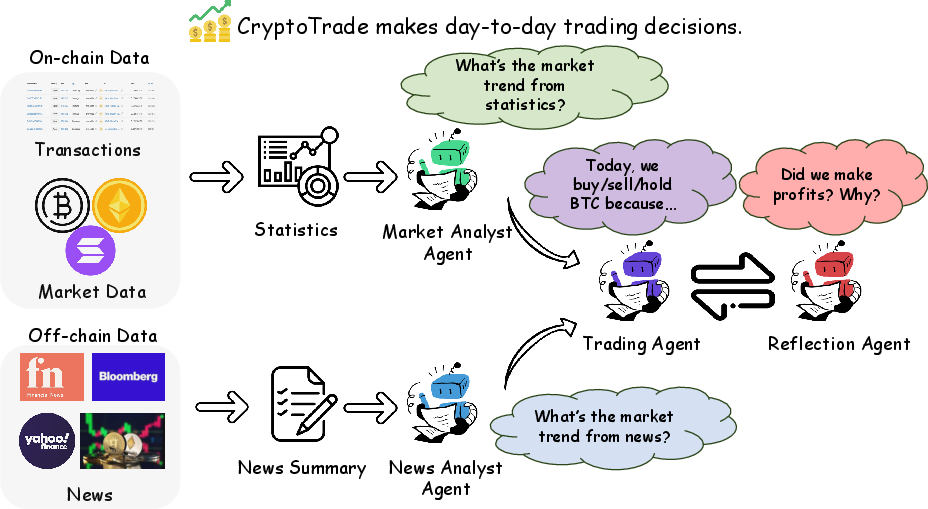
Figure 1: CryptoTrade Framework. Integrated analysis of on-chain and off-chain data directs LLM-based agents in daily trading decisions.
Data Collection
CryptoTrade employs sophisticated data collection mechanisms to acquire comprehensive market insights. On-chain data is derived from platforms like CoinMarketCap and Dune, capturing cryptocurrency valuations, volumes, transaction counts, and more. Concurrently, off-chain data involves the systematic gathering of news articles via the Gnews API, with a focus on reputable sources like Bloomberg and Yahoo Finance. This dual approach allows the framework to enrich trading strategies with a holistic market view.
Agent Design
Within the framework, the Market Analyst Agent processes on-chain data to extract technical indicators like SMA, MACD, and Bollinger Bands. Conversely, the News Analyst evaluates off-chain data to gauge market sentiment and event significance.
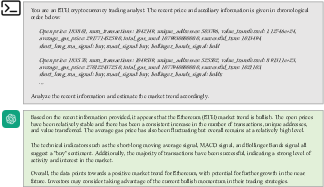
Figure 2: A sample of the Market Analyst.
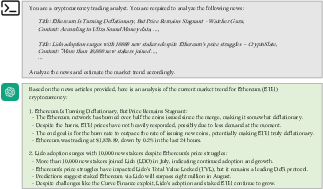
Figure 3: A sample of the News Analyst.
The Trading Agent integrates analyses from these components to formulate and justify trading actions, while a Reflection Agent reviews prior transactions for strategic enhancements.
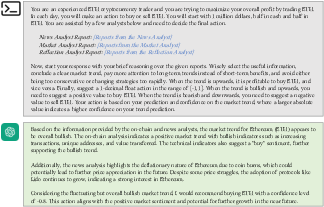
Figure 4: A sample of the Trading Analyst.
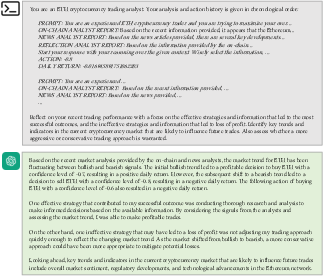
Figure 5: A sample of the Reflection Analyst.
By embedding reflection, the model continuously refines its strategies, enhancing its market adaptability.
Experimental Evaluation
CryptoTrade's performance was rigorously evaluated across varied market conditions using Bitcoin (BTC), Ethereum (ETH), and Solana (SOL), demonstrating significant returns and adaptability compared to both traditional and LSTM-based baselines. Experiments utilized GPT-4 and its variants in a zero-shot setting, noting superior performance without fine-tuning, underscoring the robustness of LLM integration.
The results highlighted CryptoTrade's superior ability to execute profitable trades by leveraging advanced foresight capabilities. For instance, in bullish and bearish scenarios for cryptocurrencies, CryptoTrade outperformed traditional MACD and simpler "buy-and-hold" strategies by significant margins in both returns and Sharpe ratios.
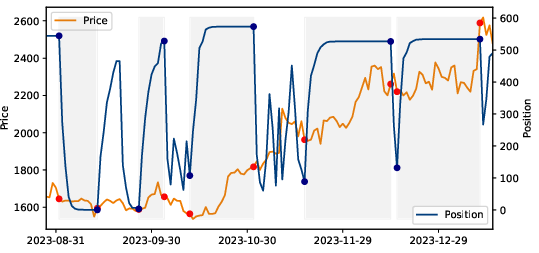
Figure 6: Significant profitable periods exploited by the CryptoTrade agent.
Case Study and Ablation Study
The paper includes a focused case study demonstrating CryptoTrade's effective application of the "buy the rumor, sell the news" strategy in response to significant market events such as the Bitcoin ETF approval. This showcases the agent's ability to capitalize on both speculative movements and confirmed market shifts.
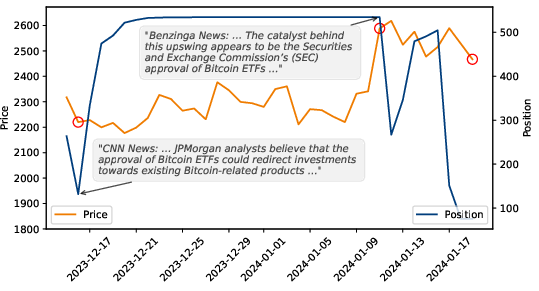
Figure 7: Case study of CryptoTrade's actions during Bitcoin ETF approval.
The ablation study systematically removed components from CryptoTrade's analytical prompts, confirming the critical role of each in maximizing predictive precision and financial returns. On-chain transaction statistics were particularly crucial, suggesting their indispensable contribution to informed trading via fine-grained market analysis.
Conclusion
CryptoTrade exemplifies a sophisticated fusion of LLMs and diverse data analytics to advance cryptocurrency trading strategies, offering robust improvements over conventional methods. By introducing a comprehensive framework that judiciously melds reflective learning with real-time data interpretation, the study not only establishes a novel benchmark for zero-shot trading but also paves pathways for future explorations in AI-driven financial systems.
Despite its promising results, the paper notes limitations regarding data scope and trading frequency currently based on daily intervals. Future work aims to enhance fine-tuning for LLMs and explore more granular trading timelines to potentially heighten returns. CryptoTrade presents an impactful blueprint for AI-driven methodologies in dynamic financial environments.