- The paper demonstrates that horizonless ECG solutions support static, stable timelike circular orbits that function as the ISCO.
- It applies numerical integration and perturbation analysis to confirm orbital stability and uncovers a non-monotonic Aschenbach effect in the orbital velocity profile.
- The findings imply observable signatures like ring-like accretion disks and enhanced energy extraction, distinguishing ECG objects from Schwarzschild black holes.
Static Stable Timelike Circular Orbits and the Aschenbach Effect in Horizonless Einstein Cubic Gravity
Introduction and Theoretical Framework
This paper investigates the existence and properties of static stable timelike circular orbits (SCOs) and the manifestation of the Aschenbach effect in horizonless, static, spherically symmetric solutions of @@@@2@@@@ (ECG). ECG extends the Einstein-Hilbert action by introducing dimension-independent cubic curvature invariants, resulting in higher-order corrections while preserving a ghost-free spectrum in four-dimensional spacetime. The focus on horizonless solutions, absent of electromagnetic charges or additional matter content, isolates the gravitational sector and enables direct comparison with Schwarzschild solutions.
The ECG field equations reduce to a highly nonlinear ordinary differential equation for the metric function f(r) under asymptotic flatness (f(∞)=1, f′(∞)=0) and regularity at the origin (f(0)=f0>0). Numerical treatment reveals two distinct solution branches (Branch 1 and 2), parameterized by f0 and the dimensionless coupling λ, each exhibiting unique behavior in the structure of circular orbits.
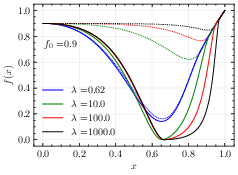
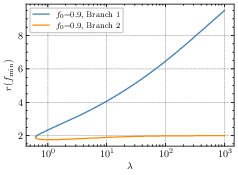
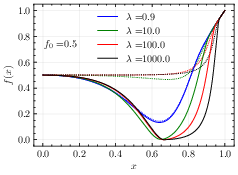
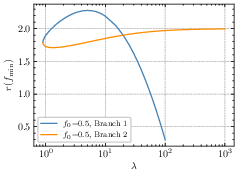
Figure 1: Solutions of f(r) for f0=0.9 (top) and f0=0.5 (bottom) for different λ, showing the distinction between Branch 1 (dashed) and Branch 2 (solid).
Existence and Structure of Static Stable Circular Orbits
The study derives the geodesic equations and analyzes the conditions for both the existence and stability of circular orbits. Circular orbits exist at radii rCO where the effective potential Veff(r) attains an extremum, and stability is ensured by Veff′′(rCO)≥0. Specifically, static orbits require vanishing angular velocity (Ω=0) and correspond to extrema of f(r), i.e., f′(rSSCO)=0 and f′′(rSSCO)≥0.
A salient result is the identification of static orbits as the innermost stable circular orbits (ISCOs), contrasting with Schwarzschild geometry wherein the ISCO possesses nonzero angular momentum and velocity. These static ISCOs imply the theoretical possibility of ring-like accretion structures that do not emit Doppler-broadened radiation.
The permitted region for circular orbits can be discontinuous, determined by positivity constraints on both f′(r) and an auxiliary function D(r)=[2f(r)−rf′(r)]/2. It is particularly in Branch 2 for high λ that D(r) becomes negative over intervals, fragmenting the allowed domain for stable orbits.
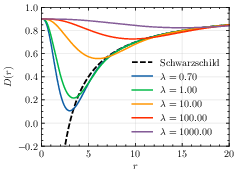
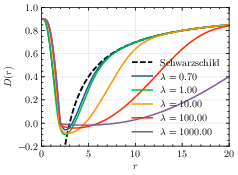
Figure 2: D(r) for differing λ, contrasting the behavior in Branch 1 (left) and Branch 2 (right). Schwarzschild and ECG cases are shown for direct comparison.
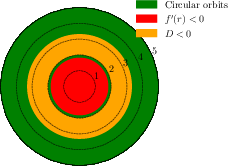
Figure 3: Colored regions denoting allowed/disallowed circular orbits; green for permissible, red for f′(r)<0, and orange for D(r)<0 in Branch 2 with f0=0.9, λ=0.7.
Numerical integration of perturbed initial conditions confirms the dynamical stability of these orbits under both radial and angular velocity perturbations.
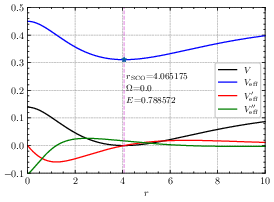
Figure 4: Effective potential for Ω=0 in Branch 1 (f0=0.9, λ=10), highlighting the minimum at the static orbit radius.
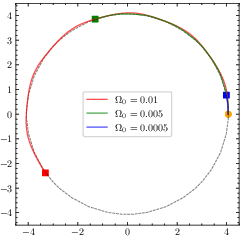
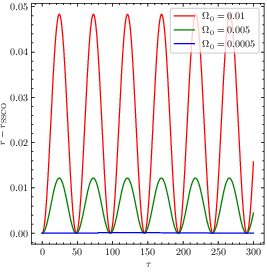
Figure 5: (a) Geodesic trajectory under angular velocity perturbation; (b) radial deviation as a function of proper time, confirming orbital stability in Branch 1 for f0=0.9, λ=10.0.
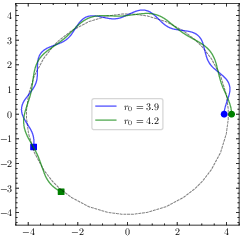
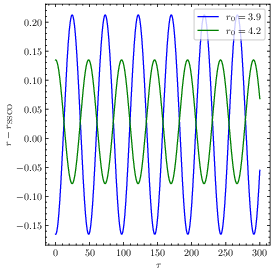
Figure 6: (a) Geodesic trajectory under radial perturbation; (b) corresponding radial deviation. The orbit remains confined around the static solution.
Aschenbach Effect and Orbital Velocity Profile
A central result is the demonstration of the Aschenbach effect—non-monotonicity of the orbital velocity v(ϕ), as measured by a ZAMO, as a function of r. While in vacuum Schwarzschild spacetime v(ϕ) increases monotonically as r decreases, in ECG (for sufficiently high λ) there exists a region where v(ϕ) first increases then decreases, vanishing exactly at the static stable orbit. This non-monotonicity extends to the coordinate angular velocity ΩCO and, in certain parameter regimes, is accompanied by discontinuities in the allowed domain of the orbits.
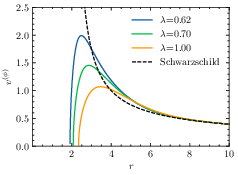
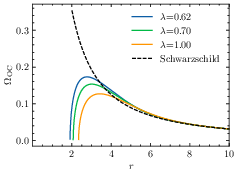
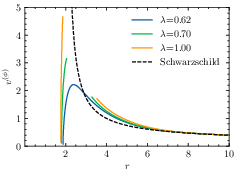
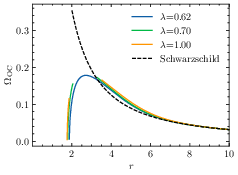
Figure 7: The distribution of orbital velocity v(ϕ) for Branch 1 and 2, enabling direct comparison with the monotonic Schwarzschild case.
The specific energy E of particles on circular orbits also displays rich structure, potentially diverging at photon spheres (zeros of D(r)), and for certain stable orbits near the center, E>1. Such configurations imply that particles can radiate energy in excess of their rest mass as they spiral inward, a feature not present for neutral test particles in Schwarzschild spacetime.
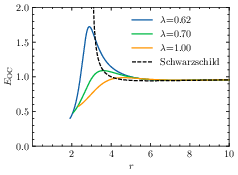
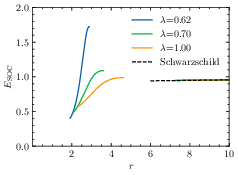
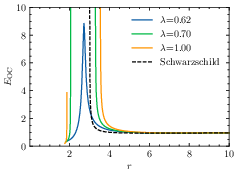
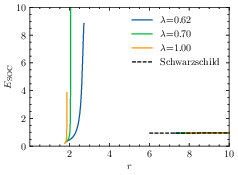
Figure 8: Specific energy E of particles on (left) all circular orbits and (right) only stable circular orbits for both branches, with Schwarzschild comparison (dashed).
Physical and Theoretical Implications
These findings have several important ramifications:
- Astrophysical Observability: The existence of static ISCOs predicts the formation of ring-like, non-Doppler-broadened features in accretion disks, providing a direct observational discriminator from black holes.
- Energy Extraction: The E>1 property for stable orbits near the center suggests that matter can radiate more energy than its rest mass, impacting the efficiency of accretion processes and posing constraints for high-energy phenomena around compact objects.
- Spacetime Structure: The discontinuous region structure for circular orbits in certain ECG parameter regimes provides a unique lens to distinguish horizonless ECG objects from black holes, particularly through studies of accretion dynamics and quasi-periodic oscillations (QPOs).
- Future Directions: A detailed radiative transfer analysis for disks composed of such SCOs is anticipated, aimed at predicting observable spectra and signatures associated with horizonless ECG objects.
Conclusion
This paper demonstrates that horizonless, static, spherically symmetric solutions in Einsteinian Cubic Gravity generically support static, stable, timelike circular orbits that act as the ISCO. These orbits induce a distinctive non-monotonic (Aschenbach) profile in the orbital velocities measurable by ZAMO observers, and, depending on the ECG parameters, fragment the domain of allowed circular orbits. The energetic and dynamical properties of SCOs predicted herein offer accessible, quantifiable observational tests for distinguishing modified gravity scenarios from standard GR black holes, thus motivating further studies on their astrophysical impact and possible detection.