- The paper introduces a unified framework linking scaling and inversion symmetries to efficiently characterize fractal dimensions and chaos.
- It formalizes inversion functions and inverse sets to reveal geometric relationships in phase space for discrete maps.
- Its methodology rapidly estimates Lyapunov exponents, demonstrating strong convergence and applicability across multiple chaotic systems.
Discrete Dynamical Systems with Scaling and Inversion Symmetries
Introduction and Motivation
The paper "Discrete dynamical systems with scaling and inversion symmetries" (2602.02622) constructs a unified framework for analyzing discrete dynamical systems based on scale and inversion symmetries. Recognizing that scale invariance is fundamental to complex systems—manifested in power laws, fractal structures, and critical phenomena—the authors establish the equivalence of scaling and geometric inversion, subsequently leveraging this symmetry to provide alternative and efficient methods for characterizing fractals and quantifying chaos, specifically via Lyapunov exponents.
Scaling and Inversion: Structural Connections
The study formalizes scaling transformations (S(x)=sx) and geometric inversion in the plane, where inversion with respect to a circle of radius r is defined by rPrQ=r2. The geometric interpretation (Figure 1) presents inversion as a mapping between interior and exterior points relative to the reference circle.
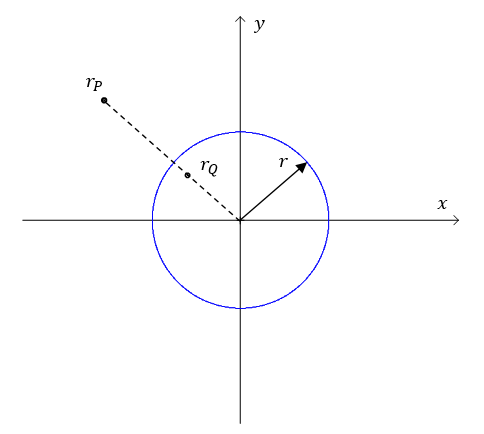
Figure 1: The inversion transformation in the plane, defined by rPrQ=r2, which maps external points P into internal points Q and vice versa.
A critical insight is that scaling can be constructed as a composition of two sequential inversions. This group-theoretic perspective places both transformations within the broader family of conformal mappings. The connection enables a systematic extension of scaling analysis to the language of inversion symmetry, underpinning the methods developed for fractals and chaotic maps analyzed in the sequel.
The framework introduces the concepts of inverse sets—subsets of phase space connected by inversion relations, e.g., xjxℓ=kx—and develops the notion of orbits in discrete systems related by these inversions. For one-dimensional dynamical systems, the phase space is partitioned into symmetric pairs under inversion, illustrated by phase portraits for paradigmatic nonlinear maps (Figure 2).

Figure 2: Phase portrait of the map xm+1=μxm3: orbits generated from distinct initial conditions belong to symmetric inverse sets.
The core mathematical structure is the inversion characteristic function fi(α,k)(ε) and its governing differential equation. Solutions admit both algebraic and exponential representations, with the inversion exponent γ encoding the scaling behavior intrinsic to the system.
Fractals: Inversion Symmetry and Dimensionality
The framework is concretely applied to fractal geometry. Considering the construction of self-similar sets such as the Sierpinski triangle, geometric inverse sets are defined for discrete measures (e.g., perimeter, area) across iterative refinements. The union of inverse sets is visualized for the equilateral triangle case (Figure 3).
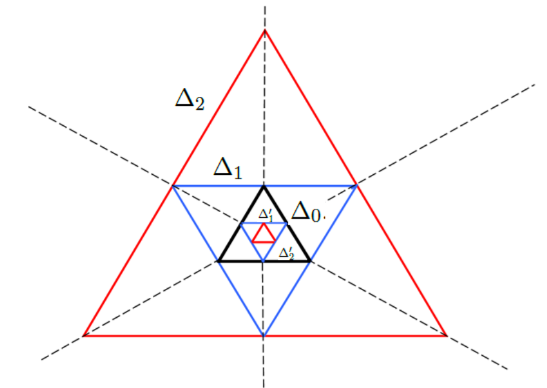
Figure 3: A geometric figure resulting from the union of the inverse sets formed by equilateral triangles.
For the Sierpinski triangle, perimeters and areas at iteration n are related by inversion centered at intermediate iterations (Figure 4).
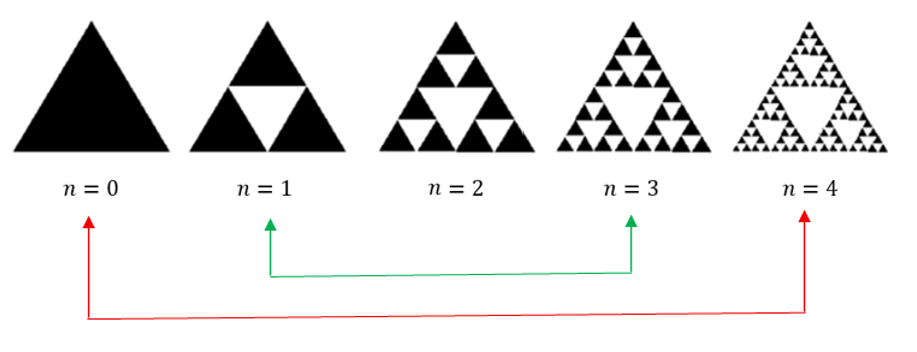
Figure 4: Sierpinski triangle up to iteration n=4, illustrating that the perimeter and area measurements are inversely related with respect to iteration n=2.
The inversion relations yield a closed-form inversion differential equation whose solution gives the fractal (self-similarity) dimension as a parameter. The formalism shows the equivalence between traditional power-law dimensionality and an exponential law arising from inversion symmetry.
Chaotic Maps: Lyapunov Exponents from Inversion Structure
The approach extends to the analysis of chaos, especially the computation of Lyapunov exponents in classic 1D maps such as the tent, logistic, and Chebyshev maps. The method utilizes the lengths of the iterated mappings Fm(x), whose asymptotic scaling is dictated by the Lyapunov exponent λ. In the chaotic regime, these mapping curves form geometric inverse sets (Figure 5).
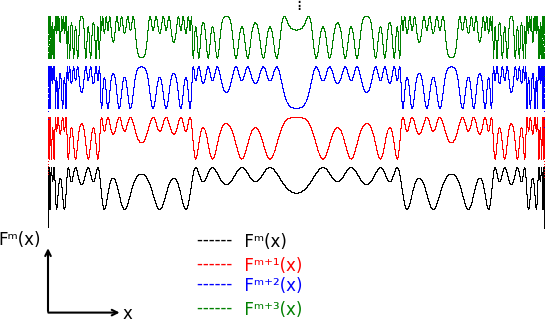
Figure 5: Illustration of the mappings Fm(x), Fm+1(x), Fm+2(x), and Fm+3(x) of a chaotic system, which are related by the scale factor ρ=eλ.
For the tent map (parameter ν=0.6), explicit computation reveals rapid convergence of the inversion exponent γ to the analytical value λ=ln(2ν)≈0.18 (Figure 6). The approach is robust: convergence requires only a small number of iterations, unlike standard time-averaging algorithms.
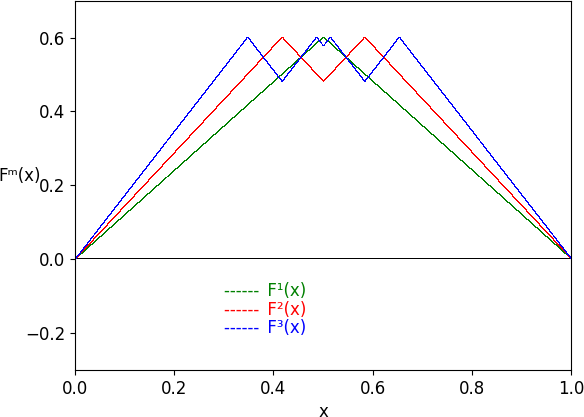
Figure 7: Mappings F1(x), F2(x), and F3(x) for the tent map (ν=0.6).
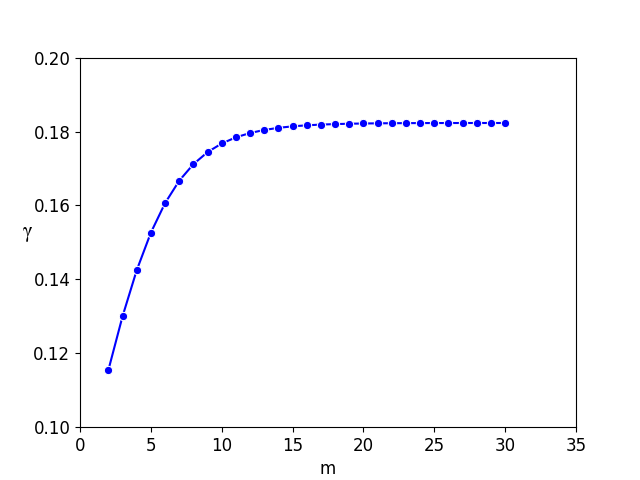
Figure 6: Inversion exponent γ as a function of m for the tent map with parameter ν=0.6.
Mapping iterates in the tent map can be directly visualized within the geometric inverse set at higher orders (Figure 8).
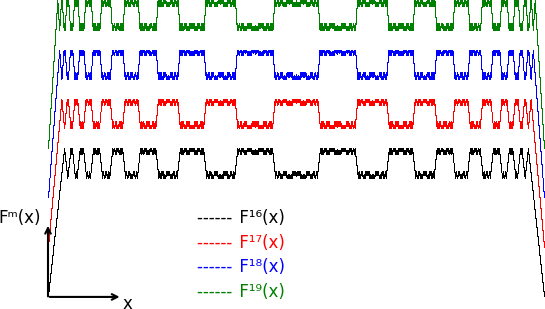
Figure 8: Illustration of the mappings F16(x), F17(x), F18(x), and F19(x) for the tent map with parameter ν=0.6.
Similar analysis for the logistic map (r=4) and Chebyshev map (β=3) shows identical performance, with respective convergence to analytical Lyapunov exponents (Figures 10 and 13). Figures 9, 11, 12, and 14 give explicit mappings and the structure of inverse sets for these maps.
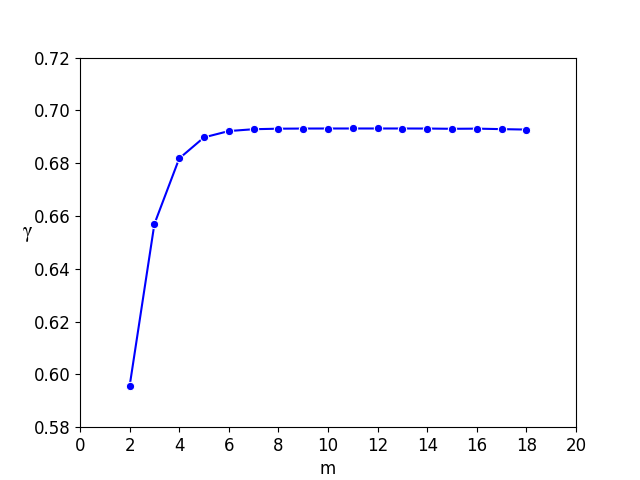
Figure 9: Variation of the inversion exponent γ as a function of the iteration m for the logistic map with parameter r=4.
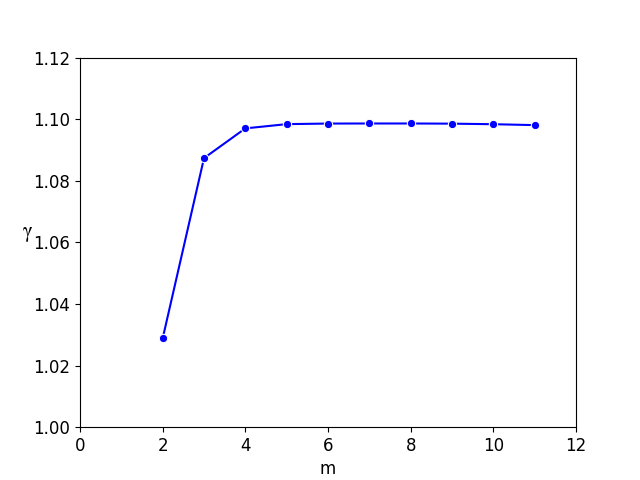
Figure 10: Variation of the inversion exponent γ as a function of the iteration m for the Chebyshev map with parameter β=3.
Numerical and Conceptual Advantages
A key empirical finding is that Lyapunov exponents estimated through this geometric/inversion approach reach their asymptotic values quickly (often after m=4−10 iterations), with strong agreement with conventional definitions. This efficiency arises directly from the inherent symmetry and does not depend on long time-averages or special initial conditions.
Moreover, for orbits with nonpositive Lyapunov exponents, the inversion exponent vanishes, consistent with the absence of exponential divergence.
Implications and Outlook
The results demonstrate that inversion symmetry provides a natural and efficient lens for analyzing scale-invariant structures in both the regular and chaotic regimes of dynamical systems. For self-similar fractals, inversion symmetry encodes the essential scaling exponents. For chaotic maps, it enables direct, rapid computation of Lyapunov exponents. The formalism is not map-specific and applies broadly to systems with underlying geometric self-similarity or scale invariance.
Potential future directions include extending the methodology to higher-dimensional systems, continuous-time dynamics, and the analysis of scaling in complex networks or stochastic systems. The group-theoretic underpinning (conformal invariance) may enable generalizations to quantum systems or field theories where scale and inversion play a central role.
Conclusion
This work establishes that the interplay between scaling and inversion symmetries yields a powerful, unified approach for characterizing fractal structures and quantifying chaos in discrete dynamical systems. The proposed inversion formalism not only recovers standard numerical results with high efficiency but also provides a transparent geometric interpretation of scaling phenomena. The recognition that chaotic dynamics and fractal geometries can be addressed within a common symmetry framework suggests further avenues for theoretical unification and computational simplification in complex system analysis.