- The paper presents high-cadence time-series photometry of 3I/ATLAS, capturing its pre-perihelion coma and tail evolution over more than four months.
- It details robust methodology including contamination mitigation, differential photometry, and forced aperture techniques to extract clean light curves from crowded fields.
- Results show a steep heliocentric brightness index (n = 5.17) compared to literature values, indicating enhanced tail contribution and potential calibration biases.
Time-Domain Photometry of Interstellar Comet 3I/ATLAS with HATPI
Introduction
The paper "HATPI Pre-Perihelion Time-series Photometry of the Interstellar Comet 3I/ATLAS" (2602.21586) presents an extensive high-cadence, wide-field photometric analysis of @@@@2@@@@, the third identified interstellar object traversing the solar system. Using the HATPI facility at Las Campanas, a dedicated 64-camera array with 45 s cadence and ∼7,100 deg2 field-of-view, the study establishes robust time-series photometry for this rare target over more than four months approaching perihelion, providing critical constraints on coma activity evolution, light curve structure, and heliocentric brightness scaling.
HATPI Instrument Overview and Observing Strategy
HATPI operates with 64 fast Mitakon 154 mm f/1.6 lenses each feeding 2,048×2,048 E2V CCDs at a plate scale of 19.7″/pix. Its custom 430–890 nm broadband filter is similar but not identical to Gaia’s G band, and photometric calibration references Gaia DR2 G and BP−RP values. The survey’s pointing and calibration stability permit differential photometry with ≃30 mmag systematics.
Comet 3I/ATLAS was monitored from 2025 May through September, covering pre-perihelion evolution. Detections in individual 45 s frames became possible after it brightened to G∼16.4 mag; prior to that, nightly stacks were required for significant detection. Observations suffered from significant crowding and blending at low galactic latitude, motivating extensive outlier rejection via image-level quality metrics, satellite trail masking, and variable neighbor flagging.
Data Processing and Light Curve Extraction
Standard CCD calibration and optimal reference-image subtraction were performed with FITSH tools, leveraging custom astrometric matching to Gaia DR2 and construction of empirical references for background subtraction. Forced aperture photometry was executed at each predicted ephemeris position determined from JPL Horizons, using three concentric apertures (28.6″, 38.4″, 46.3″ radii).
A rigorous contamination vetting protocol was essential due to background stars and variable objects, producing a clean subset of 7,294 exposures (out of over 15,000) on which the main scientific analysis is based.
HATPI delivers coma-integrated photometry: at late times, systematically brighter measurements in larger apertures confirm significant resolved tail flux exceeding the smallest aperture (Figure 1).
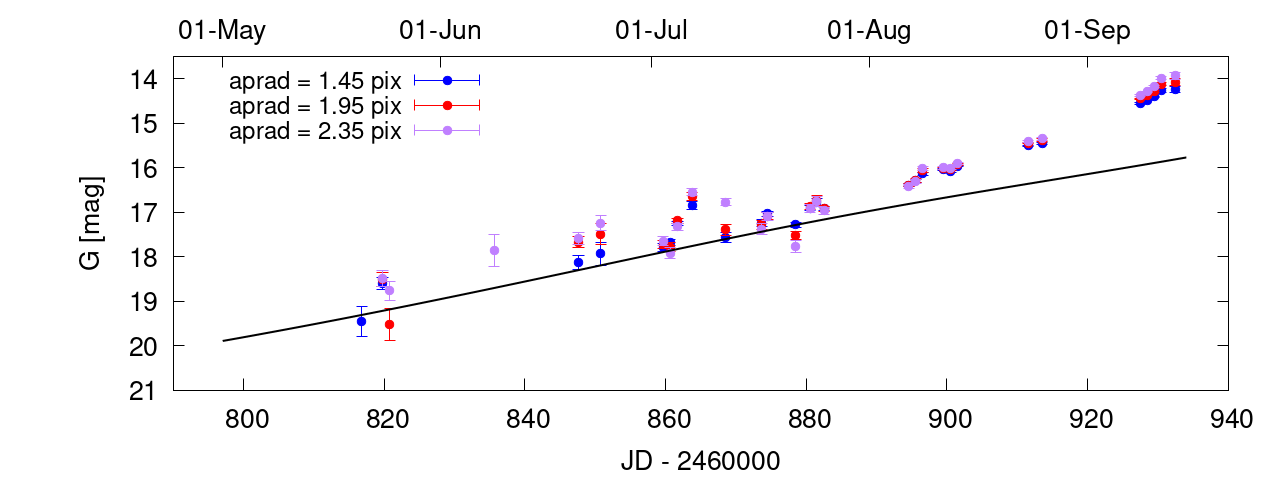
Figure 1: Systematic aperture dependence at late epochs signifies resolved flux from the extended comet tail beyond the nucleus-dominated inner aperture.
Photometric Time-Series and Variability Constraints
The unbinned and nightly-averaged light curves allow evaluation of both secular brightening and short-timescale changes. No intra-night variability above ∼0.2 mag is detected after August 6, when the coma dominates the light, thus rotational modulation from the nucleus is swamped (Figure 2).
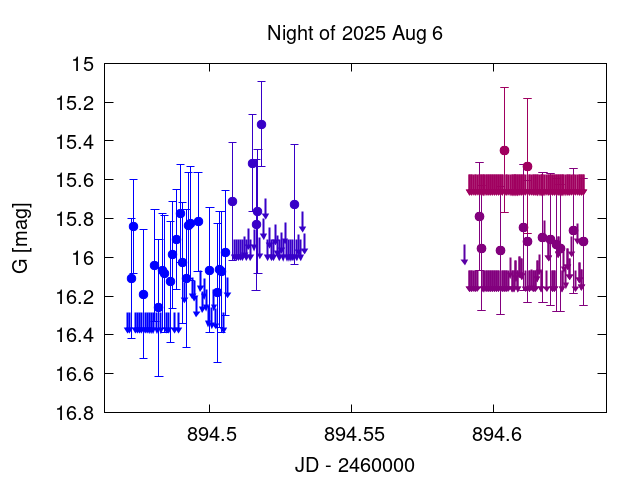
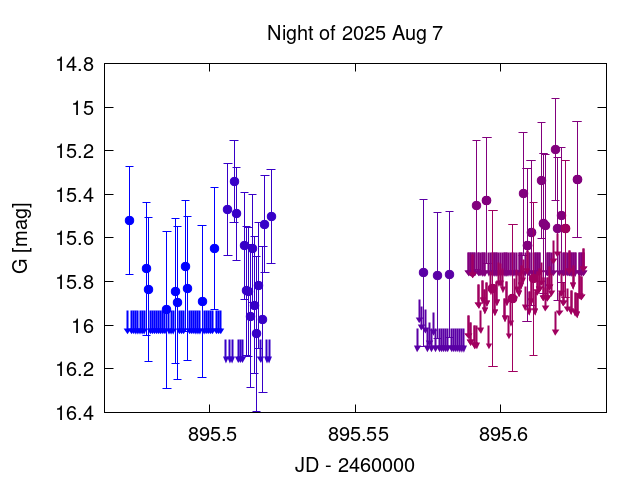
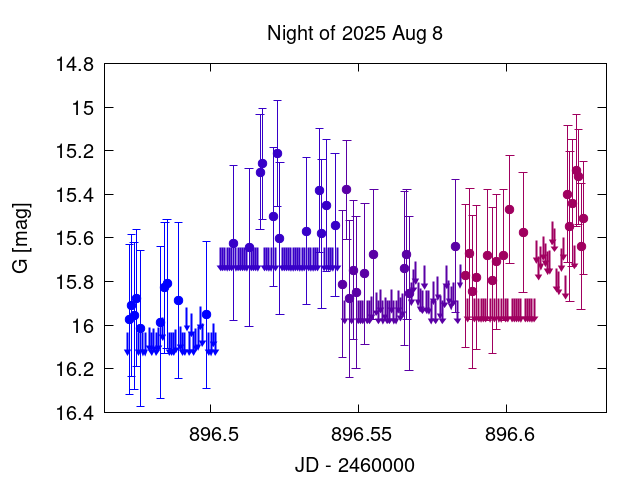
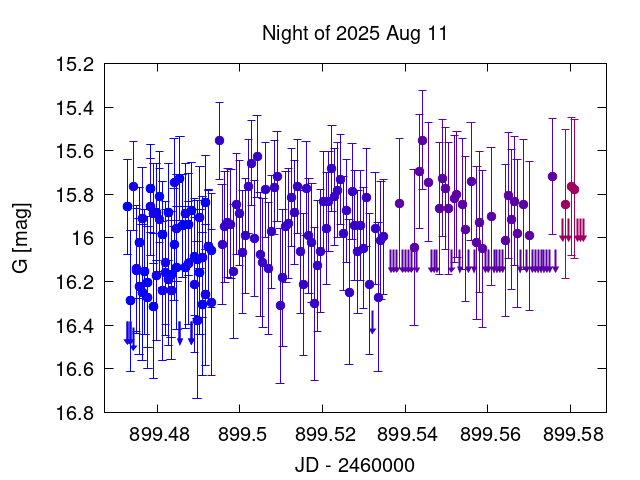
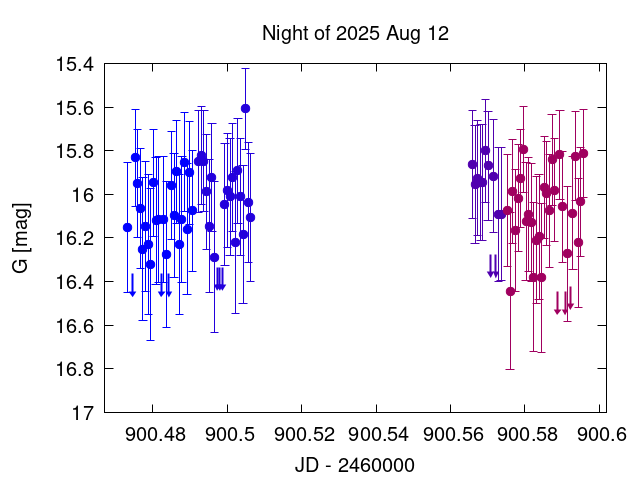
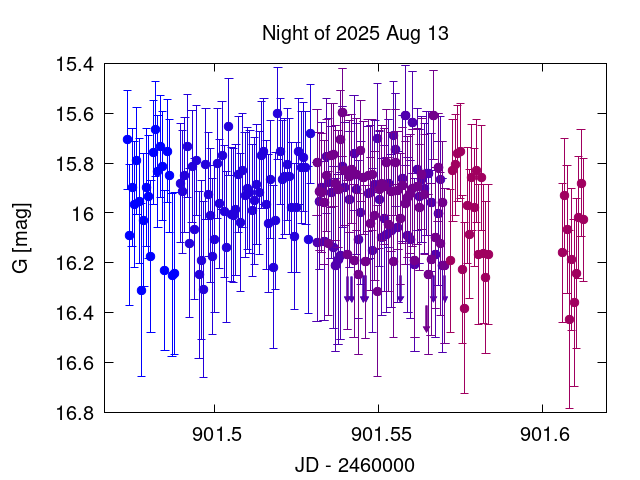
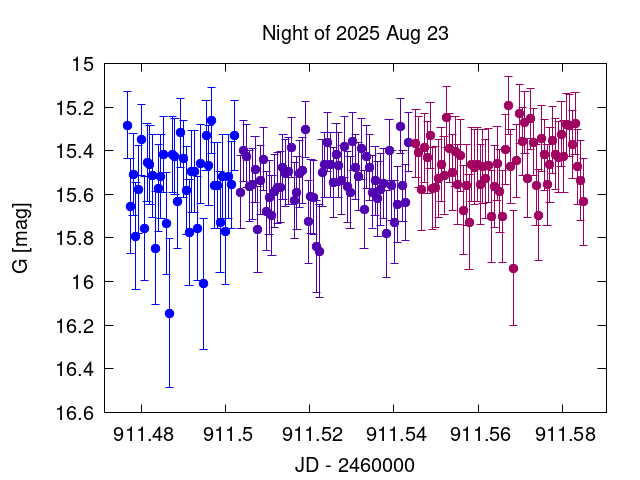
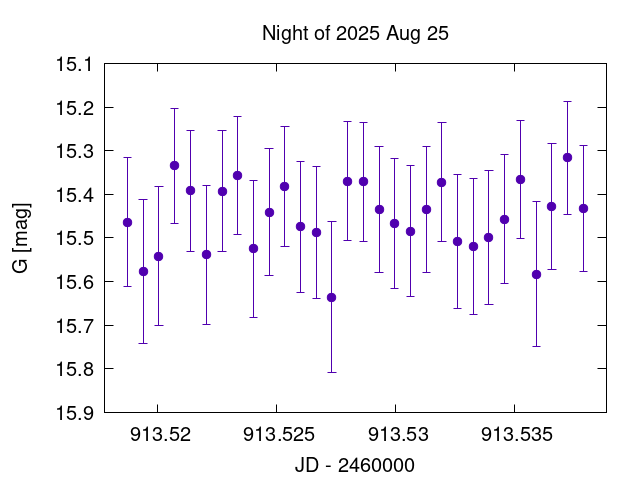
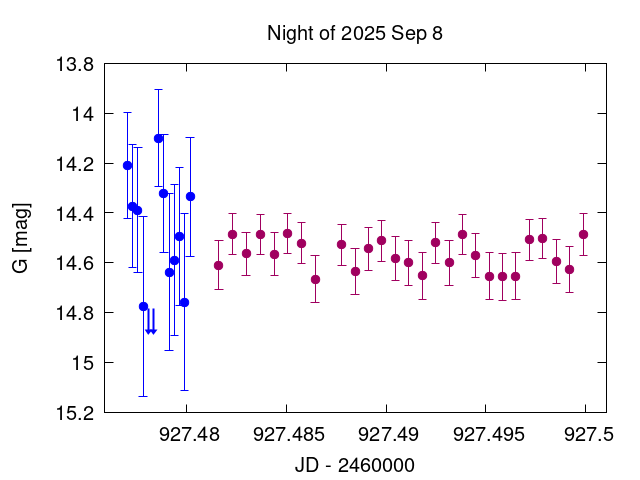
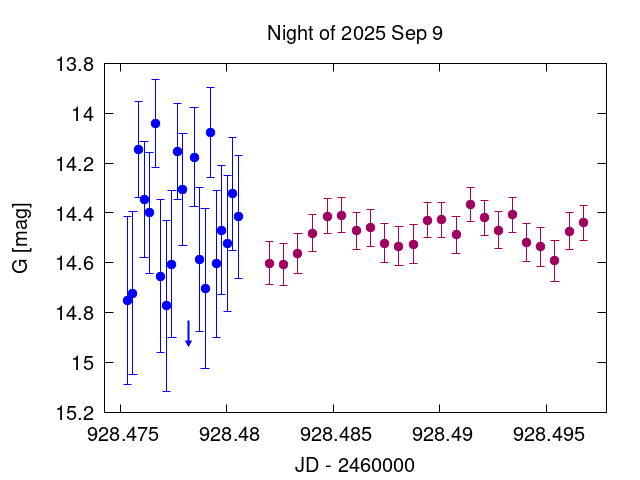
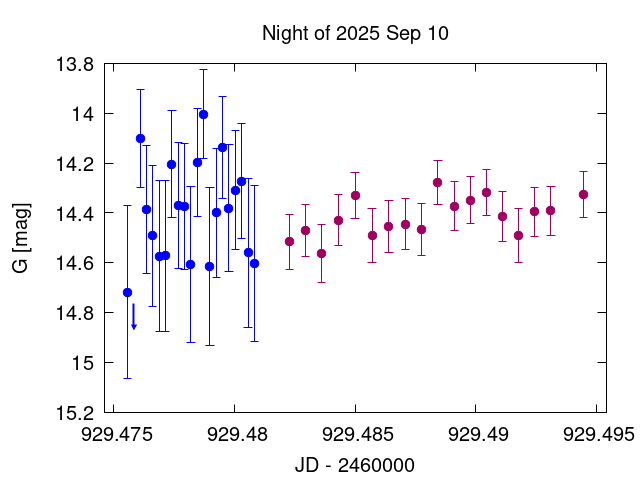
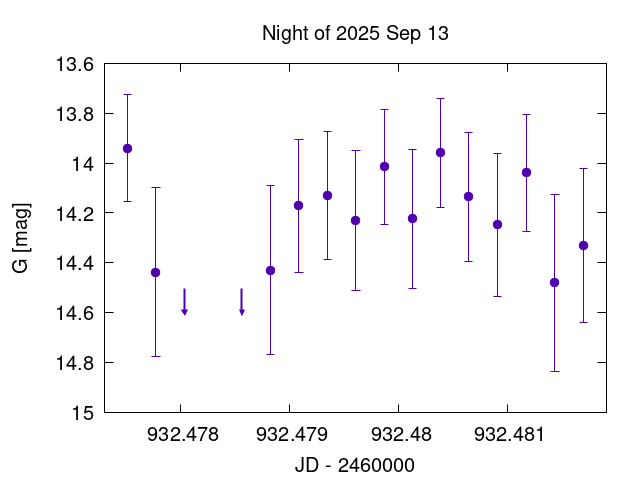
Figure 2: Individual exposure light curves for 12 nights; the absence of statistically significant night-scale variability indicates coma-dominated emission.
Early tentative detections in May are rejected as robust photometric points due to contamination, with the first secure detection on July 2 (G=17.80±0.08).
Heliocentric Brightness Evolution and Comparison with Other Observations
The paper fits the observed nightly binned magnitudes, corrected to a linear aperture of 7×10⁴ km, with a parametric form:
mF=MF+2.5log10(rHnΔ2)−2.5log10Φα
where n is the heliocentric index (activity scaling), and β parameterizes the phase function. Constrained alongside literature photometry (NOT, ATLAS, ZTF, TESS, SNIFS), HATPI yields several key results:
- Joint fit to all datasets: n=3.94, β=0.055 mag/deg.
- Fit to HATPI alone (with same β): n=5.17 (significantly steeper than the combined/literature value).
This is visualized in Figure 3, which illustrates that the HATPI data present a stronger brightening as a function of decreasing rH than previous studies. The difference is pronounced at small rH, plausibly reflecting different bandpass response, aperture size (and tail-to-nucleus fraction), and/or photometric calibration.
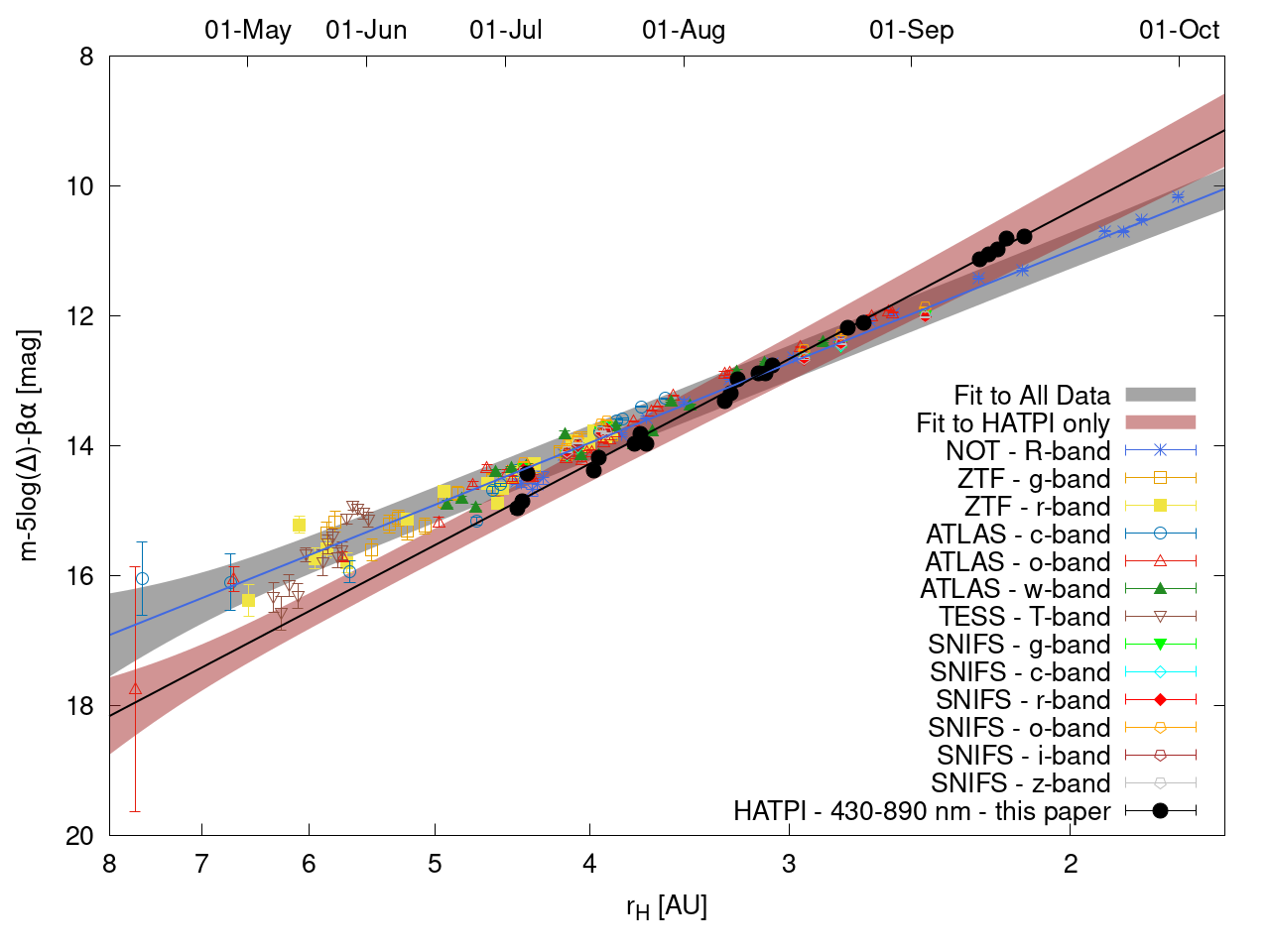
Figure 3: HATPI nightly binned light curve (7×10⁴ km aperture) compared to literature photometry, demonstrating a steeper heliocentric index in HATPI data.
Physical Interpretation and Implications
The best-fit n from HATPI alone is << the canonical n∼4 for CO2 sublimation (seen in literature), and even exceeds the typical n∼5−6 expected for H2O-dominated comets at small rH (indicative of more steeply increasing activity as perihelion approached). However, the adoption of larger photometric apertures in HATPI (due to limited spatial resolution) can bias this measurement by integrating more of the extended dust tail, which may have a non-linear dependence with rH.
Additionally, the HATPI bandpass may include certain gas emission lines (e.g., C2), but pre-perihelion spectroscopic monitoring does not robustly confirm significant emission in this range during the HATPI coverage window. Color evolution (comet becoming bluer towards perihelion) and systematic uncertainties in the photometric Gaia G mapping are shown to be subdominant (few 0.01 mag) compared to the measured effect.
The lack of short-term variability at <0.2 mag scales, even at high cadence, places constraints on rotational modulation and fragmentation activity in the coma-dominated regime during the weeks prior to perihelion.
Future Prospects and Broader Context
The study demonstrates the utility of high-cadence, all-sky time-domain imaging for transient and moving object science, stressing the value of robust contamination mitigation at low spatial resolution in crowded fields. The methodology established here is broadly applicable (and already being applied) to faint, fast-moving solar system objects, especially ones with complex coma/tail morphology that are not a focus of dedicated follow-up imaging campaigns.
Continued cross-comparison of photometric behavior derived from different apertures/bandpasses and advanced modeling of coma and tail profiles will be necessary for interpreting future interstellar interloper observations. HATPI, with its large field and temporal coverage, will remain a critical facility for such events. The observed diversity in n across datasets, especially the systematically steeper indices found with HATPI, motivates detailed synthesis of high- and low-resolution photometry and explicit coma modeling.
Conclusion
This work provides the most extensive pre-perihelion time-series photometry for 3I/ATLAS, extracting clean high-cadence light curves from challenging, crowded, low-latitude fields using rigorous quality-control procedures. The measured heliocentric index for HATPI (n=5.17) is substantially steeper than that found in prior works, a result likely driven by the survey’s large photometric aperture capturing more tail emission. The analysis sets a methodological foundation for future time-domain comet and interstellar object studies in wide-field imaging surveys.