Is an investor stolen their profits by mimic investors? Investigated by an agent-based model
Abstract: Some investors say increasing investors with the same strategy decreasing their profits per an investor. On the other hand, some investors using technical analysis used to use same strategy and parameters with other investors, and say that it is better. Those argues are conflicted each other because one argues using with same strategy decreases profits but another argues it increase profits. However, those arguments have not been investigated yet. In this study, the agent-based artificial financial market model(ABAFMM) was built by adding "additional agents"(AAs) that includes additional fundamental agents (AFAs) and additional technical agents (ATAs) to the prior model. The AFAs(ATAs) trade obeying simple fundamental(technical) strategy having only the one parameter. We investigated earnings of AAs when AAs increased. We found that in the case with increasing AFAs, market prices are made stable that leads to decrease their profits. In the case with increasing ATAs, market prices are made unstable that leads to gain their profits more.
Paper Prompts
Sign up for free to create and run prompts on this paper using GPT-5.
Top Community Prompts
Explain it Like I'm 14
What this paper is about
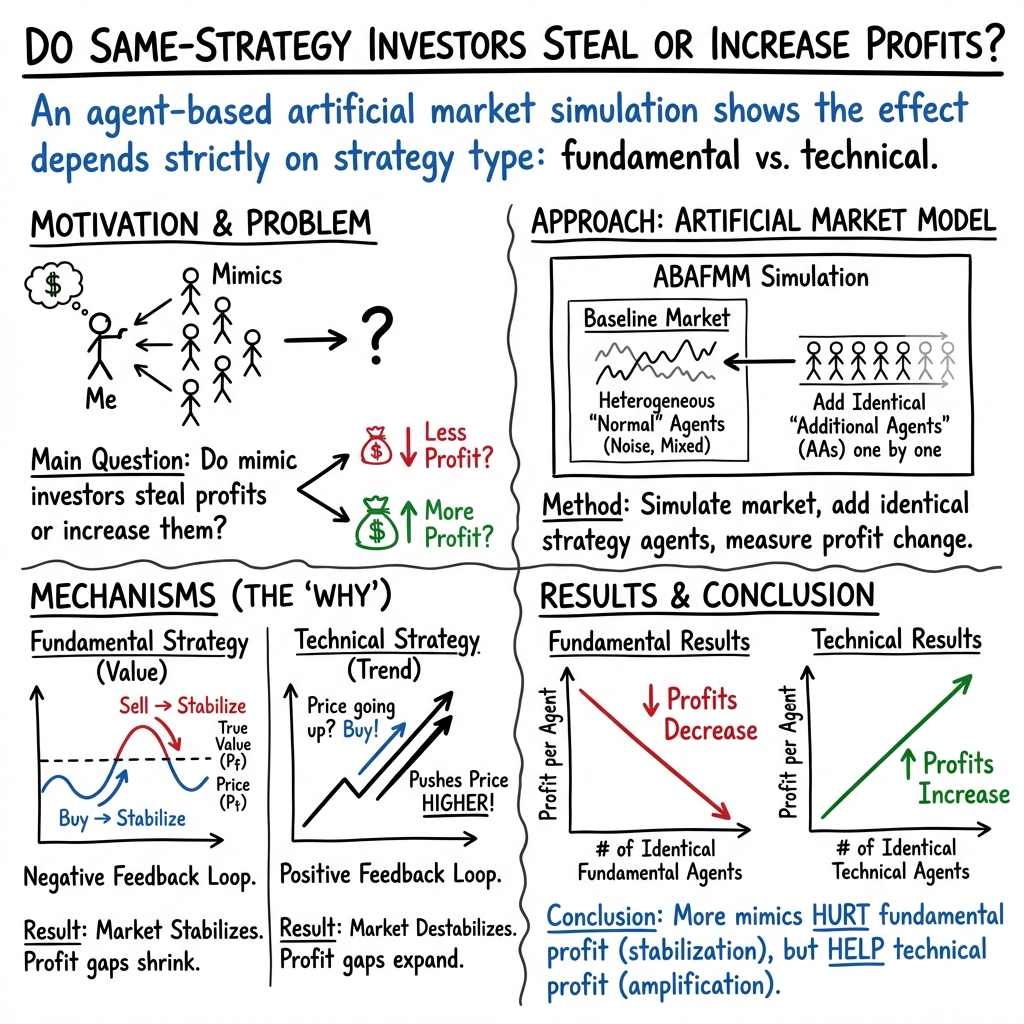
This paper asks a simple question: If lots of investors copy the same trading strategy, do they each make more money or less? The authors test this by building a large computer simulation of a stock market and watching what happens when more and more “copycat” traders join in.
The main questions
The study focuses on two easy-to-understand questions:
- If many investors follow a value-based strategy (buy when the price looks cheap, sell when it looks expensive), do their individual profits go up or down?
- If many investors follow a trend-following strategy (buy when the price is going up, sell when it’s going down), do their individual profits go up or down?
Put simply: Does copying a value strategy help or hurt you? And does copying a trend-following strategy help or hurt you?
How the researchers studied it
The authors used an “agent-based model,” which is like a video game of a market filled with many simple, rule-following computer traders:
- The market itself: It works like a real stock exchange. Buyers and sellers post prices, and when a buy and a sell match, a trade happens.
- Regular traders: There are 1,000 “normal” traders who mix:
- a value idea (is the price below or above a basic “true value”?),
- a trend idea (has price been moving up or down lately?),
- a bit of randomness (to keep things realistic).
- Copycat traders (the ones the study cares about): The researchers add extra traders one by one, up to 99, who all use exactly the same simple rule. There are two types:
- Additional Fundamental Agents (AFAs): value-focused copycats. They buy if the market price is below a fixed “fundamental value” and short-sell if it’s above. Think of them as bargain hunters who sell when things look overpriced.
- Additional Technical Agents (ATAs): trend-following copycats. They buy if today’s price is higher than it was a while ago (they ride the wave) and short-sell if it’s lower (they bet the fall continues).
Analogy:
- AFAs are like a thermostat: when the room (price) gets too cold, they turn on the heat (buy), and when it gets too hot, they cool it down (sell). This keeps the room stable.
- ATAs are like a crowd that starts cheering louder because others are cheering: if the price rises, they buy more, pushing it up further; if it falls, they sell more, pushing it down further. This can make swings bigger.
The researchers ran long simulations and measured:
- how bumpy or stable prices became,
- how much money the copycat traders made,
- how often they traded.
What they found and why it matters
Here are the main results in plain terms:
- When many value-focused copycats (AFAs) join:
- Prices become more stable. Their buying when price is “too low” and selling when it’s “too high” pushes prices back toward the fundamental value.
- Their profits per person go down as more of them join. Why? Because by stabilizing prices, they remove the very mispricing they profit from. Fewer big gaps = fewer chances to make money.
- This is a “negative feedback” loop: their actions calm the market and reduce future profit opportunities.
- When many trend-following copycats (ATAs) join:
- Prices become more unstable. Their “ride the trend” behavior amplifies ups and downs.
- Their profits per person go up as more of them join. Why? Because they help create bigger swings, and those swings are exactly what their strategy feeds on.
- This is a “positive feedback” loop: their actions make trends stronger, which creates more chances to profit.
In short:
- Copying a value strategy tends to reduce each trader’s profit because it smooths out the price bumps that value traders need.
- Copying a trend-following strategy tends to increase each trader’s profit because it makes the bumps bigger.
Why this is important
This study shows that whether copying helps or hurts depends on the kind of strategy everyone is copying:
- If lots of people act like stabilizers (value traders), markets calm down, but each person’s profits shrink.
- If lots of people act like amplifiers (trend followers), markets get shakier, but each person’s profits grow.
This matters for:
- Investors: It explains why some groups believe “too many people doing the same thing kills profits,” while others feel “doing what everyone else does makes more money.” Both can be true—just for different types of strategies.
- Market designers and regulators: It highlights how the mix of strategies can make markets more stable or more volatile. Rules that affect who trades and how they trade can change overall stability.
A final note: This is a simulation, not the real world. Real markets are more complicated. But simulations like this help us understand the basic cause-and-effect of crowd behavior in trading.
Knowledge Gaps
Knowledge gaps, limitations, and open questions
The following list identifies what is missing, uncertain, or left unexplored in the paper, framed to guide future research concretely:
- Profit accounting is underspecified and potentially unrealistic: profits are evaluated using final holdings valued at the constant fundamental price Pf rather than realized PnL at transaction prices. Define clear cash/inventory accounting, mark-to-market, and position-closing rules, and include transaction costs.
- The “fundamental value” is fixed (Pf constant). Assess how time-varying fundamentals (e.g., AR(1), random walk, macro-driven processes) alter AFAs’ stabilizing effect and profitability.
- No sensitivity analysis across the model’s key parameters (w1,max, w2,max, w3,max, Tmax, Pa, σe, tick size ΔP, tc). Systematically vary them to test robustness of the main conclusions.
- ATAs use a single, extreme memory length (ta = 100000) shared by all. Explore a range of ta values, heterogeneity across ATAs, and how memory horizons interact with volatility and profitability.
- Additional agents (AAs) are perfectly identical within type (AFAs or ATAs). Introduce parameter heterogeneity (e.g., varying thresholds, ta, risk tolerances) to examine crowding effects and dispersion in outcomes.
- Order size is fixed at one share and positions are capped at ±1 share for AAs. Test realistic position sizing, scaling in/out, and position limits to evaluate capacity constraints and crowding.
- Short selling is frictionless and unlimited for NAs; borrowing constraints, margin requirements, and shorting costs are absent. Incorporate these frictions to assess their impact on strategy profitability and market stability.
- AAs place orders at fixed, synchronized times after the initial loop. Replace this with asynchronous or stochastic timing to avoid artifacts from coordinated order submission.
- Microstructure is insufficiently detailed: order matching, partial fills, queue position, cancellations (“The remaining order is canceled to.” is incomplete), and execution prices (mid-price vs trade price) are not fully specified. Provide exact order book mechanics and use transaction prices to compute PnL.
- Results appear based on a single simulation path; there is no reporting of variability or statistical significance. Run multiple seeds and report distributions, confidence intervals, and hypothesis tests.
- Market “stability” is only qualitatively shown in figures. Quantify it with volatility, autocorrelation, kurtosis, drawdowns, tail indices, and price efficiency (distance to Pf) to substantiate claims.
- The core question—do mimic investors reduce others’ profits?—is only examined for AAs’ own profits. Measure how NAs’ profits and welfare change as AAs increase to detect profit “stealing” or redistribution effects.
- The source of profits in a mostly zero-sum trading environment is unclear without explicit cash-flow accounting. Verify whether total profits across agents are balanced and identify which agents bear losses when ATAs gain.
- Scalability is not explored beyond na = 99. Test larger populations to find thresholds where ATA-induced instability saturates or leads to bubbles/crashes, and whether AFAs’ stabilizing capacity has limits.
- Extreme-event dynamics are not analyzed. Measure tail risk (e.g., VaR/CVaR), crash frequency, and regime shifts under increasing ATAs and mixed populations.
- The positive/negative feedback narratives (Figures 4–5) lack formal derivation. Provide analytical or semi-analytical arguments (e.g., linear response or mean-field approximations) to characterize stability conditions.
- Agents are static (no learning or adaptation). Introduce adaptive weights/parameters, profit-driven strategy switching, and entry/exit to study equilibrium and path-dependence.
- Baseline market composition is fixed (n = 1000 NAs). Vary NA population size and their parameter distributions to test whether AAs’ effects depend on underlying liquidity and heterogeneity.
- Transaction costs, fees, and latency are omitted. Incorporate realistic frictions to determine whether ATA profits persist net of costs and whether crowding increases execution slippage.
- Order book depth and liquidity are stylized. Model multi-unit orders, partial fills, and dynamic bid-ask spread formation to capture price impact and crowding penalties when many ATAs act simultaneously.
- Fundamental heterogeneity is absent (single Pf). Introduce multiple AFAs with varied Pf estimates to reflect real valuation dispersion and test whether stabilization persists with disagreement.
- The per-investor scaling of profits is not fully resolved. Measure profits per AA as na grows to identify dilution/saturation points, especially for ATAs, and compare to total group profits.
- Only a single asset is modeled. Explore multi-asset settings with cross-impact to see whether mimicry propagates instability across correlated markets.
- Initial conditions (prices, holdings, cash) are not clearly specified or tested. Evaluate sensitivity to initial states and transient dynamics (e.g., warm-up length tc).
- ATA behavior when t < ta is not defined. Specify rules for early periods and examine how ta relative to tc affects early market formation and later dynamics.
- Tick-size effects are not studied. Vary ΔP to investigate how discretization influences stability, volatility, and execution quality under mimicry.
- The mechanism behind the observed decline/stabilization of ATA trade counts with na is not analyzed. Decompose order flow and fill rates to explain this pattern.
- Mixed populations of AFAs and ATAs are not explored. Study interaction effects, tipping points between stabilization and destabilization, and optimal composition for market quality.
- Reproducibility is limited: code, random seeds, and implementation details are not provided. Release source code and full specification to enable independent verification.
- There is no empirical validation. Compare model outputs (stylized facts, volatility, autocorrelation, crowding effects) to markets known for prevalent trend-following or fundamental strategies.
- Risk-adjusted performance is not reported. Compute Sharpe/Sortino ratios, drawdowns, and skewness for AFAs/ATAs to assess whether higher ATA profits come with disproportionate risk.
- Profit realization for AFAs is ambiguous since they “do not place orders when they already have one share.” Specify closing rules and evaluate round-trip PnL rather than end-of-simulation valuation against Pf.
- The mathematical specification of Eq. (1) appears malformed (e.g., denominator “/[{Wi,j,”). Clarify whether returns are normalized by the sum of weights and fix typographical/notation errors.
- Practical regulatory implications are not drawn despite references to market design. Test how changes in rules (e.g., auction cadence, position limits, tick size) modulate mimicry effects and instability.
Practical Applications
Overview
This paper builds an agent-based artificial financial market model (ABAFMM) to isolate the effect of “mimic investors” who use identical strategies. It adds two classes of additional agents: fundamental agents (AFAs) and technical agents (ATAs). Key findings:
- As the number of AFAs increases, prices stabilize, which reduces AFAs’ profit opportunities (negative feedback).
- As the number of ATAs increases, prices become more unstable, which increases ATAs’ profits by amplifying trends (positive feedback).
Below are actionable applications of these insights across industry, academia, policy, and daily life, grouped by immediacy, with sector links and feasibility notes.
Immediate Applications
The following applications can be piloted or deployed now, with reasonable adaptation to real-market data and workflows.
- Finance (Trading firms, Asset managers): Strategy crowding diagnostics
- Use case: Build a “crowding score” that flags when many desks/funds are deploying similar trend-following parameters (e.g., same look-back windows), raising volatility and tail risk.
- Tools/products/workflows: Real-time market microstructure analytics using price autocorrelation, order-imbalance persistence, and clustering of strategy parameters inferred from trade patterns; dashboards for portfolio managers and risk teams.
- Assumptions/dependencies: Requires robust inference of strategy similarity from trade data; the paper’s single-asset, zero transaction cost, infinite short-sale assumptions need adjustment for real markets.
- Finance (Risk management): Dynamic risk limits for trend-following
- Use case: Introduce leverage caps or VAR add-ons when indicators suggest ATA-like positive feedback (e.g., accelerating momentum with rising participation).
- Tools/products/workflows: Policy rules embedded in risk systems linked to a “herding volatility indicator.”
- Assumptions/dependencies: Effective detection of herding; mapping ABM signals to thresholds that avoid over-constraining legitimate trading.
- Finance (Exchanges, Market surveillance): Herding/feedback loop detection
- Use case: Real-time alerts when price moves are self-reinforcing (e.g., rising buy-side pressure with increasing trend alignment), allowing earlier intervention (volatility pauses, auctions).
- Tools/products/workflows: Surveillance modules using microstructure signals (short-horizon return autocorrelation, serial correlation in order flow, queue dynamics).
- Assumptions/dependencies: Need tuning to the specific microstructure; continuous double auction in the model differs from venues with batch auctions or different tick regimes.
- Fintech (Social/copy trading platforms): Guardrails against synchronized copy-trades
- Use case: Warn users when many are copying identical technical parameters; throttle executions to limit procyclical spikes.
- Tools/products/workflows: “Crowding warnings,” staggered execution windows, parameter diversity prompts.
- Assumptions/dependencies: User consent to throttling; platform-level data to quantify parameter similarity.
- Finance (Market making): Inventory and spread adjustments under technical herding
- Use case: Adjust spreads, inventory buffers, and hedging speed when ATA-like activity is detected to mitigate adverse selection and inventory risk.
- Tools/products/workflows: Automated spread and inventory models tied to herding signals.
- Assumptions/dependencies: Liquidity conditions and regulatory constraints; transaction costs omitted in the paper should be included.
- Finance (Portfolio construction): Parameter diversification to reduce crowding
- Use case: Deliberately vary look-back windows, thresholds, and filters across technical models to avoid synchronized trades that amplify volatility.
- Tools/products/workflows: “Parameter diversity optimizer” embedded in quant research pipelines.
- Assumptions/dependencies: Potential trade-off between diversification and individual model performance; requires robust backtesting.
- Academia (Teaching, training): ABM labs to illustrate market feedback
- Use case: Classroom simulations showing negative feedback from AFAs vs positive feedback from ATAs.
- Tools/products/workflows: Course modules using simplified agent-based simulations; Jupyter notebooks.
- Assumptions/dependencies: Simplified assumptions are pedagogically useful but not realistic; should be presented as conceptual demonstrations.
- Finance (Stress testing): Scenario analysis with incremental mimic investors
- Use case: “Add 10/20/50 ATAs with shared parameters” and assess PnL distribution, drawdowns, and liquidity stress.
- Tools/products/workflows: Internal ABM-based scenario generator; overlays on historical or synthetic data.
- Assumptions/dependencies: Requires calibration to venue-specific data; the model’s single-asset setup should be extended for multi-asset portfolios.
- Policy/Education (Retail investors): Communication on risks of trend-chasing
- Use case: Investor education materials explaining that coordinated trend-following can raise volatility and risk, even when short-term profits appear attractive.
- Tools/products/workflows: Infographics and interactive demos; broker/platform nudges.
- Assumptions/dependencies: Simplifies complex market behavior; ensure messages avoid oversimplification or paternalism.
- Finance (Compliance): Model concentration reporting
- Use case: Internal disclosures tracking how many strategies share identical signal templates or parameters; flagging capacity risk for popular strategies.
- Tools/products/workflows: Quarterly model overlap audits; governance committees.
- Assumptions/dependencies: Honest model inventories; cultural acceptance of transparency.
Long-Term Applications
The following applications require further research, scaling, multi-asset calibration, or policy development before broad deployment.
- Policy (Regulators, Exchanges): Microstructure reforms to dampen positive feedback
- Use case: Evaluate batch auctions, randomization of order arrival, dynamic tick sizes, or queueing rules that reduce reinforcement from synchronized trend-following.
- Tools/products/workflows: Regulator labs using calibrated ABMs; pilot programs with sandbox environments.
- Assumptions/dependencies: Empirical validation is essential; changes may have unintended consequences across liquidity providers and retail flows.
- Finance/Data vendors: Herding Risk Index as a market data product
- Use case: An index quantifying strategy similarity and its contribution to volatility for each asset; used by funds and regulators.
- Tools/products/workflows: Signal extraction models plus ABM-based mapping from signals to risk levels; distribution via data feeds.
- Assumptions/dependencies: Access to detailed order/trade data; robust estimation of strategy clusters.
- Finance (Quant funds): Adaptive controllers that switch between fundamental and technical regimes
- Use case: Meta-strategies that tilt toward fundamental signals when positive feedback rises and toward technical signals when markets are mean-reverting.
- Tools/products/workflows: Real-time regime detection; reinforcement learning controllers informed by ABM insights.
- Assumptions/dependencies: Avoid overfitting; need guardrails against whipsaw and transaction costs; multi-asset extensions.
- Policy (Systemic risk): Crowding-aware capital and liquidity buffers
- Use case: Incorporate crowding metrics into capital add-ons or liquidity stress scenarios for highly mimicked strategies.
- Tools/products/workflows: Supervisory stress tests incorporating ABM-derived feedback dynamics.
- Assumptions/dependencies: Requires coordination with industry; risk of penalizing common strategies without clear causality.
- Exchanges/Platforms: Parameter diversity incentives
- Use case: Incentivize heterogeneity (e.g., fee rebates for non-correlated strategies, throttling for overly-aligned parameters in high-stress periods).
- Tools/products/workflows: Identity-protected strategy classification; platform controls.
- Assumptions/dependencies: Privacy, fairness, and competitive neutrality concerns.
- Academia/Policy: Calibrated ABM “policy labs”
- Use case: Permanent research infrastructure to test market design changes, regulation drafts, and crisis interventions using calibrated ABMs.
- Tools/products/workflows: Multi-asset, multi-venue ABM environments; data-sharing frameworks.
- Assumptions/dependencies: Requires high-quality microstructure data and interdisciplinary teams.
- Finance (Product design): Capacity planning for popular strategies
- Use case: Quantify how profits decay as more funds adopt identical signals (as seen for AFAs), informing fund capacity limits and fee structures.
- Tools/products/workflows: Capacity models combining historical alpha decay and ABM simulations.
- Assumptions/dependencies: Model must include realistic constraints (transaction costs, slippage, borrow limits).
- Fintech (Robo-advisors): Crowding-aware portfolio allocators
- Use case: Adjust client allocations away from crowded technical exposures during high herding phases, with education overlays.
- Tools/products/workflows: Crowding sensors; client communication modules.
- Assumptions/dependencies: Requires transparency on algorithm design; compliance with suitability rules.
- Cross-market systemic monitoring: Network-level herding maps
- Use case: Detect synchronized trend-following across assets/sectors that can propagate volatility (e.g., momentum clusters).
- Tools/products/workflows: Graph analytics of co-movement and signal similarity; ABM scenario projections.
- Assumptions/dependencies: Multi-asset data integration; attribution challenges (macro news vs strategy herding).
Notes on model-specific assumptions that affect feasibility across applications:
- Single asset; continuous double auction; identical ATA parameters; constant fundamental value (Pf); one-share orders; zero transaction costs; no position limits (infinite long/short); no funding, risk, or margin constraints.
- Real markets require incorporating transaction costs, liquidity constraints, multi-asset interactions, funding/margin dynamics, and adaptive agent behavior.
- Any deployment should calibrate detection thresholds and policy interventions to venue-specific data and conduct rigorous backtesting to avoid unintended consequences.
Glossary
- Additional agents (AAs): Purpose-added trader types introduced to the model to study the impact of many investors using the same strategy. "Additional agents(AAs) that includes additional fundamen- tal agents (AFAs) and additional technical agents (ATAs)."
- Additional Fundamental Agents (AFAs): Agents that trade based on the relationship between market price and a fixed fundamental value, tending to stabilize prices. "1) Additional Fundamental Agents (AFAs):"
- Additional Technical Agents (ATAs): Agents that trade based on recent price movements over a fixed lookback, tending to destabilize prices. "2) Additional Technical Agents (ATAs):"
- Agent-Based Artificial Financial Market Model (ABAFMM): An agent-based simulation framework specifically designed to emulate financial market dynamics for research and design. "an agent-based artificial financial market model(ABAFMM) [1]"
- Agent-Based Model (ABM): A computational model where autonomous agents interact according to rules, producing emergent system behavior. "Agent-Based Model(ABM)"
- Artificial Market Model: A synthetic, simulated market environment used to isolate and study causal effects and policy changes. "Artificial Market Model"
- Continuous double auction: A market mechanism where buy and sell orders are matched continuously whenever prices cross, setting trades and market prices. "An exchange uses a continuous double auction to determine the market price."
- Expected price: The price forecast derived from an agent’s expected return, used to set order prices. "After the expected return has been determined, the expected price is"
- Expected return: An agent’s computed estimate of future return based on weighted fundamental, technical, and noise components. "The expected return of NA j at t is"
- Fundamental strategy: A trading rule that buys when market price is below the fundamental value and sells when above. "The first term in Eq. (1) represents a fundamental strategy:"
- Fundamental value (Pf): A fixed intrinsic valuation parameter used as the benchmark for fundamental trading and profit evaluation. "Pf is a fundamental value and is a constant."
- Limit order: An order to buy or sell at a specified price, often queued as waiting orders in the book. "many waiting limit orders."
- Lookback period (ta): The number of past time steps ATAs use to compare current price with a previous price for trend-following decisions. "all ATAs have same the one parameter, ta that how long do they refer the price ago."
- Mid-price: The average of the highest buy-order (bid) and lowest sell-order (ask) prices, used as the market reference price. "Pt is a mid-price (the average of the highest buy-order price and the lowest sell-order price) at t"
- Micro-macro interaction: The interplay between individual agent behaviors (micro) and aggregate market outcomes (macro) with feedback loops. "micro-macro interaction and feedback loops have played essential roles"
- Multi-Agent Simulation: A simulation involving many interacting agents to study system-level behavior. "Multi-Agent Simulation"
- Negative feedback: A self-damping mechanism where actions (e.g., AFAs buying in a fall) reduce deviations and stabilize the system. "This process is a negative feedback process."
- Noise (term): A random component added to agents’ return expectations to capture unpredictable influences. "The third term represents noise."
- Normal agents (NAs): Baseline trader agents representing general investors, combining fundamental and technical strategies. "we introduced the normal agents(NAs) to model a general investor."
- Positive feedback: A self-reinforcing mechanism where actions (e.g., ATAs buying in a rise) amplify price movements and instability. "This process is a positive feedback process."
- Price formation: The process by which trades and order interactions determine market prices over time. "To replicate the nature of price formation in actual financial markets"
- Price gap: The difference between the market price and the fundamental value, which can be a source of profit for AFAs. "AFAs gain the price gap between the market and fundamental as a profit"
- Rounder down/up to the nearest fraction: The rule that buy-order prices are rounded down and sell-order prices rounded up to the nearest allowed price increment. "The buy-order and sell-order prices are rounder down and up to the nearest fraction, respectively."
- Short sell: Selling borrowed shares to profit from anticipated price declines, creating a short position. "The NAs can short sell freely."
- Short-sold: The state of already having sold shares short (i.e., holding a short position). "short-sold one share"
- Tick size (&P): The minimum allowable price increment in the market. "In this study, I set &P = 0.01"
- Technical analysis strategy: A rule that bases trades on past price changes or trends rather than intrinsic value. "The second term represents a technical analysis strategy using a historical return"
Collections
Sign up for free to add this paper to one or more collections.