Exclusive Self Attention
Abstract: We introduce exclusive self attention (XSA), a simple modification of self attention (SA) that improves Transformer's sequence modeling performance. The key idea is to constrain attention to capture only information orthogonal to the token's own value vector (thus excluding information of self position), encouraging better context modeling. Evaluated on the standard language modeling task, XSA consistently outperforms SA across model sizes up to 2.7B parameters and shows increasingly larger gains as sequence length grows.



Paper Prompts
Sign up for free to create and run prompts on this paper using GPT-5.
Top Community Prompts
Explain it Like I'm 14
Explaining “Exclusive Self Attention” in simple terms
1) What this paper is about (overview)
This paper suggests a small tweak to how Transformers (a common kind of AI model for language) pay attention to words in a sentence. The tweak is called Exclusive Self Attention (XSA). Its main idea: when a word looks at the rest of the sentence for clues, it should avoid repeating what it already knows about itself and focus only on new, useful information from other words. The authors show this simple change makes LLMs learn better, especially on long texts.
2) The key questions the paper asks
- Do standard Transformers spend too much effort re‑saying what a word already contains, instead of learning from the surrounding words?
- If we force attention to ignore a word’s “own info,” will the model understand the context better and perform better overall?
3) How they did it (methods), in everyday language
First, a quick analogy for “self‑attention”:
- Imagine you’re writing an essay, and for each word you choose, you glance at the words before it to decide what fits best. That “glance” is attention: the model checks other words in the sentence and mixes their information to help understand the current word.
What the authors noticed:
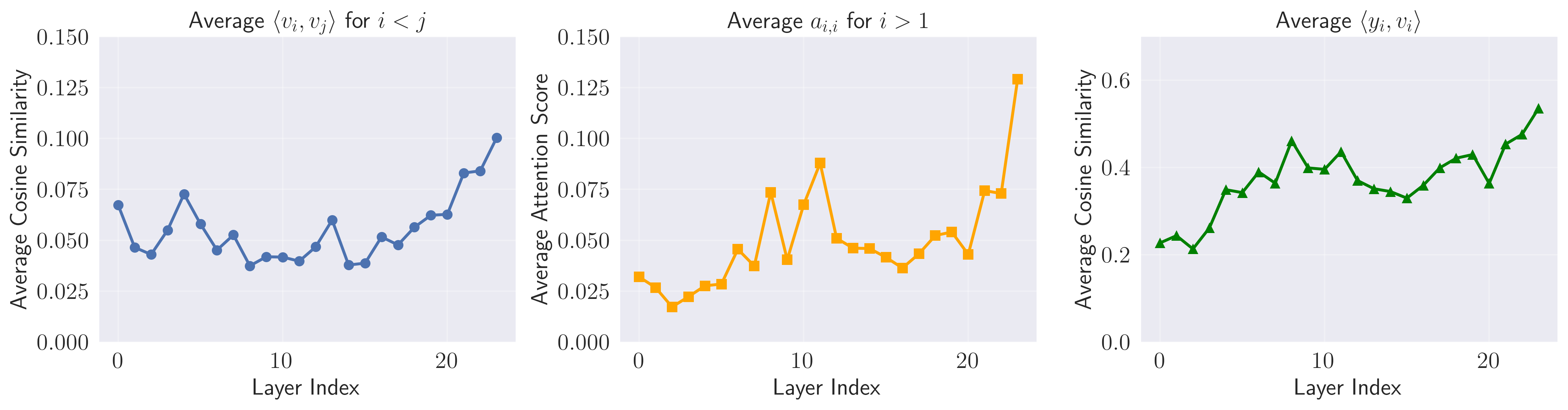
- In normal Transformers, the “attention output” for a word often looks very similar to the word’s own internal summary (its “value”). In other words, attention keeps giving back what the word already had, rather than bringing in new context. They call this the “attention similarity bias.”
What XSA does:
- XSA takes the usual attention output and subtracts the part that matches the word’s own information. Think of it like this: after gathering notes from all your classmates, you cross out anything that’s just a repeat of your own notes. That way, you only keep fresh, context information from others.
- This isn’t removing the word’s information entirely. Transformers have another part (the feed‑forward network, or FFN) and a “shortcut path” that keep the word’s own info safe. XSA just tells attention: “Focus on what you can learn from the context; the FFN will handle the word’s own features.”
How they tested it:
- They trained LLMs of different sizes (about 0.7B, 1.4B, and 2.7B parameters) on a huge web dataset (~100 billion tokens).
- They used the same training setup for fairness and compared standard attention vs. XSA.
- They measured:
- Training and validation loss (how well the model predicts text while learning and on held‑out data),
- Scores on many question‑answering and reasoning tasks,
- Speed and memory usage,
- Behavior with different learning rates,
- Performance on different text lengths (from short to very long),
- Interaction with “attention sinks” (special tokens used in some models to stabilize attention).
4) What they found and why it matters
Here are the main takeaways in simple terms:
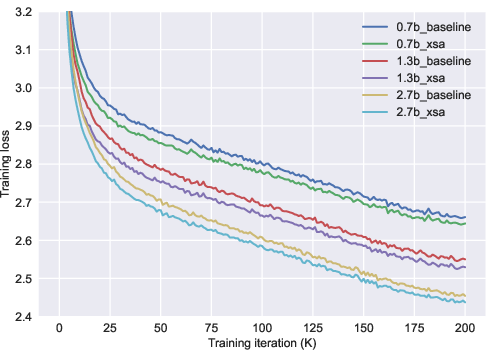
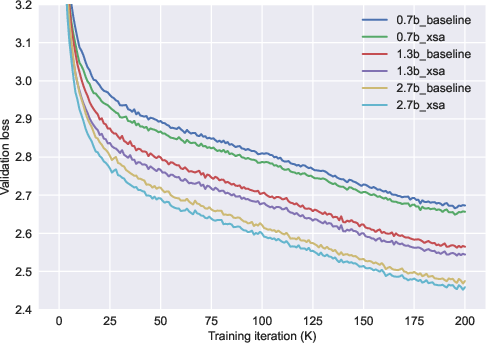
- Better learning: XSA consistently lowered training and validation loss compared to standard attention across all model sizes. That means the models understood text better during and after training.
- Better task performance: On multiple benchmarks (like BoolQ, HellaSwag, LAMBADA, and others), XSA models scored higher on average than standard models, with bigger gains in larger models.
- Minimal cost: XSA added almost no extra time or memory usage. It’s a tiny code change with noticeable benefits.
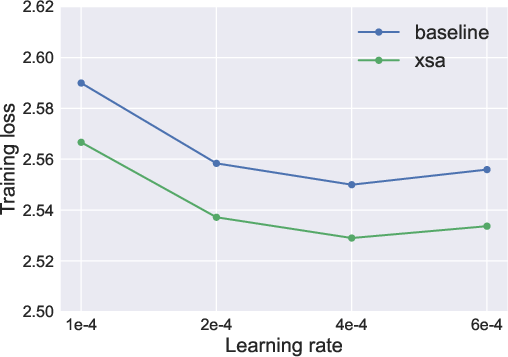
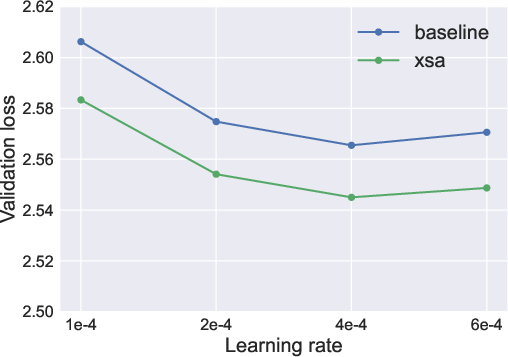
- Works across settings: The improvement held steady across different learning rates.
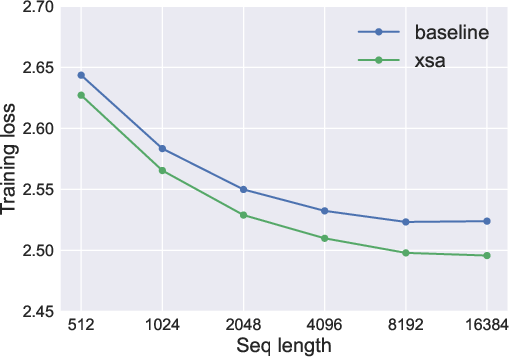
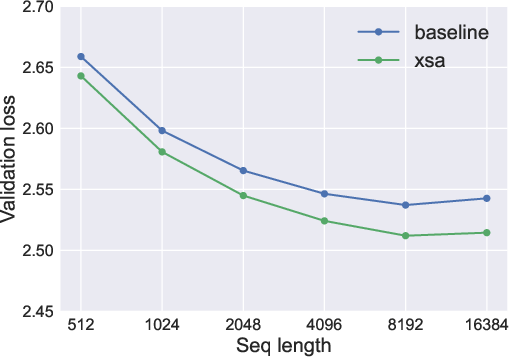
- Especially good for long texts: The longer the input sequence, the larger the advantage of XSA. This suggests XSA helps models keep track of faraway information better—a big deal for long documents or conversations.
- Plays well with others: Even when combined with “attention sinks” (a technique to stabilize attention), XSA still helped.
Why this matters:
- Attention is meant to bring in context; XSA stops it from echoing what’s already there. This clearer “division of labor” (attention = context, FFN = per‑word features) helps the model focus and learn more efficiently.
- Because the gains grow with longer texts, XSA could be especially valuable for tasks like summarizing long articles, analyzing code, or multi‑step reasoning.
5) What this could lead to (implications)
- Stronger long‑context models: Since XSA shines with longer inputs, it could help build future AI systems that handle books, long reports, or lengthy chats more reliably.
- Scales to bigger systems: The improvements increased with model size, hinting that XSA might be even more useful in very large models.
- Easy to adopt: It’s just a small, simple change to existing Transformer code, making it practical for many research and industry models.
- Open questions: The authors suggest testing XSA with other optimizers, on other data types (like images, audio, or video), and at larger scales to see how far its benefits go.
In short: Exclusive Self Attention helps Transformers use attention for what it does best—bringing in new context—while letting other parts handle the word’s own information. This small change consistently improves learning and performance, especially for long sequences, without slowing things down.
Knowledge Gaps
Knowledge gaps, limitations, and open questions
The following list synthesizes what remains missing, uncertain, or unexplored in the paper, framed as concrete, actionable items for future work:
- Scaling behavior: Validate XSA beyond 2.7B parameters and >100B tokens, with multi-epoch training and larger corpora to assess stability, convergence, and gains at true frontier scales.
- Dataset generalization: Test across diverse domains (e.g., books, news, code, math, biomedical) and tokenizers (e.g., SentencePiece, TikToken variants) to assess robustness to data and tokenizer shifts.
- Task/modalities coverage: Evaluate on encoder-only (masked LM), encoder–decoder (seq2seq), and multimodal (vision, speech) Transformers, including cross-attention blocks and bidirectional attention.
- Instruction tuning and alignment: Measure XSA’s impact on SFT/RLHF, few-shot prompting, and instruction-following benchmarks to ensure benefits translate to aligned LLMs.
- Long-context limits: Extend experiments beyond 16k context (e.g., 32k–1M tokens), including streaming/online decoding and retrieval-augmented settings, to test XSA under extreme context stress.
- Copying and identity preservation: Quantify effects on tasks requiring copying, exact reproduction, code generation, or long-span consistency where subtracting the self component might remove useful signal.
- Statistical robustness: Report multi-seed runs, variances, and significance tests for loss and downstream metrics to confirm results are not due to training noise.
- Theoretical guarantees: Provide proofs/analysis on expressiveness with residuals and FFN, conditions where XSA preserves universality, and failure cases where projecting out self value harms capacity.
- Mechanistic validation: Directly measure how XSA alters attention patterns (e.g., diagonal attention, y–v cosine similarity post-projection) across layers/heads, rather than inferring from loss curves.
- Partial/learnable exclusion: Explore variants with learnable projection strength (e.g., z = y − α·proj_v(y), with α per-head/layer), soft regularizers that penalize y·v, or gating mechanisms instead of hard removal.
- Layer/head placement: Ablate applying XSA only in specific layers (early vs late) or subsets of heads, to find minimal, most effective placements and reduce potential side-effects.
- Alternative exclusion directions: Test projecting out along other self-related directions (e.g., residual x_i, q_i, k_i) or multiple principal directions from local windows to disentangle self/context information more flexibly.
- Normalization details: Reconcile the analytical formula (division by ||v_i||2) with the implementation (use of normalized V); ablate normalized vs unnormalized projections and study numerical stability in bf16/fp8.
- Small-norm edge cases: Analyze behavior when ||v_i||≈0 (including early training) and ensure projection is numerically stable and does not introduce gradient spikes or dead directions.
- Optimizers and schedules: Evaluate compatibility with Muon, Adafactor, Lion, SGD, different weight decay, warmup lengths, and cosine vs constant schedules; search for XSA-specific hyperparameters rather than inheriting baseline LRs.
- Attention variants: Test with MHA/MQA/GQA, grouped-query attention, linear/performer-style attention, and FlashAttention kernels to ensure XSA integrates with diverse attention mechanisms and fused kernels.
- KV cache and latency: Measure end-to-end inference latency with KV caching and variable batch sizes; confirm the projection step does not hinder cache reuse or introduce latency spikes.
- Distributed and hardware portability: Benchmark training throughput/memory on A100/H100 and multi-node setups; assess kernel fusion opportunities and any hidden overheads not captured by block-level microbenchmarks on a B200.
- Positional encoding interactions: Evaluate with ALiBi, learned absolute positions, and other RoPE variants to ensure gains are not specific to one positional scheme.
- Normalization/architecture variants: Test with RMSNorm vs LayerNorm, Pre-LN vs Post-LN Transformers, and residual scaling (e.g., ReZero) to assess interactions with normalization and residual design choices.
- Cross-attention policy: Define and test whether and how XSA should apply to cross-attention (exclude along decoder-side v_i? encoder-side values? neither?), and measure effects on translation/summarization.
- Regularization and stability: Study interaction with dropout, activation/weight clipping, and gradient scaling; check whether XSA changes gradient norms or training stability profiles.
- Failure modes: Identify tasks/datasets where XSA underperforms (e.g., OBQA dip at 0.7B), characterize why, and determine mitigations (e.g., layer-selective application or partial projection).
- Bench breadth and depth: Expand beyond 8 tasks to comprehensive suites (e.g., MMLU, Big-Bench, HumanEval, GSM8K, GPQA), with zero-/few-shot setups and standardized prompts to rule out evaluation biases.
- Interpretability: Use probing/attribution to see if XSA leads to better separation of contextual vs point-wise information and whether heads become more specialized in long-range dependencies.
- Interaction with attention sinks: More systematically compare XSA to explicit sinks across sink types/counts and test combined approaches under long-context and streaming conditions.
Practical Applications
Overview
Exclusive Self Attention (XSA) is a minimal change to Transformer self-attention that subtracts the projection of the attention output onto the token’s own value vector. This explicitly removes self-like components from attention outputs, encouraging stronger context modeling. Empirically, XSA:
- Improves language modeling loss and downstream task accuracy across 0.7B–2.7B models.
- Provides larger gains as sequence length increases (up to 16k tested).
- Adds minimal speed and memory overhead.
- Is robust across learning rates and compatible with attention sinks.
Below are practical applications, grouped by deployability, with sector links, suggested tools/products/workflows, and feasibility notes.
Immediate Applications
These can be deployed now with available toolchains (e.g., PyTorch, NanoGPT/HF Transformers) and modest engineering.
- XSA-augmented LLM training for long-context tasks
- Sectors: software, legal, education, finance, healthcare, security
- What: Train or fine-tune LLMs with XSA to improve performance on long documents and multi-part reasoning (contracts, 10-Ks, scientific papers, medical notes, audit logs).
- Tools/workflows: Swap SA→XSA in your Transformer implementation; keep KV-cache unchanged; train with existing pipelines (PyTorch scaled_dot_product_attention + post-projection subtraction). Validate with LM Evaluation Harness plus long-context evals (e.g., LAMBADA, long QA).
- Assumptions/dependencies: Benefits shown for language modeling; retraining or fine-tuning recommended (drop-in inference swap on SA-trained models is not validated). Requires access to model code.
- Long-document summarization and grounding in RAG systems
- Sectors: software, legal, enterprise knowledge management, customer support
- What: Use XSA in long-context summarizers or RAG readers to reduce self-reinforcement and better leverage retrieved context.
- Tools/workflows: Integrate XSA in encoder/decoder attention for your reader model; evaluate on long-context QA/summarization datasets; combine with chunking and retrieval strategies.
- Assumptions/dependencies: Gains grow with sequence length; ensure retrieval quality and prompt formatting remain the main bottlenecks.
- Code understanding and repository-level assistants
- Sectors: software/DevEx
- What: Apply XSA to code LLMs for multi-file comprehension, test mapping, and refactor planning over large repositories.
- Tools/workflows: Fine-tune code models with XSA on long-context code corpora; integrate into IDE copilots for repo-wide search + reasoning.
- Assumptions/dependencies: Code tasks benefit from context-heavy reasoning; requires training/fine-tuning data with long contexts and proper tokenization.
- EHR summarization and longitudinal patient context
- Sectors: healthcare
- What: Improve clinical note summarization, longitudinal patient timeline reasoning, and guideline grounding by better context use.
- Tools/workflows: HIPAA-compliant training with de-identified data; fine-tune XSA models on clinical corpora; use long windows for episodes spanning months/years.
- Assumptions/dependencies: Regulatory constraints; domain adaptation crucial; clinical validation required.
- Financial and compliance document analysis
- Sectors: finance, regulatory compliance
- What: Analyze filings (10-K/Q, prospectuses), policies, and audit logs with better cross-document context modeling.
- Tools/workflows: Fine-tune XSA readers for contract clause linkage, risk summarization, and anomaly detection; integrate with compliance dashboards.
- Assumptions/dependencies: Domain-specific evaluation needed; long-context retrieval and document normalization are critical.
- Enterprise log and security analytics
- Sectors: security/IT operations
- What: Enhance anomaly detection and incident timelines over very long event streams using Transformer-based log models with XSA.
- Tools/workflows: Deploy XSA in log anomaly detectors/session models; evaluate on long-span detection scenarios.
- Assumptions/dependencies: Data labeling is scarce; gains depend on long-range correlations in logs.
- Session-based recommendation and personalization
- Sectors: e-commerce, media, advertising
- What: Improve modeling of long user sessions and cross-session context for next-item prediction and personalization.
- Tools/workflows: Train XSA-based sequential recommenders; test on long-session benchmarks; integrate with real-time inference stacks.
- Assumptions/dependencies: Benefit depends on sequence length and user behavior stationarity.
- Streaming/online generation with attention sinks
- Sectors: software, contact center AI
- What: Use XSA as an implicit attention sink to stabilize streaming models without extra sink tokens.
- Tools/workflows: Deploy XSA in streaming LLMs for live summarization/transcription; compare with explicit sink-token baselines.
- Assumptions/dependencies: Streaming policies (chunk sizes, cache management) remain important.
- On-device and edge LLMs with minimal overhead
- Sectors: mobile, automotive, consumer electronics
- What: Deploy XSA in constrained environments where any overhead must be small; gain better context use for drafting, translation, or offline assistants.
- Tools/workflows: Quantize XSA models; ensure fused attention kernels support the extra subtraction; evaluate latency on-device.
- Assumptions/dependencies: Kernel support and memory alignment with KV caching; quantization-aware training may be required.
- Research diagnostics: attention similarity bias monitoring
- Sectors: academia, applied research
- What: Add metrics that monitor cosine(y_i, v_i) per layer/head to detect self-bias and guide architecture/tuning.
- Tools/workflows: Logging hooks in training; visualize bias vs. layer and across checkpoints; correlate with validation loss.
- Assumptions/dependencies: Metric correlates with degraded context use per paper; use alongside standard evals.
- Open-source library extensions
- Sectors: software tooling
- What: Contribute XSA as a selectable attention mode in frameworks (Hugging Face Transformers, KerasNLP, Fairseq).
- Tools/workflows: PRs adding an “exclusive” attention option; config flags; unit tests for KV-cache parity and long-context.
- Assumptions/dependencies: Maintain compatibility with FlashAttention and other fused kernels; ensure BF16/FP8 support where relevant.
Long-Term Applications
These need further validation at larger scales, across modalities, or deeper systems integration.
- Foundation models at scale (70B+ parameters) and ultra-long context (100k–1M tokens)
- Sectors: cross-sector
- What: Train very large LLMs with XSA to improve efficiency and accuracy on book-length or multi-document tasks.
- Tools/products: Enterprise-grade long-context assistants; multi-document legal review; enterprise knowledge copilots.
- Assumptions/dependencies: Scaling laws with XSA not yet demonstrated at that scale; memory and kernel optimizations for ultra-long context required.
- Multimodal Transformers with XSA (vision, audio, speech)
- Sectors: media, healthcare (medical imaging reports), automotive (sensor fusion)
- What: Apply XSA to ViT/Perceiver-like models, audio LLMs, and AV sensor fusion to reduce self-overlap and improve cross-modal context integration.
- Tools/products: Video QA and summarization, long-utterance ASR/dialog diarization, multi-sensor perception stacks.
- Assumptions/dependencies: Empirical validation outside text is pending; modality-specific attention patterns may interact differently with XSA.
- Biological sequence modeling (genomics/proteomics)
- Sectors: biotech, pharma
- What: Improve long-range dependency modeling in DNA/RNA/protein LLMs (e.g., regulatory elements, protein folding signals).
- Tools/products: Variant effect predictors, protein design assistants, regulatory region annotators.
- Assumptions/dependencies: Domain transfer not yet shown; biological datasets and loss functions differ; careful benchmarking needed.
- Time-series forecasting and control (energy grids, finance, IoT)
- Sectors: energy, finance, manufacturing
- What: Use XSA in Transformers for long-horizon forecasting and control with improved context separation (e.g., seasonal + regime effects).
- Tools/products: Grid load forecasters, algorithmic trading with long histories, predictive maintenance for industrial sensors.
- Assumptions/dependencies: Gains depend on the value of long-term dependencies and data nonstationarity; evaluation on industry datasets required.
- Planning and decision-making models (RL, robotics)
- Sectors: robotics, autonomous systems, operations research
- What: Integrate XSA into Decision Transformers/trajectory models for long-horizon credit assignment and instruction following.
- Tools/products: Long-horizon task planners, warehouse robot controllers, autonomous driving behavior models.
- Assumptions/dependencies: Needs RL-specific validations; interaction with reward conditioning and policy constraints unknown.
- Memory-augmented LMs and hybrid architectures
- Sectors: software, research
- What: Combine XSA with external memory, retrieval, or recurrent state to further reduce self-redundancy and boost context utilization.
- Tools/products: Persistent workspace copilots, stateful dialogue systems, agent frameworks with episodic memory.
- Assumptions/dependencies: Systems-level design challenges (memory freshness, eviction policies); empirical tuning needed.
- Kernel-level and hardware co-optimization
- Sectors: semiconductor, AI infrastructure
- What: Fuse the XSA subtraction into attention kernels (e.g., FlashAttention-like) for zero-overhead deployment at scale.
- Tools/products: Optimized CUDA/HIP kernels; FPGA/ASIC blocks with XSA primitive.
- Assumptions/dependencies: Engineering effort to maintain numerical stability and support quantization; vendor coordination.
- Policy and sustainability impacts via efficiency per token
- Sectors: public policy, sustainability
- What: Use XSA to improve model quality at fixed compute or reduce training tokens for a target quality, contributing to lower energy and emissions.
- Tools/products: Procurement guidelines encouraging architectures with demonstrated quality-per-compute gains; reporting standards tracking attention similarity bias and energy per quality.
- Assumptions/dependencies: Requires large-scale replication to quantify savings; improvements are task- and data-dependent.
- Governance and safety evaluations focused on context use
- Sectors: policy, safety
- What: Develop audits ensuring models attend to provided evidence rather than self-reinforcement (hallucination reduction, better grounding).
- Tools/products: Compliance test suites measuring evidence sensitivity; certification checklists for long-context reasoning.
- Assumptions/dependencies: Causal link to reduced hallucinations must be demonstrated; interaction with alignment techniques to be studied.
- Curriculum and optimizer co-design
- Sectors: academia, applied ML
- What: Study curricula (increasing sequence length over training) and novel optimizers (e.g., Muon) with XSA to maximize context benefits.
- Tools/workflows: Training recipes that stage context lengths; optimizer-XSA ablations; open benchmarks for long-context scaling.
- Assumptions/dependencies: Paper notes open questions on optimizer compatibility; requires controlled experiments.
General Assumptions and Dependencies
- Retraining/fine-tuning is recommended when switching SA→XSA; drop-in inference changes on SA-trained weights may degrade performance.
- Reported gains are in language modeling; cross-domain generalization is plausible but unverified.
- XSA relies on standard Transformer components (residuals + FFN); atypical architectures may interact differently.
- Compatibility with fused attention kernels (FlashAttention) may require kernel updates to keep overhead negligible.
- Benefits are more pronounced at longer context lengths; tasks with short sequences may see smaller gains.
Glossary
- AdamW: An optimizer variant of Adam that decouples weight decay from the gradient update. "AdamW~\citep{loshchilov2017decoupled} is used with a linear learning rate warmup of 2K steps, followed by a cosine decay schedule to x of the max learning rate."
- ARC-Easy: A multiple-choice science question dataset from the AI2 Reasoning Challenge, used for model evaluation. "ARC-Easy~\citep{clark2018think}"
- Attention head: One of several parallel attention mechanisms in multi-head attention, each operating on a subspace of the model dimension. "averaged across attention heads"
- Attention Sink: A technique that adds learned “sink” tokens to stabilize or improve attention, especially in streaming/long-context settings. "Incidentally, XSA is also related to Attention Sink~\citep{xiao2023efficient}."
- Attention similarity bias: The tendency for the attention output to align closely with the token’s own value vector, reducing contextual modeling. "we call it the attention similarity bias."
- bfloat16: A 16-bit floating-point format commonly used for efficient training with sufficient numeric range. "numerical precision of bfloat16."
- BoolQ: A yes/no question-answering dataset used for downstream evaluation. "BoolQ~\citep{clark2018think}"
- Causal self attention: Self-attention masked so each position attends only to previous (or current) positions, preserving autoregressive causality. "We first define a standard (causal) self attention (SA) as :"
- Cosine decay schedule: A learning rate schedule that decays the rate following a cosine curve. "followed by a cosine decay schedule to x of the max learning rate."
- Cosine similarity: A similarity measure between vectors based on the cosine of the angle between them. "the average cosine similarity of value vectors , within a sequence;"
- Context length: The number of tokens in the model’s input window used for training or inference. "We adopt a default context length of 2048,"
- Downstream tasks: Evaluation tasks used to assess a pretrained model’s capabilities beyond its training objective. "We conduct evaluations of the final checkpoints on 8 downstream tasks:"
- d_model: The Transformer’s hidden/model dimension size. "XSA introduces minimal computational overhead across various sequence lengths and model sizes ."
- Exclusive self attention (XSA): A modified self-attention that removes components aligned with the token’s own value vector to focus on context. "We define exclusive self attention (XSA) as :"
- Feed Forward Network (FFN): The position-wise fully connected sublayer in a Transformer that updates token features independently. "feed forward (FFN) layers,"
- FineWeb-100BT: A large-scale filtered web text dataset (~100B tokens) for LLM training. "We use the FineWeb-100BT~\citep{penedo2024the}~\footnote{https://huggingface.co/datasets/HuggingFaceFW/fineweb} dataset which contains billion tokens."
- HellaSwag: A commonsense sentence-completion benchmark evaluating grounded reasoning. "HellaSwag~\citep{zellers2019hellaswag}"
- Head dimension: The dimensionality of each attention head’s projection subspace. "allow the number of attention heads and the head dimension to be configured independently"
- LAMBADA: A word prediction benchmark requiring broad discourse context. "LAMBADA~\citep{paperno2016lambada}"
- LLM Evaluation Harness: A standardized toolkit for evaluating LLMs across many benchmarks. "We run all evaluations with the LLM Evaluation Harness~\citep{eval-harness}"
- Language modeling: The task of predicting the next token in a sequence, often used for pretraining. "Evaluated on the standard language modeling task,"
- LayerNorm: A normalization technique applied across the features of each token to stabilize training. "we insert an additional LayerNorm~\citep{ba2016layer} right after the token embeddings"
- Linear learning rate warmup: A training strategy that increases the learning rate linearly during initial steps. "with a linear learning rate warmup of 2K steps,"
- Multi-head attention: An attention mechanism that uses multiple heads to jointly attend to information from different representation subspaces. "# standard multi-head attention"
- NanoGPT: A lightweight codebase for training GPT-style Transformers used for reproducible experiments. "We conduct all experiments with the NanoGPT~\footnote{https://github.com/karpathy/nanoGPT} codebase"
- OpenBookQA: A question-answering dataset designed to require open-book reasoning. "OpenBookQA~\citep{mihaylov2018can}"
- PIQA: A dataset for physical commonsense reasoning. "PIQA~\citep{ba2016layer}"
- Query/Key/Value projections: Linear projections that produce query, key, and value vectors used in attention scoring and aggregation. "where are the query, key and value projections, respectively."
- Residual connections: Skip connections that add a layer’s input to its output to aid optimization and preserve information. "in the presence of residual connections and the FFN block,"
- RoPE (Rotary Position Embedding): A positional encoding method that injects relative position information via rotations in embedding space. "we replaced the learned position embeddings with RoPE~\citep{su2023enhanced}"
- Scaled dot-product attention: The core attention computation using scaled dot products of queries and keys to weight values. "torch.nn.functional.scaled_dot_product_attention(Q, K, V, is_causal=True)"
- Self value vector: The value vector corresponding to the current token position in self-attention. "the self value vector"
- SocialIQA: A benchmark for social commonsense reasoning about interactions. "SocialIQA~\citep{sap2019social}"
- WinoGrande: A large-scale adversarial Winograd schema challenge for coreference and commonsense reasoning. "WinoGrande~\citep{sakaguchi2021winogrande}"
Collections
Sign up for free to add this paper to one or more collections.