- The paper presents SouPLe, a new framework that uses dynamic, learnable prompt contexts to bridge the semantic gap between audio and visual features.
- It employs an audio tokenizer and a Meta-net to transform audio signals and image features into aligned tokens for effective mask decoding.
- Quantitative results show SouPLe exceeds baseline models in cIoU and AUC scores on datasets like VGG-SS, SoundNet-Flickr, and AVSBench.
Overview of "SouPLe: Enhancing Audio-Visual Localization and Segmentation with Learnable Prompt Contexts" (2603.22732)
The paper introduces "SouPLe", a novel framework designed to improve audio-visual localization and segmentation by utilizing learnable prompt contexts. Traditional approaches have struggled to adequately leverage the strong representational capacities of models like CLIP for this task, primarily due to the inefficiencies in capturing semantic nuances between audio embeddings and visual context through static prompts. SouPLe addresses these shortcomings by integrating sound-aware, instance-conditional learnable context tokens that dynamically adapt to visual features, essentially bridging the semantic gap between audio and visual modalities.
Methodological Advances
SouPLe Framework Design
SouPLe builds upon the limitations observed in the ACL-SSL approach where the classification token is inadequately replaced by an audio-embedded token, and static prompts fail to sufficiently align with these tokens.
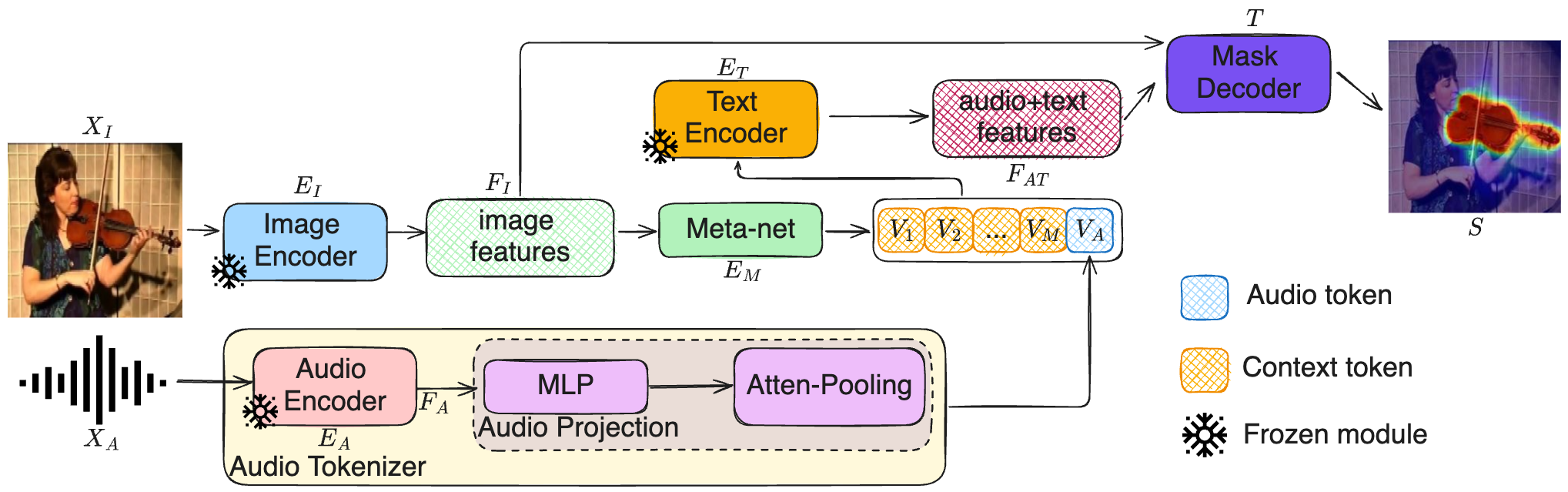
Figure 1: Pipeline of our SouPLe framework, illustrating the comprehensive process from audio-visual input to context token integration.
SouPLe's architecture involves a strategy where an audio-visual pair is processed by converting the audio signal into a CLIP-compatible token through the Audio Tokenizer, while image features are transformed into learnable context tokens via a Meta-net. These tokens are then concatenated with the audio-embedded token, creating a robust interaction within the CLIP-based text encoder to produce well-aligned audio-text features for mask decoding.
Visual-Audio-Text Alignment
The method leverages a Visual-Audio-Text Alignment (VAT) module to compute a comprehensive contrastive loss at both image and feature levels. This integration ensures an efficient alignment of audio-text features with visual embeddings, thereby achieving a refined understanding and localization of sounding regions.
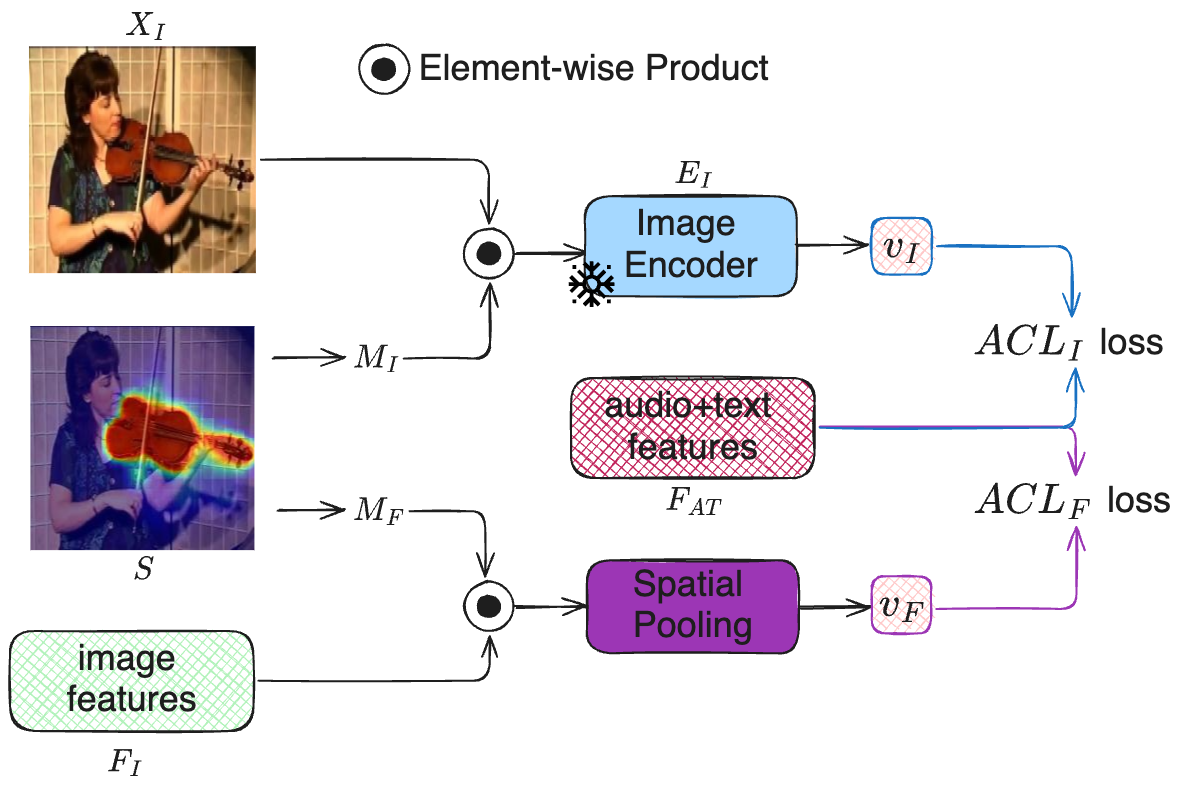
Figure 2: Visual-Audio-Text Alignment (VAT) module demonstrating the multilayered integration of audio, visual, and textual features for optimal alignment.
Empirical Evaluation
Quantitative Results
SouPLe surpasses baseline models, including ACL-SSL, in several benchmarks, showcasing its substantial improvements in localizing and segmenting sound sources. Notably, SouPLe achieved a marked improvement in Continuous Intersection over Union (cIoU) and Area Under the Curve (AUC) scores across the VGG-SS, SoundNet-Flickr, and AVSBench datasets. This performance highlights the framework’s ability to generalize its results beyond training categories, reflecting a significant advancement in audio-visual semantic alignment.

Figure 3: Sound localization results on VGG-SS, SoundNet-Flickr, and AVSBench, along with a comparison with ACL-SSL.
Open-Set and Extended Evaluation
The paper further evaluates SouPLe in open-set scenarios, where it performs commendably, particularly in unheard audio categories, emphasizing its adaptability to new and unseen data without explicit supervision. Additionally, SouPLe outperforms previous methods in extended audio-visual challenges that include silent objects and off-screen audio.
Discussion and Implications
SouPLe's integration of learnable context through dynamic, audio-aware prompts represents a substantial methodological shift in the pursuit of improving audio-visual learning models. By moving away from static prompt systems, the paper demonstrates that adaptive approaches can significantly enhance generalizability and accuracy in complex, multisensory environments.
The implications extend beyond improved performance metrics; SouPLe provides a more nuanced model capable of adaptive learning within dynamic audiovisual contexts, setting the stage for further research into instance-conditional adaptations in multimodal learning.
Conclusion
In conclusion, "SouPLe: Enhancing Audio-Visual Localization and Segmentation with Learnable Prompt Contexts" contributes a pivotal advancement in audio-visual modeling by introducing a dynamic, context-driven approach. SouPLe not only addresses the limitations inherent in prior methodologies but also lays the groundwork for future explorations into adaptive, context-based prompt learning frameworks. This represents a meaningful evolution in bridging the semantic gaps within audio-visual tasks, offering a robust solution to real-world applications of multimodal perception.