- The paper introduces opacity-balanced band-limiting to achieve artifact-free feed-forward 3D reconstruction.
- It integrates a novel 3D band-limiting post-filter with opacity balancing to counter aliasing in extreme zoom-in and zoom-out scenarios.
- Experimental results demonstrate 5.4–7.5 dB PSNR gains and strong cross-domain generalization on multi-resolution benchmarks.
Authoritative Summary of "AA-Splat: Anti-Aliased Feed-forward Gaussian Splatting" (2603.29394)
Introduction and Motivation
AA-Splat introduces a feed-forward 3D Gaussian Splatting (FF-3DGS) architecture designed to robustly address aliasing artifacts common in current FF-3DGS frameworks during novel view synthesis (NVS) and 3D reconstruction. Prior FF-3DGS models, such as DepthSplat, are prone to severe rendering artifacts—erosion under zoom-in (structures appearing unnaturally thin) and dilation artifacts under zoom-out (structures appearing excessively thick)—due to physically incorrect screen-space dilation filters. These become prominent when rendering at out-of-distribution resolutions and focal lengths. Although anti-aliasing solutions have been explored in optimization-based per-scene Gaussian splatting, the feed-forward setting, where a single model generalizes across scenes without finetuning, lacked an effective anti-aliasing paradigm.
AA-Splat Architecture and Opacity-Balanced Band-Limiting
AA-Splat adapts the DepthSplat backbone, integrating a novel Opacity-Balanced Band-Limiting (OBBL) mechanism which combines a 3D Band-Limiting Post-Filter (3D-BLPF) and an opacity balancing (OB) technique.
- 3D Band-Limiting Post-Filter (3D-BLPF): The maximal frequency bound for each 3D Gaussian primitive is computed using multi-view camera poses and focal lengths, yielding a Nyquist-based minimum scale for each primitive. This prevents the regression of degenerate (needle-like, sub-pixel) Gaussians and enforces spectral band-limiting at the representation level.
- Opacity Balancing (OB): Expanding the Gaussian primitives increases overlap among pixel-aligned splats, decreasing the visibility of certain primitives and degrading NVS quality. OB clamps and normalizes the opacity of primitives, ensuring all contribute meaningfully to the rendered output, thereby mitigating grid-like artifacts.
This synergy ensures alias-free rendering across arbitrary sampling rates, including aggressive zoom-in/zoom-out scenarios, as well as improved cross-domain generalization.
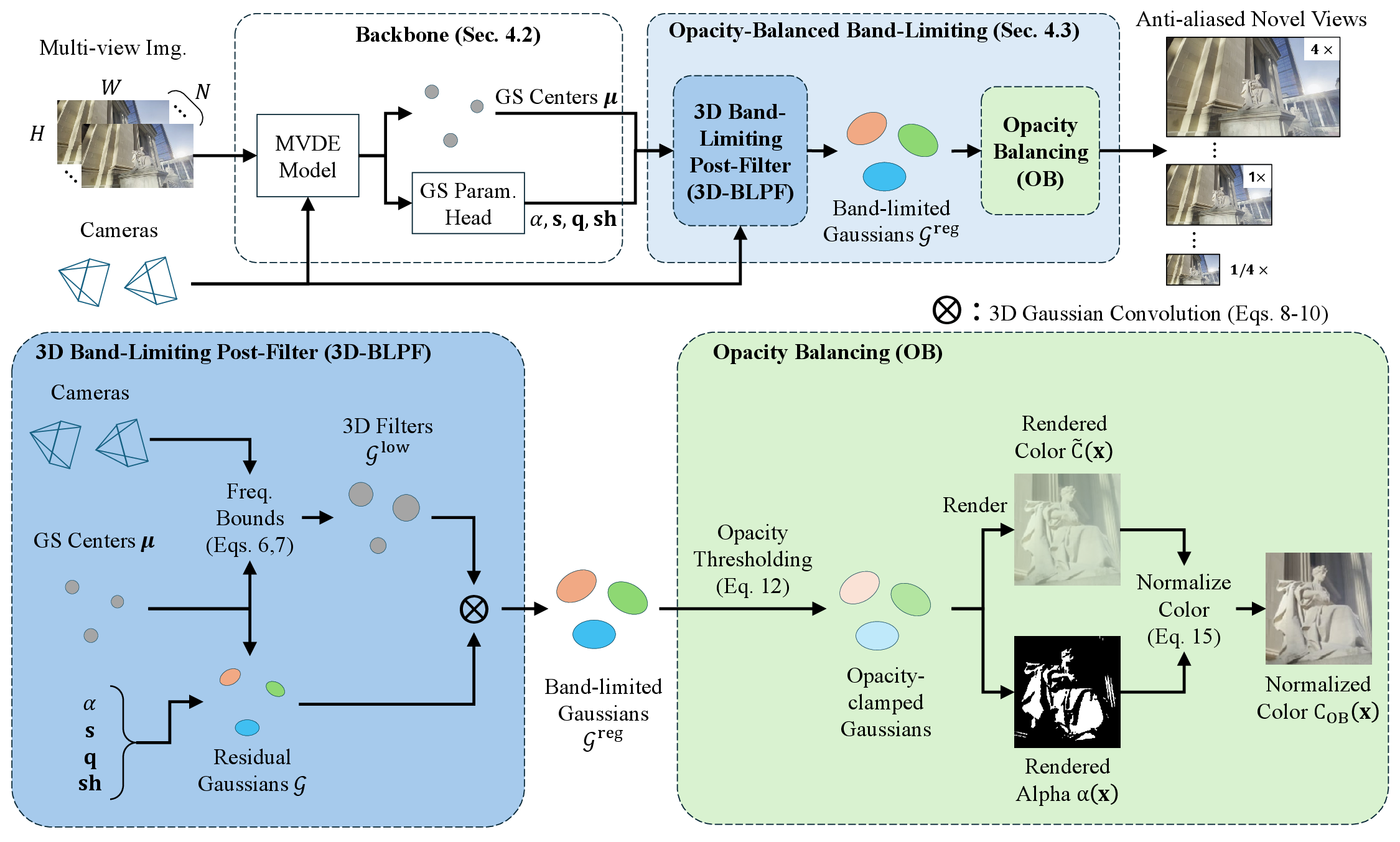
Figure 1: AA-Splat pipeline integrates per-view depth unprojection, frequency bound-driven band-limiting post-filtering, GS head parameter prediction, and opacity balancing for robust anti-aliasing.
Experimental Results and Visual Analysis
AA-Splat achieves 5.4–7.5 dB PSNR gains over SOTA baselines (e.g., DepthSplat) across all tested resolution scales (4× to 1/4×), both in-distribution and zero-shot out-of-distribution tests. Visual results demonstrate that competing models exhibit visible seams, voids, and dilation artifacts at scaling extremes, while AA-Splat maintains photometric fidelity.
- RE10K Evaluation: AA-Splat consistently outperforms competitors on multi-resolution benchmarks, largely suppressing aliasing artifacts even under intensive scaling.
- Cross-Dataset Generalization: In zero-shot settings (trained on RE10K; tested on DL3DV and ACID), AA-Splat sustains high PSNR and perceptual quality, a notable achievement given the dataset domain and resolution shifts.
- Ablation Studies: Removal of either 3D-BLPF or OB leads to pronounced grid and jagged edge artifacts, confirming their complementary necessity. Substituting anti-aliasing filters from prior works (e.g., Mip-Splatting) into the feed-forward pipeline does not suffice; explicit 3D band-limiting and opacity balancing are required.
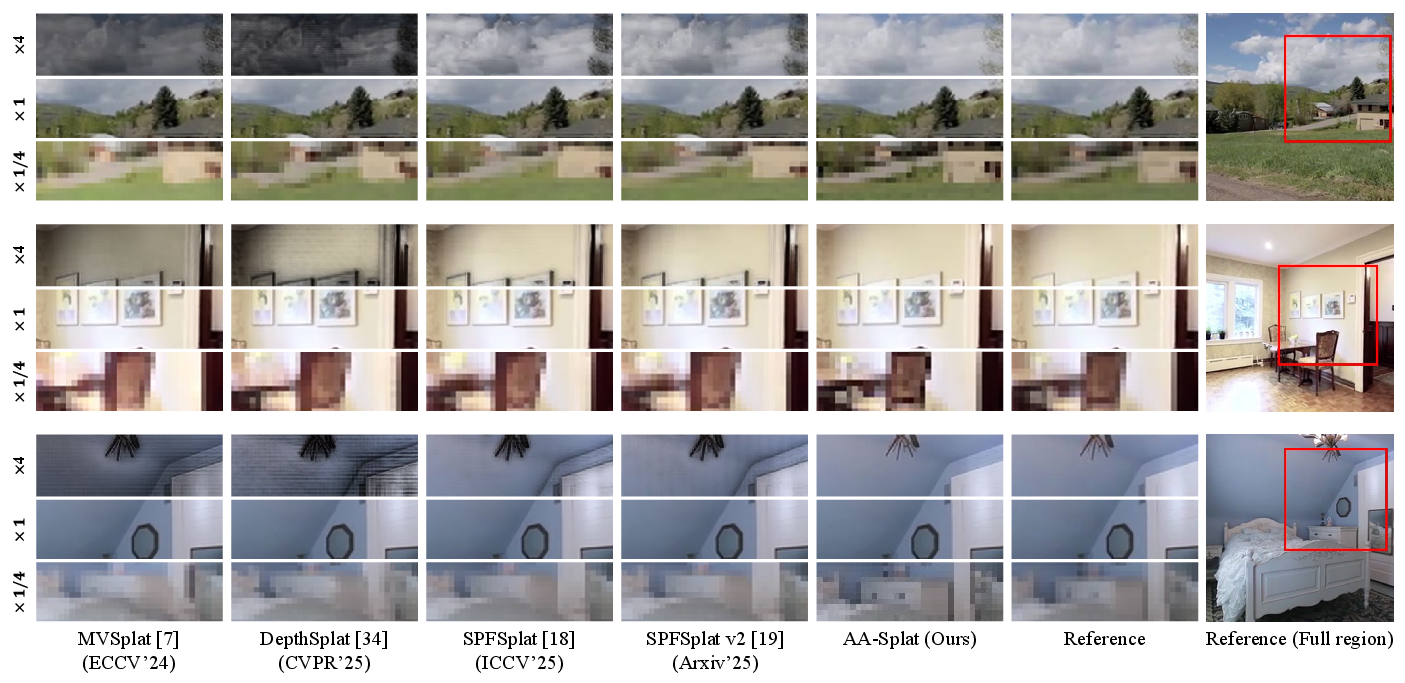
Figure 2: Multi-scale visual comparison on RE10K; AA-Splat yields alias-free, sharp reconstructions under zoom-in (4×) and zoom-out (1/4×) conditions.
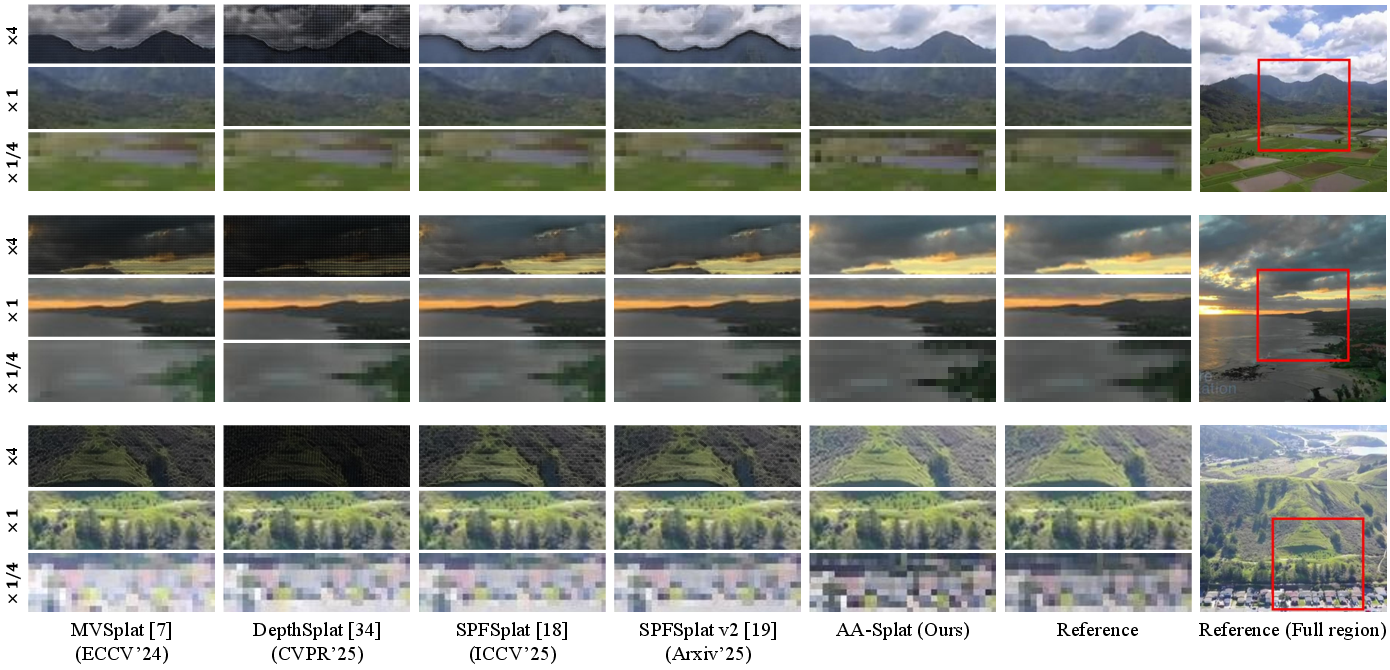
Figure 3: Cross-dataset generalization on ACID; AA-Splat suppresses dilation and brightening artifacts prevalent in baseline models.
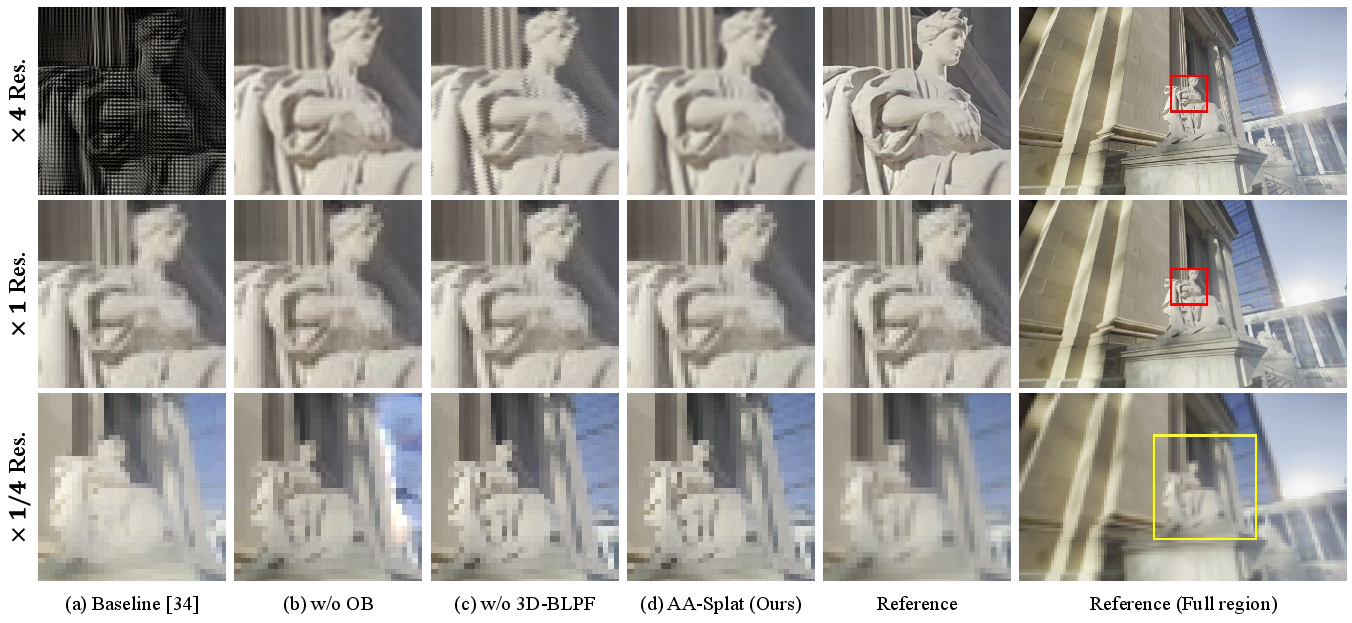
Figure 4: Ablation results on DL3DV; OB and 3D-BLPF combined are vital for suppressing grid and jagged-edge artifacts under zoom-in.
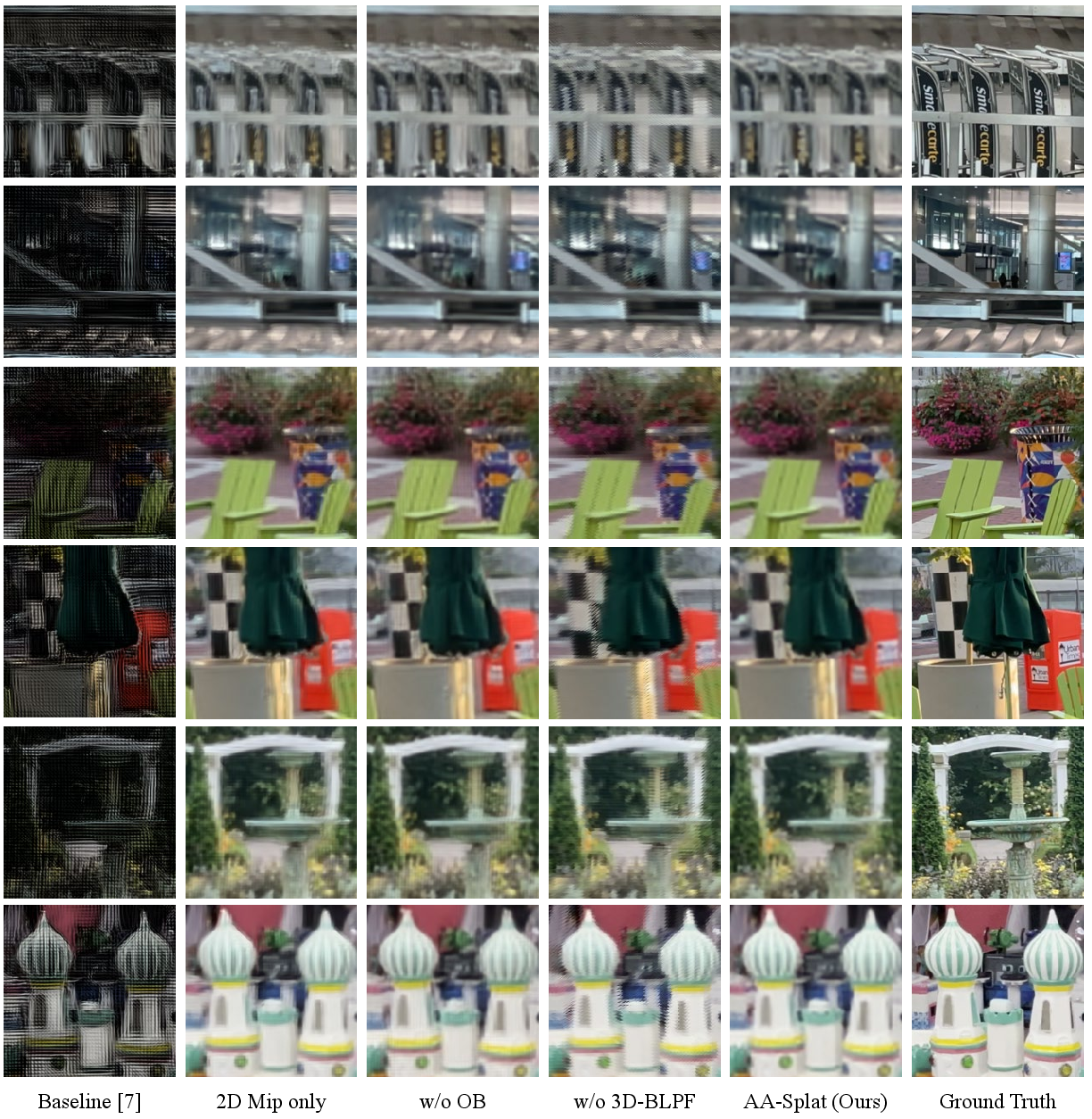
Figure 5: Further ablation on DL3DV; each OBBL component is necessary for optimal rendering fidelity and suppression of high-frequency artifacts.
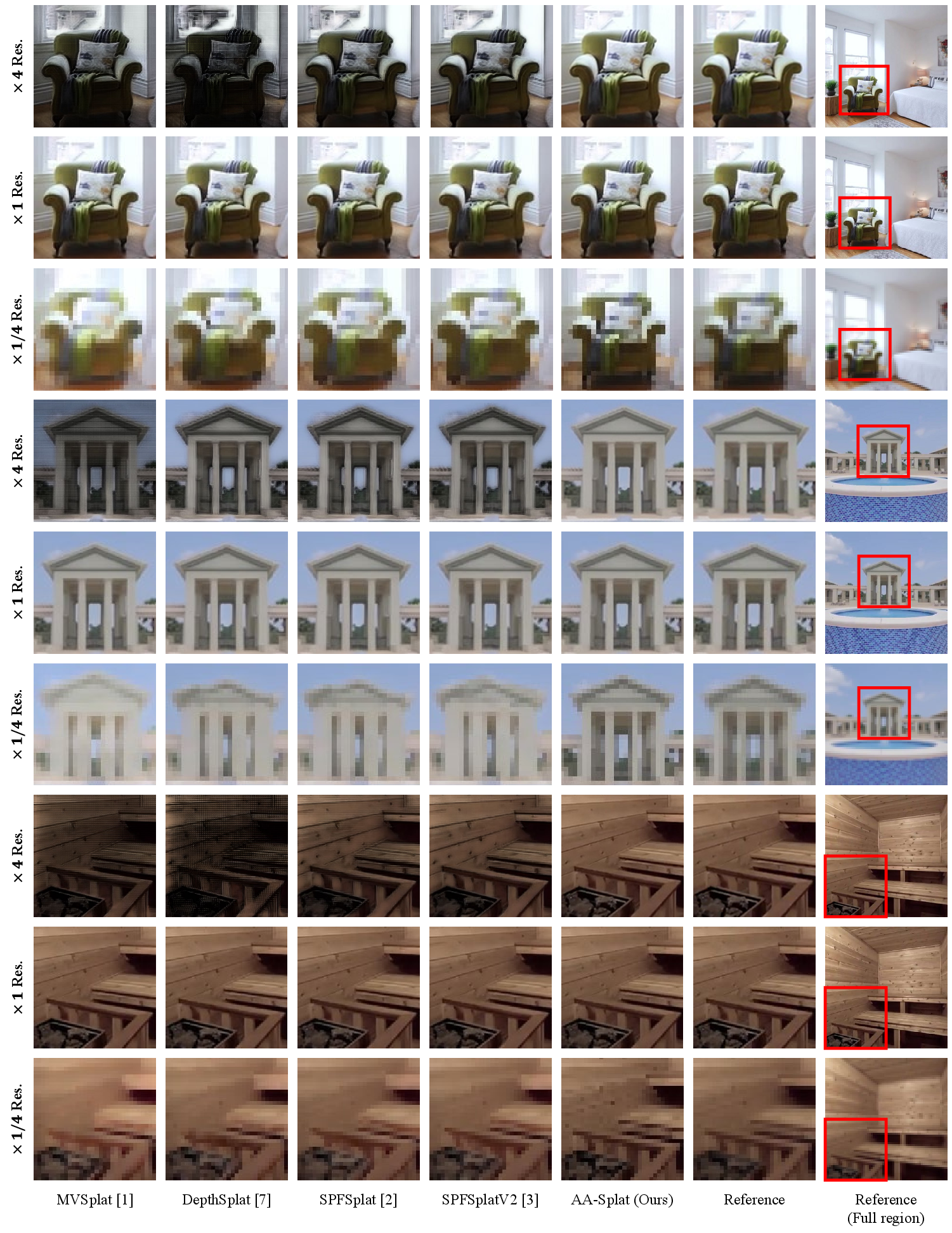
Figure 6: Additional multi-scale comparisons on RE10K; AA-Splat consistently outperforms baselines across scenarios.
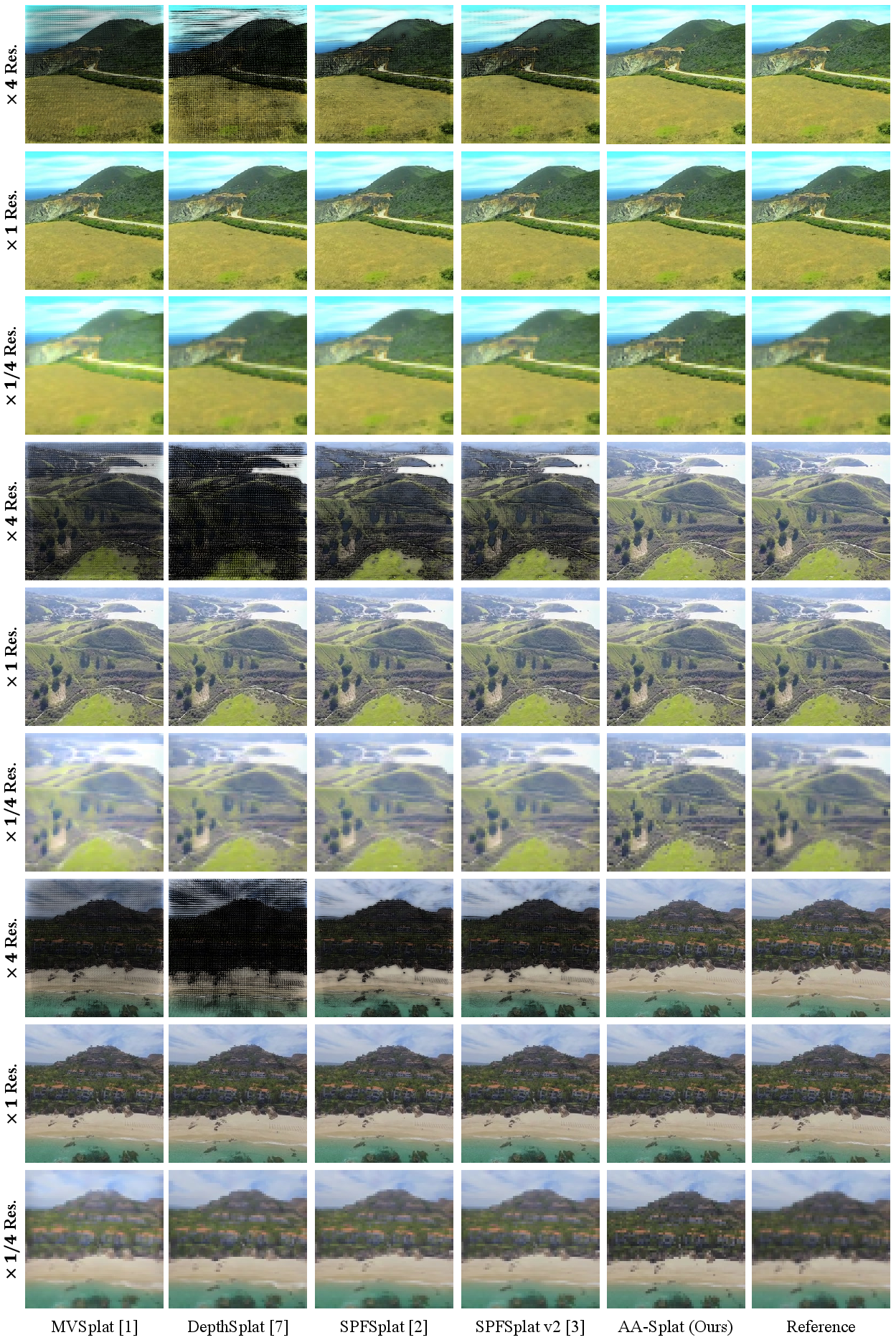
Figure 7: Additional visual generalization results on ACID; robust artifact-free rendering under varied sampling rates.
Implications and Future Directions
Practically, AA-Splat enables high-fidelity, artifact-free feed-forward NVS and 3D reconstruction across wide resolution and focal length regimes, advancing interactive applications such as VR/AR, robotics perception, and digital content creation. Its cross-domain robustness reduces the requirement for per-scene finetuning or retraining, significantly broadening deployment efficiency.
Theoretically, AA-Splat demonstrates that generalized anti-aliasing in feed-forward architectures demands both spectral band-limiting and explicit opacity management. The OBBL framework could be extended to other primitive-based rendering domains, informing the design of future high-resolution, generalizable 3D generative models.
Anticipated research directions include:
- Integration with Dynamic Scenes: Extending OBBL for temporal consistency in dynamic scenarios.
- Generalization to Non-Gaussian Primitives: Applying anti-aliasing strategies to more diverse primitive-based or hybrid neural scene representations.
- End-to-End Training Regimes: Investigating scale-invariant priors and anti-aliasing loss terms to further enhance robustness and generalization.
- Efficient Hardware-Accelerated Rendering: Leveraging AA-Splat’s feed-forward property for real-time deployment in edge devices.
Conclusion
AA-Splat sets a new standard for feed-forward 3DGS architectures by achieving robust alias-free rendering and generalization through its Opacity-Balanced Band-Limiting design. The approach decisively addresses fundamental artifacts that arise in out-of-distribution and high-resolution regimes, yielding strong improvements in quantitative and qualitative performance on established NVS and 3D reconstruction benchmarks. Its architectural principles are likely to influence future research in scalable, generalizable, and anti-aliased neural rendering.