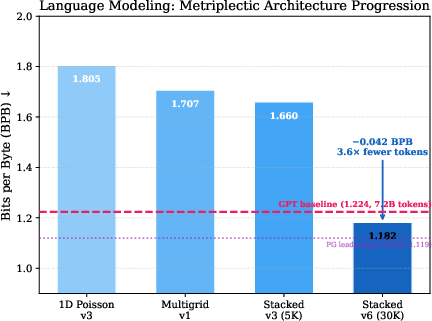
- The paper introduces Metriplector, which models neural computation as field dynamics governed by metriplectic equations, unifying vision, reasoning, and language tasks.
- The methodology integrates physics-inspired operators, including stress-energy tensor readouts via Noether's theorem and a learned Poisson bracket, to achieve competitive accuracy with fewer parameters.
- Empirical results demonstrate robust generalization across domains such as maze solving, Sudoku, CIFAR-100, and language modeling, outperforming conventional architectures in efficiency and accuracy.
Metriplector: Physics-Grounded Neural Architecture via Metriplectic Dynamics
Overview
The paper "Metriplector: From Field Theory to Neural Architecture" (2603.29496) introduces Metriplector, an architecture primitive that instantiates computations as dynamics over abstract physical fields governed by the metriplectic (GENERIC) formalism. The key paradigm is that input configures an abstract physical system—fields, sources, operators—and the evolution of this system, defined by metriplectic dynamics, serves as the central computation. Readout is achieved via the stress-energy tensor Tμν, a conserved quantity derived from Noether's theorem.
Metriplector is deployed across multiple domains—maze pathfinding, Sudoku constraint satisfaction, CIFAR-100 image recognition, and causal language modeling—with each task utilizing only a subset of the metriplectic spectrum (diffusive, Hamiltonian, or full dynamics). The architecture achieves strong parameter efficiency, competitive accuracy, and robust structural generalization across tasks, notably solving Sudoku with zero structural injection and outperforming conventional architectures at similar parameter counts for CIFAR-100.
Architectural Foundations
Metriplector is built on variational mechanics and the GENERIC framework. In classical physics, the metriplectic equation unifies reversible (Hamiltonian) and irreversible (dissipative) dynamics:
z˙=L(z)⋅∇E(z)+M(z)⋅∇S(z)
where L is a skew-symmetric Poisson bracket (energy conserving), M is a symmetric positive semi-definite metric bracket (entropy producing), E is the energy functional, and S is the entropy functional. Crucially, the degeneracy conditions (M⋅∇E=0, L⋅∇S=0) enforce that Hamiltonian dynamics cannot produce entropy and dissipation cannot alter energy.
This formalism is adapted to neural computation: input embeddings configure a physics operator (via learned projections), fields evolve according to the metriplectic equation, and features are extracted via Noether's conserved currents.
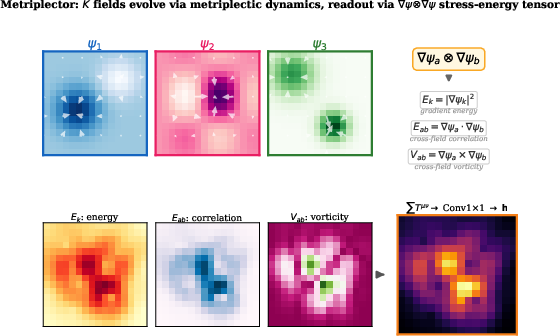
Figure 1: Visualization of Metriplector field interaction, depicting field evolution, gradient energies, cross-field correlations, and vorticity computation for readout.
Domain-Specific Instantiations
Dissipative Branch: Screened Poisson
For spatial reasoning (maze, Sudoku), Metriplector reduces to solving a screened Poisson equation on a graph, representing equilibrium of the dissipative dynamics:
(LW+Λ)ϕ=b
Here, LW is a learned Laplacian with conductances z˙=L(z)⋅∇E(z)+M(z)⋅∇S(z)0, z˙=L(z)⋅∇E(z)+M(z)⋅∇S(z)1 is per-node damping, and z˙=L(z)⋅∇E(z)+M(z)⋅∇S(z)2 is a source vector. The system is solved via conjugate gradient, with efficient implicit differentiation for gradients.
Full Metriplectic Dynamics
For recognition tasks such as CIFAR-100, both dissipative and Hamiltonian components are activated, requiring Euler integration over z˙=L(z)⋅∇E(z)+M(z)⋅∇S(z)3 field channels. The antisymmetric Poisson bracket z˙=L(z)⋅∇E(z)+M(z)⋅∇S(z)4, learned as a z˙=L(z)⋅∇E(z)+M(z)⋅∇S(z)5 matrix, enables cross-field advection and energy-conserving feature mixing—essential for fine-grained class discrimination.
Causal Branch
For autoregressive language modeling, the dissipative branch is instantiated on a causal chain, reducing to a parallelizable z˙=L(z)⋅∇E(z)+M(z)⋅∇S(z)6 recurrence (Blelloch scan). Multigrid and cross-field interactions are included to capture multi-scale context and inter-field dependencies.
Readout via Physical Conserved Quantities
A central architectural principle is the use of the stress-energy tensor z˙=L(z)⋅∇E(z)+M(z)⋅∇S(z)7 for feature extraction. Derived from spatial translation invariance in Noether's theorem, z˙=L(z)⋅∇E(z)+M(z)⋅∇S(z)8 computes:
- Gradient energy: z˙=L(z)⋅∇E(z)+M(z)⋅∇S(z)9 (diagonal and cross-field correlations)
- Vorticity: L0 (rotational structure)
This physics-derived readout outperforms heuristic alternatives on CIFAR-100 by up to 2.6 accuracy points, and the same feature is used for Sudoku constraint satisfaction, demonstrating the unification of recognition and reasoning via conserved physical quantities.
Empirical Results and Diagnostics
Parameter Efficiency and Scalability
For CIFAR-100 classification, Metriplector achieves 81.03% accuracy with only 2.26M parameters, 10–15L1 fewer than DenseNet-BC (82.8% at 25.6M). The L2-field bottleneck allows tractable pairwise physics-based interactions (L3 features), permitting deep evolution and full cross-field coupling while maintaining efficiency.
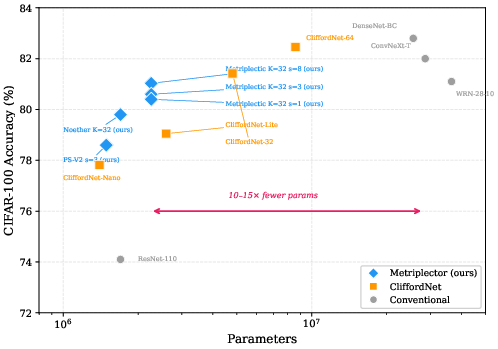
Figure 2: CIFAR-100 accuracy vs. parameter count; Metriplector achieves competitive performance with orders of magnitude fewer parameters compared to conventional architectures.
Ablation and Structural Guarantees
Critical architectural components are validated by controlled ablations: removing the Poisson bracket L4 costs 13.4 points of accuracy, and violating the operator-from-input principle (decoupling L5 from physics operators) results in field collapse and a 14.3-point drop.
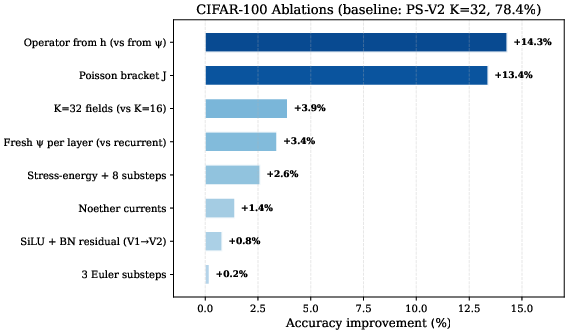
Figure 3: Ablation impacts on CIFAR-100; operator-from-input and Poisson bracket are essential for performance, confirming the necessity of full metriplectic structure.
Physics Diagnostics
The learned Poisson tensor L6 develops degenerate singular values (signature of skew-symmetry), Frobenius norm and effective rank grow with layer depth, indicating stronger cross-field coupling in later layers. Field magnitudes and spatial variance spike at the final layer, concentrating discriminative structure for optimal Noether readout.
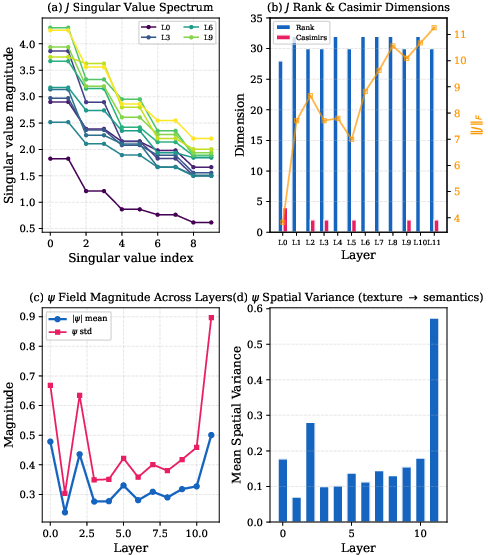
Figure 4: Physics diagnostics across 12 CIFAR-100 layers; skew-symmetric structure, increasing cross-field coupling, and spatial localization in late layers.
Field Specialization
Metriplector fields remain moderate through early layers, with sharp magnitude and variance increase immediately before readout, demonstrating controlled energy concentration and feature localization.
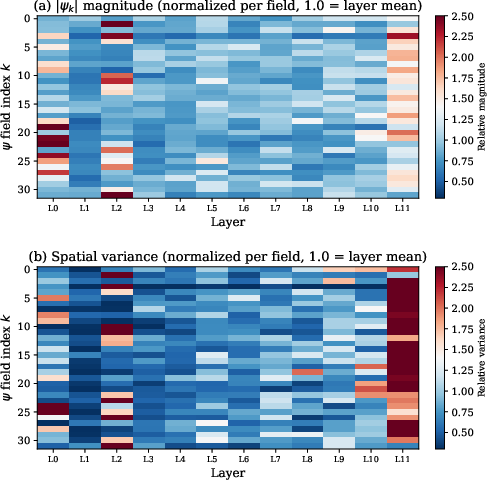
Figure 5: Specialized field behavior across layers; discriminative channels activate strongly only before readout.
Dynamics Budget
Hidden state evolution shows monotonic growth, with learned step sizes increasing in deeper layers, evidencing self-organized expansion of dynamics budget as depth increases.
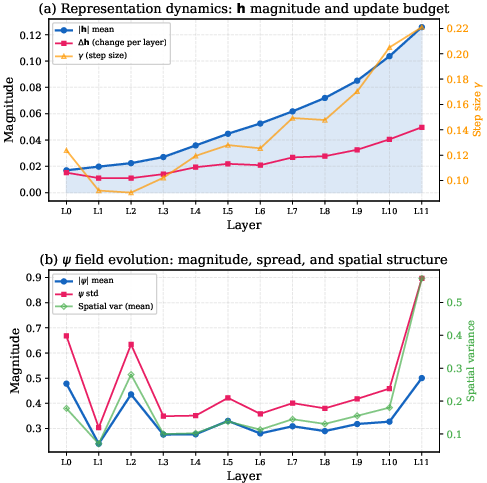
Figure 6: Dynamics budget analysis; controlled growth in representation and field magnitude across layers.
Cross-Domain Structural Generalization
Metriplector achieves:
Implications and Future Directions
Metriplector demonstrates that encoding exact physical structure in architecture primitives enables parameter-efficient learning, robust structural generalization, and principled feature extraction via conserved currents. This constitutes a potent inductive bias, greatly reducing capacity requirements and obviating heuristic architecture design.
Parameter efficiency exceeds that of established architectures in vision and language for comparable accuracy, raising prospects for scaling to larger domains such as ImageNet or high-capacity LLMs. The operator-from-input principle and full metriplectic spectrum provide a flexible yet unified framework for task-specific architectural adaptation. Emergent behaviors—such as Sudoku box discovery and maze type separation—indicate that structure can be learned from minimal representations when supported by physical dynamics.
Future work will address symplectic integrators for Hamiltonian channels, unification across domains via a single architecture, scaling of M1-field bottleneck, and exploration of renormalization-group analogs in multigrid object layers.
Conclusion
Metriplector instantiates a physics-native computation primitive, configuring field dynamics over learned operators and extracting features via Noether's conserved quantities. Empirical results confirm that exact physics structure, coupled with learned reasoning components, leads to parameter-efficient, transferable and robust architectures across vision, reasoning, and language modeling tasks. The stress-energy tensor readout, operator-from-input principle, and the metriplectic instantiation spectrum constitute foundational advances in neural architecture, with direct implications for future scalable, interpretable, and structure-aware AI models.