- The paper presents a Bayesian pairwise survey ranking aesthetic merit of 88 constellation genitives, with Pegasi emerging as the top choice.
- It employs statistically rigorous methods, including a random spanning tree and the ASAP algorithm to maximize information gain, ensuring robust rankings.
- The study highlights discrepancies between self-reported favorites and forced-choice outcomes, revealing clear generational differences in aesthetic perception.
Aesthetic Rankings of Constellation Genitives: An Empirical Survey Approach
Survey Design and Statistical Methodology
This paper presents an empirical framework for ranking the aesthetic merit of the genitive forms of all 88 IAU-recognized constellations. The author developed a web-based pairwise comparison survey targeting professional astronomers, primarily those working in stellar astrophysics due to their routine engagement with constellation genitives. The survey received 74 responses: 47 graduate students, 17 postdoctoral researchers, and 10 faculty members.
Pairwise comparisons (87 per survey) probed relative preferences. Survey initialization followed a uniformly random spanning tree of the constellation graph, ensuring each genitive appeared at least once in the initial round. Subsequent comparison selection was performed using the ASAP algorithm (Mikhailiuk et al., 2020), which maximizes expected information gain, efficiently updating rankings in a fully Bayesian framework to estimate score and uncertainty for each genitive. Scores were calculated as the statistical mean of perceived merit, with 1σ uncertainties presented throughout.
Results: Aggregate and Demographic Trends
The overall ranking positions Pegasi as the top constellation genitive, followed by Centauri and Andromedae. Orionis, despite being frequently self-reported as a favorite, was only seventh in the final ranking. Gruis received the lowest score. The ranking was decomposed by career stage, revealing variations in aesthetic judgment between students, postdocs, and faculty. Faculty responses were few, resulting in higher statistical uncertainty and preventing robust inference regarding their preferences.
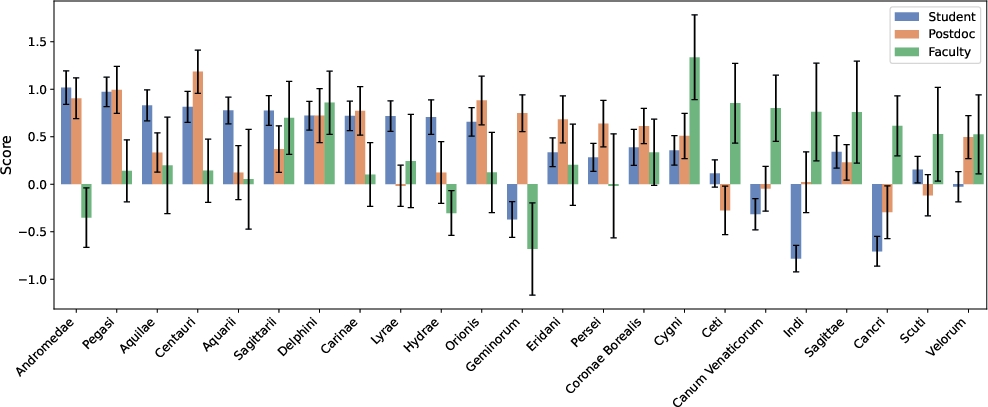
Figure 1: Scores of top-ranked constellation genitives, broken down by career stage, highlighting demographic differences and 1σ uncertainties.
A leave-one-out analysis demonstrated that the top 10 list is robust against single respondent influence, indicating consistency in aggregate outcomes. Edge density in the comparison matrix was high (≈29%), supporting the stability of the results.
Discrepancies in Self-Reported Preferences
Prior to the survey, respondents could optionally nominate a favorite constellation genitive. Orionis was the most frequently selected, yet ranked seventh in the survey-driven outcome. Pegasi, the ultimate winner, was rarely selected in advance, emphasizing divergence between spontaneous self-reporting and forced-choice pairwise comparisons.
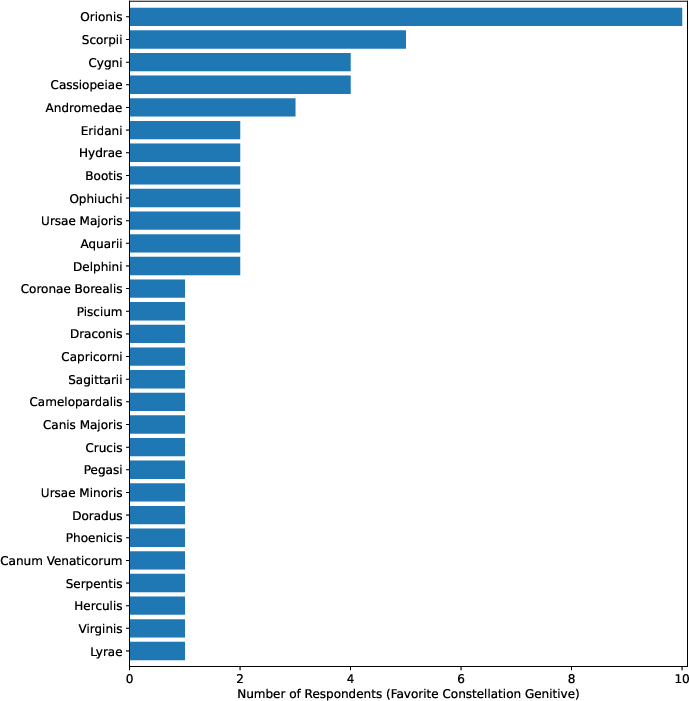
Figure 2: Favorite constellation genitives, as optionally self-reported, with Orionis dominating and Pegasi rarely chosen.
This discrepancy suggests the presence of biases in open-ended versus forced-choice elicitation and highlights the utility of the pairwise methodology in minimizing anchoring and popularity effects.
Qualitative Analysis, Phonetics, and Cultural Associations
The sentiment analysis using VADER [Hutto_Gilbert_2014] failed to discriminate among genitives, yielding uniformly neutral scores. The author instead performed a manual assessment of phonetic and cultural associations. The top 5 genitives were typically linked to mythological, astrophysical, or phonetic distinctiveness (e.g., Pegasi’s connection to exoplanet discovery [mayor_pegasib_1995], Centauri’s proximity and mythic resonance, Andromedae’s galaxy association). Bottom-ranked genitives (Normae, Equulei, Horologii, Muscae, Gruis) typically lacked mythic resonance or phonetic appeal, and several originated from instrument-themed constellations named in the Enlightenment period [warner_lacaille_2002].
Implications and Directions for Future Research
The results underscore generational variation in aesthetic taste, with students and postdocs in greater agreement than faculty, suggesting potential shifts in cultural or disciplinary preferences over time. The methodology represents a scalable approach to surveying subjective preferences in nomenclature or academic jargon, with broad implications for outreach, education, and public engagement.
The stable aggregate ranking and evidence of generational differences open avenues for broader, more diverse follow-up studies. Expanding the sample size, especially among faculty and international respondents, could elucidate sociolinguistic trends in astronomical nomenclature. Practically, such rankings may inform standardized naming conventions or outreach prioritization when communicating astronomical discoveries.
Conclusion
This paper utilizes a Bayesian pairwise comparison survey and active sampling to rigorously rank the aesthetic merit of constellation genitives and identifies Pegasi as the most pleasing. The divergence between self-reported favorites and aggregate rankings illustrates methodological sensitivity to elicitation format. The results suggest generational differences in taste and demonstrate the value of systematic empirical inquiry into subjective nomenclature preferences. Future investigations should implement incentive-driven surveys across larger, more representative cohorts to robustly map the landscape of aesthetic preference in scientific language.