- The paper demonstrates that human agency in co-creation can partially restore creative diversity lost to default LLM homogenization through iterative editing.
- The study used a randomized controlled trial with a 2x2 factorial design to compare AI-assisted versus independent writing under originality versus technical quality incentives.
- Incentives for originality led to more diverse outputs by encouraging selective AI use, though complete independence from LLM-driven homogeneity was not achieved.
Incentives and Human Co-Creation with Generative AI: An Empirical Analysis
Introduction and Motivation
The empirical study "Incentives shape how humans co-create with generative AI" (2604.03529) addresses central questions regarding how incentive structures and interactive modalities influence the diversity of artifacts produced when humans co-create with LLMs. Motivated by the widespread concern that human-AI collaboration may induce homogenization of outputs—narrowing the collective space of ideas and expressions—the work systematically investigates how incentive regimes modulate user strategies and final outcomes in creative writing.
Unlike most prior studies which constrain human-AI interaction to limited single-turn settings (e.g., one-shot brainstorming or text completion), this work allows for iterative and unconstrained AI-assisted co-creation, closely paralleling real-world workflows. It further introduces experimentally manipulated incentives for either originality or quality, enabling a direct dissection of how extrinsic motivators interact with the purported homogenizing influence of LLMs. The approach thereby provides significant insight into the strategic, not merely technological, drivers of diversity in AI-augmented creative processes.
Experimental Design
The authors conducted a randomized controlled trial (n=200) using a 2×2 factorial design, crossing AI access (SELF vs. AI) with incentive type (Technical Quality, T, vs. Originality, O). Participants were tasked with writing a 250–350 word short story in a controlled browser-based environment that ensured engagement and minimized potential contamination from external tools.
- AI condition: Subjects interacted with an integrated interface providing GPT5-Mini assistance, capable of brainstorming, drafting, and editing upon request, with logs capturing the full interaction history.
- SELF condition: Subjects wrote independently without AI access, and were strictly proscribed from using external tools.
Each incentive regime provided distinct instructions and explicit bonus structures. The Quality condition mapped rewards to technical grading on a rubric, decoupled from creativity, while the Originality condition rewarded uniqueness relative to peers. The platform captured dense temporal logs (snapshots every 5 seconds) and full AI conversation transcripts, allowing for high-resolution analysis of user strategies and output evolution.
Quantifying Diversity and Adoption
Recognizing the inherent complexity in quantifying text diversity, the study employs a battery of established and SOTA metrics:
- Embedding-based similarity: Cosine similarity in sentence embedding spaces (e.g., all-MiniLM-L12-v2, mpnet, Qwen3, etc.), focusing on higher-order narrative or stylistic signals.
- Token/n-gram analyses: Lexically-oriented metrics such as BLEU, ROUGE-L, and n-gram diversity scores, capturing surface-level variation.
- Custom diversity/adoption index: Using n-gram overlap between AI outputs and final submissions to assign an "AI adoption" score, robustly checked by embedding-based paraphrase-sensitive variants (correlations > 0.94 across measures).
Main Empirical Findings
Human Agency Restores Diversity Lost to LLMs—Partially
Full drafts generated by LLMs were highly homogeneous, with frequent stylistic and structural tropes (e.g., stories opening with "I woke up…"). However, when humans were given the latitude to interact repeatedly and edit, the final distributions of story embeddings diversified substantially.
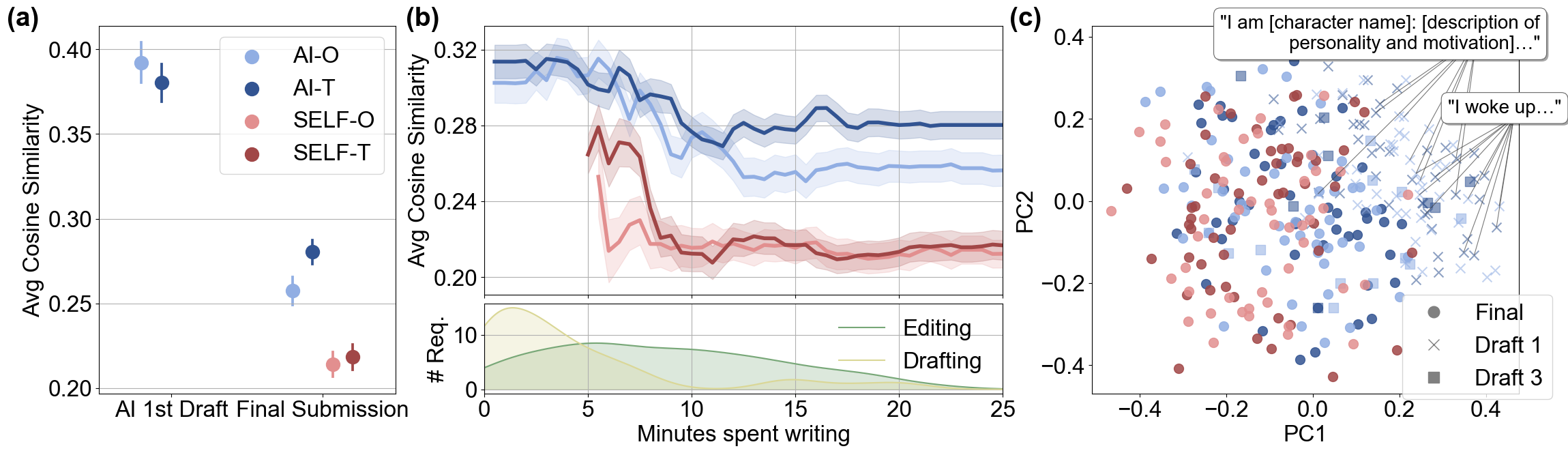
Figure 1: Embedding-based similarity and trajectory of diversity increase through time, indicating that human agency diverges from the initial LLM homogenization as sessions proceed.
Despite this return towards diversity, a residual homogenizing effect persisted: AI-assisted submissions remained statistically more similar to each other than those authored independently, especially in higher-order embedding spaces—even after significant user-led editing and iteration.
Incentives for Originality Mitigate, But Do Not Eliminate, Homogenization
Subjects incentivized for originality (AI-O) achieved higher diversity in their outputs compared to those rewarded strictly for technical quality (AI-T), as validated across embedding-based and token-level metrics. However, the increased diversity in AI-O did not reach the diversity baseline of the SELF group.
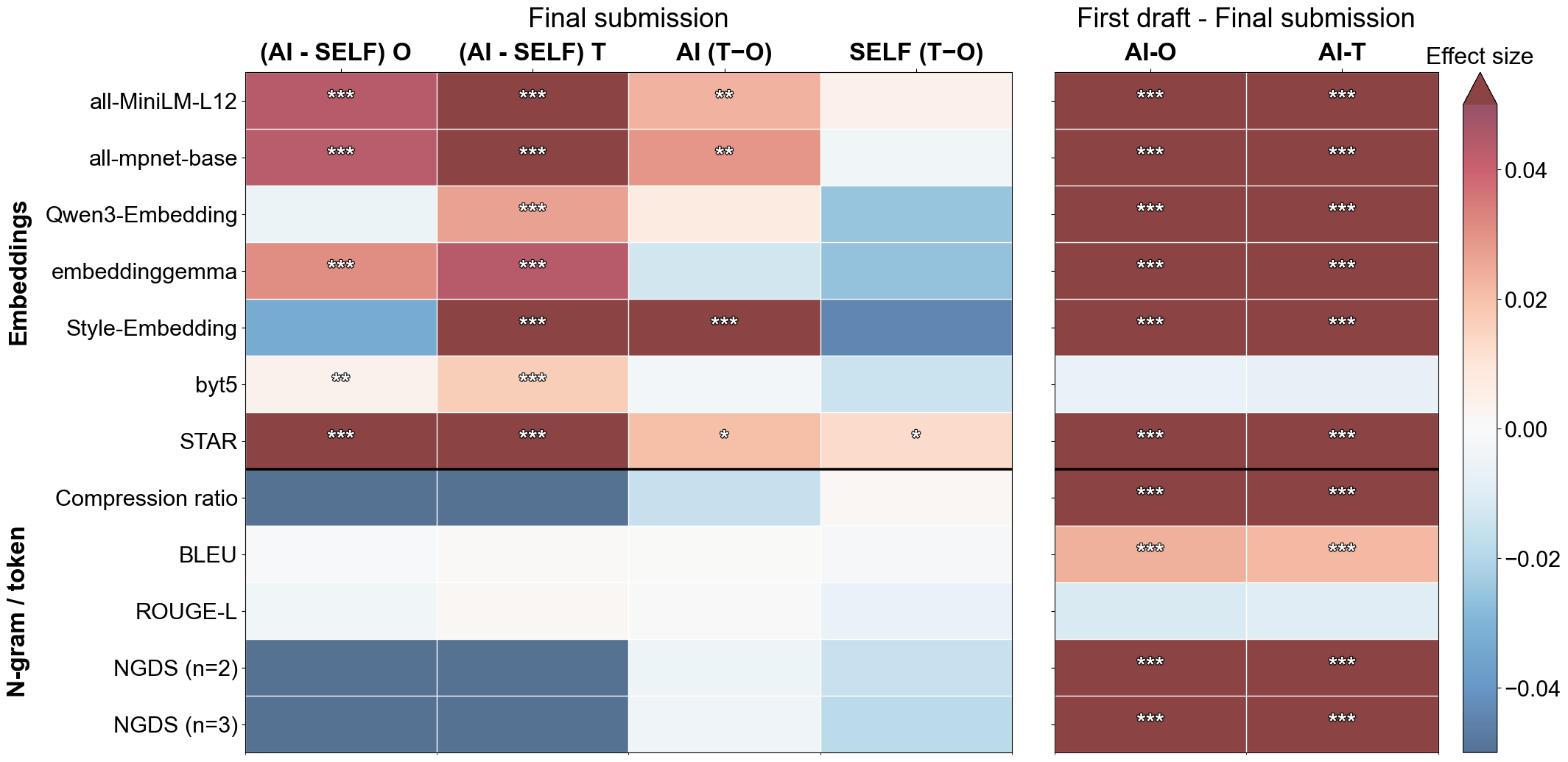
Figure 2: Effect sizes from difference in means tests, showing statistically significant impacts of incentive and AI usage on diversity at submission and first-AI-draft levels.
Notably, the effect of incentivizing originality was only significant within the AI-augmented cohorts; varying the incentive had negligible impact on diversity in the SELF condition, indicating that incentive effects are specific to the human-LLM interactive regime.
Mechanisms: Strategic Use of AI and Behavioral Adaptation
Analysis of AI adoption scores and session logs reveals that increased diversity under the originality incentive is achieved not by eschewing AI, but by changing the nature of its use. In AI-O, participants relied on AI more for ideation, mechanical editing, or targeted problem-solving while selectively filtering or resisting verbatim adoption of LLM drafts.
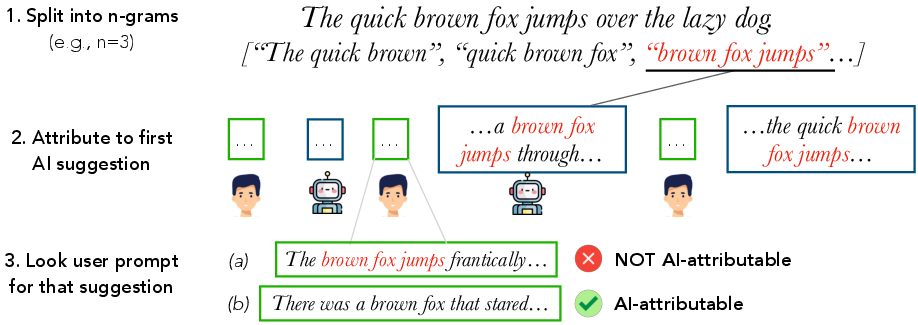
Figure 3: Illustrative pipeline for attributing portions of text to AI suggestions, forming the basis for adoption/anchoring metrics.
Bimodal distributions were observed in adoption scores: most participants either heavily anchored on AI outputs or drew minimally. Low-adoption users in AI-O still engaged the LLM (e.g., for multiple prompts, partial edits) but were more judicious in what they integrated, retaining greater narrative agency.
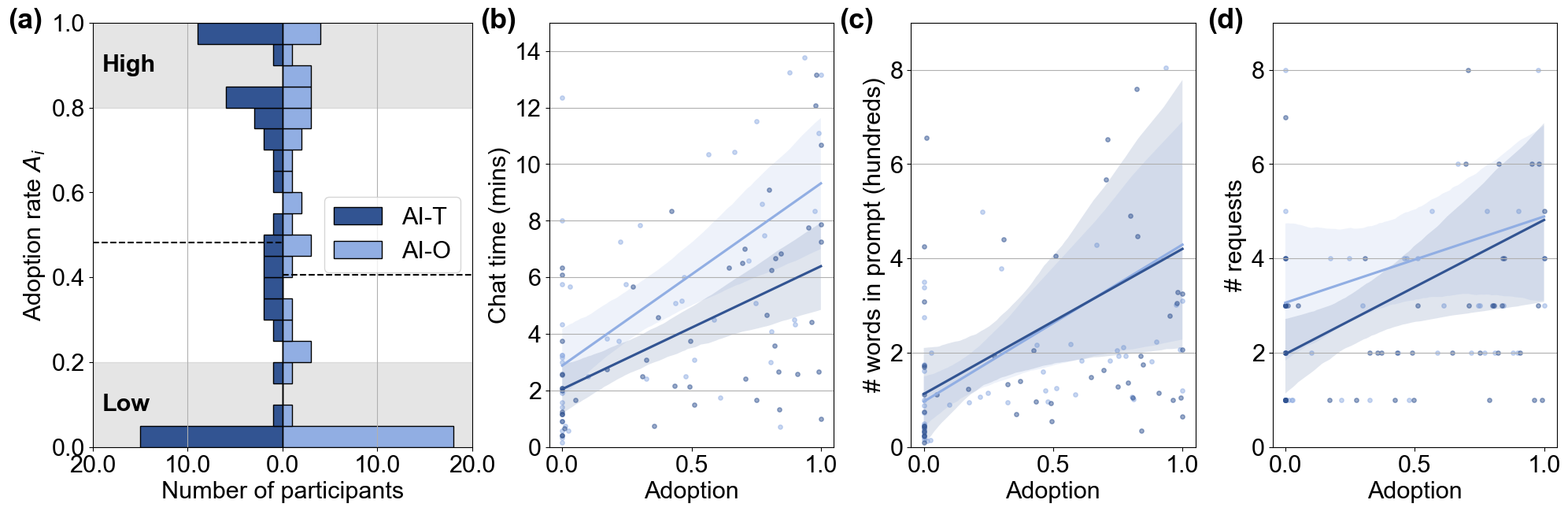
Figure 4: Adoption score histograms and breakdowns of AI prompt engagement—revealing increased interaction without increased verbatim adoption in originality-incentivized conditions.
Experience with AI Drives Overreliance and Lowered Diversity
Counterintuitively, subjects with higher self-reported experience using AI tools (overall and in writing tasks) were significantly more prone to high adoption strategies, resulting in more homogeneous outputs. There was no evidence that increased experience conferred better optimization for originality or more sophisticated prompt engineering towards diversity goals.

Figure 5: Distribution of editing and drafting requests by adoption, incentive, and AI experience, indicating a positive association between experience and reliance on AI-produced text.
Qualitative Evidence on Perceived Agency
Participants broadly reported feeling in control and treated the AI as a tool for initial scaffolding, yet retained a sense of authorship and responsibility for final edits. Notably, even high-adoption users expressed satisfaction and perceived creative agency, suggesting subjective evaluations of authorship can diverge from objective measures of anchoring. Low-adoption participants, especially in the originality arm, consciously refrained from overreliance—citing a preference for personal voice, dissatisfaction with LLM prose, or principled objections to AI co-authorship.
Theoretical and Practical Implications
The work provides concrete evidence that the creative trajectory of human-AI collaboration is contingent not just on model architecture or static interface affordances, but critically on incentive design and behavioral adaptation. The homogenizing effects of LLMs are not inevitable nor uniform: incentives for originality can shift user strategies towards selective collaboration, filtering, and augmentation, leading toward restoration of diversity, though not reaching full independence from LLM priors.
Practically, the results suggest that in domains where diversity, originality, or distinctive style are valued (e.g., creative writing, college admissions, marketing, or research), incentive engineering and system design—rather than LLM tuning per se—may be the most leverageable vectors for maintaining collective heterogeneity. Conversely, these findings warn that high reliance on AI for automation under flat incentive structures risks transformation toward a monotone creative landscape.
Limitations and Future Directions
Two central limitations are noted: (1) the single-session experimental design does not permit learning or adaptation over longer time horizons and cannot address whether engagement with LLMs can eventually support users in discovering richer or more unique voices; (2) interface design choices (side-by-side chat) reflect current usage paradigms but may deviate with the evolution toward more proactive or deeply embedded agentic AI systems.
Future research should systematically examine the long-run dynamics of co-creative habits, and explore how mixed or adaptive incentive structures can mediate potential diversity-quality tradeoffs. Additionally, more granular exploration of prompts, edits, and agentive behaviors could further elucidate the micro-dynamics of agency under different reward structures.
Conclusion
This work provides strong causal evidence that the effects of generative AI on creative diversity are not inherent but are highly sensitive to extrinsic motivators and interactive affordances. While LLMs impose a default homogenizing prior, strategic human agency—shaped by incentives—can substantially restore diversity in co-created artifacts, albeit imperfectly. The interplay of AI capability, interface design, and incentive alignment will be central in determining whether future workflows amplify or compress the space of human expression.