- The paper presents a novel analytic-numerical framework to compute the SGWB from amplified spectator scalar field fluctuations during reheating.
- It employs both Hartree approximations and lattice simulations to capture nonlinear dynamics and parametric resonance effects.
- The gravitational wave signal exhibits a steep blue tilt with amplitude ΩGWh² around 10⁻¹¹ at frequencies of ~10⁷–10⁸ Hz, probing reheating microphysics.
Gravitational Wave Production from Spectator Scalar Field Matter Perturbations
Introduction and Motivation
This work ["Gravitational Waves from Matter Perturbations of Spectator Scalar Fields" (2604.05078)] provides a systematic computation of the stochastic gravitational wave background (SGWB) generated at second order during reheating by spatial gradients in the fluctuations of a spectator scalar field χ. These fields, minimally coupled and energetically subdominant during inflation, are coupled to the inflaton ϕ via a portal σϕ2χ2 and may possess a quartic self-interaction λχχ4/4!. The analysis targets the nontrivial, high-frequency SGWB sourced not by the usual linearly-generated tensor metrics, but by field-gradient terms arising from parametric resonance and subsequent non-equilibrium dynamics in the early universe.
Parametric resonance, regulated by Hartree backreaction, leads to many orders of magnitude amplification of χ fluctuations near the resonance band. Importantly, the large inflationary mass of χ suppresses superhorizon power, keeping CMB isocurvature under control—this allows strong small-scale features without violating large-scale constraints. By focusing on the direct field-gradient source in the Einstein equations, the study develops a factorized (spectral × temporal) analytic framework complemented and validated by nonlinear lattice simulations.
Dynamics of Energy Transfer and Spectator Field Evolution
The background cosmology assumes a standard inflationary sector transitioning to reheating via oscillating inflaton dynamics. The benchmark inflaton model is a T-model α-attractor with quadratic potential, yielding post-inflation matter domination.
The energy densities of the primary and spectator components are shown in the following:
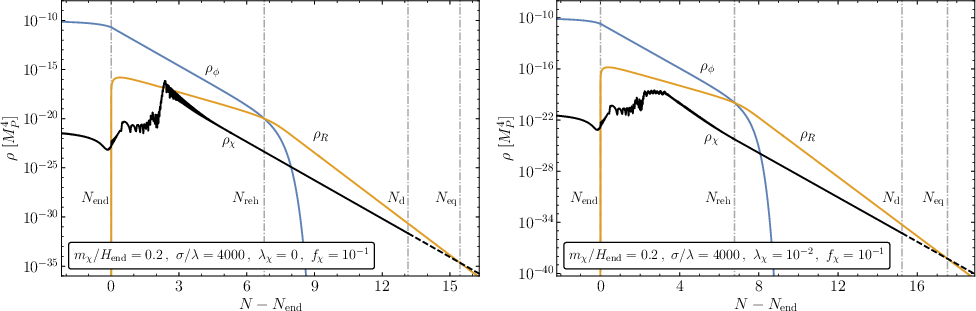
Figure 1: Energy densities of the inflaton ρϕ, visible radiation ρR, and spectator field ρχ as functions of ϕ0-folds, highlighting dynamics with and without ϕ1 self-interaction.
The onset of reheating triggers substantial energy transfer via parametric resonance. The efficiency and temporal structure of this process depend strongly on the ϕ2-ϕ3 portal (ϕ4) and the ϕ5 self-coupling (ϕ6):
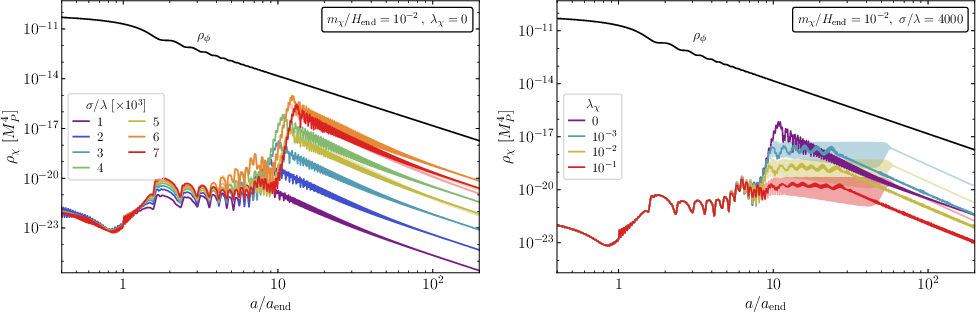
Figure 2: Early reheating evolution of ϕ7 for varying ϕ8 (left) and ϕ9 (right), compared with σϕ2χ20 (black). Both Hartree and lattice methods shown.
Key features demonstrated include non-monotonic dependence on σϕ2χ21 due to resonance band structure and fragmentation, and strong suppression of amplification for large σϕ2χ22 due to Hartree detuning. Lattice simulations confirm Hartree for IR dynamics but reveal significant rescattering beyond mean-field at high σϕ2χ23.
Spectator Power Spectrum and Non-Equilibrium Enhancement
The post-inflation amplification yields a frozen, vacuum-subtracted spectator spectrum sharply peaked near the resonance scale, with a universal σϕ2χ24 white-noise IR scaling inherited from the large effective mass regime. This behavior is corroborated numerically:
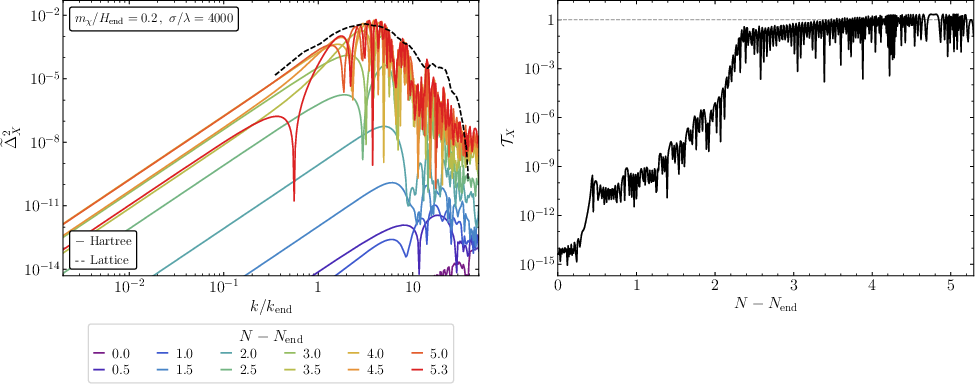
Figure 3: Time evolution of the rescaled σϕ2χ25 power spectrum during resonance, and transfer function for IR growth.
The exponential enhancement—up to 15 orders of magnitude over a few σϕ2χ26-folds—is shut off either by Hubble redshifting of the inflaton envelope or by backreaction from σϕ2χ27 self-interactions. Lattice and Hartree results are congruent for IR, with UV deviations arising from turbulent energy transfer to short modes.
The direct σϕ2χ28 source in the Einstein equations is isolated and treated with a vacuum-subtracted, four-point Wick contraction. The resulting SGWB spectrum factorizes into a momentum integral over the frozen spectrum and a temporal integral governed by the expansion history. The spectral integral, σϕ2χ29, admits a λχχ4/4!0 IR scaling for white noise input, which is validated numerically:
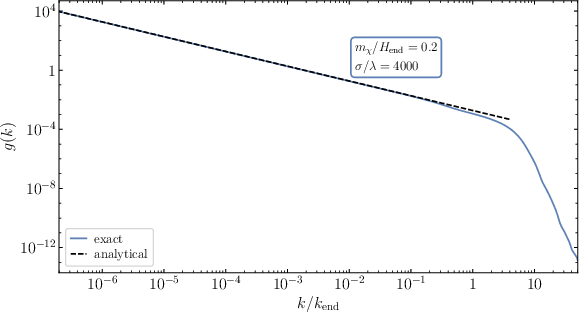
Figure 4: Exact and analytic approximation for the GW spectral integral λχχ4/4!1. The IR scaling λχχ4/4!2 dominates until resonance cutoff.
The time-dependent build-up of gravitational wave energy is decomposed into contributions from: early-time (parametric amplification), matter-dominated reheating, and the subsequent radiation-dominated era.
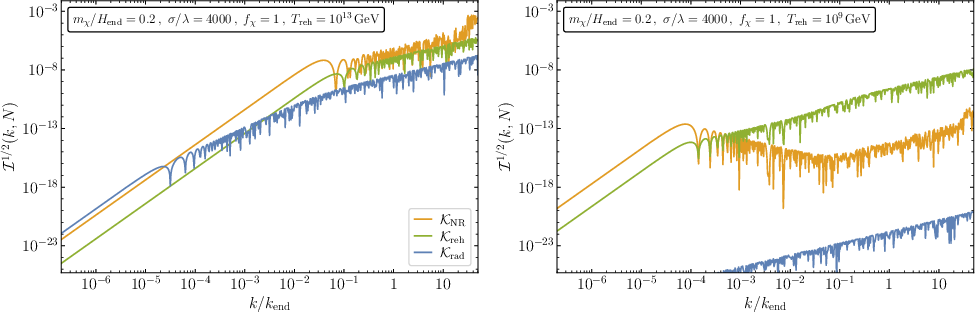
Figure 5: Relative contributions of each phase to the time-dependent factor λχχ4/4!3 for two λχχ4/4!4 benchmarks.
The dominant source is set by the largest available λχχ4/4!5 and amplifies at higher frequencies, with the spectrum sharply rising as λχχ4/4!6 near the resonance scale.
Gravitational-Wave Signal Predictions and Parameter Dependence
The resulting gravitational wave energy density exhibits a steep blue tilt in the IR (λχχ4/4!7), peaking at ultra-high frequencies λχχ4/4!8--λχχ4/4!9 Hz. The total amplitude can reach χ0 for strong coupling (χ1) and χ2 GeV, as shown:
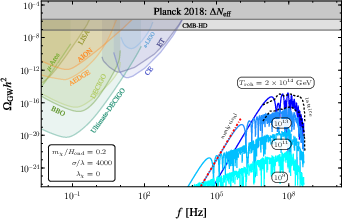
Figure 6: GW spectra for varying χ3 (χ4), with lattice (dashed) and analytic (dot-dashed) results.
The dependence on χ5 is highly non-monotonic, mirroring resonance band structure:
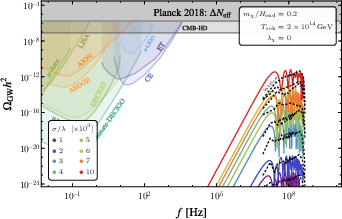
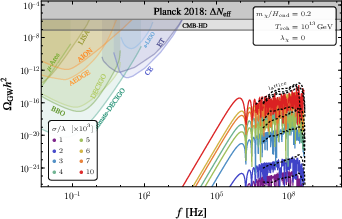
Figure 7: GW spectra for varying portal coupling (χ6). Black dashed: lattice spectra.
The GW signal is largely insensitive to χ7 as long as parametric resonance is efficiently driven by the portal.
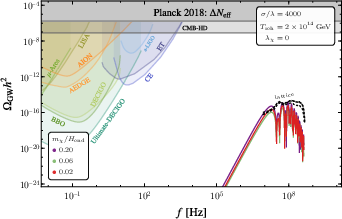
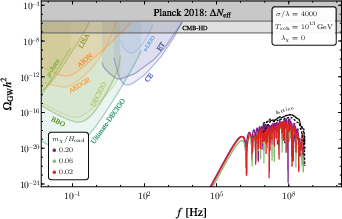
Figure 8: GW spectrum as a function of χ8 for fixed χ9 and χ0.
When χ1 self-interaction is increased, the GW amplitude is suppressed for large χ2 due to earlier resonance shutdown; at intermediate values, mode-mode rescattering can boost UV power, an effect fully captured by lattice simulations:
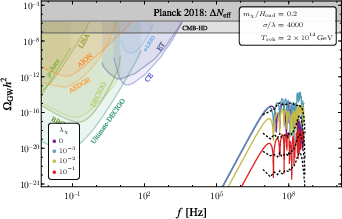
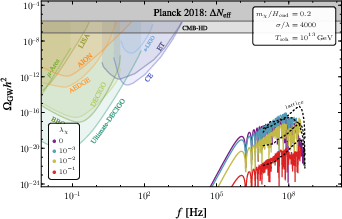
Figure 9: GW spectra for varying χ3, showing enhancement at intermediate and suppression at high χ4. Black dashed: lattice computations.
Implications and Theoretical Significance
The analysis demonstrates that second-order SGWB from spectator sector matter gradients can achieve significant amplitudes at ultra-high frequencies—orders of magnitude above those attainable by the linear inflationary background. The sensitivity to χ5, χ6, and χ7 highlights the potential for GW detection to probe reheating microphysics and dark sector interactions inaccessible to electromagnetic or even large-scale structure probes. The signal's frequency localization at χ8 LIGO/LISA bands places it beyond current detector capabilities, but amplitudes χ9 are sufficient to motivate future resonant-cavity or other ultra-high-frequency GW concepts.
This framework is robust against CMB isocurvature constraints due to the suppression of superhorizon α0 power by heavy effective mass during inflation. Lattice simulations validate the IR predictions of the analytic Hartree approach and reveal the role of nonlinear fragmentation and rescattering—essential for correct UV behavior, but subdominant for IR-dominated GW production.
Extension to alternative inflationary potentials (e.g., quartic) and to curvaton-like or stable relic scenarios are possible, with enhancements generally anticipated if post-inflation expansion is more radiation-like.
Conclusion
This study establishes an analytic and numerical approach for predicting gravitational wave backgrounds from spectator scalar matter perturbations amplified during reheating via inflaton-induced parametric resonance. The main findings include:
- Parametric resonance, strongly regulated by α1 and α2, can enhance the GW background by α3 orders of magnitude relative to the gravitational production baseline.
- Maximum GW amplitude scales as α4, reaching α5 at α6--α7 Hz, well above BBN/CMB bounds but outside current detector reach.
- The signal is highly sensitive to inflaton-spectator portal structure and reheating dynamics, and only weakly on α8 mass in the strong-coupling regime.
- Lattice and Hartree approaches agree in the IR, with lattice revealing important additional features at high α9 and in the UV.
- The framework developed provides a target and motivation for continued experimental innovation in ultra-high-frequency GW detection and offers a cosmological probe of reheating and dark-sector microphysics otherwise inaccessible to conventional means.
The methodology invites future generalization to nonminimal couplings, full metric-sourced (isocurvature) second-order tensor channels, and broader exploration of parameter space in contemporary and next-generation cosmological studies.