- The paper introduces a robust network analysis using maximum-entropy null models to quantify international collaboration and citation significance over 30 years.
- It finds a widening divergence with pronounced US-China polarization since around 2000, alongside distinct integration patterns among other global research powers.
- The study implies that emerging bridging countries and a potential third pole, notably India, are critical for shaping global AI governance and regulation.
Polarization and Integration in Global AI Research
Introduction
"Polarization and Integration in Global AI Research" (2604.17602) presents a quantitative network analysis of the evolving structure of international collaborations and knowledge exchanges in AI research over three decades. Leveraging large-scale bibliometric datasets, the authors employ a maximum-entropy-based null model to control for country-specific research activity, enabling a robust identification of significant cross-country links. The study reveals pronounced bipolarity between the United States and China, a diversified set of integration dynamics among other major research powers, and the emergence of bridging countries that may play a pivotal role in the future regulatory and innovation landscape of AI.
Methodological Framework
The authors construct yearly networks from 1990 to 2021, with nodes as countries and weighted edges representing either co-authorship (undirected) or citation (directed) relationships. To assess whether observed collaborations and citations are statistically significant, these empirical networks are compared against ensembles of randomized networks generated via the Enhanced Configuration Model (ECM), preserving degree and strength distributions. The statistical significance (z-score) of each bilateral relationship is computed, and temporal evolution is analyzed to reveal persistent integration, divergence, and polarization patterns.
The dynamic time warping metric and k-means clustering are applied to bilateral trajectories in the collaboration/citation significance plane, yielding four archetypal dynamics: Scientific Convergence (SC), Scientific Divergence (SD), Knowledge Integration (KI), and Knowledge Divergence (KD). This stratification allows for a comprehensive typology of global AI research relationships.
Results: Evolving Poles, Divergence, and Integration Pathways
The analysis confirms and quantifies a continuous and widening divergence between the US and China in both collaboration and knowledge exchange significance since approximately 2000. Despite substantial growth in raw collaboration and citation volumes, the observed links fall increasingly below null model expectations. This divergence is robust to variance corrections and alternative randomization algorithms.
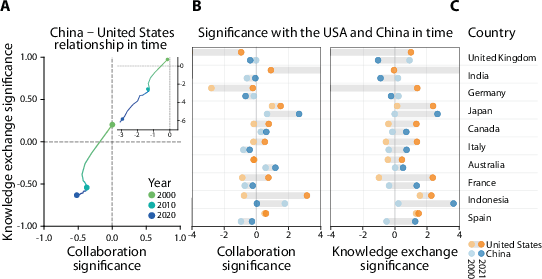
Figure 2: Temporal dynamics of collaboration and knowledge exchange significance between China and the US and other AI leaders, highlighting a persistent and increasing deficit relative to expected values.
The shifting significance of collaborations and citations with the US and China for leading AI research countries uncovers heterogeneous integration and polarization trends:
- Exclusive US Integration: The UK and Germany's ties with the US have become more significant, while those with China have weakened.
- Dual Integration (Bridging): Several European countries (France, Italy, Spain), Japan, Canada, and Australia exhibit increased significance with both the US and China, maintaining a “bridge” position.
- Exclusive China Convergence: A large group, including Brazil, Russia, South Korea, Taiwan, Singapore, India, and some developing countries, integrate exclusively or increasingly with China. India, in particular, shows rapid convergence with China and divergence from the US, suggesting emergence as a third AI research pole.
- EU Fragmentation: Within the EU-28, major knowledge producers increasingly play a hub-and-spoke role, strongly connecting to smaller neighbors while diverging from each other.
Implications for Global AI Governance and Regulation
These findings have critical implications for the geopolitics of AI research and for efforts to harmonize global AI governance. The structural bifurcation into US- and China-centered poles not only reflects science policy and regulatory strategies but also suggests a risk for increased regulatory fragmentation. The paper highlights that “bridge” countries—especially several European states, Canada, and Japan—are strategically positioned to maintain cross-bloc knowledge flows and potentially mitigate the risks of polarization.
Furthermore, the empirical evidence of growing China-centric integration, particularly among developing and emerging economies, signals a redistribution of AI research influence that may challenge traditional US and EU leadership in both innovation and standard-setting. The authors argue that effective global AI regulation may depend less on the initiatives of the US and China per se, and more on their capacity to retain and incentivize cooperation with these bridging countries. The fragmentation observed within the EU, however, may weaken Europe's bridging capacity, unless addressed through targeted science and AI policy (e.g., the expansion of the European Research Area and harmonization of regulatory frameworks).
Theoretical and Practical Relevance, and Future Directions
The use of maximum-entropy-based null models represents a critical methodological advancement in the comparative analysis of large-scale scientific collaboration networks, controlling for confounding due to overall productivity and network connectivity. The identification of archetypal integration and divergence trajectories allows for a dynamic, systems-level understanding of research globalization and fragmentation beyond crude volume-based metrics.
Practically, the study's results should inform national and supranational policy, particularly decisions regarding international collaboration restrictions, AI regulation, and strategic investment in science diplomacy. The increased centrality of China, the potential emergence of India as a scientific pole, and the critical role of bridges highlight where regulatory, funding, and diplomatic leverage may have maximal system-level impact.
Future research directions may include forward projection using agent-based network simulations informed by observed trends, granular analyses at the sub-field or institutional level, or extension of the methodology to patent and industrial R&D networks in AI.
Conclusion
This paper provides a rigorous quantitative mapping of the evolving topology of global AI research collaboration and knowledge flow networks. It finds that the international system is polarizing into US- and China-centered spheres with increasing significance, yet with a multipolar periphery wherein several key countries continue to bridge both worlds. The resilience and policy choices of these bridging countries—and the willingness of US and China to design interoperable governance and maintain open scientific collaboration—are likely to be decisive in the trajectory of both AI innovation and its global regulation.