- The paper demonstrates that thermal optical phonons chiefly suppress high harmonic generation in graphene by causing ultrafast phase scrambling.
- It employs a two-band semiconductor Bloch framework with stochastic phonon sampling to replicate experimental spectral cutoffs and ellipticity trends.
- The study quantifies an ultrafast dephasing timescale of ~5.7 fs, linking zero-point phonon motion to the observed decoherence in high field regimes.
Ultrafast Electron-Optical-Phonon Coupling and High Harmonic Generation in Graphene
Introduction
The study titled "Role of ultrafast electron-optical-phonon interactions in high harmonic generation from graphene" (2604.23294) addresses the fundamental role of thermal optical phonons in high harmonic generation (HHG) from graphene under intense ultrafast laser irradiation. While strong-field HHG in solids has been conventionally analyzed in terms of electronic dynamics, this work demonstrates that thermal phononic degrees of freedom (DOF) exert primary control over critical aspects of HHG, including spectral suppression, yield, dephasing times, and ellipticity response. The paper delivers strong, numerically substantiated claims that go beyond phenomenological decoherence models by providing a mechanistic, phase-based perspective on phonon-induced suppression and cleaning of the high harmonic spectrum in graphene.
Methodological Framework
The theoretical approach is rooted in a two-band semiconductor Bloch equation (SBE) description for graphene, with tight-binding Hamiltonians parameterized for both equilibrium and static-phonon-displaced lattices. Optical in-plane Γ-point phonons (LO/TO modes) are incorporated by sampling frozen lattice configurations according to their quantum thermal occupation at temperature T, constructing an ensemble of static snapshots. For each snapshot, SBE-driven HHG dynamics are computed, and the total emitted spectrum is coherently averaged weighted by phonon occupation statistics. This framework properly models experimental conditions in which a macroscopic solid features randomly distributed phononic configurations.
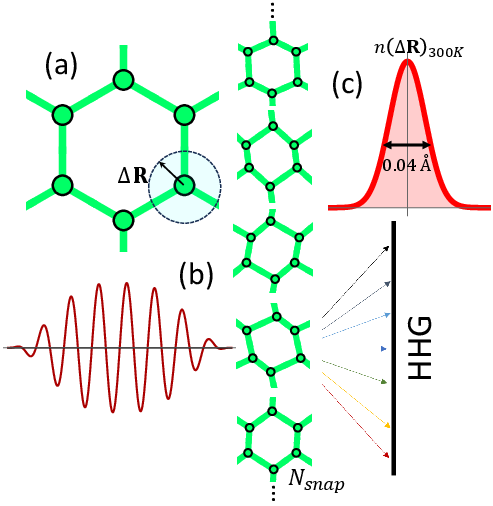
Figure 1: Schematic of phononic DOF sampling—phononic displacements, though exaggerated, are sampled to model thermal occupancy and phonon-induced lattice disorder; the distribution function visualizes the thermal spread at 300K.
The complete HHG response emerges from coherent summation over these stochastic lattice realizations, capturing how phonon occupation scrambles the emission phases. Phenomenological dephasing (finite T2) is included optionally to distinguish pure e-ph effects from e-e and macroscopic decoherence.
Main Results: Suppression, Dephasing, and Phase Scrambling
HHG Yield Suppression and Spectral Cleaning
The simulations establish that including thermal optical phonons via stochastic lattice distortion sharply suppresses nonperturbative HHG above ~3 eV—consistent with the absence of experimentally observed harmonics above this energy from graphene. This suppression is not replicable by moderate phenomenological dephasing alone. In contrast, for the equilibrium lattice, the calculated HHG extends far beyond 3 eV, in contradiction with experiment.
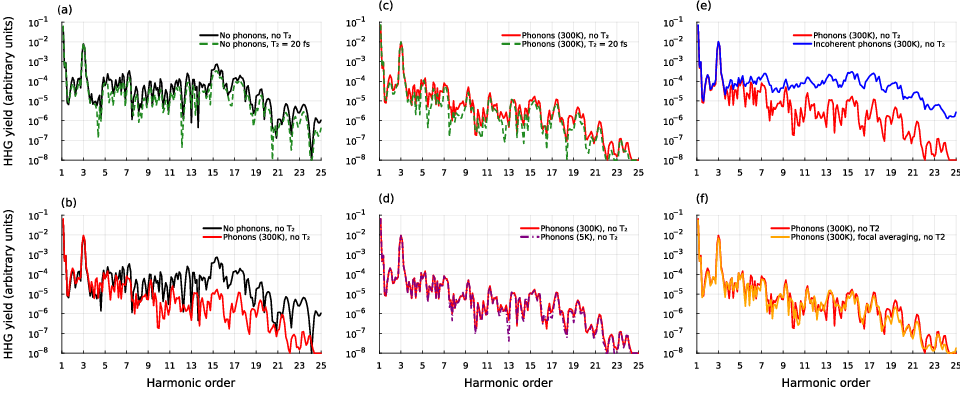
Figure 2: HHG spectra comparing equilibrium (no phonons) to phononic (thermal sampling) cases; phononic interactions cause plateau suppression and spectral cleaning robust to additional phenomenological T2 dephasing; temperature dependence is weak in realistic experimental ranges.
A temperature dependence study indicates that, for graphene, HHG suppression by phonons is dominated by zero-point motion, becoming temperature dependent only above ~1500 K. Statistically, the ensemble-averaged phase scrambling persists at low temperatures due to quantum lattice fluctuations.
Mechanism: Interband-Selective Phase Scrambling
Decomposition of the emission into interband and intraband channels reveals that phonon-induced suppression uniquely targets the interband component. Intraband harmonics remain essentially unaffected by the presence of thermal phonons. Detailed phase analysis across phononic snapshots demonstrates that for higher harmonics, the emission phase distribution broadens substantially, resulting in strong destructive interference upon summation. Low-order harmonics remain phase-coherent, explaining the observed selectivity in harmonic suppression.
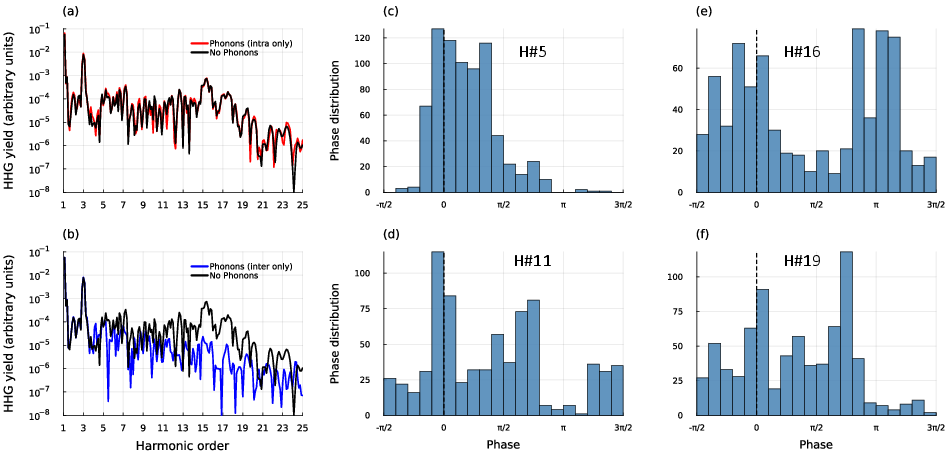
Figure 3: Suppression is specific to interband HHG; the phase distributions for harmonics above H5 show broadband phase scattering, a signature of strong destructive interference from phononic-induced disorder.
This effect is attributed to the centrality of the Dirac cone's Berry phase and the sensitivity of gapless interband coherences to lattice symmetry breaking—even for subpercent displacements—without requiring time-evolving phonons.
Phonon-Induced Dephasing Timescale
Analysis of the Brillouin-zone-averaged interband coherence ∣ρcv(t)∣ after pulse extinction reveals a near-exponential decay with an extracted T2 of 5.7 fs for phonon-induced dephasing, with minimal additional suppression from shorter e-e scattering rates. Equivalent suppression occurs if a purely phenomenological dephasing of T0 fs is imposed in the absence of true electron-phonon interaction, confirming the primary role of e-ph processes in ultrafast decoherence for strong-field HHG in graphene.
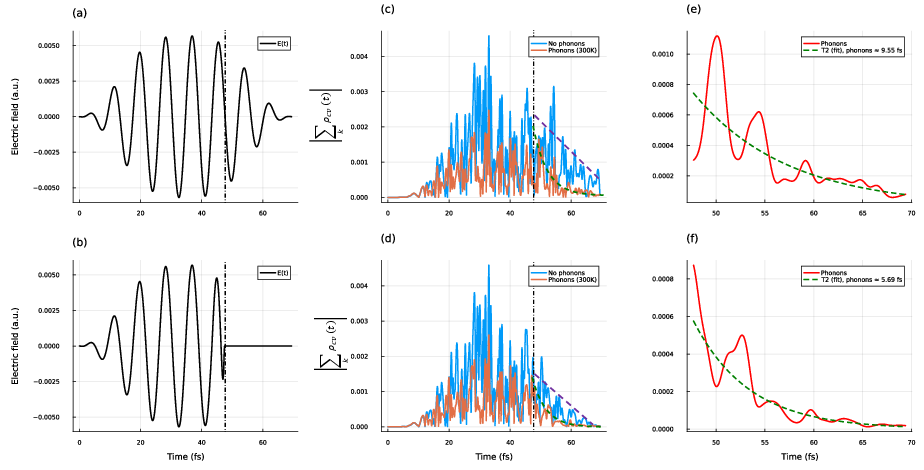
Figure 4: Interband coherence decay for the phononic case matches an exponential with T1 fs, evidencing ultrafast e-ph dephasing distinct from T2-T3 timescales or macroscopic decoherence.
Ellipticity Dependence
Phononic interactions additionally lead to smoother and more experimentally consistent ellipticity dependence for individual harmonic yields, with observable phonon-induced shifts in the maximizing ellipticity. This establishes HHG ellipticity scans as a potential probe of thermal phonon occupation on ultrafast timescales.
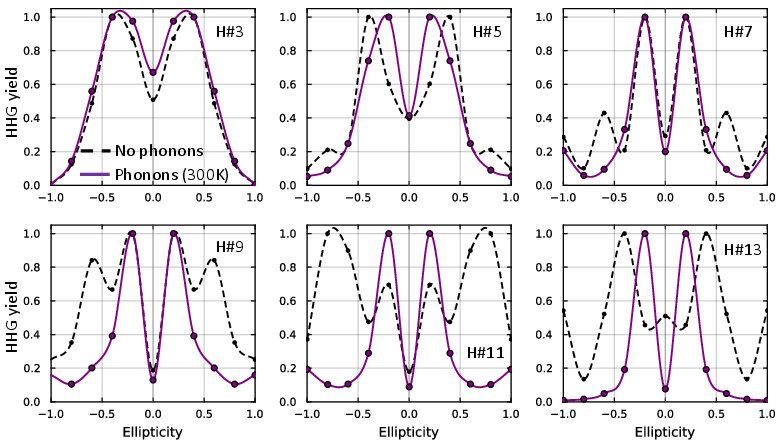
Figure 5: Harmonic yields versus driving field ellipticity; thermal-phonon inclusion reduces spectral side features and can shift optimal ellipticity, suggesting a route for phonon spectroscopy.
Implications and Outlook
This work constitutes a significant step in understanding the "ultrafast dephasing time problem," providing a quantitative, mechanistic link between thermal optical phonons and decoherence in strong-field solid-state HHG. The findings resolve a long-standing discrepancy between theoretical coherence times in simulations and experimental HHG plateau cutoff energies and spectral cleanliness in graphene.
The static snapshot approach justifies the applicability of these conclusions to attosecond-scale experiments, placing phononic phase scrambling at the heart of spectral suppression—beyond any timescale constraints inherent to phonon motion. The results generalize to other 2D or bulk systems, especially those where significant Berry curvature or topological effects interact with thermal phonon-induced symmetry breaking.
Practically, the analysis indicates that accurate modeling and predictive design for strong-field experiments and HHG-based spectroscopy must incorporate at least static thermal phonon disorder, even at cryogenic temperatures for materials with substantial zero-point displacement. The identified phase scrambling mechanism further suggests possibilities for spectroscopies of phonon dynamics and phononic occupation using high-field, ultrafast optical probes.
Theoretically, this work highlights the need to go beyond standard phenomenological decoherence and to connect quantum geometry, band topology, and lattice fluctuations in models of strong-field solid-state phenomena. The approach may contribute to the understanding of the feasibility and dynamical stability of nonequilibrium Floquet phases in graphene, where ultrafast decoherence and strong e-ph coupling are key constraints [Merboldt et al., Nat. Phys. 21, 1093 (2025)].
Conclusion
"Role of ultrafast electron-optical-phonon interactions in high harmonic generation from graphene" (2604.23294) rigorously establishes the dominance of optical phonon-induced phase scrambling as the leading mechanism for HHG suppression and ultrafast dephasing in graphene. The methodology and results provide a paradigm for incorporating electron-phonon coupling in ultrafast and strong-field phenomena in solid-state systems, opening routes for ultrafast phonon spectroscopy and precise band-structure engineering in 2D materials. The demonstrated static mechanism for phase scrambling applies independently of carrier frequency, suggesting wide relevance in attosecond science and tailored, high-field photonics.