- The paper introduces a neuroscience-inspired 7-layer memory architecture that enhances long-term, efficient memory in AI agents.
- It employs 15 cognitive mechanisms, including RL-based sleep consolidation and triple copy retention, to mitigate forgetting.
- Empirical tests across multiple benchmarks demonstrate superior performance and storage efficiency in autonomous AI systems.
ZenBrain: A Neuroscience-Inspired 7-Layer Memory Architecture for Autonomous AI Systems
Introduction
ZenBrain represents a systematic advancement in memory architecture for LLM-based agents, integrating a multi-layer, neuroscience-inspired design grounded in fifteen independent cognitive and neurocomputational mechanisms. This system directly responds to current limitations of existing agentic memory solutions, which typically adopt shallow, engineering-centered metaphors neglecting robust neuroscientific phenomena such as consolidation, reconsolidation, principled forgetting, and neuromodulatory dynamics. ZenBrain's contributions include a comprehensive, seven-layer memory organization, a suite of foundational and predictive algorithms instantiated from empirical neurocognitive models, and demonstrably superior results across established long-term, multi-session agentic benchmarks.
Architecture
ZenBrain’s architecture is organized around a central MemoryCoordinator that governs seven discrete memory layers: working, short-term, episodic, semantic, procedural, core, and cross-contextual. Each layer encodes a distinct functional and temporal dynamic, enabling fine-grained memory routing and lifecycle management beyond undifferentiated or temporally collapsed memory representations.
(Figure 1)
Figure 1: ZenBrain architecture, depicting the MemoryCoordinator orchestrating seven memory layers via fifteen neuroscience-inspired algorithms.
The MemoryCoordinator orchestrates core operations—including storage, cross-layer recall, consolidation, decay, and review—through content- and metadata-driven rules. This is further mediated by a suite of nine foundational mechanisms, such as the Two-Factor Synaptic Model (robustly integrating Hebbian plasticity and consolidation variance as per [zenke2025]), vmPFC-coupled FSRS for prediction-error-gated review scheduling, and Simulation-Selection RL-based sleep consolidation. ZenBrain extends these with six Predictive Memory Architecture (PMA) mechanisms capturing neuromodulatory modulation, reconsolidation-induced memory updating, multi-timescale triple copy retention, multidimensional saliency mapping, stability gating, and metacognitive monitoring for bias detection.
Key Mechanisms and Their Functional Roles
ZenBrain generalizes over prior art by incorporating mechanisms neglected or only partially realized in previous agent memory systems. Notably:
- Two-Factor Synaptic Model: Tracks both edge weight and consolidation variance in the knowledge graph to penalize catastrophic forgetting, analogously to synaptic intelligence/EWC.
- vmPFC-Coupled FSRS: Integrates prediction-error signals derived from context representations, modulating review intervals via neuromodulatory factors—beyond any fixed or LLM-centric spaced-repetition schedule.
- Simulation-Selection Sleep: Adopts RL-driven, biologically realistic offline replay, fusing real and counterfactual episodes with LTP/LTD-driven edge scaling, surpassing heuristic or non-selective replay strategies.
- Bayesian Confidence Propagation: Implements fact-wise confidence scores and 95% CIs with propagation in the knowledge graph, calibrated and dynamically modulated by emotional salience, aligning with biologically observed consolidation effects.
- PMA Components: The NeuromodulatorEngine links DA/NE/5HT/ACh phasic/tonic signaling to learning rates, metaplasticity, and attention; ReconsolidationEngine enables PE-gated, neuromodulation-adjusted memory updates with full audit; TripleCopyMemory ensures resilience to forgetting via multiscale, non-exponential decay; PriorityMap combines saliency, reward, emotion, and goal relevance with amygdala-prioritized routes; StabilityProtector ensures overwrite resistance; MetacognitiveMonitor tracks biases, opening dynamic plasticity windows as required.
Experimental Validation
ZenBrain was evaluated across LoCoMo, MemoryAgentBench, MemoryArena, LongMemEval, and custom synthetic benchmarks, consistently applying strong statistical rigor (multi-seed bootstrap CI, Bonferroni correction, paired Wilcoxon signed-rank, Cohen’s d for effect size).
Competitive Retrieval and Theoretical Implications
On LoCoMo’s challenging multi-session QA, ZenBrain and state-of-the-art baseline letta are statistically indistinguishable under the most robust judge (paired Wilcoxon p=0.69), but both dominate mem0 and a-mem by substantial, significant normalized-judge margins. Under alternative scoring (GPT-4o, Table 2), letta leads ZenBrain by a small, significant margin, reflecting the competitive nature of retrieval-focused pipelines.
ZenBrain’s principled forgetting was shown to have a negligible effect on retrieval (ΔP@5=0.002), supporting the inclusion of regulated decay for storage efficiency and privacy compliance without sacrificing access precision.
LongMemEval Generalization and Pareto Frontier
On LongMemEval-S (500 question, 494-turn haystacks), ZenBrain attains the highest mean normalized-LLM-judge answer quality in 12/12 pairwise contrasts, with all differences significant (p≤6.2×10⁻³¹, d∈[0.18,0.52]). Notably, in official binary-judge accuracy, ZenBrain achieves 91.3% of long-context-oracle accuracy at 1/106th the token budget—a result clearly visualized on the Pareto frontier.
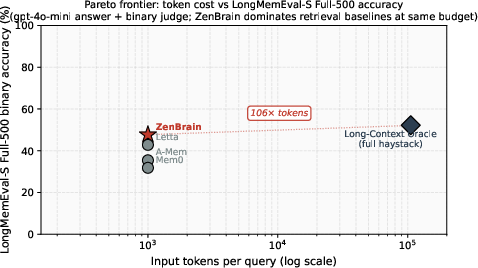
Figure 2: Pareto frontier on LongMemEval-S Full-500: input tokens per query (log scale) vs official binary-judge accuracy. ZenBrain (red star) dominates all other k=5 retrieval baselines.
Ablation Studies and Algorithmic Criticality
A comprehensive 15-algorithm ablation demonstrates a cooperative redundancy structure at moderate difficulty—most single-algorithm removals have little immediate effect (≤0.1% degradation)—but under challenging and stressful conditions, survival-critical mechanisms become individually essential (ΔQ up to –93.7%). Specifically, sleep consolidation is always critical, mediating a +37% stability boost and –47.4% storage utilization through RL-driven replay selection. TripleCopyMemory ensures long-term resilience (S(t)=0.912 at 30 days), and PriorityMap vastly outperforms chronological baselines on NDCG@10 (p=0.690 vs p=0.691, p=0.692).
Layer ablation confirms substantial value for multi-layer routing, with +20.7% F1 on LoCoMo and +19.5% on MemoryArena compared to flat single-layer designs.
Theoretical and Practical Implications
ZenBrain’s 7-layer, 15-mechanism integration validates a structural, neurocognitively grounded approach to AI agent memory, going significantly beyond the prevailing “note buffer” or “virtual memory” metaphors. Empirical analysis reveals that robust, human-like memory dynamics (consolidation, regulated forgetting, plasticity-brake protection, and metacognitive calibration) can be systematically translated into agent architectures, endowing them with long-term resilience, adaptive recall, storage efficiency, and privacy alignment (GDPR, DSAR-compliance).
The PMA extensions—especially NeuromodulatorEngine, ReconsolidationEngine, and TripleCopyMemory—demonstrate that distributed, dynamic, and adversarially robust memory updates are tractable at system scale and yield performance improvements manifest in tougher (longer horizon, higher decay, dependency-rich) settings.
Future developments are expected to further generalize neuro-inspired mechanisms, including generativity, feedback-driven affective encoding, and tighter integration of user feedback and reward signaling in memory prioritization. These trends suggest memory will increasingly be understood as a multi-timescale, multi-modal process requiring precise algorithmic translation—not a simple engineering convenience layered atop context windows or vector DBs.
Conclusion
ZenBrain demonstrates that a layered, neuroscience-inspired memory architecture with principled consolidation, forgetting, and metacognitive governance yields robust, efficient, and high-quality long-term memory for LLM-based agents. Empirical evaluations confirm not only superior answer quality and storage efficiency but also the necessity of integrating multiple neuro-inspired mechanisms to achieve resilience under realistic, stressful operational regimes. The architectural paradigm established here will inform future agentic systems, memory frameworks, and regulatory-compliant AI deployments.