- The paper demonstrates that high-harmonic spectroscopy and inelastic scattering can resolve real-space and real-time lattice vibrations in graphene.
- The study applies a tight-binding model and semiconductor Bloch equations to disentangle interband and intraband dynamics with clear symmetry selection rules.
- The findings open pathways for ultrafast optoelectronic metrology and precise control of electron–phonon interactions in quantum materials.
Probing Ultrafast Lattice Dynamics in Real Space and Real Time via High-Harmonic Spectroscopy and Inelastic Scattering
Introduction and Motivation
Understanding lattice dynamics and their coupling to electronic and optical responses in solids is central to condensed matter physics, ultrafast optics, and materials engineering. The work "Probing Lattice Dynamics in Real-Space and Real-Time" (2605.20631) provides a comprehensive study of how high-harmonic generation (HHG) and inelastic scattering can serve as time- and space-resolved probes of coherent lattice vibrations, particularly in two-dimensional (2D) materials like monolayer graphene.
The thesis is structured around two synergistic approaches: (1) using high-harmonic spectroscopy to access attosecond electronic responses modulated by coherent phonons, and (2) reconstructing real-space and real-time lattice vibrations from momentum-resolved inelastic scattering data, circumventing the need for pump-probe femtosecond experiments.
High-Harmonic Generation in Solids and Lattice-Phonon Interplay
Mechanisms of HHG in Solids
The extension of HHG from gases to solids revealed profound mechanisms wherein strong-field-driven carrier dynamics in periodic band structures generate high-order harmonics. The semiclassical recollision model, successfully applied to atomic gases, requires adaptation for solids, as interband (recombination of electrons and holes between valence and conduction) and intraband (nonlinear current within a band) processes compete and intertwine.

Figure 1: The two-band picture for HHG in solids, showing the momentum-resolved energy dispersion for monolayer graphene.
Graphene serves as an ideal platform due to its Dirac electronic dispersion, high experimental accessibility, and well-characterized phonon modes.
Theoretical Treatment and Numerical Framework
The electronic structure is modeled using a tight-binding approach focused on the delocalized π/π∗ bands, while electron dynamics in the presence of a strong field are simulated via semiconductor Bloch equations (SBE) in the Houston basis. This allows natural delineation of interband and intraband contributions to the nonlinear current.

Figure 2: High-harmonic spectra of monolayer graphene, decomposed into parallel/perpendicular components and intra/interband processes.
The approach captures symmetry-imposed selection rules: pristine graphene generates only odd harmonics for linearly polarized driving, and the polarization of emitted harmonics aligns with lattice symmetries.
Probing Coherent Lattice Vibrations via HHG
Coherent Phonon Excitation and Symmetry Breaking
The lattice Hamiltonian employs a harmonic Born model, and atomic displacements corresponding to the in-plane optical E2g phonons of graphene are treated classically. The coherent excitation of these modes, with well-controlled amplitude and phase, modulates the instantaneous band structure and induces time-dependent changes in the optical response.
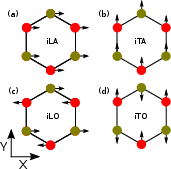
Figure 3: Sketches of atomic vibrations for the degenerate E2g (in-plane LO/TO) phonon modes in graphene's real-space honeycomb lattice.
HHG Spectra as a Fingerprint of Lattice Dynamics
Introduction of coherent phonon dynamics manifests as unique sidebands on the HHG spectrum, with the energy spacing precisely matching the phonon frequency. The intensity and polarization of sidebands directly report on vibrational amplitude, mode symmetry, and electron-phonon coupling.
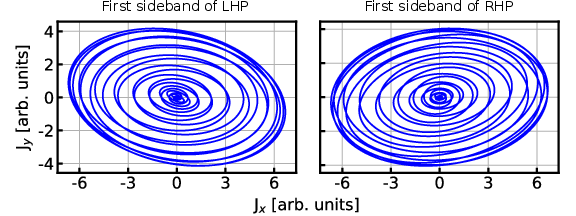
Figure 4: High-harmonic spectra of monolayer graphene with/without coherent lattice motion. Sidebands appear at frequencies shifted by integer multiples of the phonon frequency. Even/odd sidebands show distinct polarization selection.
Time-frequency analysis via Gabor transforms further demonstrates that high-harmonic emission becomes modulated at the phonon period, evidencing real-time coupling between lattice and electronic degrees of freedom.
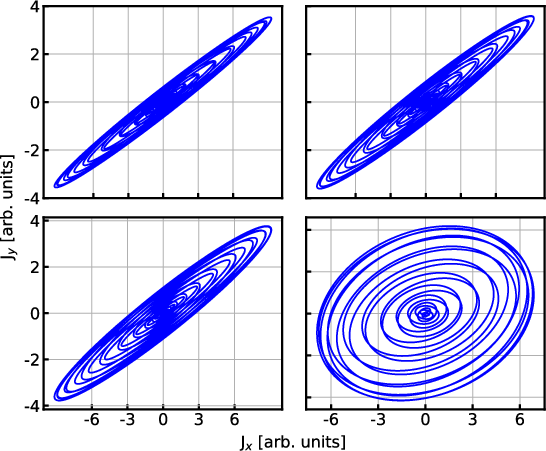
Figure 5: Time-frequency maps of the HHG current, revealing periodic modulations at the coherent phonon frequency imposed on sub-cycle electron dynamics.
Symmetry and Dynamical Selection Rules
Static and dynamic lattice deformations break reflection symmetry planes, as confirmed both by direct static displacement calculations and time-dependent Floquet symmetry analysis. Even- and odd-order sidebands show polarization properties governed by the associated dynamical symmetries of the system and probe field.
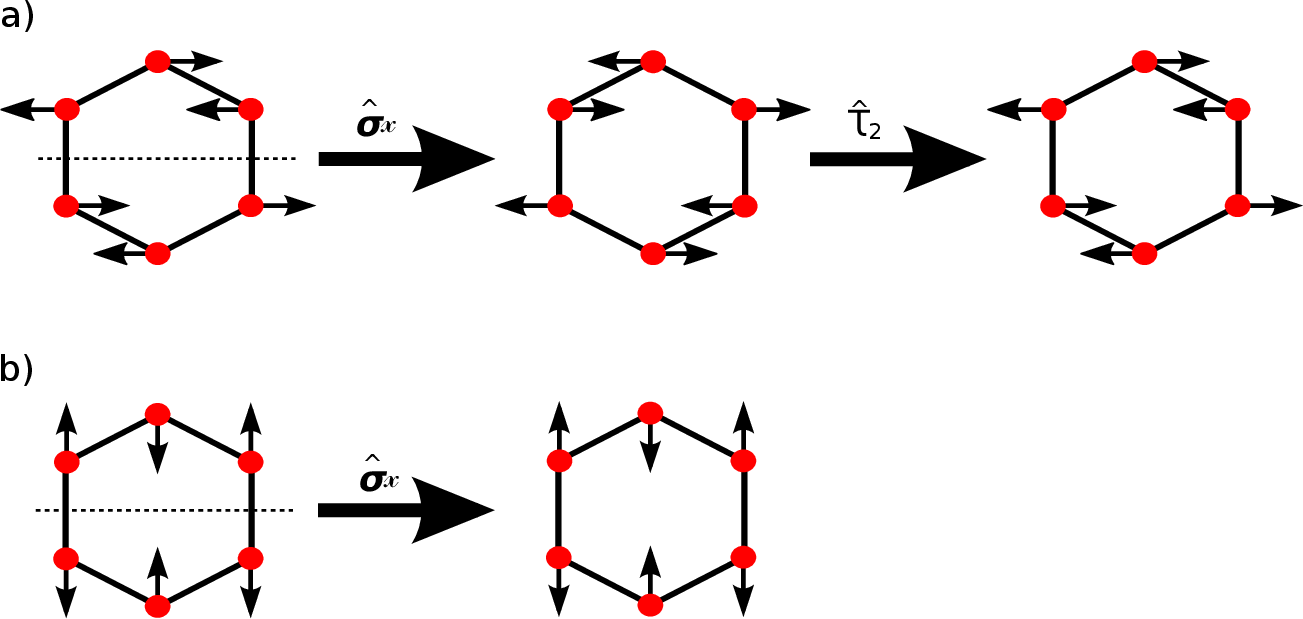
Figure 6: Schematic of dynamical symmetries in the Floquet Hamiltonian under coherent phonon excitation; group-theoretical selection rules dictate polarization of harmonic sidebands.
These symmetry-based results highlight HHG as a highly sensitive probe of transient inversion and reflection symmetry breaking, accessible on ultrafast timescales and without the need for long multi-pulse experiments.
Sensitivity and Dependence on System Properties
The paper systematically demonstrates the sensitivity of HHG spectra to:
- Phonon amplitude and anharmonicity (sideband intensities increase monotonically with amplitude, weak dependence on harmonicity within physical displacements)
- Phonon mode coupling (superpositions or chiral excitation induce changes in sideband polarization)
- Isotope substitution (sideband splitting tracks phonon frequency shifts due to isotope mass)
- Optical parameters (probe pulse polarization, intensity, and dephasing)
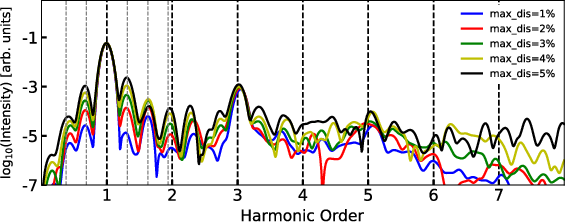
Figure 7: Sidebands grow with increasing atomic vibrational amplitude, confirming the nonlinear sensitivity of the spectroscopic response.

Figure 8: Isotope substitution modifies the phonon energy, shifting sideband positions in the HHG spectrum.
These dependencies underscore the utility of HHG as both metrology and control tool for lattice dynamics.
Phase and Chirality Mapping of Circular Phonons
The method is extended to extract the phase difference and chirality when both in-plane phonon modes are coherently excited with a phase offset. The HHG sideband polarization encodes not only amplitude but also phase, with chiral phonon modes probing the symmetry of circularly polarized light-matter coupling.
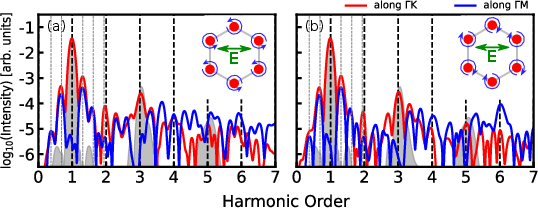
Figure 9: HHG spectra for left- and right-circular phonon modes in graphene, showing sideband structures sensitive to phonon chirality.
Figure 10: Extraction of phase difference between phonon modes from the x-y time-domain projection of emitted current.
These results link lattice and photonic chiralities, with implications for ultrafast valleytronics and optoelectronic switching.
Four-Dimensional Imaging via Inelastic Scattering
The second half of the work establishes a rigorous framework for reconstructing real-space, real-time lattice dynamics purely from inelastic scattering data in the (k,ω) domain. Through the fluctuation-dissipation theorem and Kramers-Kronig relations, the full response function χ(k,t) is constructed and Fourier-transformed to χ(x,t).
Snapshots of lattice evolution following a localized excitation, such as an ultrafast pump, are directly visualized.
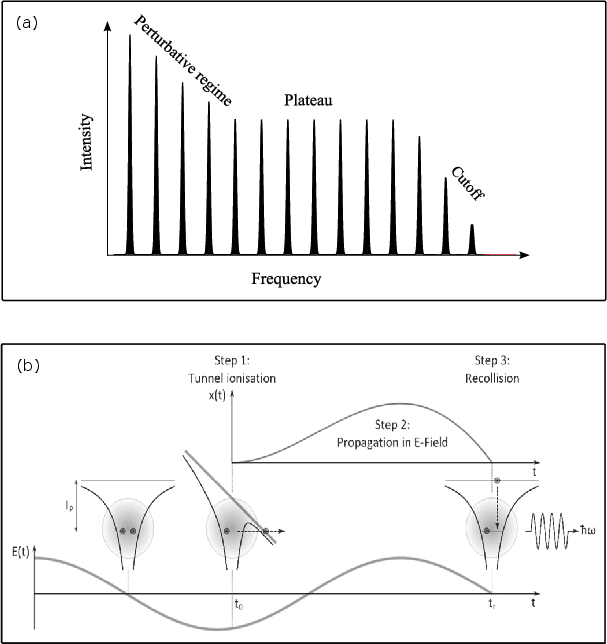
Figure 11: Representative high-harmonic spectrum illustrating the three-step recollision process in the gas phase, background for the extension to solid-state HHG.
Real and imaginary parts of the response function reveal phonon lifetimes and spatial propagation, with clear quantitative agreement to time-resolved diffuse x-ray scattering experiments.
Implications and Outlook
This work demonstrates that high-harmonic spectroscopy can serve as a real-time, all-optical probe of lattice dynamics and their effect on ultrafast electron behavior, with high sensitivity to symmetry, phase, phonon energy, and chirality. The polarization, temporal modulation, and sideband structure of HHG signals encode rich information about both the lattice and electron subsystems.
The reconstruction method from inelastic scattering is broadly applicable to solid state systems regardless of sample opacity or experimental limitations of pump-probe methods and is validated by strong agreement with direct ultrafast x-ray data.
These results have profound implications for:
- Ultrafast optoelectronic device metrology and control (e.g., valleytronics, petahertz electronics)
- All-optical mapping of electron-phonon coupling and symmetry-breaking phenomena, potentially complementing ARPES and Raman
- Fundamental studies of coherent control, nonlinear phononics, and symmetry engineering in 2D and topological materials
The methods described can enable imaging and manipulation of coupled electron-lattice dynamics in materials and devices on genuinely quantum timescales.
Conclusion
"Probing Lattice Dynamics in Real-Space and Real-Time" (2605.20631) provides a comprehensive, quantitatively robust framework for interrogating coherent phonon-driven phenomena in solids using both high-harmonic spectroscopy and inelastic scattering. The approach integrates attosecond electronic timescales and picometer spatial resolution, establishes robust symmetry-selection relationships, and demonstrates utility across a variety of physical and experimental regimes. The implications for ultrafast functional material science, symmetry-resolved spectroscopy, and quantum optics are substantial, and the methods described are immediately extensible to a broad class of quantum materials.