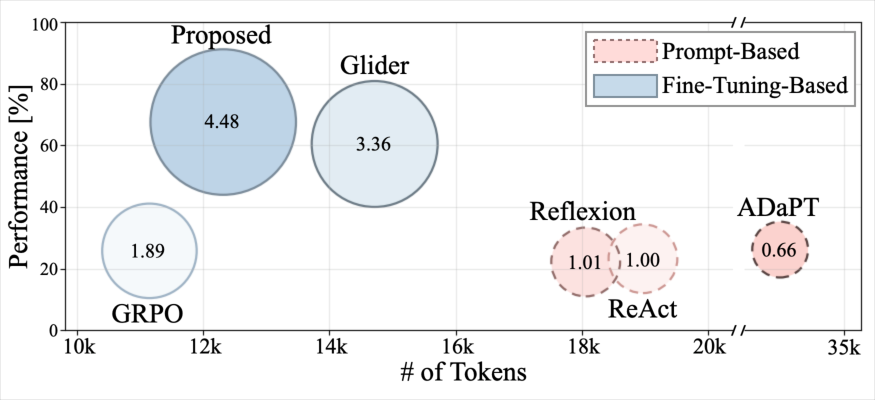
- The paper introduces a hierarchical framework that decouples high-level sub-goal planning (System 1) and atomic action execution (System 2) using role-specialized LLM agents.
- It demonstrates significant improvements in performance and token efficiency across both in-distribution and out-of-distribution interactive environments.
- The approach leverages curated hierarchical datasets, combining SFT for planning and an offline-to-online RL pipeline for execution to mitigate drift and adapt robustly.
Multi2: Hierarchical Multi-Agent Decision-Making with LLM-Based Agents in Interactive Environments
Motivation and Challenges in Long-Horizon LLM-Based Agents
Multi-turn, long-horizon decision-making with LLM-based agents remains highly challenging due to persistent compounding errors, objective drift, and token inefficiency—especially in agentic settings where actions change the state of interactive environments. Previous approaches demonstrate limited robustness: as horizons lengthen, even hierarchical prompting schemes or fine-tuned models degrade, suffering alignment failures and productivity loss. The lack of formal role specialization and execution-side adaptation exacerbates these issues.
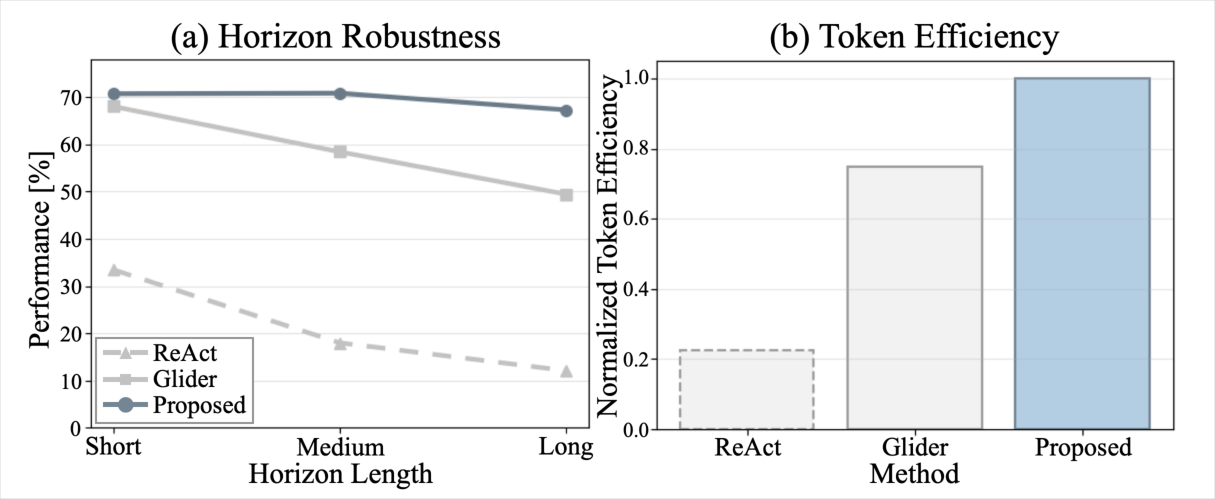
Figure 1: Challenges in long-horizon interaction on the ScienceWorld using Llama-3.1 8B backbone, comparing horizon robustness and token efficiency of ReAct, Glider, and Multi2.
Multi2 Framework: Hierarchical Role-Specialized Decision-Making
Multi2 introduces a strictly hierarchical multi-agent framework, decoupling high-level sub-goal planning (System 1) and atomic action execution (System 2). These roles are instantiated as distinct LLM-based policies, each with a separate LoRA adapter while sharing the same LLM backbone. System 1 operates as a sub-goal generator trained via SFT on human-annotated data, prioritizing stable, context-aware semantic planning and intent preservation. System 2, by contrast, is exclusively responsible for action realization and is optimized via an offline-to-online RL pipeline. This decoupling supports explicit role specialization and targeted adaptation of execution, mitigating the bottlenecks of drift and token inefficiency.
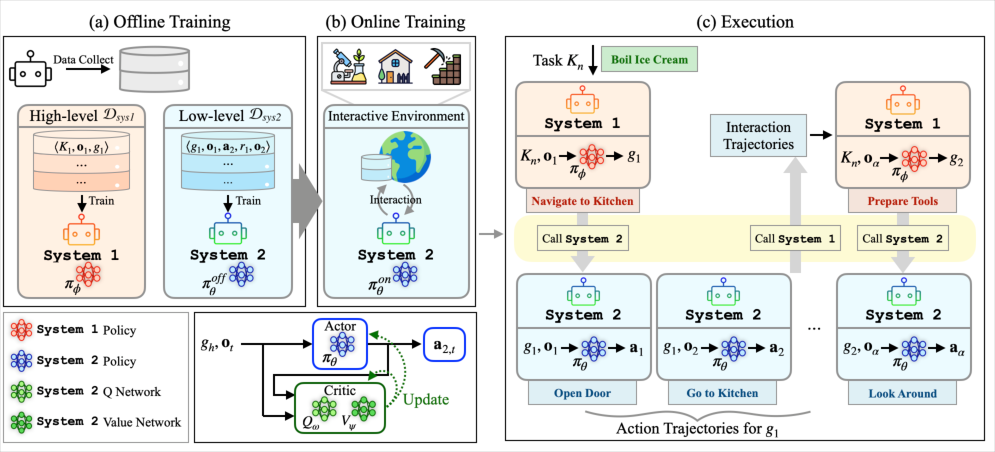
Figure 2: Overview of Multi2. System 1 and System 2 are trained on role-specific datasets, with System 2 undergoing both offline RL pretraining and online refinement for continual adaptation.
Hierarchical Dataset Construction and Training Paradigms
A major contribution is the creation and release of curated hierarchical datasets spanning ScienceWorld, ALFWorld, and TextCraft. These datasets partition experience for SFT-based sub-goal generation and RL-based action execution, enabling reproducible role alignment in both offline and online training settings.
- System 1 SFT: Cross-entropy loss is minimized over {task description, state observation} → sub-goal pairs, yielding consistent sub-goal proposals under distributional generalization.
- System 2 RL: Policy and value networks are initialized offline, minimizing a composite objective that integrates advantage-weighted imitation and critic-anchored regularization. During online RL, adaptation is governed by KL regularization to maintain close proximity to the offline reference policy, preventing mode collapse or value drift.
Experimental Analysis: Benchmarking and Ablations
Multi2 demonstrates consistent and pronounced improvements over both prompt-based and fine-tuning hierarchical baselines in interactive, partially observable environments.
Failure analysis of baselines highlights the prevalence of invalid actions, unproductive loops, and constraint violations stemming from drift or execution misalignment. These modes are dramatically reduced by Multi2’s hierarchical organization and role-specialized training.
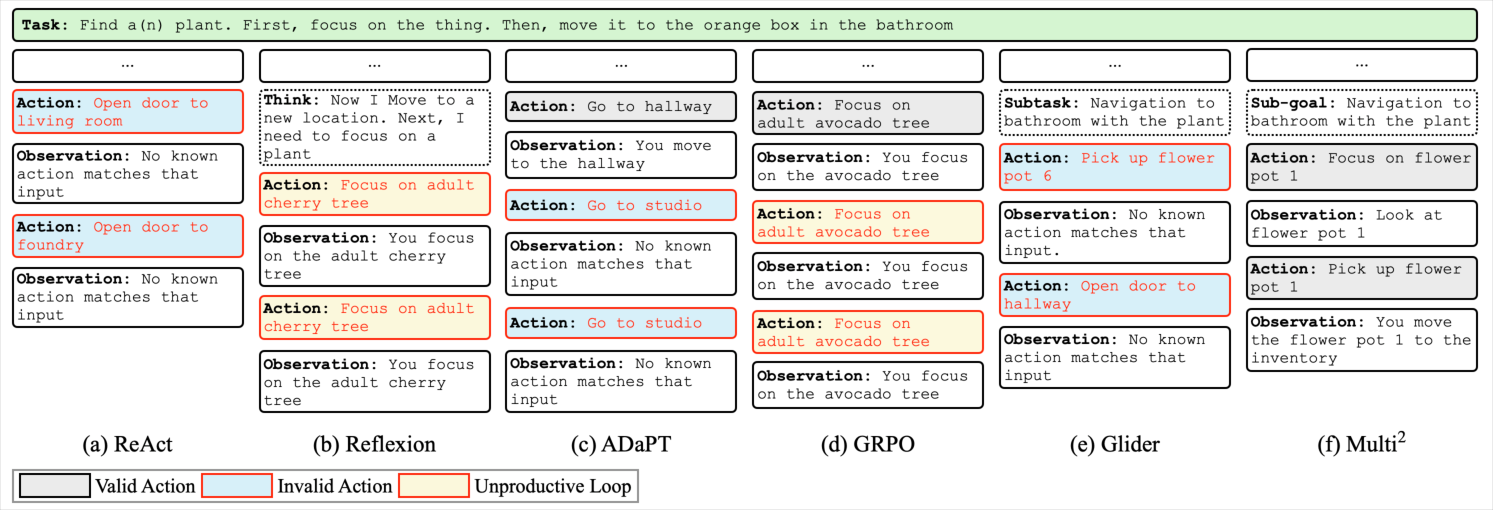
Figure 4: Representative failure examples of baseline agents on the ScienceWorld Find-a-plant task, illustrating invalid actions and unproductive loops in non-hierarchical or non-role-specialized baselines.
Robustness to Long Horizons and Difficulty: Stratified analysis shows that whereas prompt-based agents deteriorate rapidly as task horizon increases, Multi20 sustains robust performance even on hard tasks—especially under distribution shift.
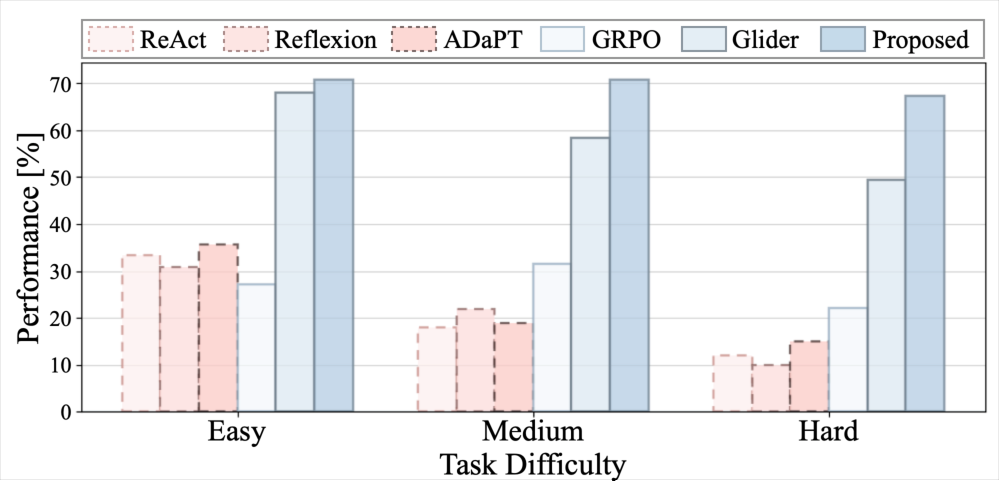
Figure 5: Objective drift robustness on the ScienceWorld ID split with Llama-3.1 8B, stratified by task difficulty; Multi21 maintains superior performance in hard/long-horizon scenarios.
Ablations: Component analyses confirm that joint use of role-specific LoRA adapters, role-specialized training assignments (SFT for System 1, RL for System 2), and both offline and online RL phases are critical. Removing any of these elements results in significant degradation.
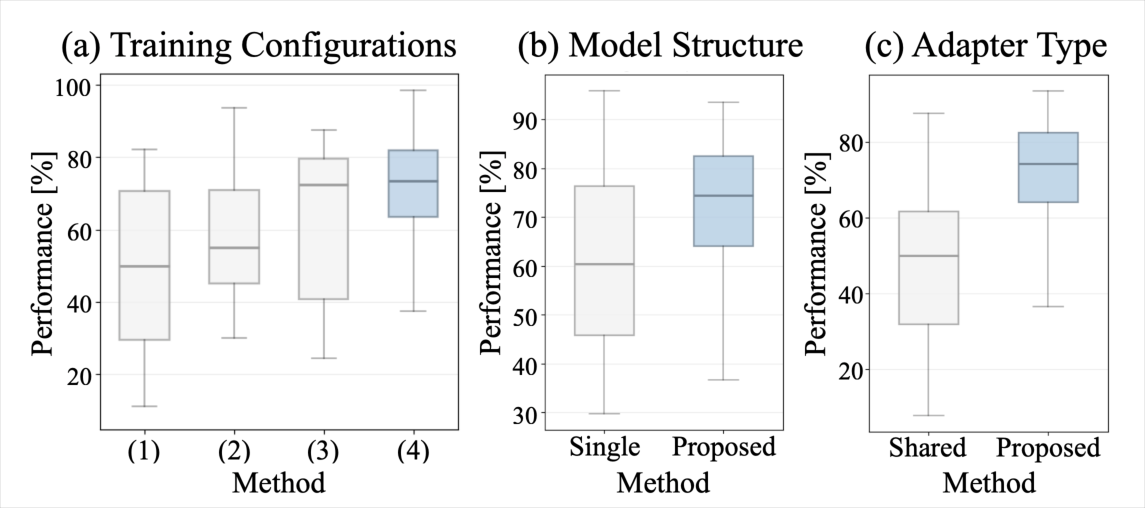
Figure 6: Ablation results for training configurations, model structure, and adapter type on ScienceWorld, demonstrating necessity of hierarchical, role-specialized organization.
Loss design studies reveal that the policy-anchored advantage term and KL regularization in System 2 training yield tighter, less brittle performance distributions and are essential for stable and transferable adaptation.
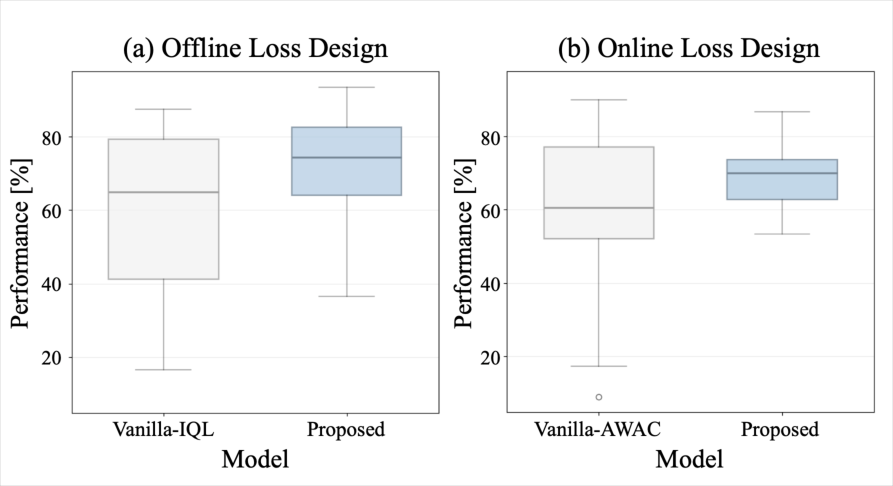
Figure 7: Ablation results for offline and online RL loss functions, showing that KL regularization and policy anchoring are necessary for stable performance.
Model Scale: Performance on OOD splits increases with model capacity, highlighting the importance of backbone scale in supporting generalization under distributional mismatch.
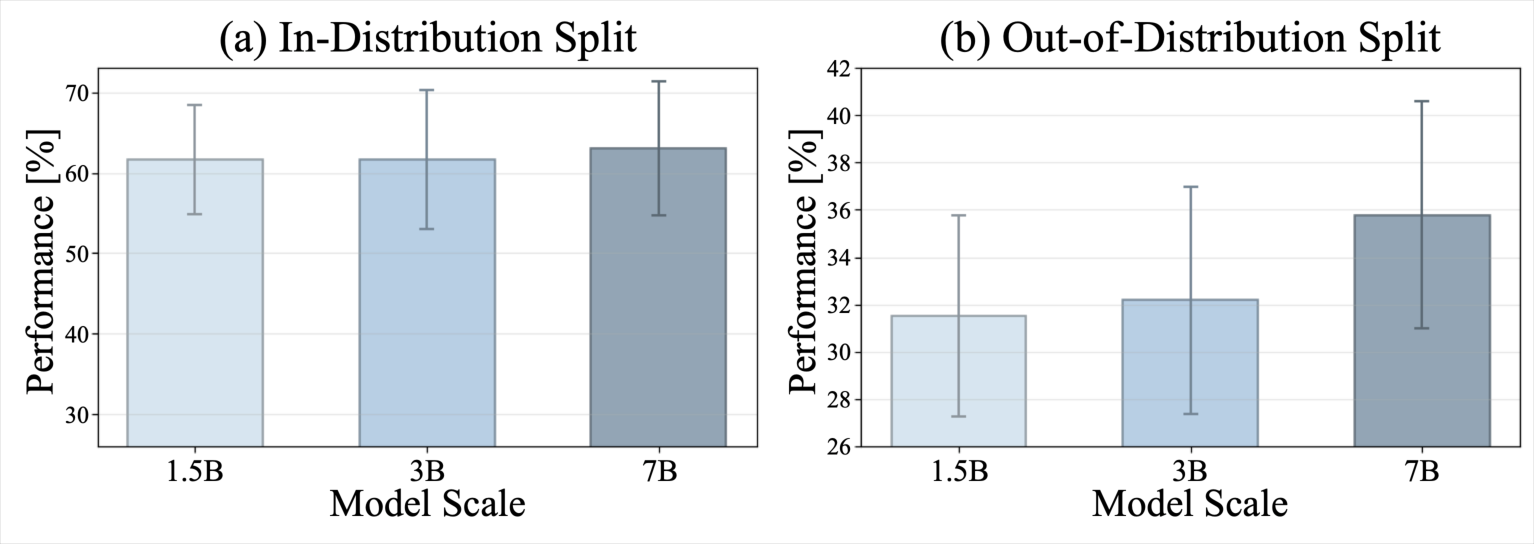
Figure 8: Effect of backbone model scale on Multi22 performance in ScienceWorld with Qwen-2.5 backbones; OOD gains are monotonic with respect to scale.
Online RL Adaptation and Continual Self-Improvement
Online RL updates contribute further improvement, especially in the OOD setting and for medium/hard tasks, by correcting subtle execution errors and reducing compounding failures accumulated during multi-turn interaction. The explicit regularization in objective design ensures sample-efficient and stable adaptation without mode collapse.
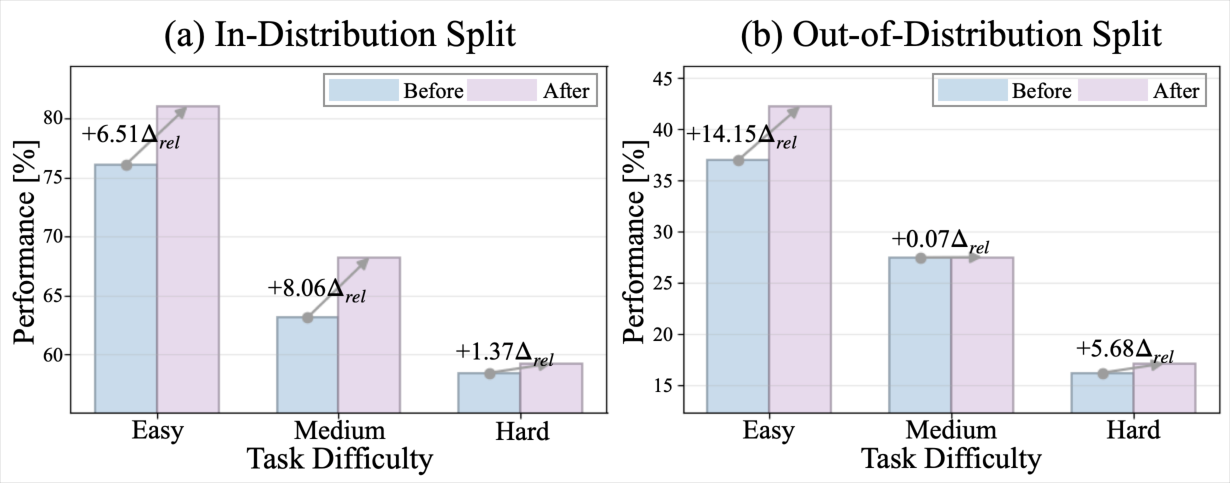
Figure 9: Online RL adaptation on ScienceWorld with Qwen-2.5 3B; within-task adaptation yields further performance improvements, particularly OOD.
Theoretical and Practical Implications
Multi23 establishes an operational template for LLM-centric decision agents in dynamic environments, offering a clear path by which hierarchical decomposition, formal role specialization, and differentiated optimization objectives yield concrete, measurable gains. The paradigm generalizes to a wide array of agentic benchmarks and supports practical engineering by enabling fast adaptation, stateful interaction, and stringent budget-constrained inference. On the theoretical front, it motivates future research on hierarchical RL for large sequence models, decomposed adaptation under distribution shift, and continual online improvement.
Conclusion
The Multi24 hierarchical role-specialized agent framework resolves key limitations of existing LLM-agent methods in long-horizon, dynamic environments by combining explicit sub-goal planning, token-efficient execution, and robust, sample-efficient RL adaptation. The combination of structured datasets, modular training regimes, and cross-domain evaluation establishes a reproducible foundation for agentic LLM research and deployment.
Reference: "Multi25: Hierarchical Multi-Agent Decision-Making with LLM-Based Agents in Interactive Environments" (2606.03698).